How to Teach a Puppy to Sit: A Step-by-Step Guide
Most puppies don’t understand what “sit” means the first time they hear it—and that’s completely normal.
They aren’t ignoring you or being stubborn. They’re simply trying to figure out what you want.
One of the biggest mistakes new puppy owners make is expecting a verbal command to have meaning before their puppy has learned the behavior. Like learning their name or walking on a leash, the sit command is built through repetition, rewards, and clear communication.
The good news is that “sit” is one of the easiest and most useful behaviors your puppy can learn. It becomes the foundation for polite greetings, calmer mealtimes, better leash manners, and future commands like “stay” and “down.”
With a few minutes of practice each day, you’ll not only teach your puppy to sit—you’ll build trust that makes every future training session easier. Reward-based methods using capturing or luring, followed by clear verbal and hand cues, are widely recommended for beginner puppies.
Table of Contents
- Quick Answer
- Why “Sit” Is the Foundation of Puppy Training
- How Puppies Actually Learn the Sit Command
- When Should You Start?
- What You’ll Need
- Two Ways to Teach a Puppy to Sit
- How to Teach a Puppy to Sit in 9 Easy Steps
- Common Problems and Solutions
- FAQs
How to Teach a Puppy to Sit
Quick Answer (Featured Snippet)
To teach a puppy to sit, hold a treat close to your puppy’s nose and slowly lift it upward and slightly backward. As soon as your puppy’s bottom touches the floor, immediately say “Yes!” (or click a clicker) and reward within about one second. Once your puppy reliably follows the hand movement, add the verbal cue “Sit” just before the hand signal. Finally, gradually fade the food lure until your puppy responds to the verbal cue or hand signal alone.
Why “Sit” Should Be Your Puppy’s First Command
Many people think teaching a puppy to sit is about obedience.
It’s actually about communication.
When your puppy understands “sit,” everyday situations become much easier.
For example:
- Greeting visitors politely
- Waiting before meals
- Staying calm before going outside
- Preparing for grooming
- Learning more advanced commands
Instead of constantly correcting unwanted behavior, you can ask your puppy to perform a simple action they already understand.
That’s why professional trainers often introduce “sit” as one of the very first behaviors.
How Puppies Actually Learn the Sit Command
Dogs don’t understand English.
They learn through associations.
When your puppy hears a cue, performs the correct action, and immediately receives something rewarding, their brain begins connecting those events together.
This process is called operant conditioning.
Simply put:
Good behavior → Reward → Puppy repeats that behavior.
A marker word such as “Yes!” or a clicker makes this learning even clearer because it tells your puppy the exact moment they got it right. The reward follows immediately afterward.
Did You Know?
The marker word isn’t the reward.
It’s a promise that the reward is coming.
That’s why trainers often say “Yes!” the instant the puppy sits before handing over the treat.
When Should You Start Training?
Most puppies are ready to begin simple reward-based training from about 8 weeks of age.
Don’t expect long lessons.
Young puppies learn best through several sessions lasting just three to five minutes.
Stopping while your puppy is still having fun leaves them excited for the next lesson instead of becoming bored or frustrated.
Age Guide
| Puppy Age | Expected Progress |
|---|---|
| 8–10 weeks | Learns to follow a food lure |
| 10–12 weeks | Begins sitting with a hand signal |
| 12–16 weeks | Responds to the verbal cue indoors |
| 4–6 months | Sits around mild distractions |
| 6+ months | Uses the sit command reliably in daily life |
Every puppy learns differently.
Some understand the movement within one session.
Others need several days of practice.
Both are completely normal.
What You’ll Need
You don’t need expensive equipment.
Just prepare:
- Small, soft treats
- A quiet room
- A positive attitude
- Optional clicker
- Five distraction-free minutes
High-value treats help your puppy stay focused, especially during early learning.
Before You Begin
Training works best when your puppy is:
- Calm
- Slightly hungry
- Awake
- Comfortable
- Free from major distractions
Avoid training immediately after a large meal or an energetic play session.
Real-Life Example
Imagine trying to learn something new in the middle of a loud party.
You’d probably struggle to concentrate.
Puppies feel the same way.
That’s why many owners see much faster progress by starting inside the house before practicing outdoors.
Two Ways to Teach a Puppy to Sit
Many owners don’t realize there are two effective ways to teach the sit command.
Method 1: Lure Training
This is the method most beginners use.
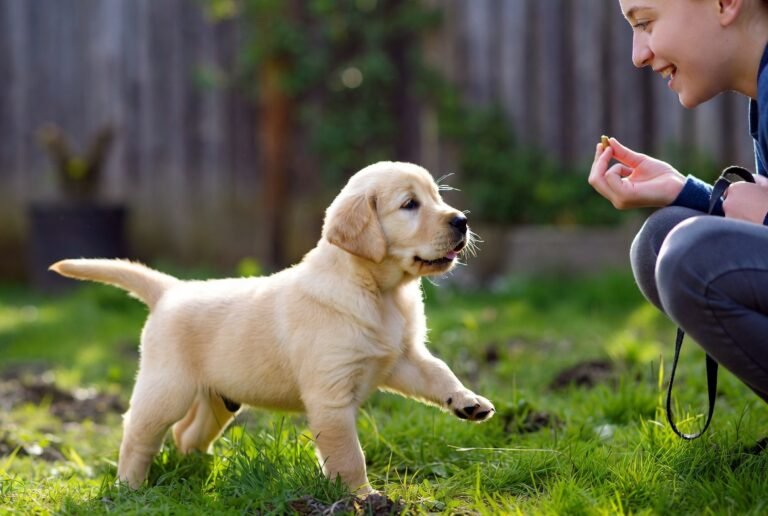
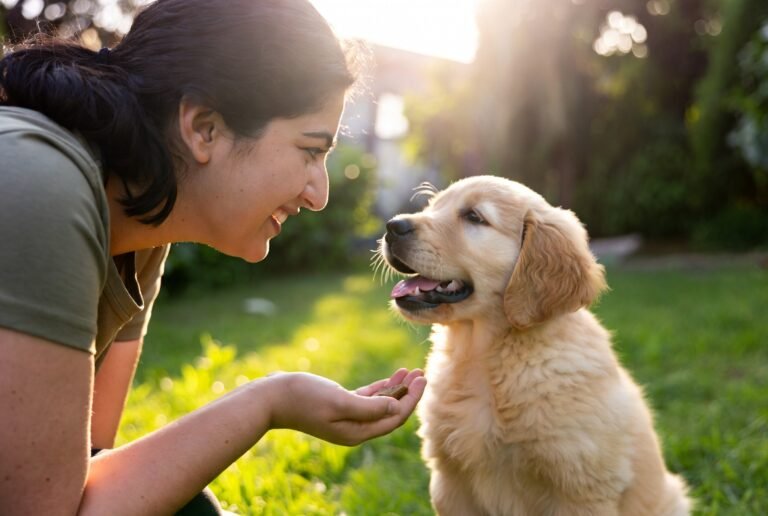
A treat guides your puppy into the sitting position.
Once your puppy understands the movement, you gradually remove the food lure while keeping the same hand signal.
Eventually, the empty hand becomes the signal instead of the treat.
Method 2: Capture Training
Some puppies naturally sit on their own.
When that happens:
Say “Yes!”
Reward immediately.
Repeat this every time your puppy voluntarily sits.
Soon your puppy starts offering the behavior because sitting consistently leads to rewards.
Only after this pattern becomes reliable should you introduce the verbal cue “Sit.” This method is known as capturing and is also recommended by the AKC.
How to Teach a Puppy to Sit in 9 Easy Steps
Step 1. Get Your Puppy’s Attention
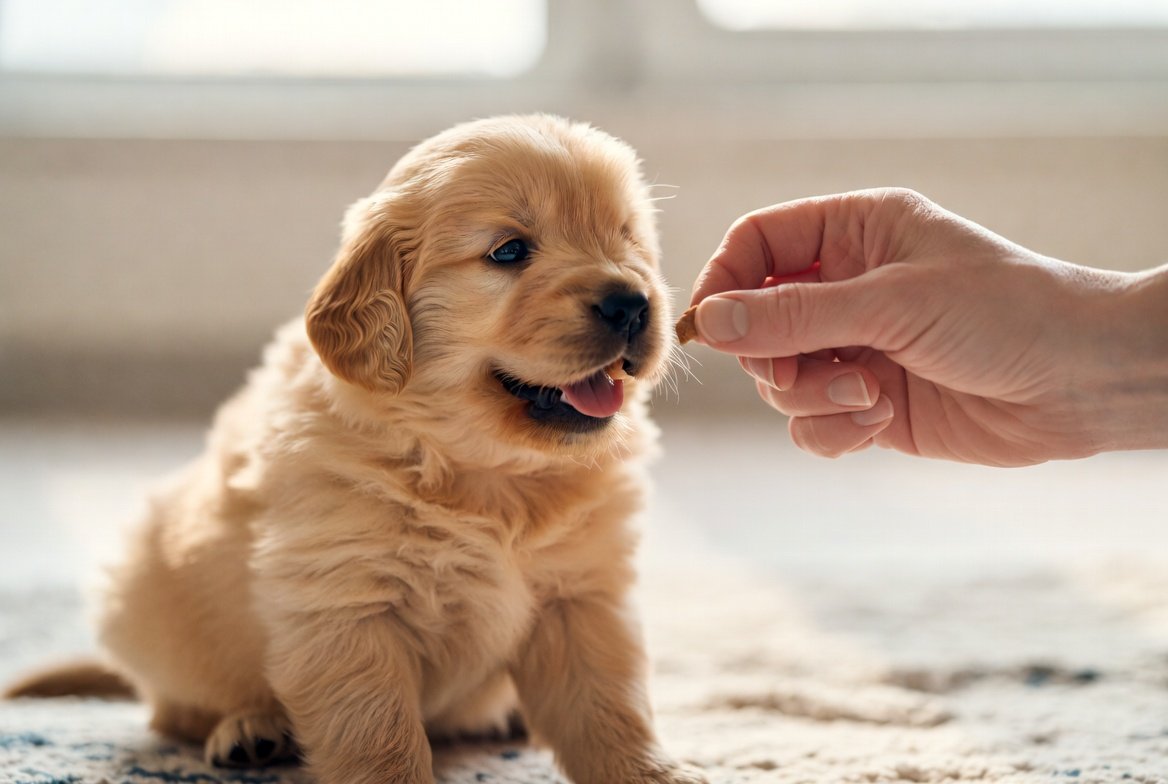
Hold a small treat close to your puppy’s nose.
Don’t wave it around.
Don’t let them grab it.
Simply wait until your puppy focuses on you.
Without attention, learning can’t begin.
Trainer Tip
If your puppy keeps looking around the room, choose a quieter location instead of repeating commands.
Step 2. Guide Your Puppy’s Nose Upward
Slowly move the treat upward and slightly back over your puppy’s head.
As their nose follows the treat, their head lifts.
For most puppies, their back end naturally lowers into a sitting position.
The instant their bottom touches the floor:
Say “Yes!”
Then immediately reward.
Avoid pushing on your puppy’s back or forcing them into position, as this can be confusing and is generally not recommended.
Step 3. Add the Verbal Cue
Once your puppy begins sitting consistently with the lure, it’s time to introduce the command.
Say:
“Sit.”
Pause briefly.
Then perform the same hand motion.
After enough successful repetitions, your puppy starts connecting the spoken word with the action.
Mini Success Story
Bella, a 9-week-old Golden Retriever, spent two days happily following the treat but didn’t seem to understand the word “sit.”
Her owner kept every lesson under five minutes and rewarded every success.
By the end of the week, Bella started sitting the moment she heard the cue—even before the treat appeared.
That steady progress is exactly how most puppies learn.
Step 4. Fade the Food Lure
Once your puppy follows the treat into a sit every time, begin removing the lure.
Here’s how:
- Pretend you’re holding a treat, but keep your hand empty.
- Make the same hand movement.
- As soon as your puppy sits, say “Yes!” and reward with a treat from your other hand.
This teaches your puppy that the hand signal, not the food, is the real cue. AKC recommends gradually fading the lure so the dog responds to the empty hand first, then eventually to the verbal cue alone.
Common Mistake
Many owners keep showing the treat forever.
If your puppy only sits when they see food, it’s time to start fading the lure.
Step 5. Practice in Different Locations
Dogs don’t naturally generalize commands.
Your puppy may sit perfectly in your kitchen but stare at you blankly in the backyard.
That doesn’t mean they’ve forgotten.
It simply means they haven’t learned that “sit” means the same thing everywhere.
Practice in gradually more challenging places:
- Living room
- Kitchen
- Backyard
- Quiet sidewalk
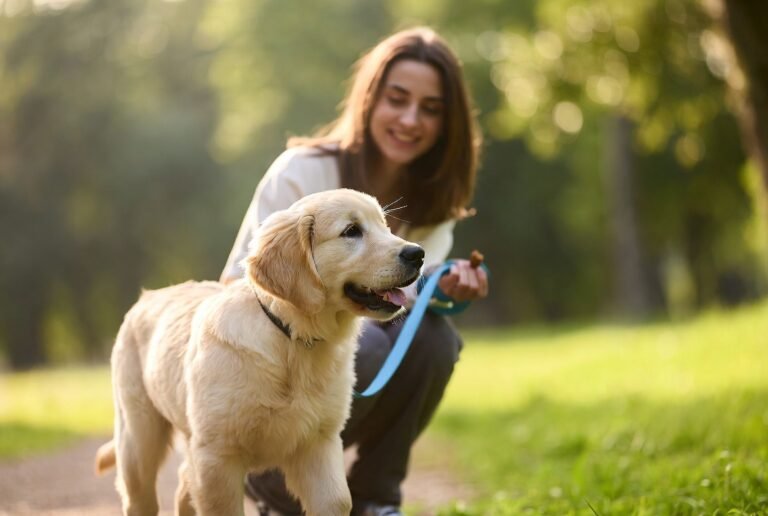
- Local park during quiet hours
Why This Matters
Every new environment teaches your puppy that the command—not the location—is what matters.
Step 6. Introduce Small Distractions
Real life isn’t quiet.
Eventually your puppy needs to listen even when exciting things are happening.
Start with easy distractions:
- Someone walking past
- A toy on the floor
- Mild household noises
- Birds outside the window
If your puppy struggles, reduce the distraction instead of repeating the command.
Trainer Tip
Success builds confidence.
Always make training slightly challenging—but never overwhelming.
Understanding Your Puppy’s Body Language
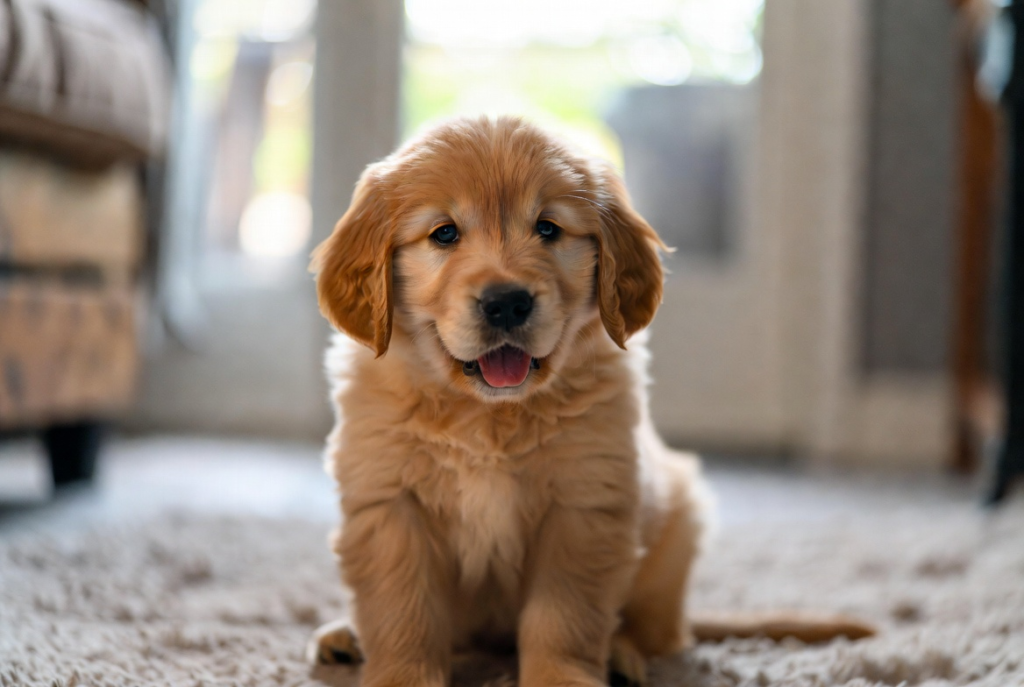
Your puppy tells you how they’re feeling long before they bark or whine.
Learning these signals helps you adjust your training.
| Body Language | Meaning | What To Do |
|---|---|---|
| Relaxed tail wag | Comfortable | Continue training |
| Looking away | Losing focus | Short break |
| Lip licking or yawning | Mild stress | Reduce distractions |
| Repeated jumping | Excited | Wait for calm |
| Walking away | Mentally tired | End the session positively |
Training should feel enjoyable—not stressful.
Step 7. Switch to Variable Rewards
At first, reward every successful sit.
Once your puppy understands the command, begin rewarding unpredictably.
For example:
- First sit → Treat
- Second sit → Praise
- Third sit → Treat
- Fourth sit → Toy
- Fifth sit → Treat
This is called a variable reward schedule, and it helps maintain reliable behavior because your puppy never knows when the next reward is coming. Continue praising every successful sit even as food rewards become less frequent.
Pro Tip
Never remove rewards completely.
Even adult dogs appreciate occasional surprises.
Step 8. Use “Sit” Throughout the Day
Formal training is only part of learning.
The best opportunities happen naturally.
Ask your puppy to sit before:
- Meals
- Going outside
- Putting on the leash
- Greeting visitors
- Throwing a toy
- Getting into the car
Soon your puppy begins offering the sit automatically because calm behavior consistently leads to good things.
Step 9. Teach a Release Cue
Many owners teach sit but forget to tell the puppy when it’s okay to move.
Choose a simple release word such as:
- OK
- Free
- Break
Ask your puppy to sit.
Wait one or two seconds.
Say your release word in a cheerful voice and encourage them to stand or move.
A release cue tells your puppy the exercise has ended and prevents confusion about how long they should remain sitting. Common release words include “OK” and “Free.”
Mini Story
Charlie learned “sit” within four days but popped up immediately after every reward.
Once his owner introduced the release cue “OK,” Charlie quickly understood that he should remain sitting until he heard those magic words.
What Progress Should You Expect?
Every puppy learns differently, but a typical timeline looks like this:
| Training Stage | Expected Progress |
|---|---|
| Week 1 | Follows the food lure |
| Week 2 | Sits with a hand signal |
| Week 3 | Responds to the verbal cue indoors |
| Week 4 | Sits with mild distractions |
| Weeks 5–6 | Responds reliably in everyday situations |
Think of progress as a staircase, not a straight line.
Some days your puppy will seem brilliant.
Other days they’ll act as though they’ve forgotten everything.
That’s a normal part of learning.
My Puppy Won’t Sit Outside
This is one of the most common questions from new owners.
Outside, your puppy is surrounded by:
- New smells
- Birds
- People
- Other dogs
- Moving cars
The environment is simply more rewarding than your treats.
Go back to an easier location and slowly build toward busier places.
My Puppy Sits Then Instantly Stands Up
Usually this happens because:
- The reward came too late.
- There’s no release cue.
- The puppy thinks standing earns the treat.
Reward while your puppy is still sitting, then use your release word before encouraging them to move.
Different Breeds, Different Learning Styles
Every puppy can learn to sit, but not every breed learns in exactly the same way.
Some are highly food-motivated, while others respond better to praise or play.
| Breed | Training Tip |
|---|---|
| Labrador Retriever | Food rewards usually keep them engaged. |
| Golden Retriever | Gentle repetition and praise work well. |
| Border Collie | Learns quickly but benefits from mental challenges. |
| German Shepherd | Enjoys structured, consistent training sessions. |
| French Bulldog | Short, fun sessions help prevent boredom. |
| Shih Tzu | Patience and high-value treats often improve focus. |
Your puppy’s personality matters just as much as their breed.
Common Mistakes That Slow Progress
Even experienced owners sometimes make these mistakes.
- Repeating “sit” over and over.
- Rewarding too late.
- Training for too long.
- Using low-value treats.
- Starting in a distracting environment.
- Pushing the puppy into position.
- Expecting perfect results after one session.
Warning
If something isn’t working, don’t keep repeating the same mistake.
Instead, make the exercise easier so your puppy can succeed.
How Do You Know Training Is Working?
Look for gradual improvements instead of perfection.
Your puppy is making progress when they:
- Sit more quickly after hearing the cue.
- Follow an empty hand instead of a food lure.
- Stay seated until released.
- Respond in different rooms.
- Recover from distractions more easily.
- Offer a sit without being asked.
These small wins show that your puppy is beginning to understand the behavior rather than simply following the treat.
Daily Training Checklist
Before every session, ask yourself:
- ✅ Is my puppy calm?
- ✅ Do I have small, soft treats?
- ✅ Am I in a quiet location?
- ✅ Will I keep training under five minutes?
- ✅ Am I rewarding immediately?
- ✅ Will I finish on a successful repetition?
Consistency beats long training sessions every time.
Myth vs. Fact
| Myth | Fact |
|---|---|
| Puppies understand the word “sit” naturally. | They learn by connecting the cue with a rewarded behavior. |
| Treats are bribery. | Treats are teaching tools when used correctly. |
| Saying “sit” louder helps. | Clear timing and consistency matter far more than volume. |
| Older puppies are easier to train. | Young puppies can begin learning basic cues from around eight weeks of age. |
| Every puppy learns at the same speed. | Learning depends on personality, environment, and consistent practice. |
Frequently Asked Questions
How many times a day should I teach my puppy to sit?
Three to five short sessions each day are usually more effective than one long session. Puppies have short attention spans, so frequent practice works best.
Should I use a clicker?
A clicker is optional. A clear marker word like “Yes!” works just as well if you use it consistently.
My puppy only sits when I have treats. What should I do?
Gradually fade the food lure, use an empty hand as the signal, and reward from your other hand. Over time, begin rewarding unpredictably while continuing to praise successful sits.
Why won’t my puppy sit outside?
Outdoor environments contain many exciting distractions. Practice in easier locations first, then slowly increase the difficulty as your puppy becomes more confident.
Should I push my puppy into a sitting position?
No. Physically pushing your puppy can be confusing or intimidating. Encourage the behavior with capturing or luring instead.
Can I teach “stay” immediately after “sit”?
It’s usually easier to teach a reliable sit first. Once your puppy understands staying seated, introduce a release cue and then begin adding duration for “stay.”
What’s the best reward for sit training?
Small, soft treats that your puppy loves usually work best. As training progresses, you can also reward with praise, toys, or play.
How long does it usually take to teach a puppy to sit?
Many puppies begin understanding the behavior within a few days, while reliable responses in different environments often take several weeks of consistent practice. Every puppy learns at their own pace.
Conclusion
Learning how to teach a puppy to sit is about much more than one simple command.
Every successful repetition strengthens communication, builds trust, and lays the groundwork for future obedience skills.
Some puppies seem to understand “sit” almost immediately. Others need a little more time, patience, and encouragement. Both are perfectly normal.
Celebrate the small wins, keep your sessions short and enjoyable, and always end on a positive note.
Before long, your puppy won’t just sit because they see a treat—they’ll sit because they’ve learned that listening to you leads to success, confidence, and fun. That’s the beginning of a lifelong partnership built on trust.