Puppy Stops Walking When He Sees People: 7 Reasons
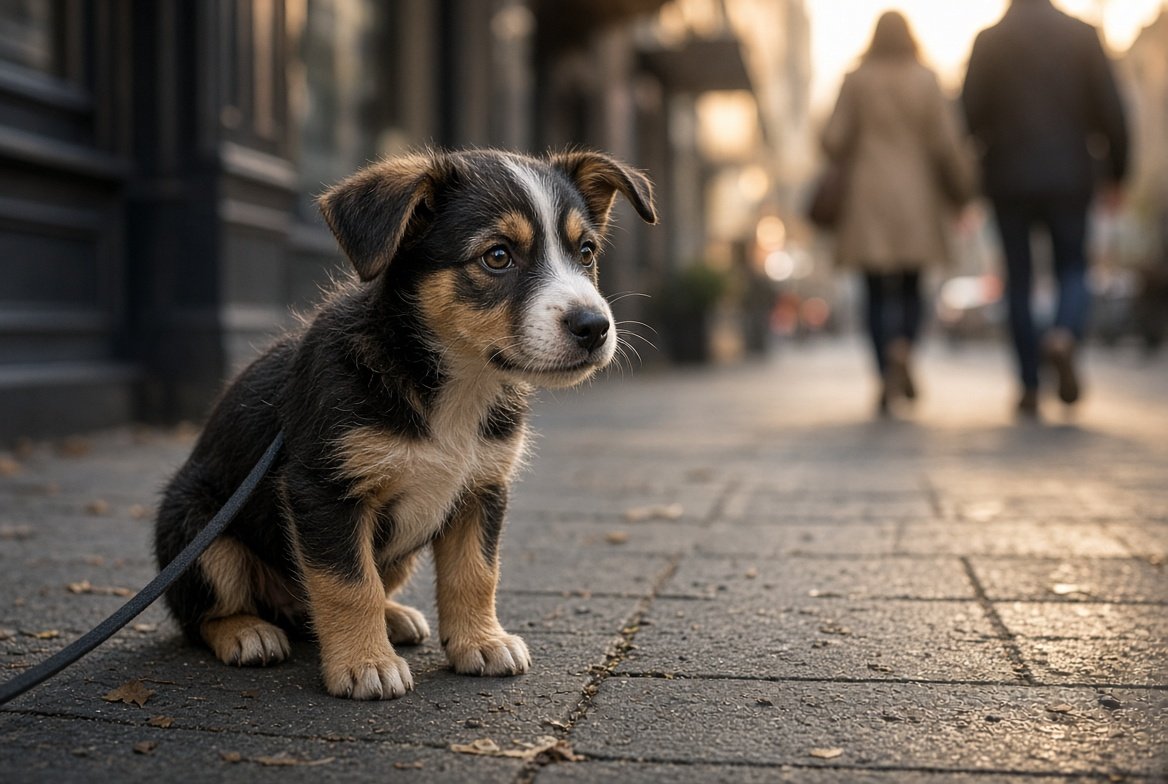
You’re walking your puppy when someone appears ahead. Instead of continuing, he suddenly slows down, stops, sits, or stares at the person.
If your puppy stops walking when he sees people, don’t assume he’s being stubborn. He may be curious, excited, unsure, frightened, or simply overwhelmed by everything happening around him. The same stopping behavior can have very different causes.
The most useful clue is what your puppy’s body looks like while he’s stopped. A relaxed puppy who watches a passerby and then continues walking is very different from a puppy who freezes, crouches, tucks his tail, or tries to retreat.
Puppies also need to learn how to handle people while walking on a leash. They aren’t born knowing that a stranger can pass nearby without needing to greet them or becoming something to worry about. Gradual, positive exposure gives them an opportunity to learn that skill without being pushed beyond what they can handle.
Table of Contents
- Why does my puppy stop walking when he sees people?
- Why does my puppy sit when strangers pass?
- How can I tell if my puppy is curious or scared?
- What should I do when my puppy stops walking?
- How to teach your puppy to walk past people
- Why does my puppy watch people on walks?
- What if my puppy won’t walk past strangers?
- Common mistakes to avoid
- Expert tips for calmer walks
- Quick checklist
- Myth vs. Fact
- When should you seek professional help?
- Frequently Asked Questions
- Conclusion
Why Does My Puppy Stop Walking When He Sees People?
There isn’t one universal reason. Look at the situation, your puppy’s body language, and what happens when the person gets closer or passes.
1. Your puppy is curious
People are incredibly interesting to a young puppy.
A stranger may be wearing different clothes, carrying something unusual, walking quickly, talking loudly, or simply moving in a way your puppy hasn’t seen before.
Your puppy may stop because he wants a moment to observe.
For example, imagine your puppy is walking normally when someone wearing a large hat approaches. He stops, looks at the person, sniffs the air, and then continues walking once they pass.
If his body remains loose and he can easily return his attention to you, curiosity may be the simplest explanation.
Pro tip: You don’t have to interrupt every moment of observation. Give your puppy a second to notice the person, then reward him for calmly checking back in with you.
2. He wants to greet the person
Some puppies stop because they want to go toward people, not away from them.
You may see your puppy lean forward, wag his tail, pull toward the stranger, whine, or become increasingly excited as the person gets closer.
In that situation, stopping can be connected to anticipation.
There’s another factor to consider: what happens after your puppy stops?
If stopping consistently results in the person coming over to pet him, your puppy can learn that stopping predicts a greeting.
That doesn’t mean he’s deliberately manipulating you. He’s simply learning which behaviors produce outcomes he likes.
Your puppy doesn’t need to greet every person on the sidewalk. Learning to notice people and continue walking is an equally useful skill.
3. He feels unsure about strangers
A puppy can be friendly at home and still feel uncertain around unfamiliar people outdoors.
A stranger approaching directly may seem very different from a familiar family member. Someone leaning over your puppy, staring directly at him, reaching toward his head, or moving quickly can also make an uncertain puppy uncomfortable.
Possible signs of discomfort include:
- Stiff posture
- Crouching or freezing
- Tail tucked close to the body
- Lip licking
- Yawning in context
- Looking away
- Trying to move away
- Hiding behind you
- Barking or growling
AKC notes that discomfort isn’t always dramatic. Subtle changes such as a stiff body, lip licking, yawning, or fixed eyes can also indicate that a dog isn’t comfortable around strangers.
Common mistake: Waiting for your puppy to bark before taking his discomfort seriously.
A quiet, frozen puppy may still be telling you that he needs more space.
4. The leash makes him feel trapped
Your puppy has fewer choices when he’s attached to a leash.
If a person makes him uncomfortable, he can’t simply walk away whenever he wants. That restriction can make an unfamiliar situation harder to handle.
AKC explains that a leash is a form of restraint and that some puppies can find being restrained intimidating, especially when something outside is already frightening or overwhelming.
This can create a pattern like:
Person appears → puppy becomes uncertain → leash limits movement → puppy stops or freezes.
If that’s what you’re seeing, pulling him toward the person isn’t likely to teach him that the situation is safe.
Creating more distance may be much more useful.
5. He is overwhelmed by everything around him
The person may not actually be the only trigger.
Think about everything your puppy experiences on a walk:
- Cars
- Bicycles
- Traffic sounds
- Dogs barking
- Children
- Strong smells
- New surfaces
- Construction
- Doors opening
- People moving in different directions
A puppy may cope with each thing individually but struggle when several distractions happen together.
If he walks comfortably on a quiet street but repeatedly stops on a crowded sidewalk, the overall level of stimulation may be too high.
AKC recommends introducing puppies to new people, places, and situations gradually rather than exposing them to too much too quickly.
6. He’s still learning how to walk around distractions
Walking politely is not an instinctive skill.
Your puppy has to learn that he can see something interesting without immediately moving toward it, stopping to investigate, or becoming distracted.
Leash walking itself needs to be taught, starting with simple situations and gradually adding distractions. AKC recommends building leash skills in manageable environments before expecting a puppy to handle more challenging outdoor situations.
So if your puppy is young and inexperienced, stopping when people appear may simply mean he hasn’t learned the alternative yet.
Instead of asking, “How do I stop him from stopping?” ask:
“What do I want him to do when he sees a person?”
A useful answer is:
Notice the person → check in with you → keep walking.
7. He may be going through a cautious phase
Puppies can sometimes become more hesitant about things that previously seemed normal.
A puppy who happily approached strangers last week may suddenly stop and watch them this week.
Developmental fear periods are recognized in puppies, and AKC advises giving puppies space to move away from something that scares them rather than forcing them closer.
This doesn’t mean every sudden stop is a fear period. It simply means that a temporary increase in caution can happen as puppies develop.
The response should remain the same: observe, give appropriate space, and keep experiences positive.
Why Does My Puppy Sit When Strangers Pass?
If your puppy sits when strangers pass, don’t judge the behavior by the sitting alone.
Sitting can mean several different things.
| What you notice | What it may suggest |
|---|---|
| Loose body, calmly watching | Curiosity |
| Leaning toward the person | Excitement or desire to greet |
| Relaxed body and easy attention | Comfortable observation |
| Stiff body or freezing | Possible discomfort |
| Tail tucked and body lowered | Possible fear |
| Trying to retreat | Wants more distance |
| Pulling toward the person | Greeting excitement |
These aren’t diagnoses. They’re clues.
The most important question is whether your puppy can disengage.
If he looks at someone, then happily looks back at you and continues walking, that’s very different from a puppy who becomes increasingly tense and cannot respond to you.
How Can I Tell If My Puppy Is Curious or Scared?
Watch his whole body rather than focusing on his tail or ears alone.
A curious puppy may:
- Look at the person
- Sniff
- Keep a loose body
- Take treats normally
- Look back at you
- Continue walking after observing
- Show interest without trying to escape
A worried puppy may:
- Freeze
- Crouch
- Stiffen
- Tuck his tail
- Look away repeatedly
- Lick his lips
- Tremble
- Try to hide or retreat
- Stop taking food
VCA describes fear responses in dogs as including behaviors such as cowering, looking away, tucked tails, lip licking, trembling, hiding, and stiffening.
One particularly useful clue is whether your puppy can still respond to you.
If he can look at you, take a treat, and move with you, you have more room to work with.
If he’s frozen and unable to engage, the situation may be too difficult right now.
What Should I Do When My Puppy Stops Walking?
Your first response should depend on what his body language is telling you.
If he looks curious and relaxed
Give him a brief moment to observe.
Then:
- Say his name or use a familiar attention cue.
- Reward him for looking back at you.
- Encourage him to move with you.
- Continue walking.
If he looks frightened
Don’t pull him toward the person.
Instead:
- Stop moving toward the trigger.
- Create more distance.
- Let your puppy settle.
- Reward calm attention toward you.
- Continue only if he is comfortable enough to respond.
AKC specifically recommends allowing a fearful puppy to move away from something frightening rather than forcing him closer.
If necessary, cross the street, turn around, or step behind a parked car or other visual barrier.
That isn’t “giving in.”
It’s managing the situation so your puppy doesn’t have to repeatedly experience something beyond his comfort level.
If he wants to greet the person
Use your walking cue and reward your puppy for choosing to continue with you.
You can also teach a polite greeting separately, in controlled situations.
The important distinction is that seeing a person doesn’t automatically mean meeting them.
How to Teach Your Puppy to Walk Past People
The easiest way to teach this is to start before your puppy is overwhelmed.
Step 1: Teach attention at home
Say your puppy’s name.
When he looks at you, reward him.
Practice until turning toward you becomes an easy, familiar behavior.
Step 2: Move somewhere quiet
Choose a location where people are visible but far enough away that your puppy remains relaxed.
Don’t begin beside a crowded entrance or busy sidewalk.
Step 3: Let him notice people
When your puppy sees someone, don’t immediately pull him away or demand that he stare at you.
Give him a moment to notice.
Then reward him for calmly looking back toward you.
This creates a useful pattern:
Person appears → good things happen → puppy checks in with you.
Step 4: Keep your distance
If your puppy freezes, stops eating, tries to retreat, or becomes increasingly tense, you’re probably asking for more than he can comfortably handle.
Increase the distance.
AKC recommends working at a distance where the dog remains comfortable and pairing the presence of strangers with high-value rewards.
Step 5: Gradually make it harder
Once your puppy can calmly watch people from farther away, gradually practice at closer distances.
Don’t measure progress by how close you can get.
Measure it by how calmly your puppy can handle the situation.
Step 6: Practice walking past
Start with calm people who aren’t approaching your puppy.
Walk parallel to them or pass at a comfortable distance.
Reward your puppy for staying connected with you.
Step 7: Add more realistic distractions
Eventually, practice around:
- People walking quickly
- People wearing hats
- Children at a distance
- Joggers
- People carrying bags
- Busier sidewalks
VCA recommends exposing puppies to different types of people and situations while allowing the puppy to approach and interact at their own pace.
Why Does My Puppy Watch People on Walks?
If you’re asking, “why does my puppy watch people on walks?”, watching by itself isn’t necessarily a problem.
Your puppy may simply be gathering information.
The more important question is:
Can he watch and then disengage?
For example:
Your puppy sees a person across the street. He looks at them for a few seconds, then looks back at you when you say his name and continues walking.
That’s a much easier situation than:
Your puppy sees a person, becomes stiff, stares intensely, stops taking treats, and cannot respond to you.
The first puppy is observing.
The second may be overwhelmed.
What If My Puppy Won’t Walk Past Strangers?
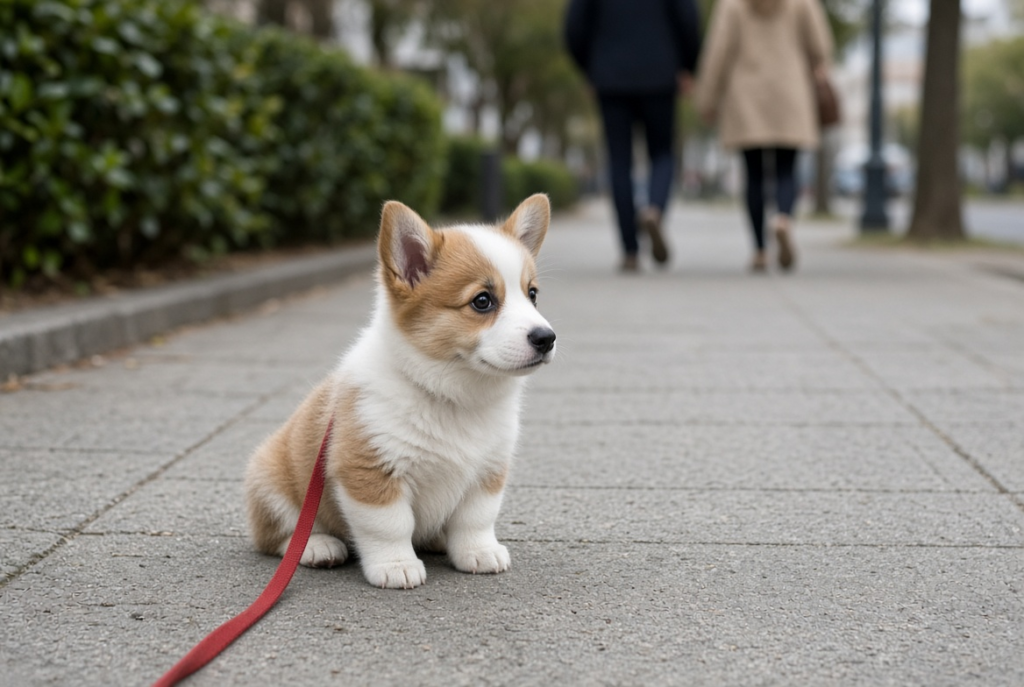
If your puppy won’t walk past strangers, don’t make getting closer the immediate goal.
Instead, make the situation easier.
If he’s fearful
Increase distance and pair people with something positive.
If he’s excited
Reward calm attention before he reaches the person.
If he’s curious
Allow brief observation, then encourage movement.
If he’s overwhelmed
Choose a quieter route or shorten the walk.
If he’s trying to greet everyone
Teach him that calm walking can be rewarding even when people don’t stop to say hello.
The goal isn’t to force your puppy to walk past every person immediately.
The goal is to teach him that people can be present without creating a problem.
A Simple Training Plan
Use this progression:
Level 1: Puppy sees a person far away → remains relaxed → reward.
Level 2: Person walks past at a comfortable distance → puppy stays calm → reward.
Level 3: Puppy sees person → checks in with you → reward.
Level 4: Puppy walks past person → reward continued movement.
Level 5: Repeat in gradually busier environments.
If your puppy struggles at a particular level, return to the previous one.
VCA notes that gradual exposure works best when the stimulus is kept at a level the dog can handle; pushing too quickly can increase fear rather than resolve it.
Common Mistakes to Avoid
Pulling your puppy toward strangers
If he’s uncomfortable, pulling him closer removes his ability to create distance.
Give him another option.
Forcing greetings
A puppy doesn’t need to be petted by every person he sees.
AKC specifically advises against forcing introductions when a dog is uncomfortable.
Getting too close too quickly
If your puppy can calmly watch people from 30 feet away, don’t assume he is ready to pass them at 5 feet.
Build gradually.
Punishing freezing, growling, or barking
These behaviors can provide information about discomfort.
Punishing fear-related communication doesn’t address the underlying emotion and can make the situation more difficult.
Allowing every stranger to greet your puppy
Constant greetings can make people extremely exciting.
Teach your puppy that sometimes people pass by without interacting.
Making every walk a training session
Your puppy also needs opportunities to sniff, explore, and simply enjoy being outside.
Training should fit into the walk rather than turning every outing into a demanding obedience exercise.
Expert Tips for Calmer Walks
Reward before your puppy stops
Don’t wait until the leash is tight or your puppy is frozen.
Reward the calm moment when he notices a person.
Give people instructions
If your puppy is uncertain, say:
“He’s learning to be comfortable around people, so please give him some space.”
You don’t need to apologize for protecting your puppy’s comfort.
Use distance as a training tool
Distance isn’t failure.
If your puppy behaves beautifully 20 feet from a stranger but struggles at 5 feet, those extra 15 feet are useful information.
Let your puppy opt out
A puppy who is uncomfortable should have a way to move away.
VCA emphasizes giving dogs a choice about whether to interact and stopping an interaction when signs of fear appear.
Keep sessions short
A few successful encounters can be more useful than a long walk filled with situations your puppy can’t handle.
Practice with predictable people
A calm friend can make an excellent training partner because you can control the distance, speed, and direction.
Quick Checklist
Before your next walk, ask:
- Does my puppy stop around everyone or only certain people?
- Does he look relaxed or tense?
- Does he want to approach or move away?
- Can he take treats?
- Can he respond to his name?
- Does he resume walking after the person passes?
- Am I giving him enough distance?
- Am I allowing unnecessary greetings?
- Am I rewarding calm behavior?
- Do I have an escape route if he becomes overwhelmed?
These observations can help you identify the real reason behind the stopping.
Myth vs. Fact
Myth: My puppy is stopping because he’s stubborn.
Fact: Stopping can result from curiosity, excitement, uncertainty, fear, environmental overload, or the challenges of leash walking.
Myth: Socialization means letting everyone pet my puppy.
Fact: Good socialization doesn’t require constant physical interaction. Puppies can learn that different people are normal simply by seeing them and having positive experiences at a comfortable distance.
Myth: If my puppy isn’t barking, he’s comfortable.
Fact: Fear can be subtle. Freezing, stiffening, lip licking, cowering, hiding, and trying to retreat can all indicate discomfort.
Myth: I should force my puppy to face strangers.
Fact: Forcing a frightened puppy closer can make the experience worse. Gradual exposure at a manageable distance is a better approach.
When Should You Seek Professional Help?
Stopping occasionally doesn’t automatically mean your puppy has a serious behavior problem.
However, professional guidance is worth considering if your puppy regularly:
- Freezes around people
- Tries to escape
- Trembles or cowers
- Growls, snaps, or lunges
- Cannot take food around strangers
- Becomes increasingly fearful
- Refuses to walk even after people have passed
- Has a sudden major change in behavior
If your puppy’s behavior changes suddenly or you suspect pain or another physical problem, speak with your veterinarian.
For significant fear around people, a qualified positive-reinforcement trainer or veterinary behavior professional can help you create a plan suited to your puppy.
VCA advises professional help for dogs showing significant fear responses because fear can escalate when the dog repeatedly experiences situations without adequate relief.
Frequently Asked Questions
Why does my puppy stop walking when people walk by?
Your puppy may be curious, excited, uncertain, frightened, or overwhelmed. Watch his body language and whether he can resume walking after the person passes.
Why does my puppy sit when strangers pass?
Sitting can be a way of observing someone, waiting for a greeting, or responding to uncertainty or fear. The rest of his body language tells you much more than the sitting itself.
Why won’t my puppy walk past strangers?
He may not yet feel comfortable passing people at close range. Create more distance, reward calm behavior, and gradually teach him to walk past people without forcing interactions.
Why does my puppy watch people on walks?
People are interesting and unfamiliar, so watching can be normal. The key is whether your puppy can disengage and continue walking.
Should strangers pet my puppy?
Not necessarily. If your puppy is uncomfortable, strangers should give him space rather than approaching or touching him.
How do I stop my puppy from stopping for everyone?
Teach an attention or “let’s go” cue and reward your puppy for noticing people and then reconnecting with you. Practice first at a comfortable distance.
Should I pull my puppy past a stranger?
Avoid dragging a frightened or frozen puppy toward someone. Create distance and give him an opportunity to become comfortable enough to respond.
Can socialization make my puppy more comfortable around people?
Positive, gradual exposure can help puppies become more comfortable with different people and environments. The experience should remain manageable rather than overwhelming.
What if my puppy wants to greet every person?
Reward calm walking and attention toward you instead of allowing every person to become a greeting opportunity. Your puppy can learn that people are part of the environment without meeting everyone.
When should I worry about my puppy freezing around people?
Take repeated freezing seriously if it is accompanied by fear signals, gets worse over time, prevents normal walks, or is difficult to manage. A veterinarian or qualified behavior professional can help determine the next step.
Conclusion
When your puppy stops walking when he sees people, the behavior is worth understanding before trying to stop it.
He may be fascinated by strangers, eager to greet them, unsure about them, frightened, overwhelmed by the environment, or simply inexperienced with walking around distractions.
The best response depends on what your puppy is communicating.
If he’s relaxed, reward attention and teach him to continue walking. If he’s uncomfortable, create distance instead of pulling him toward the person. If he’s overwhelmed, make the environment easier. And if he’s repeatedly showing fear, get professional guidance rather than forcing him through the situation.
Your goal isn’t to make your puppy ignore every person.
It’s to teach him that people can appear, pass by, and disappear while he remains comfortable, connected to you, and confident enough to keep walking.