
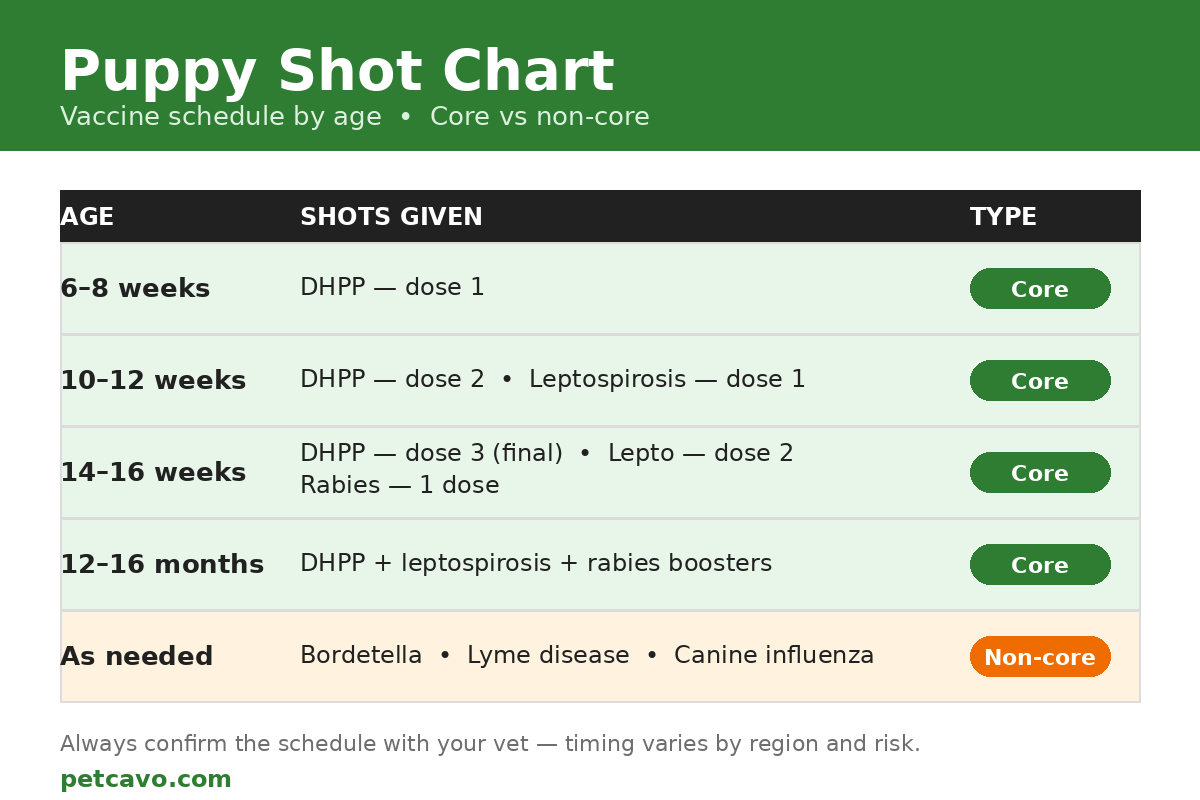
Puppy Shot Chart: Complete Vaccine Schedule by Age
Complete puppy shot chart by age: first shots at 6–8 weeks, boosters every 2–4 weeks until 16 weeks, then a 12–16 month booster. Costs, catch-up rules, side effects, and when it’s safe to go outside.
Quick answer: Puppies need their first shots at 6–8 weeks, boosters every 2–4 weeks until at least 16 weeks, then one more booster at 12–16 months. The core puppy shot chart covers distemper, adenovirus-2, parvovirus, leptospirosis, and rabies. Below is the full age-by-age chart, costs, and catch-up rules.
Puppy Shot Chart: Which Vaccines at Every Age
This puppy shot chart follows the AAHA 2022 canine vaccination guidelines — the standard schedule used by vets across the US. “Core” means recommended for every puppy; “non-core” means recommended only for some puppies, based on lifestyle and local risk. Your vet tailors the plan to your puppy.
| Age | Shots given | What it prevents | Core / non-core | Typical cost per dose* |
|---|---|---|---|---|
| 6–8 weeks | DHPP — dose 1 | Distemper, adenovirus-2, parvovirus, parainfluenza | Core | $20–$60 |
| 10–12 weeks | DHPP — dose 2; leptospirosis — dose 1 (from 12 weeks) | The same four diseases, plus leptospirosis | Core | $20–$60 per shot |
| 14–16 weeks | DHPP — dose 3 (final); leptospirosis — dose 2; rabies — 1 dose | The same diseases, plus rabies | Core | $20–$60; rabies about $20–$30 |
| 12–16 months | DHPP booster; leptospirosis booster; rabies booster (per local law) | The same diseases | Core | $20–$60 per shot |
| As lifestyle requires (often 9–16 weeks) | Bordetella; Lyme disease; canine influenza | Kennel cough; Lyme disease; dog flu | Non-core | Varies by clinic |
*Costs vary by clinic and region; exam fees are usually charged on top. Want a printable version of this puppy shot chart? Bookmark this page, or ask your vet for a printed copy at your puppy’s first visit — most clinics hand one out.
What Each Core Puppy Vaccine Protects Against
- Distemper: a widespread, often fatal virus that attacks the respiratory tract, gut, and nervous system. There is no cure — vaccination is the only real protection.
- Adenovirus-2: causes respiratory illness; the vaccine also protects against adenovirus-1, which causes infectious hepatitis.
- Parvovirus: the disease vets fear most in puppies — severe vomiting and bloody diarrhoea, frequently deadly without intensive care.
- Parainfluenza: one of the kennel-cough viruses, bundled into most DHPP combination shots.
- Leptospirosis: a bacterial infection picked up from water or soil contaminated with wildlife urine; it can destroy the kidneys and liver — and it can spread to people. AAHA’s 2022 guidelines (updated in 2024) now list it as core for every puppy — a change from older schedules that treated it as optional.
- Rabies: fatal once symptoms appear, and required by law in most of the US. Timing follows your state’s rules.
What Do ‘5-in-1’ and ‘7-in-1’ Mean on a Puppy Shot Chart?
Those numbers aren’t AAHA terms — they simply count the diseases in one combination shot, and recipes differ between brands. A ‘5-in-1’ usually means the DHPP combination plus one extra disease. ‘6-in-1’ and ‘7-in-1’ add more, depending on the brand. Whatever the label, the schedule is the same: the combo is repeated every 2–4 weeks until at least 16 weeks. Ask your vet exactly which diseases are in the syringe.
Non-Core Vaccines: Which Puppies Actually Need Them
Non-core doesn’t mean unnecessary — it means your vet decides based on how your puppy lives and where. AAHA recommends these for some dogs based on lifestyle, geographic location, and risk of exposure.
- Bordetella (kennel cough): for puppies headed to boarding, daycare, training classes, groomers, or dog parks.
- Canine influenza (H3N8/H3N2, “dog flu”): for social puppies in areas where it circulates — boarding facilities often require it.
- Lyme disease: for puppies in tick-heavy regions; pair it with proper tick prevention.
- Rattlesnake toxoid: only for dogs with genuine rattlesnake exposure risk in certain regions.
How Much Do Puppy Shots Cost?
Expect roughly $20–$60 per vaccine dose at a private clinic (rabies around $20–$30), plus an exam fee at each visit — but treat every number as a ballpark, because costs vary widely by clinic and region. A full first-year series commonly runs into the low hundreds at a private practice; low-cost clinics, shelters, and community vaccine events charge far less. Ask for an itemized estimate at the first visit so nothing surprises you.
Catch-Up Schedule for Adopted Puppies With Unknown Vaccine History
Adopted an older puppy with no records? AAHA’s rule of thumb is simple: when in doubt, vaccinate — the benefits far outweigh the risks for a dog with unknown history. The standard catch-up for a puppy over 16 weeks is two DHPP doses 2–4 weeks apart, two leptospirosis doses 2–4 weeks apart, and rabies as local law requires — then a booster within a year. Your vet will build the exact plan at the first exam.
What to Do If a Puppy Shot Is Late
Don’t panic — and don’t restart the whole series. In most cases your puppy simply picks up where they left off; just call your vet and rebook as soon as you can. Until the series is complete, keep outings low-risk: skip dog parks and unknown dogs, stick to your own yard, and carry your puppy through busy public places.
Puppy Shot Side Effects and When to Call the Vet
Most puppies feel little more than a sore spot. Common, mild reactions include tenderness or slight swelling where the shot was given, tiredness, a smaller appetite, or a mild fever — usually gone within a day. After intranasal vaccines, a few days of sneezing or a runny nose is normal.
Call your vet promptly if mild signs last more than 24 hours or your puppy seems very uncomfortable — and treat these as emergencies: facial swelling or hives, repeated vomiting or diarrhoea, trouble breathing, or collapse. Severe reactions typically strike within minutes to hours, which is why many clinics ask you to wait a few minutes after the jab. (VCA’s guide to care after vaccination)
Socializing Before the Shots Are Done: What AVSAB Says
Here’s the tension every owner feels: the prime socialization window slams shut around 12–14 weeks — before the shot series finishes. The American Veterinary Society of Animal Behavior resolves it plainly: it should be the standard of care for puppies to receive socialization before they are fully vaccinated.
Their guidance: start puppy classes as early as 7–8 weeks, as long as the puppy has had at least one set of vaccines 7+ days before the first class plus a first deworming, and stays up to date through the class. Do it safely — choose classes that require health checks, carry your puppy through busy public areas, invite healthy vaccinated adult dogs to your home, and skip high-traffic dog zones until the series is done. (AVSAB position statement on puppy socialization) If your puppy freezes or plants his paws at the sight of strangers during these outings, don’t worry — that’s normal, and our guide explains why puppies stop walking when they see people.
When Can Your Puppy Go Outside and Meet Dogs?
The green light usually comes about 1–2 weeks after the final shots at around 16 weeks — once immunity has had time to build. Confirm the exact timing with your vet, since local disease risk matters. Until then, your own yard is far lower-risk than dog parks, and brief, controlled meetings with healthy, vaccinated dogs beat crowded dog areas every time. Once your vet gives the all-clear, our guide to leash training a puppy will help you make those first outings a success. Don’t be surprised if your puppy sits down and stares the first time another dog approaches — that’s common too, and our guide explains why puppies sit when they see other dogs.
Puppy Shot Chart FAQ: Real Owner Questions
How old do puppies need to be for shots?
Puppies should get their first shots at 6–8 weeks old, per the AAHA 2022 canine vaccination guidelines. Boosters follow every 2–4 weeks until the puppy is at least 16 weeks old, with another booster at 12–16 months. Your vet may adjust this slightly for your puppy’s health and local disease risk.
How many rounds of puppy shots are there?
Most puppies get at least three rounds of the core DHPP combination vaccine between 6 and 16 weeks, plus two doses of leptospirosis vaccine starting at 12 weeks and one rabies shot. A final round of boosters is due at 12–16 months; after that, core vaccines move to a three-year cycle.
When does my puppy get the rabies shot?
Most puppies receive their first rabies vaccine around 12–16 weeks of age, but the exact timing is set by law and varies by state. Rabies vaccination is required by law in most of the United States. Ask your vet what’s required where you live — they’ll schedule it at the legal age.
What does DHPP stand for?
DHPP stands for distemper, hepatitis (caused by canine adenovirus), parainfluenza, and parvovirus. It’s the core combination vaccine given in the puppy series — one injection protecting against four serious diseases at once.
How much do puppy shots cost?
Costs vary by clinic and region. As a rough guide, a single vaccine dose runs about $20–$60 at a private practice (rabies around $20–$30), plus an exam fee per visit. Low-cost clinics, shelters, and vaccine events are cheaper. Ask your clinic for an itemized estimate before the first visit.
What if I miss a shot or a puppy shot is late?
Don’t panic and don’t restart the whole series. Call your vet — in most cases your puppy simply picks up where they left off. Keep outings limited (skip dog parks and unknown dogs) until the series is complete, and get back on schedule as soon as possible.
When is my puppy fully protected?
Puppies build full protection about 1–2 weeks after their final shots at around 16 weeks of age. Until your vet confirms the series is complete, limit contact with unknown dogs and high-traffic dog areas.
Are puppy shots safe? What are the side effects?
Serious reactions are rare. The most common side effects are mild and short-lived: soreness or slight swelling where the shot was given, tiredness, a smaller appetite, or a mild fever for about a day. Call your vet right away if you see facial swelling, hives, repeated vomiting, trouble breathing, or collapse.
Can a titer test replace my puppy’s shots?
No — a titer test can’t replace the puppy series.
A titer measures antibodies in the blood to show whether a dog is already protected against distemper, parvovirus, or adenovirus. AAHA doesn’t recommend routine titer testing just to decide whether scheduled boosters are needed, and a rabies titer never replaces the legally required rabies vaccination.
A titer can occasionally be useful for an adult dog with unknown vaccine history — ask your vet whether it makes sense for your dog.
Photo credits
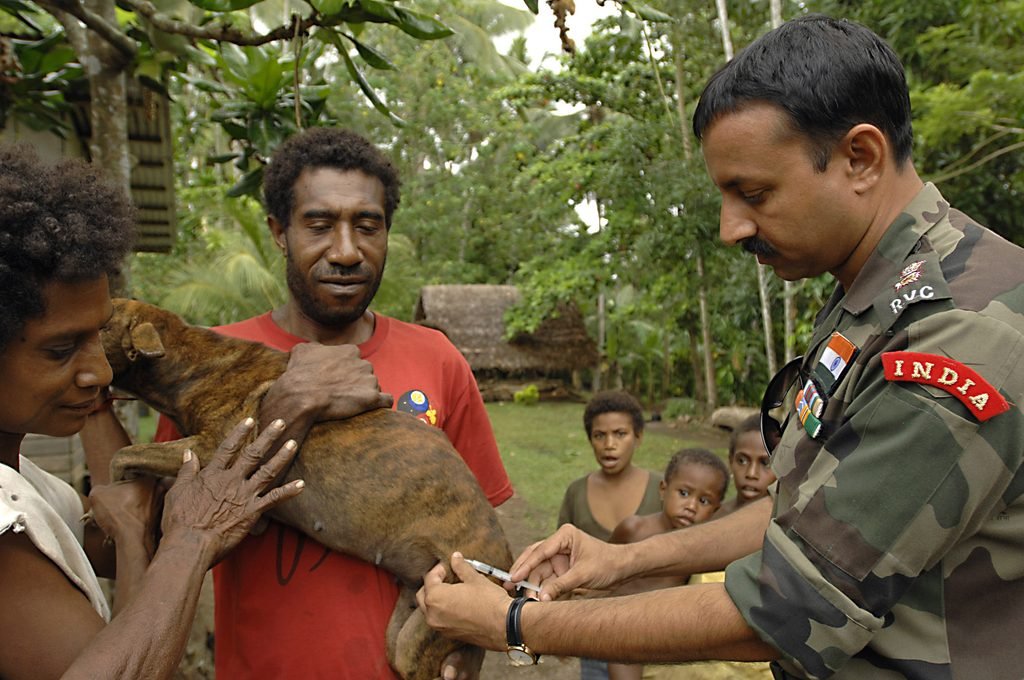
- Veterinarian giving puppy shots: U.S. Navy photo by Mass Communication Specialist 3rd Class Bryan M. Ilyankoff, public domain, via Wikimedia Commons
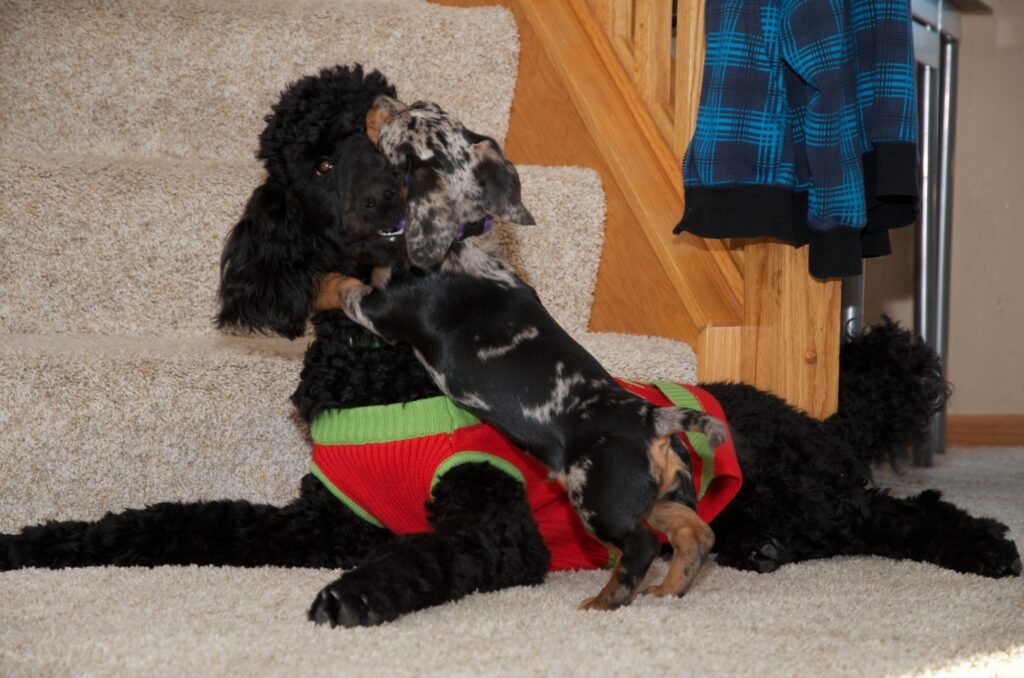
- Socialization photo: Tim Wilson, CC BY 2.0, via Wikimedia Commons
- Featured image: original puppy shot chart infographic by PetCavo



7 Comments