Why Does My Puppy Sit Down When I Put the Leash On?
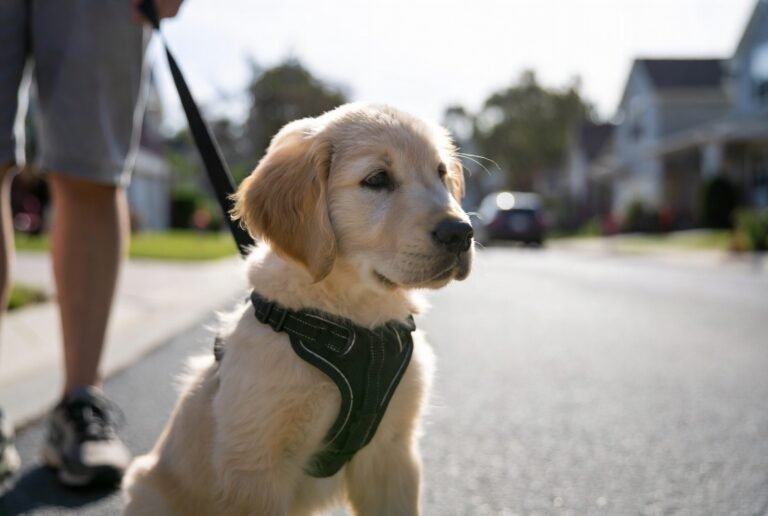
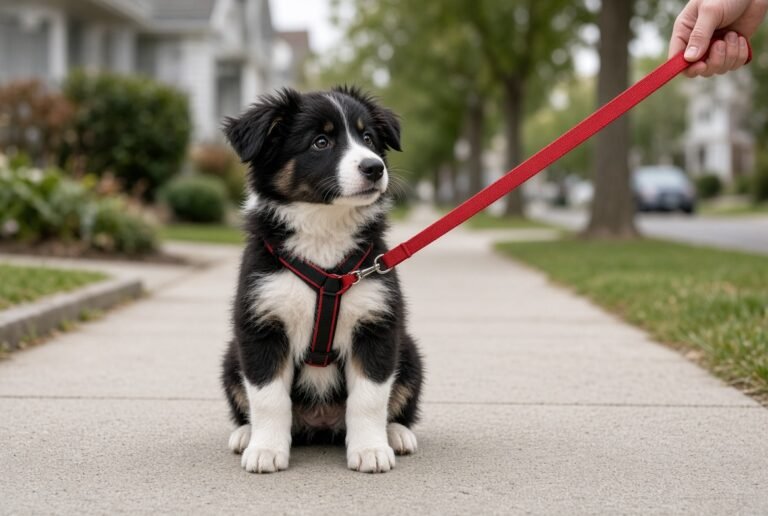
You clip the leash onto your puppy, take one step toward the door, and suddenly your puppy sits down. Maybe they stare at you, back away, walk backwards, or simply refuse to move.
It can look stubborn, but a puppy usually isn’t sitting there to make your walk difficult. Puppies aren’t born understanding what a leash means. The equipment can feel strange, and the restriction on movement can be confusing or uncomfortable at first. The American Kennel Club notes that puppies may sit down because a leash or harness can feel constricting, and recommends building leash skills gradually with rewards.
The key is to figure out why your puppy stops before trying to make them walk. A puppy that is simply unfamiliar with the leash needs different help from one that is frightened, uncomfortable, tired, or overwhelmed by the environment.
Table of Contents
- Why Does My Puppy Sit Down When I Put the Leash On?
- Quick Answer: What Your Puppy May Be Telling You
- Is It Normal for a Puppy to Sit When the Leash Goes On?
- 7 Reasons Your Puppy Sits Down With the Leash
- Why Does My Puppy Walk Backwards on the Leash?
- Why Does My Puppy Refuse to Move Forward?
- How to Teach a Puppy to Feel Comfortable on a Leash
- A Simple Leash Training Plan
- What to Do When Your Puppy Stops During a Walk
- Common Leash Training Mistakes
- Expert Tips for Easier Puppy Walks
- Myth vs. Fact
- When to Contact a Veterinarian or Trainer
- Frequently Asked Questions
- Conclusion
Quick Answer: What Your Puppy May Be Telling You
If your puppy sits down as soon as the leash goes on, the timing gives you a useful clue.
| What you notice | What it may suggest |
|---|---|
| Sits immediately after clipping on the leash | The leash feels unfamiliar or restrictive |
| Backs away from the leash | Uncertainty about the equipment |
| Walks backwards when you move | Trying to escape pressure or restraint |
| Walks indoors but freezes outside | The outdoor environment may be overwhelming |
| Moves when you loosen the leash | Pressure may be part of the problem |
| Bites or grabs the leash | The leash may be unfamiliar or exciting |
| Suddenly stops after previously walking well | Look for a new trigger, discomfort, or change in routine |
| Sits after a long period of activity | Your puppy may need a break |
These clues aren’t a diagnosis. They’re a way to decide what to test next.
Is It Normal for a Puppy to Sit When the Leash Goes On?
It can be completely normal during the early stages of leash training.
A puppy has to learn that wearing equipment, feeling the leash move, following a person, and walking through different environments are separate skills. The AKC specifically points out that puppies aren’t born knowing how to walk on a leash and recommends starting leash training before expecting normal walks.
The RSPCA also recommends short, reward-based leash sessions and advises against pulling, jerking the leash, or yelling when a puppy struggles.
When sitting is probably part of normal learning
Your puppy may simply need practice if they:
- Relax after a few minutes
- Take treats while wearing the leash
- Walk normally without the leash
- Follow you for a few steps indoors
- Improve when training happens in a quiet location
- Become more comfortable from session to session
When the behavior deserves closer attention
Look more carefully if your puppy:
- Suddenly starts refusing the leash after previously accepting it
- Cries, yelps, or appears painful when equipment is put on
- Repeatedly tries to escape the collar or harness
- Shows intense fear
- Refuses to move even in familiar, quiet surroundings
- Develops other unusual physical or behavioral changes
A puppy who is learning a new skill may need patience. A puppy who appears distressed or suddenly changes behavior may need a different approach.
7 Reasons Your Puppy Sits Down When You Put the Leash On
1. Your Puppy Hasn’t Learned What the Leash Means
To you, clipping on the leash means it’s time to walk.
To a puppy, it may simply mean that something is suddenly attached to their body and their movement has changed.
That doesn’t mean your puppy is refusing to cooperate. They may genuinely not understand what you’re asking.
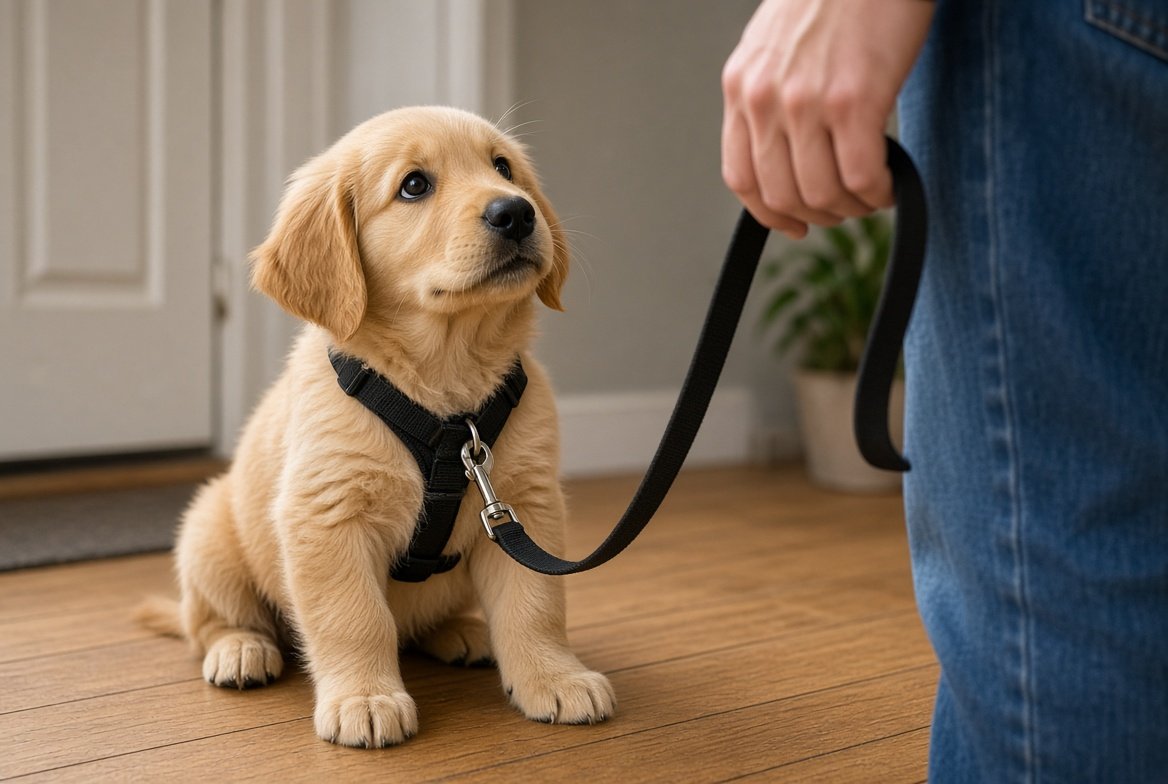
Practical example: Your puppy happily follows you from the kitchen to the living room without a leash. The moment you attach one, they sit. That pattern strongly suggests that the equipment itself needs more introduction.
Start by teaching the meaning of the leash before expecting a walk.
2. The Leash or Harness Feels Strange
New equipment can feel unusual around a puppy’s neck, chest, shoulders, or body.
Some puppies freeze. Others scratch, bite the leash, back away, or try to wriggle out of the harness.
The RSPCA recommends using equipment that is safe and comfortable and teaching loose-leash walking through reward-based training.
Try this: Put the harness on for a short period while your puppy is relaxed, reward calm behavior, and remove it. Repeat before adding the walking part.
Don’t rush from “wearing the harness” to “walking down the street.”
3. Your Puppy Doesn’t Like the Feeling of Restraint
Some puppies seem fine with the leash until you actually hold the other end.
That’s an important distinction.
A leash hanging loosely from the harness may not bother them. Feeling resistance when they move can be much more noticeable.
The AKC notes that some puppies find a leash or harness constricting and may sit down or try to move in the opposite direction.
If your puppy moves when the leash is loose but stops as soon as it becomes tight, avoid pulling harder. Give your puppy a chance to discover that staying near you keeps the leash comfortable.
4. Outside Is Too Much Too Soon
Your puppy may have no problem walking around the house but freeze the moment you step outside.
That’s because the outside world is dramatically more stimulating.
There may be:
- Cars and trucks
- Barking dogs
- People
- Bicycles
- Loud sounds
- New smells
- Different surfaces
- Wind and moving objects
A puppy that sits in this situation may be overwhelmed rather than stubborn.
Real-world example: Your puppy walks three steps down the driveway and then sits when a car passes. Instead of dragging them forward, create more distance from the road and practice in a quieter area.
The AKC recommends gradually increasing the difficulty of leash training rather than expecting a puppy to handle a busy environment immediately.
5. The Leash Is Being Used With Too Much Pressure
A common cycle looks like this:
Puppy stops → leash becomes tight → owner pulls → puppy resists → owner pulls harder.
That can turn a simple training problem into a physical struggle.
If your puppy stops, try keeping the leash loose and waiting for voluntary movement instead of dragging them forward.
The RSPCA recommends stopping rather than pulling or jerking the leash and rewarding the dog when they return to a loose leash.
6. Your Puppy Is Distracted, Excited, or Overwhelmed
A young puppy has a lot to process on a walk.
A leaf blowing across the pavement may be more interesting than you. A new smell may stop them completely. Another dog may be exciting or frightening.
This is why leash training should become harder gradually.
If your puppy can follow you around the living room but cannot concentrate near a busy road, don’t assume the puppy has forgotten the training. The environment has simply become more difficult.
Move back to a quieter location and rebuild the behavior there.
7. Your Puppy Is Tired or Something Feels Wrong
Sitting down isn’t always a training issue.
If your puppy has already been playing, exploring, training, and walking, they may simply need a break. The RSPCA specifically advises allowing a puppy that sits or lies down during a walk time to rest and ending the walk if they appear too tired to continue.
A sudden change is different.
If your puppy previously walked comfortably but now repeatedly refuses to move, especially alongside signs of pain or illness, don’t assume the answer is more training. A veterinarian can help determine whether there is a physical problem.
Why Does My Puppy Walk Backwards on the Leash?
If your puppy walks backwards on the leash, look at exactly when it happens.
If they back away as soon as the leash is attached, the equipment may feel unfamiliar. If they only walk backwards when you apply pressure, the sensation of restraint may be the trigger.
If it happens only outside, something in the environment may be making your puppy uncomfortable.
What to do
Keep the leash loose and return to a familiar, quiet area.
Then:
- Attach the leash.
- Reward your puppy for staying calm.
- Take one small step.
- Reward your puppy for following.
- Stop before they become frustrated.
- Repeat in short sessions.
The AKC recommends beginning with small steps and rewarding the puppy for following you rather than expecting a long walk immediately.
Why Does My Puppy Refuse to Move Forward on the Leash?
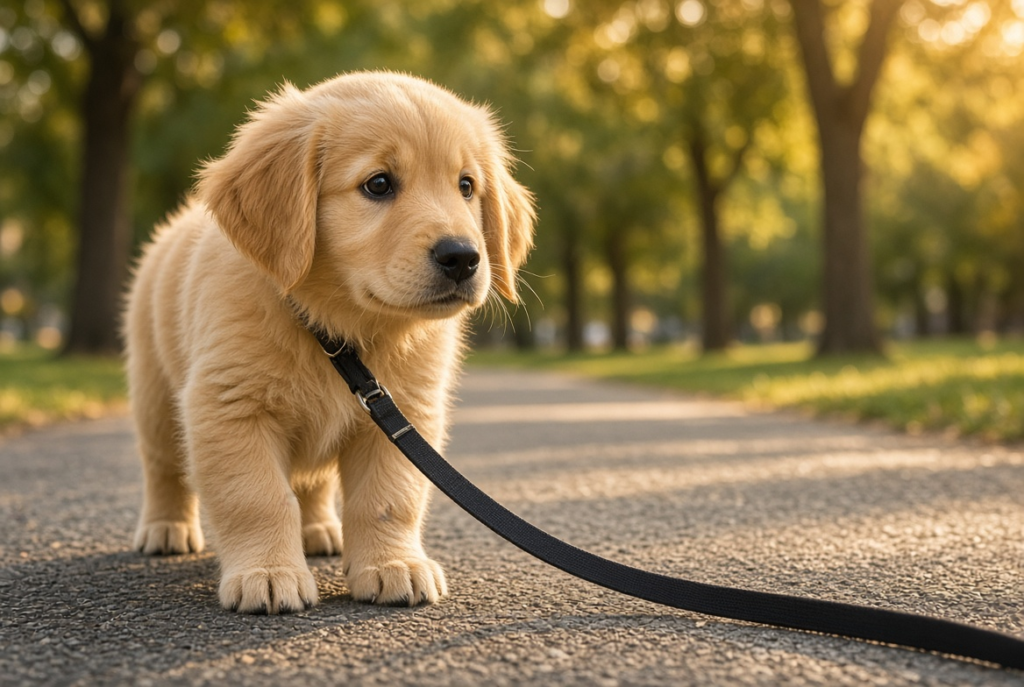
If your puppy refuses to move forward on the leash, first ask whether the problem happens everywhere.
| Pattern | What to check first |
| Stops immediately indoors | Leash or harness familiarity |
| Walks indoors but freezes outside | Outdoor environment |
| Stops around traffic or loud noises | Fear or overstimulation |
| Stops when the leash becomes tight | Pressure from restraint |
| Stops after prolonged activity | Fatigue or need for a break |
| Suddenly stops after walking normally | New trigger or possible discomfort |
This distinction matters.
You don’t solve every type of stopping by encouraging the puppy to walk farther. Sometimes the right answer is to make the situation easier.
How to Teach a Puppy to Feel Comfortable on a Leash
The goal of early leash training isn’t distance.
It’s confidence.
The AKC recommends introducing leash skills before expecting a puppy to complete normal walks and rewarding the puppy for staying near you.
Start with the leash itself
Put the leash somewhere your puppy can see it.
Let them investigate it without immediately clipping it on. Reward calm interest.
You are teaching:
Leash appears = good things happen.
Practice wearing it indoors
Attach the leash for a short period while you stay nearby.
Don’t immediately pull or walk toward the door.
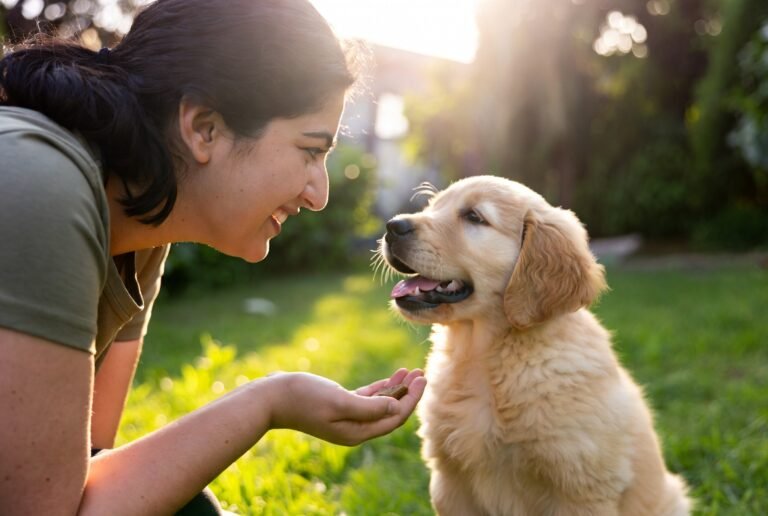
Reward your puppy for standing, sitting, or moving calmly while wearing it.
Reward one or two steps
Take one step.
If your puppy follows, reward.
Take another step.
Repeat.
At first, two successful steps are more useful than twenty frustrated ones.
The AKC recommends rewarding puppies for following and gradually increasing the distance between rewards as their skills improve.
Add movement gradually
Once your puppy follows you comfortably indoors, add:
- Gentle turns
- Short hallway walks
- Another quiet room
- A calm yard
- A quiet outdoor location
- Gradually more distractions
Don’t increase distance, distractions, and duration all at once.
A Simple Leash Training Plan
Stage 1: Get comfortable with the equipment
Spend several short sessions rewarding your puppy for calmly wearing the collar or harness.
Stage 2: Introduce the leash
Attach it while your puppy is relaxed.
Reward calm behavior without asking for a walk.
Stage 3: Move indoors
Take one or two steps.
Reward following.
Keep the leash loose.
Stage 4: Practice near the doorway
Walk around the entrance without automatically leaving.
This helps separate “leash on” from “suddenly we’re outside.”
Stage 5: Step outside briefly
Choose a quiet location.
Let your puppy look, sniff, and process the environment.
Reward voluntary movement toward you.
Stage 6: Increase difficulty slowly
Once your puppy is comfortable, gradually add distance and distractions.
There is no need to rush through these stages. If your puppy starts sitting, backing away, or freezing more often, make the exercise easier again.
What to Do When Your Puppy Stops During a Walk
When your puppy suddenly sits, don’t immediately pull.
Instead:
- Stop walking.
- Keep the leash loose.
- Look at what your puppy is noticing.
- Give them a moment.
- Encourage attention toward you.
- Reward voluntary movement.
- If they’re still uncomfortable, reduce the difficulty.
- End the session if your puppy appears tired or distressed.
The RSPCA recommends giving puppies time to rest when they sit or lie down during walks and heading home if they appear too tired to continue.
What if your puppy won’t take a treat?
Don’t keep increasing pressure.
A puppy that is too distracted, worried, or overwhelmed may not be interested in food at that moment.
Move to a quieter location or return to an easier training step.
Common Leash Training Mistakes
Pulling the Puppy Forward
Dragging a puppy teaches very little about how you want them to walk.
Instead, create opportunities for them to choose the direction you want and reward those choices.
Starting Outside Too Quickly
The front door isn’t the only thing your puppy needs to learn.
The leash, harness, walking surface, sounds, people, dogs, and traffic can all be new experiences.
Expecting a Long Walk
Early leash training can be very tiring mentally.
Short, successful sessions are more useful than pushing through a difficult session.
Changing Everything at Once
If your puppy is struggling, don’t simultaneously change the leash, harness, treats, route, walking cue, and training method.
Change one major factor at a time so you can see what helps.
Punishing Your Puppy for Stopping
Yelling, jerking the leash, or forcing a frightened puppy forward can make the situation harder.
Reward-based training gives your puppy a clearer idea of what behavior earns reinforcement.
Expert Tips for Easier Puppy Walks
Keep the leash loose whenever practical. A loose leash gives your puppy room to learn without constant pressure.
Use one consistent walking cue. A simple phrase such as “Let’s go” can become a predictable signal for moving with you.
Reward attention, not perfection. Looking at you, taking a step, or following a turn can all be useful moments to reinforce.
Let your puppy sniff. Walking doesn’t have to mean marching continuously from one point to another. Exploration is part of the experience.
Train below the puppy’s limit. If your puppy repeatedly freezes, the current environment may be too difficult.
Keep sessions short. The AKC recommends short, successful training sessions while puppies are learning new skills.
Myth vs. Fact
| Myth | Fact |
| My puppy sits because they’re stubborn. | Sitting can reflect confusion, discomfort, fear, distraction, or fatigue. |
| I should pull harder when my puppy refuses to move. | Pulling can add pressure; reward-based training is a better starting point. |
| Puppies automatically know how to walk on a leash. | Leash walking is a learned skill. |
| A long walk is the fastest way to teach leash skills. | Short, successful practice can build the foundation first. |
| My puppy must walk forward whenever I say so. | Early training should focus on voluntary engagement and gradually building the skill. |
| Every puppy should learn at the same speed. | Puppies differ in confidence, experience, and ability to handle distractions. |
When to Contact a Veterinarian or Trainer
A puppy sitting down during early leash training isn’t automatically a medical or behavioral emergency.
But don’t ignore a significant change.
Talk to your veterinarian if your puppy suddenly stops wanting to walk, appears painful, has difficulty moving, or shows other signs of illness.
If your puppy consistently shows strong fear of the leash, harness, outdoors, or walking despite gradual training, consider working with a qualified trainer who uses reward-based methods.
The goal isn’t simply to make the puppy complete the walk. It’s to understand what is causing the resistance and change the experience accordingly.
Frequently Asked Questions
Why does my puppy sit down when I put the leash on?
Your puppy may not yet understand the leash, may dislike the sensation of restraint, or may feel uncomfortable wearing the collar or harness. Some puppies also become worried when they realize the leash means going outside.
Why does my puppy back away from the leash?
Your puppy may find the equipment unfamiliar or may dislike the feeling of being restrained. Introduce the leash gradually and reward calm behavior before expecting your puppy to walk.
Why does my puppy refuse to move forward on the leash?
The cause could be unfamiliarity, leash pressure, outdoor distractions, fear, fatigue, or discomfort. Look at when and where the behavior happens before changing your training approach.
Should I pull my puppy when they sit down?
No. Avoid turning the situation into a pulling contest. Keep the leash loose, give your puppy a moment, and reward voluntary movement when they are comfortable.
Why does my puppy walk backwards on the leash?
Walking backwards can be a response to the unfamiliar feeling of the leash or pressure on the line. Start in a quiet environment and reward your puppy for taking small steps toward you.
Why does my puppy walk normally indoors but freeze outside?
Outside introduces many more sights, sounds, smells, people, animals, and surfaces. Your puppy may simply be overwhelmed by the extra stimulation. Start outdoors somewhere quiet and gradually increase distractions.
Should I use treats for leash training?
Yes, rewards can help your puppy understand which behaviors you want. The AKC recommends rewarding puppies for staying near you and following on a loose leash.
How long should puppy leash training sessions be?
Keep early sessions short enough that your puppy can remain successful. The AKC suggests short sessions, with five to ten minutes being a useful guideline for some puppies.
What should I do if my puppy sits during a walk?
Stop, keep the leash loose, and look for the reason. Give your puppy time to process the surroundings, reward voluntary movement, and reduce the difficulty if they seem worried or overwhelmed.
When should I worry about my puppy refusing to walk?
Pay closer attention if the behavior appears suddenly, persists despite gradual training, or comes with signs of pain, illness, or intense fear. A veterinarian can help rule out physical problems, while a qualified reward-based trainer can help with persistent training or fear issues.
Conclusion
If you’re wondering, why does my puppy sit down when I put the leash on?, the answer is usually found in the circumstances around the behavior.
Your puppy may be unfamiliar with the leash, uncomfortable with the equipment, unsure about restraint, overwhelmed by the outdoors, or simply tired. The important part is to identify the pattern instead of treating every refusal as stubbornness.
Start with tiny steps.
Let your puppy become comfortable with the equipment, practice indoors, reward voluntary movement, keep the leash loose, and gradually introduce more challenging environments. If your puppy struggles, make the exercise easier rather than forcing them through it.
A puppy that sits today isn’t necessarily a puppy that will hate walks tomorrow.
The goal is not to make your puppy move at any cost. It’s to teach them that walking with you is safe, predictable, and rewarding.