Puppy Sits Down When Leash Gets Tight: What Does It Mean?
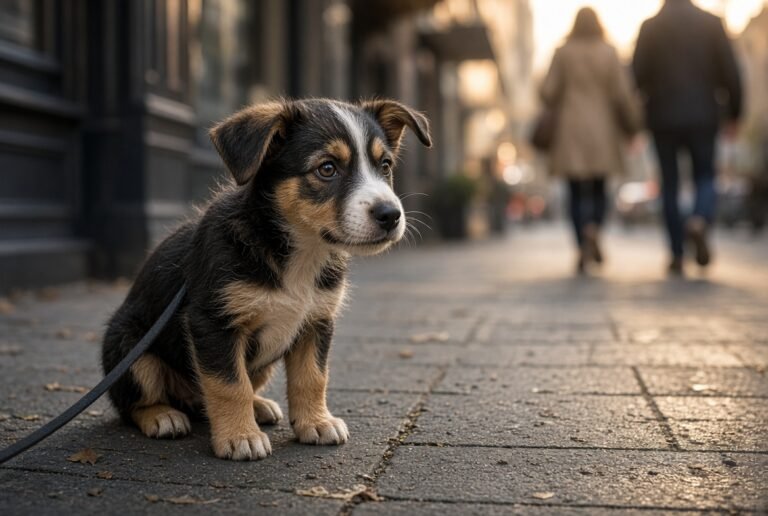
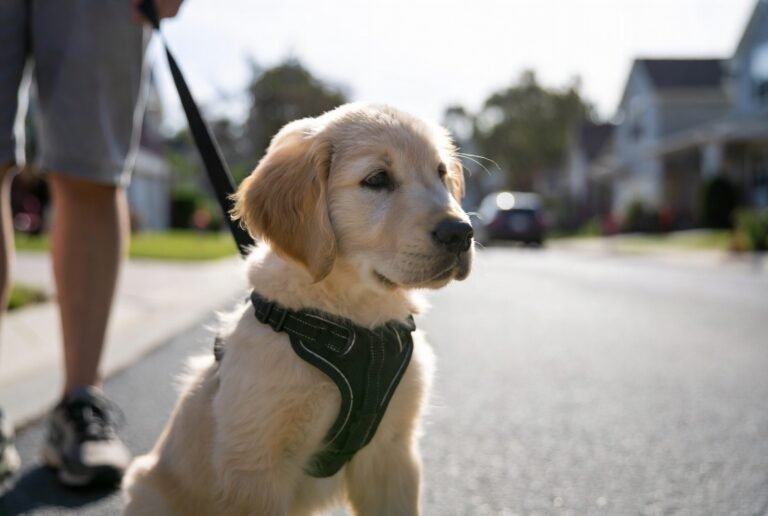
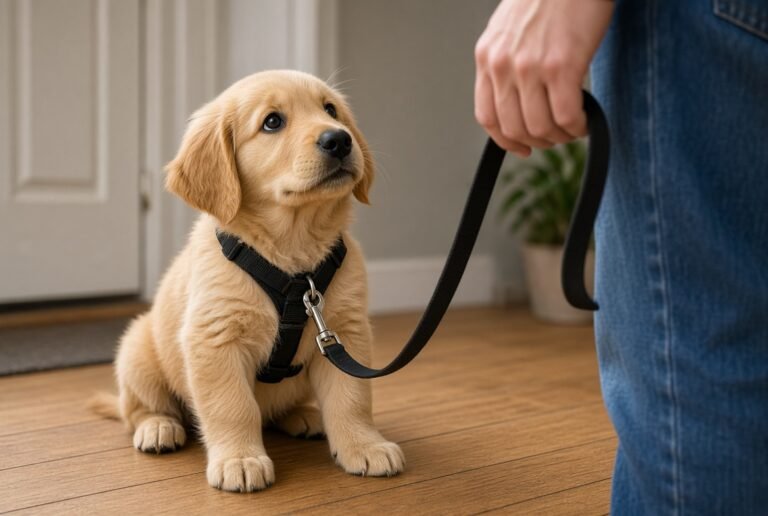
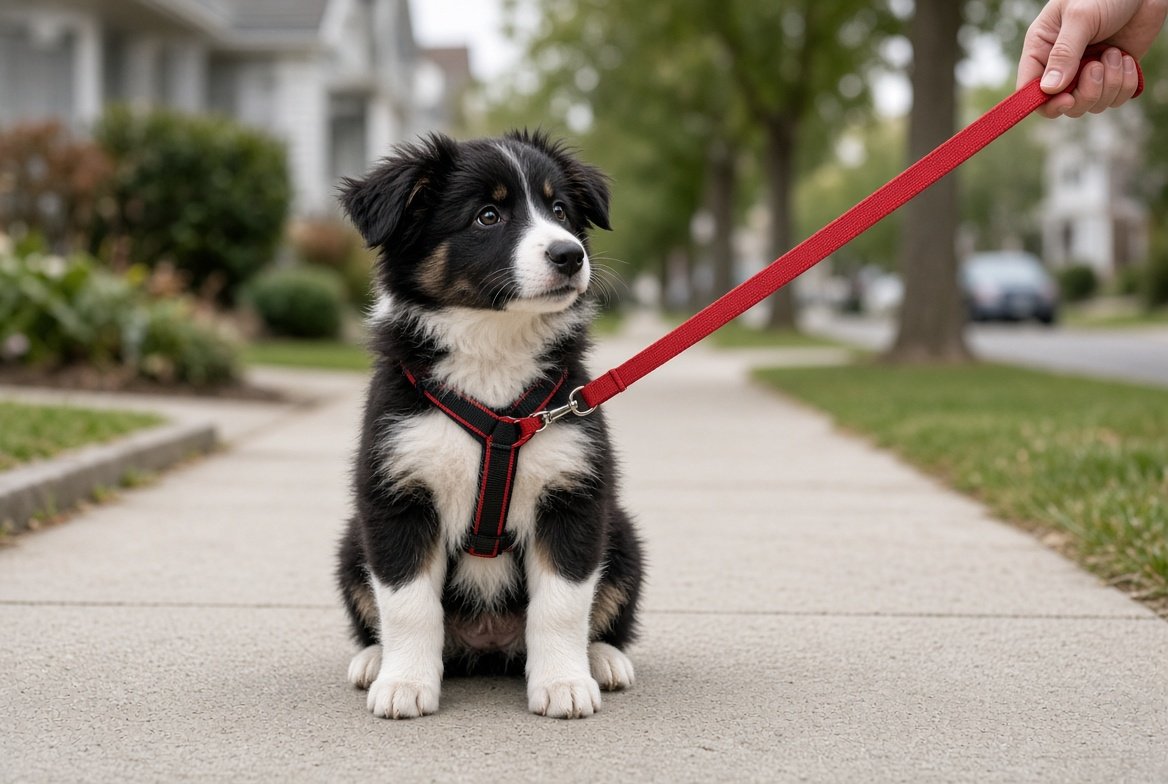
You’re walking your puppy when the leash reaches its limit. It becomes tight, and suddenly your puppy sits down. You loosen the leash, and he starts moving again.
If your puppy sits down when leash gets tight, the pressure itself may be part of the problem. Puppies aren’t born knowing what a leash means, and some need time to learn how to move comfortably while restrained. Loose-leash walking is a skill that has to be taught and reinforced.
The good news is that sitting at the end of the leash doesn’t automatically mean your puppy is stubborn. The behavior can have several explanations, and the pattern around the sitting usually gives you the best clue.
Table of Contents
- Why does my puppy sit when the leash gets tight?
- How can you tell why your puppy is stopping?
- What should you do when your puppy sits?
- How to teach your puppy to handle leash pressure
- Does the collar or harness matter?
- Why does my puppy stop walking outside?
- Common leash-training mistakes
- Expert tips for easier walks
- When should you contact a veterinarian or trainer?
- Myth vs. Fact
- Frequently Asked Questions
- Conclusion
Why Does My Puppy Sit When the Leash Gets Tight?
Several things can cause this behavior. The most important distinction is whether your puppy is simply responding to leash tension or whether something about the situation is making him uncomfortable or afraid.
1. He is naturally resisting the leash pressure
When you hold a puppy back with a tight leash, he may instinctively resist that pressure.
This is sometimes called an opposition response. If you pull against a dog, the dog may pull back; if you try to drag him in the opposite direction, he may brace himself or stop walking. AKC specifically describes this tug-of-war effect during leash walking.
So if your puppy walks forward, the leash tightens, and he immediately sits or digs in, he may simply be responding to the physical sensation.
Example: Your puppy notices an interesting smell and moves toward it. You stop him with the leash, the leash becomes taut, and he sits. Once you loosen the leash, he gets back up.
In this situation, pulling harder usually isn’t the lesson your puppy needs.
2. He doesn’t understand what leash tension means
Your puppy may know how to walk, but that doesn’t mean he understands what to do when the leash becomes tight.
If nobody has taught him to check in with you, return toward you, or respond to a cue such as “let’s go,” stopping may be the easiest response he knows.
AKC recommends teaching puppies directional cues, rewarding them for staying near their handler, and building loose-leash walking gradually.
Think of it this way:
Tight leash: “Something is stopping me.”
Loose leash + trained cue: “I know how to continue with my person.”
Your job is to teach the second association.
3. The collar, harness, or leash feels uncomfortable
A puppy may also stop because the equipment feels unfamiliar or uncomfortable.
This is especially worth considering if your puppy sits down as soon as you attach the leash, even before you start walking.
Check that:
- The collar or harness fits correctly.
- Nothing is rubbing or restricting movement.
- Your puppy can move naturally.
- The leash isn’t unnecessarily heavy.
- Your puppy has had time to become comfortable wearing the equipment.
AKC recommends introducing leash equipment gradually and notes that a properly fitted harness can be useful for puppies because it avoids direct pressure on the neck.
4. Something in the environment is worrying him
Sometimes the leash gets blamed when the environment is actually the bigger issue.
A puppy may walk normally in your home but stop outside when he encounters:
- Traffic
- Loud noises
- Unfamiliar people
- Other dogs
- New surfaces
- Busy sidewalks
- Strange objects
AKC notes that some puppies are frightened by the leash, collar, restraint, or outdoor environment and may initially refuse to move.
If your puppy remains tense even after the leash becomes loose, look beyond the leash itself.
5. He is excited or frustrated
Not every puppy who stops is scared.
A puppy may become highly focused on a smell, person, dog, squirrel, or another interesting distraction. If he wants to move toward it but the leash prevents him, frustration can contribute to stopping, pulling, or other leash behaviors.
AKC notes that leash-related behaviors can occur when young dogs are frustrated or don’t yet understand leash walking, particularly in highly stimulating environments.
The solution isn’t necessarily to let him reach every distraction. Instead, teach him how to stay connected with you while gradually working around distractions.
6. Sitting has become a successful strategy
Dogs repeat behaviors that produce useful results.
If your puppy sits and you immediately stop, loosen the leash, offer food, pick him up, or change direction, he may learn that sitting changes the situation.
That’s not the same as saying your puppy is deliberately manipulating you.
He has simply discovered that a particular behavior produces a predictable outcome.
7. He may simply be tired or overwhelmed
Puppies have limited attention spans and can become overwhelmed more easily than experienced adult dogs.
A walk that looks easy to you can contain dozens of new smells, sounds, people, surfaces, and sights for a puppy.
If your puppy starts sitting more frequently toward the end of a walk, consider whether the session is simply becoming too difficult or tiring.
VCA recommends keeping early leash-training sessions short and building from practice inside the home toward outdoor walking gradually.
How Can You Tell Why Your Puppy Is Stopping?
Don’t focus only on the fact that your puppy sits. Look at when he sits and what happens immediately afterward.
Try this three-question check
1. Does he start walking again when the leash loosens?
If yes, leash pressure may be contributing.
2. Does he look relaxed or worried?
A relaxed puppy who looks around normally is different from one who becomes stiff, crouched, tense, or tries to retreat.
3. Does it happen everywhere or only around certain triggers?
If it happens whenever the leash becomes tight, the pressure may be important. If it happens only around traffic, dogs, people, or particular locations, the environment deserves closer attention.
A quick comparison
| Pattern | What it may suggest |
|---|---|
| Leash tightens → puppy sits → leash loosens → puppy walks | Leash pressure may be contributing |
| Puppy sees a trigger → becomes tense → stops | Environmental concern may be contributing |
| Puppy stops even before walking begins | Equipment or restraint may be uncomfortable |
| Puppy reaches an exciting distraction → leash tightens → puppy resists | Excitement or frustration may be involved |
| Puppy becomes increasingly reluctant to move | Consider discomfort, fear, or another underlying issue |
These patterns aren’t a diagnosis. They’re simply useful observations that can help you choose the right training approach.
What Should You Do When Your Puppy Sits?
If your puppy stops because the leash has become tight, your first response should be to avoid making the pressure stronger.
Try these steps:
- Stop moving forward. Don’t drag your puppy.
- Keep the leash from getting tighter.
- Give him a moment to process the situation.
- Check his body language.
- Use a familiar cue, such as “let’s go,” if you’ve already taught it.
- Reward movement toward you.
- Continue only when the leash is loose.
AKC recommends stopping when the dog pulls and waiting for the leash to become slack or for the dog to return attention toward the handler.
The important part is consistency.
Your puppy should gradually learn that loose leash = movement, rewards, and continued exploration.
How to Teach Your Puppy to Handle Leash Pressure
You don’t need to wait for your puppy to have a problem on a busy walk before teaching him what to do.
Step 1: Start inside
Put the leash on in a quiet room.
Reward your puppy for standing near you, looking toward you, and taking a few steps without tension.
Keep the sessions short.
VCA recommends starting leash training inside the home before gradually moving outdoors.
Step 2: Reward the behavior you want
Don’t wait for your puppy to pull before interacting with him.
Reward him while he is already doing something useful:
- Walking beside you
- Looking at you
- Following your movement
- Keeping the leash loose
- Returning toward you
AKC emphasizes rewarding desired leash behavior rather than simply correcting unwanted behavior.
Step 3: Teach “let’s go”
Say “let’s go” and move a few steps.
When your puppy follows, reward him.
Practice this when he’s calm. That way, the cue already has meaning before you use it around distractions.
Step 4: Practice direction changes
Walk a few steps, then turn.
Reward your puppy for following you.
AKC recommends teaching directional cues so puppies understand when their handler is changing direction instead of simply experiencing a sudden pull on the leash.
Step 5: Teach a check-in at the end of the leash
Eventually, your puppy will reach the end of the leash.
Instead of automatically pulling him backward, stop and wait for him to turn toward you or return toward you.
Once the leash becomes slack, reward him and continue.
This teaches a useful alternative to simply sitting against leash pressure. AKC describes this type of automatic look-back as part of loose-leash training.
Step 6: Increase distractions gradually
Once your puppy can do the behavior inside, move to a quiet outdoor area.
Then gradually make the environment more challenging.
Don’t jump from a quiet living room to a crowded park and expect identical behavior.
Does the Collar or Harness Matter?
It can.
A properly fitted harness may be useful for puppies because it can avoid direct pressure on the neck, while a collar can be perfectly appropriate when properly fitted and used. AKC recommends checking that equipment doesn’t restrict movement and suggests lightweight fixed-length leashes for leash training.
| Option | Potential benefit | Important consideration |
|---|---|---|
| Collar | Lightweight and simple | Tight leash pressure acts around the neck |
| Harness | Can reduce direct neck pressure | Must fit correctly |
| Fixed-length leash | Predictable and easier to manage | Handler controls the available distance |
| Retractable leash | Gives more freedom | Less predictable for structured loose-leash practice |
A harness isn’t a magic fix.
If your puppy refuses to move when leash is tight, changing equipment may help with comfort, but your puppy still needs to learn what loose-leash walking means.
Why Does My Puppy Stop Walking Outside?
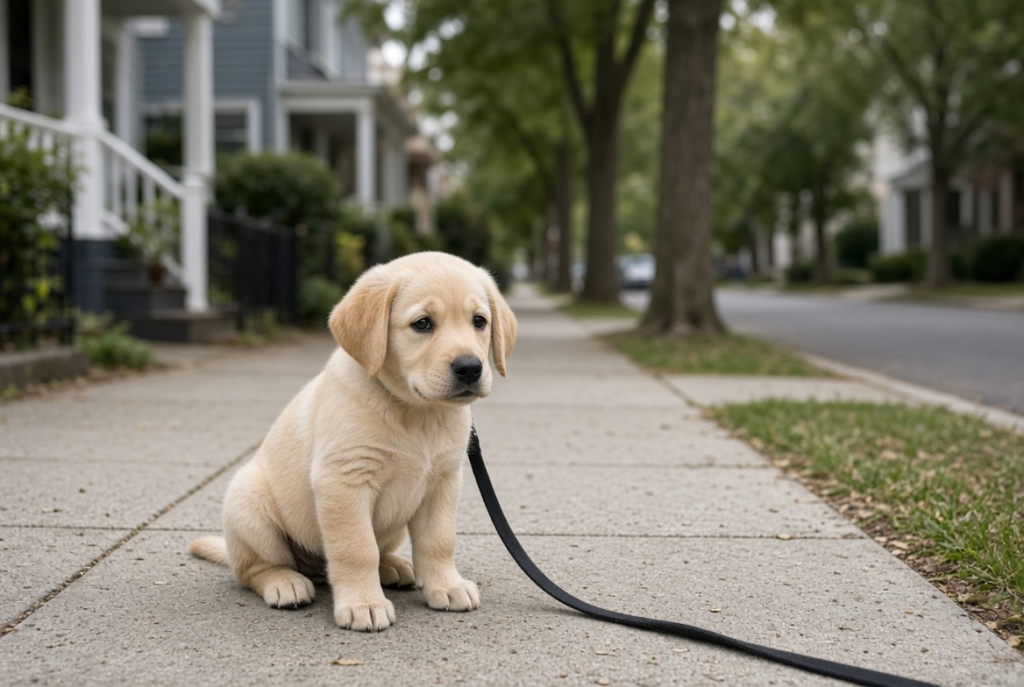
If your puppy walks happily inside but stops outdoors, don’t immediately assume the leash is the problem.
Outside, your puppy has to process much more information.
A car may pass. A dog may bark. Someone may approach. A motorcycle may make a loud noise. A new surface may feel strange under his paws.
For some puppies, that is enough to make walking difficult.
What should you do?
Make the environment easier.
Start somewhere quiet and allow your puppy to explore at his own pace. Reward attention toward you and gradually work closer to more distracting environments.
If he becomes overwhelmed, increase distance or return to an easier setting rather than forcing him to continue.
AKC specifically recommends helping reluctant puppies develop positive associations with the leash and avoiding rushing or pulling them around.
Real-World Examples
Example 1: The leash reaches its limit
Your puppy is walking normally, notices a smell, and moves forward. The leash becomes tight. You stop him, and he immediately sits.
You loosen the leash and he gets up.
What this suggests: The timing makes leash pressure a likely contributor.
Better approach: Stop pulling, encourage a check-in, reward movement toward you, and continue with a loose leash.
Example 2: Your puppy freezes near traffic
Your puppy walks well inside but stops when cars pass outside.
What this suggests: The environment may be more important than leash pressure.
Better approach: Begin farther from traffic and gradually build his confidence.
Example 3: Your puppy stops around another dog
Your puppy sees another dog and becomes intensely focused. He reaches the end of the leash and sits.
What this suggests: Excitement or frustration may be contributing.
Better approach: Create more distance, regain your puppy’s attention, and reward calm behavior before moving closer.
Common Leash-Training Mistakes
Pulling harder
A tight leash followed by more pulling can create a tug-of-war. Dogs may naturally resist pressure, making the original problem worse.
Dragging your puppy
If your puppy is frightened or overwhelmed, dragging him forward doesn’t teach him how to feel comfortable.
Waiting for perfect behavior
Reward your puppy while he’s already doing the right thing.
Don’t wait until the leash is completely tight.
Making walks too difficult
If your puppy succeeds at home but struggles outside, the answer may be to lower the difficulty rather than increase leash pressure.
Using the leash as the only communication
Your puppy needs to learn cues such as “let’s go,” attention, and direction changes.
AKC emphasizes communicating what you want rather than relying on the leash to physically move the dog.
Expert Tips for Better Walks
Keep the leash loose whenever possible
A loose leash gives your puppy room to move without constant physical pressure. AKC describes a loose leash as hanging in a relaxed “J” shape rather than remaining taut.
Reward check-ins
Whenever your puppy looks toward you voluntarily, make that behavior worthwhile.
Let appropriate sniffing happen
Sniffing is part of normal exploration. AKC recommends allowing appropriate opportunities to sniff during walks rather than treating every stop as disobedience.
Keep sessions short
Young puppies can lose focus quickly. Short, successful sessions are often more useful than prolonged battles.
When Should You Contact a Veterinarian or Trainer?
Occasional stopping during leash training isn’t necessarily a sign that something is wrong.
However, speak with your veterinarian if your puppy suddenly becomes reluctant to walk, appears painful, limps, cries when the leash or equipment is used, or shows a significant change from his normal behavior.
If fear or anxiety seems to be driving the behavior, or you’re repeatedly struggling despite gradual training, a qualified reward-based trainer can help you identify the trigger and adjust the training plan.
Don’t assume every refusal to move is a training issue.
Myth vs. Fact
Myth: My puppy is just stubborn.
Fact: Sitting can be a response to leash pressure, confusion, discomfort, excitement, environmental concerns, or learned behavior.
Myth: Pulling harder will make him walk.
Fact: Pulling can trigger resistance and create a leash tug-of-war. Teaching your puppy what to do instead is more productive.
Myth: A harness will solve the problem.
Fact: A properly fitted harness may improve comfort and reduce direct neck pressure, but it doesn’t teach loose-leash walking by itself.
Frequently Asked Questions
Why does my puppy sit when the leash pulls?
Your puppy may be reacting to the pressure itself. He may also be confused about what to do, uncomfortable with the equipment, excited about something, or worried about the environment.
Why does my puppy stop when leash pressure starts?
If the stopping happens immediately after the leash becomes tight and your puppy resumes walking when it loosens, the pressure may be contributing to the behavior.
Why does my puppy resist leash pressure?
Some dogs naturally resist pressure applied through a leash. Pulling against them can create an opposition response, causing them to brace, pull back, or stop.
Why does my puppy refuse to move when the leash is tight?
He may find the pressure uncomfortable or confusing. If he also shows fear or remains frozen after the leash loosens, consider whether the environment or equipment is contributing.
Should I pull my puppy forward when he sits?
Avoid dragging him. Reduce the tension, check his body language, use a familiar cue, and reward him for choosing to move with you.
Is it normal for a puppy to sit when the leash gets tight?
It can happen while a puppy is learning to walk on a leash. Puppies aren’t born understanding restraint or loose-leash walking. What matters is the pattern, your puppy’s body language, and whether he can comfortably resume walking.
Conclusion
When your puppy sits down when leash gets tight, don’t immediately label the behavior as stubbornness.
Start with the pattern. If the leash tightens, your puppy sits, and he starts walking again once the leash loosens, leash pressure may be contributing. If he becomes tense around particular sounds, dogs, people, or places, the environment may be playing a bigger role.
The most helpful response is usually not more force.
Teach your puppy what you want instead: walk with you, check in, respond to “let’s go,” and keep the leash loose. Start in easy environments, reward progress, and increase distractions gradually.
With patient practice, the leash can become a simple communication and safety tool rather than something your puppy feels he needs to resist.