

Why Does My Dog Bark at Nothing? Causes & Fixes
Why does my dog bark at nothing? Your dog hears, smells and sees things you can’t. Use the 3 a.m. checklist, then the 2-week Quiet plan.
It’s 2 a.m. Your dog is standing in the middle of the living room, barking at the wall. You check the door and the window. Nothing. No one is there — but your dog is sure something is happening.
Quick Answer
Your dog is almost never barking at nothing. Dogs hear sounds up to about 45,000 Hz, smell scents hours old and see movement in dim light, so they usually react to something real you cannot detect. Boredom, anxiety, pain and age-related confusion can cause it too. Watch where your dog faces, then keep a short log.
Why does my dog bark at nothing?
Because your dog can sense things you can’t. Three senses explain most of it.
Can my dog hear something I can’t?
Yes. Louisiana State University’s hearing-range page puts a dog’s top hearing at about 45,000 Hz, based on Heffner’s 1983 study. That is far above the roughly 23,000 Hz top of human hearing. Your dog may hear a neighbour’s TV, a mouse in the wall or a distant dog long before you notice anything. Oddly, hearing loss can make a dog bark more, not less: PetMD notes that some dogs with fading hearing bark more, or more loudly, because they can no longer judge their own volume.
Can my dog smell something I can’t?
Yes. Dogs have up to about 300 million scent receptors, against about 6 million in humans. A scent hours old — a fox in the garden, another dog past the fence — can be enough to set one off.
Can my dog see something I can’t?
Yes. Dogs see in low light far better than we do. They have a reflective layer behind the retina, the tapetum lucidum, which bounces light back through it — it is also why their eyes shine in torchlight. A shadow, a reflection or a small movement at dusk can look like a threat to them, and the bark is their alarm.
What is my dog barking at?
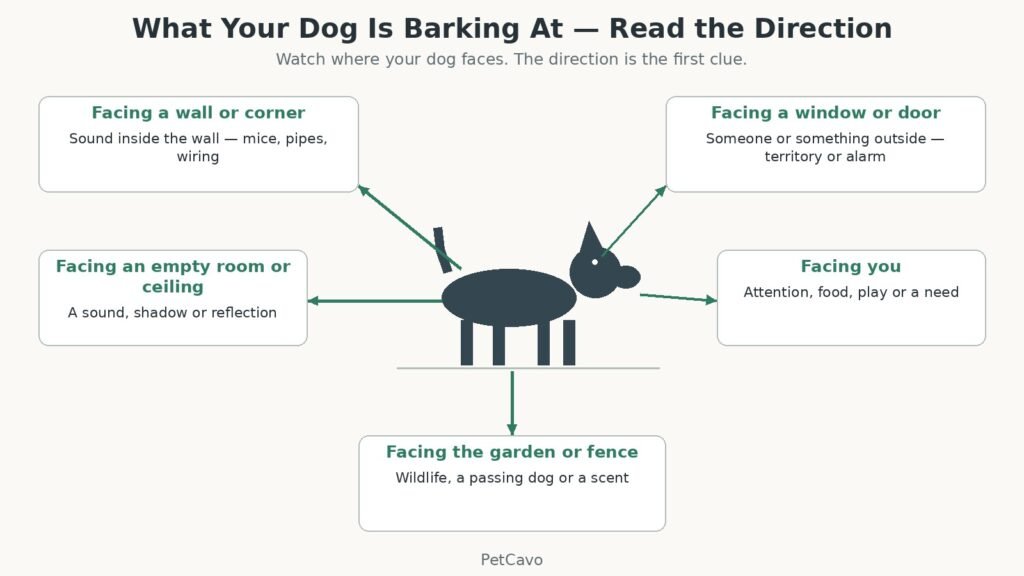
Look at where your dog faces. That tells you more than the bark itself.
| Where your dog faces | What it may mean | What to do |
|---|---|---|
| A wall or corner | Sound inside the wall — mice, pipes, wiring | Listen at the wall; look for droppings |
| A window or door | Someone or something outside — territory or alarm | Close the curtain; look outside |
| An empty room or the ceiling | A sound, a shadow, or a reflection | Check lights, mirrors, appliances |
| At you | Attention, food, play, or a need such as the toilet | Needs met? Then wait for quiet |
| The garden or fence | Wildlife, a passing dog, a scent | Check the garden in daylight |

What kind of bark is it?
Barking is not one behaviour. The ASPCA lists several types of barking, each with its own fix. Match the bark first — treating the wrong type wastes weeks.
| Type | Sounds like | First step |
|---|---|---|
| Alert | Sharp, quick barks at a sound or movement | Check the trigger, then distract and reward quiet |
| Attention-seeking | Barking at you, often with staring or nudging | Ignore the bark; reward quiet |
| Separation anxiety | Barking only when you leave, with pacing or drooling | Short departures; record while you are out |
| Fear | High, rapid barks at a specific thing | Increase distance; desensitise slowly |
| Territorial | Barking at the window, door or fence | Block the view; manage the boundary |
| Play | Short, excited barks with play bows | Give a play break, then a calm task |
| Social | Barking when greeting people or dogs | Teach a calm greeting routine |
| Compulsive | Same bark, same pattern, hard to stop | Book a vet visit; add enrichment |
| Boredom or loneliness | Long, monotone barking when alone | More exercise and scent work |
| Pain | Sudden barking, yelping or guarding a body part | Book a vet visit at once |
| Senile (CCD) | Night barking and confusion in an older dog | Book a vet visit; see the senior section |
If fear is the cause: desensitise in 3 steps
Fear barking needs a different fix from the others. The aim is to change how your dog feels about the trigger, not to punish the bark. VCA’s desensitisation and counterconditioning advice, in short:
- Find the distance where your dog notices the trigger but stays calm — across the street, or with the sound turned low.
- At that distance, give a treat every time the trigger appears, so the trigger starts to predict good things.
- Move a little closer only after two or three calm sessions. If your dog stiffens, barks or tries to move away, go back to the last distance that worked.
When Barking Looks Compulsive
Compulsive barking has a fixed pattern. It repeats the same way, it is hard to stop, and there is no clear trigger. Watch for licking, chewing or pacing that goes with it, and for sores from licking. If your dog has a fixed pattern, book a vet visit — pain or an underlying health problem can drive it, and a behaviourist can help once medical causes are ruled out.
Why does my dog bark at nothing in my room?
Your dog may be guarding the room, reacting to a sound in the wall, or asking for something — water, the toilet, or you. Check needs first, then listen at the wall and look for a shadow or a reflection. If it happens only in one room, the trigger is usually in that room.
Why does my dog bark at nothing outside?
Outside, the triggers multiply: a passing dog, wildlife, a scent on the wind, or a neighbour’s noise. Use the facing-direction table above — if your dog faces the fence, the trigger is beyond it. Block the view or bring your dog in for a short break.
Why does my dog bark at nothing for hours?
Barking for hours usually means boredom, loneliness, or a trigger that never goes away — a neighbour’s dog, building work, or a sound in the wall. First rule out pain and check the vet list below. Then add a sniff-heavy walk, puzzle feeding and a safe chew, and start the log: a pattern usually shows in a few days.
Why is my dog barking at nothing and scared?
A scared dog barks high and fast, often with its tail tucked and its body low. The cause is usually a specific sound, object or place. Do not drag your dog towards it — increase the distance and work through the 3 desensitisation steps above.
Why is my dog barking and growling at nothing?
Growling with barking usually means your dog feels threatened or is guarding something — a spot, a toy, or you. Do not punish the growl: it is a warning. Give your dog space, remove the thing being guarded if you can do so safely, and see a vet or a qualified behaviourist if it keeps happening.
Why does my dog bark in his sleep?
He is probably dreaming. Dogs twitch, whimper and bark softly in sleep, just as people do. VCA notes that dreaming movements are usually brief and relaxed, while seizure movements are more rigid and intense — and the AKC adds that you can usually wake a dreaming dog, but not one having a seizure. If the movements are stiff, last more than a minute, or your dog seems confused afterwards, call your vet.
What is the spiritual meaning of a dog barking at nothing?
Some people believe a dog barking at an empty corner senses a spirit or a presence. There is no scientific evidence for that, and it is worth checking the natural causes first — hearing, smell, a shadow, pain, or confusion in an older dog. If the natural causes are ruled out and the belief brings you comfort, there is no harm in it. What matters is that your dog is checked, calm and safe.
Why does my dog bark at nothing at night?
At night the world gets quieter for you but louder for your dog. Traffic and household noise fall away, so small sounds — a distant dog, a car door, mice in a wall — stand out. Anxiety also peaks at night: when the house goes dark and quiet, a nervous dog can feel more alone. Short bursts of barking during sleep, with twitching paws, are usually just dreaming; leave a dreaming dog alone.
In a flat, tell your neighbours you are working on it — and keep night sessions short and calm, so the barking does not become a habit for the whole building. If your dog pants as well as barks at night, read our guide to dog panting at night: panting can point to pain, heat or anxiety, and it changes what to do next.
The 3 a.m. Checklist
Work through it in order. It takes two minutes.
- Listen. Is there a sound — a mouse, a pipe, a neighbour’s TV?
- Look. Where is your dog facing?
- Check needs. Water, toilet, pain? Let your dog out once, calmly.
- Wait. If nothing is wrong, wait for a pause, then reward quiet.
Is my dog barking at a ghost?
It is a fair question — many owners ask it when a dog stares at an empty corner. Start with natural causes: mice in a wall, a smoke detector’s low-battery chirp, a reflection, a scent you cannot smell. Dogs hear sounds up to about 45,000 Hz and smell scents hours old, so most “ghost” barking has a physical trigger. There is no scientific evidence that dogs sense ghosts. Run the five-minute check — listen, look, check needs — before assuming anything unusual. If barking comes with disorientation, it can follow hearing or sight loss, or a neurological problem; book a vet visit.
Which dogs bark the most?
Some breeds were bred to use their voice. The AKC names Yorkshire Terriers, Beagles and Chihuahuas as breeds known for being vocal.
| Often more vocal | Often quieter |
|---|---|
| Yorkshire Terrier — alert, territorial | Akita — quiet, reserved |
| Beagle — scent, excitement, loneliness | Afghan Hound — calm, independent |
| Chihuahua — alert, protective | Greyhound — gentle, low-energy |
Why is my old dog barking at nothing?
New barking in a senior dog has different causes. Book a vet visit first, not training.
The most common cause is canine cognitive dysfunction (CCD), the dog version of dementia. A Neilson et al. study in 2001 found 28% of dogs aged 11 to 12 and 68% of dogs aged 15 to 16 show at least one sign of CCD. Watch for: confusion after dark, or getting stuck in corners (sundowning); staring at walls, or barking at nothing; house-soiling after years of being clean; and sleeping more in the day and less at night. Vets remember the signs with the letters DISHAA: disorientation, changes in interaction, sleep-wake changes, house soiling, activity changes and anxiety.
Hearing and sight fade too. A dog that cannot hear you come up behind it, or cannot make out a shape in dim light, may bark at a surprise. Pain matters as well: sore joints, dental pain or an upset stomach can make a dog more reactive, especially at night.
If your older dog barks at night, stares at walls, gets stuck in corners, or forgets house training, book a vet visit this week. Emergency: collapse, trouble breathing, sudden weakness, or a seizure — call your vet at once.
Sudden barking or a gradual change?
Sudden barking in a dog that was quiet before is the one to act on fast: it can mean pain, a sudden loss of hearing or sight, or a medical problem. A slow, gradual rise in night barking over months is more typical of CCD. Either way, a new pattern in an old dog starts at the vet, not with training.
New barking in an old dog? Vet first, not training. Book the vet visit before you change any routine — pain, CCD and sensory loss all need a medical check first, and training cannot fix any of them.
What should I do tonight?
Work through these steps in order. Most cases of why does my dog bark at nothing settle once you find the trigger.
- Look where your dog faces. Use the table above. The direction points to the trigger.
- Check needs. Water, toilet, pain, hunger — meet them once, calmly.
- Give your dog a job. A sniff-heavy walk, a puzzle feeder, scatter feeding or a safe chew. Ten minutes of scent work can tire a dog more than a fast walk.
- Teach “Quiet”. Wait for a pause, even a one-second breath, say “Quiet” and give a treat at once.
- Start a log tonight. Note the time, the room, where your dog looked and what happened just before.
The Timed “Quiet” Protocol
Build silence a little at a time. The ASPCA’s sequence is 2 seconds, then 5, then 10, then 20.
- Let your dog bark three or four times, then say “Quiet” once, in a calm voice.
- Hold a smelly treat on your dog’s nose to lure a pause.
- The moment your dog is quiet, mark it with “Yes” or a clicker and give the treat. Treat while quiet — never while barking.
- When 2 seconds of quiet is easy, wait 5, then 10, then 20 seconds before the treat.
- Lengthen the pause only when your dog wins most tries. If it fails twice, go back a step.
- Practise in short sessions, a few times a day, away from the main trigger.
The 2-Week Quiet Plan
Week 1 builds the skill; week 2 uses it where it counts.
Week 1 — teach Quiet away from the trigger. Practise the Timed Quiet Protocol above in a calm room, in short sessions a few times a day. Your only goal is a reliable pause on the word “Quiet”. Judge it on day 7: if your dog can hold 10 to 20 seconds of quiet most tries, move on. If not, repeat week 1 — do not jump ahead.
Week 2 — use Quiet at the trigger. Now practise near the real trigger: the window, the door, the garden fence. Start far from it, reward quiet, and move closer a little at a time. Keep the log going every night.
Day 14 — judge the log. Count the episodes in week 2 against week 1. Fewer, shorter or quieter episodes mean it is working — keep going. No change after two honest weeks, or barking that is getting worse, means it is time for the vet or a qualified behaviourist, not more of the same.
The 3-bark rule
The 3-bark rule is a training convention created by trainer Diane Garrod. Let your dog bark three times — enough to alert — then say “thank you”, count to three, and give a “done” cue that ends the barking. Garrod teaches it backwards: train the “done” cue first, then add the count. It works because the dog gets to raise the alarm, then gets a clear signal to stop. It is not a law of dog behaviour, and it will not suit every dog.
How do I keep a barking log?
Before you change anything, spend a week writing down each barking episode. A log turns “why does my dog bark at nothing” from a mystery into a pattern, and patterns usually show in a few days.
| Date and time | Where facing | What happened before | How it ended |
|---|---|---|---|
| Tue 3 a.m. | Kitchen wall | Scratching sound | Stopped when light on |
| Wed 11 p.m. | Front window | Neighbour’s car door | Stopped after 2 minutes |
| Fri 2 a.m. | Bedroom door | Nothing heard; dog restless and panting | Barked on and off for 20 minutes |
Read your pattern
| Pattern | Likely cause | Next step |
|---|---|---|
| Same time daily | Routine trigger | Block the view; change the routine |
| Only when you are out | Separation distress | Short departures; record while out |
| At night | Sound in the wall or outside | Listen; check the wall |
| With other signs | Pain or CCD | Book a vet visit |
What the example rows show
- Row 1 (Tue 3 a.m.): a sound in the wall at the same hour — check for mice, and listen at the wall tonight.
- Row 2 (Wed 11 p.m.): a routine trigger outside at a set time — block the view at that hour, or bring your dog in.
- Row 3 (Fri 2 a.m.): no clear trigger, and a restless, panting dog — that one needs a vet check, not training.
What if my dog only barks when I am out?
That points to separation distress, not a ghost in the hallway. Barking that happens only when you leave, with pacing, drooling or damage near the door, is a strong sign. Test it simply: record audio or video while you are out, or ask a neighbour when the barking happens.
Separation Anxiety: Short Departures That Help
Build up slowly. The ASPCA’s advice is to start with departures so short your dog stays calm — even a few seconds — then build up in small steps. Leave a safe chew or a food puzzle, and keep arrivals and departures low-key.
For the full picture — signs, causes and the step-by-step plan — see the ASPCA’s separation anxiety guide.
Puppies and newly adopted dogs
A puppy or a newly adopted dog barks at new sounds and places while it learns what is safe. Settle it with a fixed routine, a safe resting place and gentle socialisation. Settling fades over days to a few weeks. Get help sooner if the barking grows worse, comes with fear or aggression, or does not improve.
For the first days, our guide to crate training a puppy shows how to set up a safe den and stop the nighttime crying.
What should I not do when my dog barks at nothing?
Don’t yell. To your dog, a raised voice sounds like you are joining in. It adds energy to the barking. Don’t punish. The American Veterinary Society of Animal Behavior advises against punishment-based training — it can make fear and anxiety worse. Skip bark collars as a first step. They make barking unpleasant but do not fix why your dog barks. Don’t ignore a sudden change. A dog that never barked at night and now does every night needs a vet check, not just training.
When should I call the vet?
Most barking is normal and needs no medical attention. But call your vet if you notice any of the signs below.
| How urgent | Signs | What to do |
|---|---|---|
| Emergency | Collapse, trouble breathing, seizure, sudden weakness | Call your vet at once |
| Same day | Barking and not eating — see how long a dog can go without eating; vomiting or diarrhoea; pain | Book a vet visit today |
| This week | New night barking, confusion or house-soiling in a dog over eight; ongoing barking with no trigger | Book a vet visit |
At the visit, your vet will do a full physical exam and usually run blood and urine tests to rule out pain or illness. You know your dog better than anyone. If the barking feels different from their usual behaviour, trust that and get it checked.
Key Takeaways
- Your dog is almost never barking at nothing — they hear, smell, or see something you cannot detect.
- Where your dog faces points to the trigger.
- Match the bark type before you train; the fix depends on it.
- Teach “Quiet” in short steps: 2, then 5, then 10, then 20 seconds of silence.
- New barking in a senior dog, or barking with other signs, needs a vet visit first.
- Follow the 2-week Quiet plan and judge your log on day 7 and day 14.
Frequently Asked Questions
Why does my dog bark at nothing in the middle of the night?
At night small sounds stand out more: a distant dog, a car door, mice in a wall, or wildlife outside. Use the 3 a.m. checklist, then check hearing and pain if it keeps happening.
Why does my dog stare at the wall and bark?
The most common reason is sound inside the wall: mice, rats or insects squeak and scratch at pitches we miss. Listen at the wall and look for droppings.
Is barking at nothing a sign of anxiety?
It can be. Anxious dogs scan the room for threats, so small sounds and shadows feel bigger to them. Look for pacing, lip-licking and a tucked tail, and work on calm departures and a safe resting place.
Why is my old dog suddenly barking at nothing?
New barking in a senior dog often points to canine cognitive dysfunction, hearing or vision loss, or pain. Book a vet visit before training.
Do bark collars stop barking at nothing?
They can stop the bark, but they do not fix the cause. Citronella, vibration and shock collars work only while worn, and pain-based collars can make anxiety worse.
Can dogs really hear things I can’t?
Yes. A dog’s hearing tops out at about 45,000 Hz — far above the roughly 23,000 Hz top of human hearing.
Could my dog really be barking at a ghost?
There is no scientific evidence that dogs sense ghosts or spirits. A dog staring at an empty corner is almost always reacting to a sound, smell or reflection you cannot sense.
What is the 3 bark rule?
The 3-bark rule is a training convention created by trainer Diane Garrod. Let your dog bark three times — enough to alert — then say “thank you”, count to three, and give a “done” cue that ends the barking. Garrod teaches it backwards: train the “done” cue first, then add the count. It is not a law of dog behaviour, and it will not suit every dog.
Can barking be trained out of a dog?
Mostly, yes — but “trained out” usually means “trained to a level you can live with”, not silence. Alert barking is normal dog behaviour. With a log, the Quiet protocol and the 2-week plan above, you should see fewer, shorter or quieter episodes by day 14. If the cause is pain, fear or CCD, training alone will not fix it — see a vet first.
What do vets recommend to stop barking?
Vets usually start with a health check, because pain, CCD and hearing or vision loss all cause barking. Once health is ruled out, the standard advice is to find the trigger, reward quiet, and desensitise fear-based barking — the same approach the ASPCA’s barking guide takes. The AVSAB advises against punishment-based training, and bark collars are a last resort, not a first step.
Sources
How we checked this: every number in this guide comes from the source listed next to it — the hearing range from Louisiana State University, the CCD figures from the Neilson et al. study on PubMed, and the training steps from the ASPCA and VCA. Where sources disagreed, we used the veterinary or university source.
- ASPCA — Barking: aspca.org
- ASPCA — Separation Anxiety: aspca.org
- Louisiana State University — Hearing Range: lsu.edu
- PetMD — 8 Dog Nose Facts You Probably Didn’t Know: petmd.com
- American Kennel Club — Can Dogs See in the Dark?: akc.org
- American Kennel Club — Dog Dreaming vs. Seizures: akc.org
- VCA Animal Hospitals — Senior Pet Cognitive Dysfunction: vcahospitals.com
- VCA Animal Hospitals — Introduction to Desensitization and Counterconditioning: vcahospitals.com
- VCA Animal Hospitals — What Does It Mean When Dogs Twitch In Their Sleep?: vcahospitals.com
- PetMD — How To Help a Senior Dog With Hearing Loss: petmd.com
- Diane Garrod — The Three Bark Rule, via VetriScience: vetriscience.com
- American Veterinary Society of Animal Behavior — Position Statements: avsab.org
- Neilson et al. — Canine cognitive dysfunction: pubmed.ncbi.nlm.nih.gov
Photo Credits
Featured image: Chopper Life — Pexels, free licence.
Dog barking at a blank wall: Daigoro Folz — Pexels, free licence.
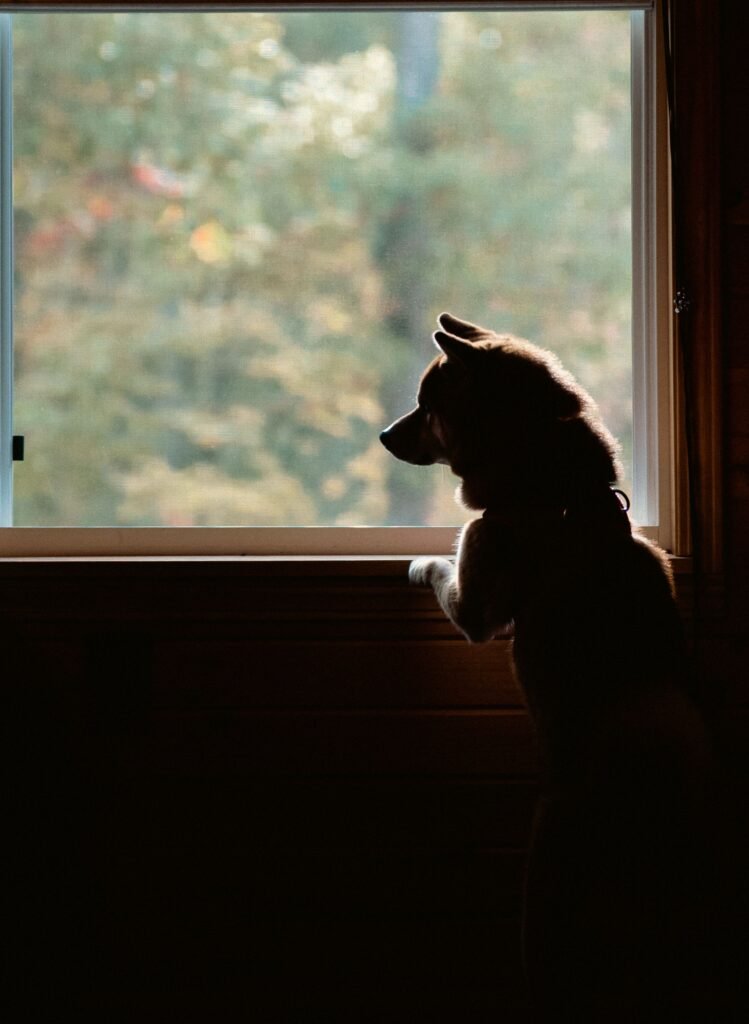
Dog looking out of a window at night: Chris F — Pexels, free licence.







6 Comments