Cat Tongue Explained: Why It Is Rough, How It Works, and What It Reveals About Your Cat
A cat’s tongue is one of nature’s most impressive designs. What looks like a simple pink organ is actually a highly specialized tool used for grooming, eating, drinking, and survival.
If you have ever felt your cat lick your hand, you probably noticed something unusual. Instead of feeling soft like a human tongue, it feels rough, almost like sandpaper.
That rough texture is not because your cat’s tongue is dirty. It comes from hundreds of tiny structures that help cats maintain their coats and perform behaviors inherited from their wild ancestors.
Understanding how a cat tongue works can help you better care for your pet, recognize healthy behavior, and notice signs that something may be wrong.
Table of Contents
- Why Is a Cat Tongue Rough?
- The Science Behind a Cat Tongue
- Cat Tongue Anatomy Explained
- How Cat Tongue Spikes Help Grooming
- Why Cats Spend So Much Time Grooming
- How Cats Drink Water With Their Tongues
- Cat Tongue vs Human Tongue
- Domestic Cat Tongue vs Lion and Tiger Tongue
- Common Cat Tongue Problems and Warning Signs
- Why Does My Cat Lick Me?
- Why Does My Cat Keep Licking Itself?
- Cat Tongue Myths vs Facts
- Common Mistakes Cat Owners Make
- Expert Tips for Maintaining Cat Oral Health
- Frequently Asked Questions About Cat Tongues
Why Is a Cat Tongue Rough?
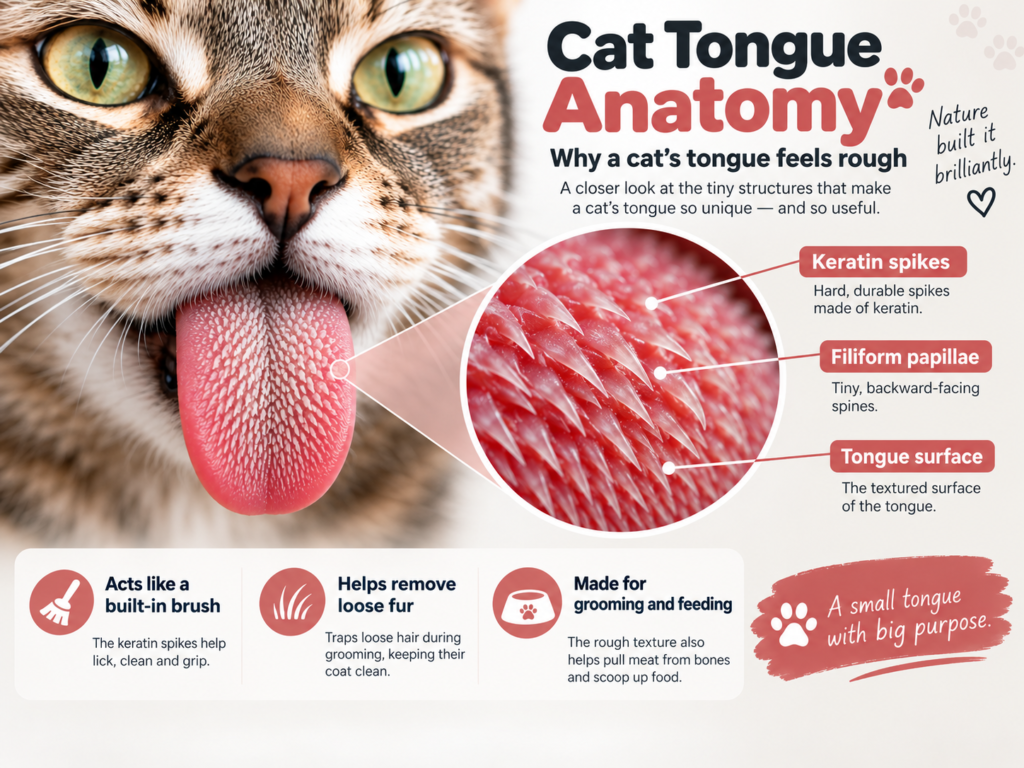
A cat’s tongue feels rough because it contains hundreds of tiny backward-facing structures called filiform papillae.
These small, hook-like structures cover the surface of the tongue and are made from keratin, the same tough protein found in claws, fur, and the outer layer of human nails.
When a cat licks its fur, these papillae act like a natural comb. They grab loose hair, remove dirt, and help spread natural oils throughout the coat.
This is why a cat’s tongue feels completely different from a dog’s or human tongue.
A dog’s tongue is mostly designed for drinking and cooling, while a cat’s tongue is built for precision grooming.
Quick Example
Imagine running a small brush through tangled hair.
A cat’s tongue performs a similar job, except the “brush” is built directly into its body.
The Science Behind a Cat Tongue
A cat tongue is a result of millions of years of evolution.
Wild cats needed a tool that could help them survive after hunting. They needed to remove blood, clean their fur, separate tangled hair, and maintain hygiene without human assistance.
The rough surface of their tongue provided exactly that advantage.
The Role of Filiform Papillae
Filiform papillae are the main reason cats have such unique tongues.
Their functions include:
- Removing loose fur
- Cleaning debris from the coat
- Helping separate tangled hair
- Assisting with eating meat
- Distributing saliva through fur
The papillae point backward toward the throat, which allows them to pull material inward during licking.
Why Is Keratin Important?
Keratin makes the papillae strong and durable.
Without this hard material, the tongue would not be effective at removing fur or handling tougher food materials.
This same protein is also found in:
- Cat claws
- Hair
- Human fingernails
Cat Tongue Anatomy Explained
A cat tongue is made up of several important parts that work together.
| Part | Function |
|---|---|
| Filiform papillae | Remove loose fur and clean the coat |
| Taste buds | Detect certain flavors |
| Muscle tissue | Allows flexible movement |
| Saliva glands | Help with moisture and grooming |
Unlike humans, cats have fewer taste abilities because they are obligate carnivores. Their bodies are designed primarily around consuming animal-based foods.
How Flexible Is a Cat Tongue?
A cat’s tongue is extremely flexible.
It can move in different directions, allowing cats to clean difficult areas such as:
- Legs
- Chest
- Back
- Around the shoulders
This flexibility is one reason cats can groom themselves so effectively.
How Cat Tongue Spikes Help Grooming
Many people call the structures on a cat tongue “spikes,” but they are actually modified papillae.
These tiny hooks work like a built-in grooming tool.
When a cat licks:
- The tongue extends outward.
- The papillae spread through the fur.
- Loose hair and dirt get trapped.
- The cat pulls the tongue back into the mouth.
- The material is swallowed or removed.
Why Do Cats Get Hairballs?
Because these papillae collect loose fur, cats naturally swallow some hair during grooming.
Most swallowed hair passes through the digestive system, but some may collect in the stomach and form hairballs.
Frequent hairballs may indicate:
- Excessive shedding
- Skin irritation
- Over-grooming
- Lack of brushing
Long-haired cats often need more grooming support because they remove more fur during licking.
Why Cats Spend So Much Time Grooming
Grooming is not only about cleanliness.
Cats groom for several reasons:
Keeping Their Coat Healthy
Licking helps spread natural oils that keep fur smooth and protected.
Temperature Regulation
A cat’s saliva can help provide a cooling effect as it evaporates from the fur.
Stress Relief
Some cats groom themselves when they feel relaxed.
However, excessive grooming can sometimes be a sign of stress or discomfort.
Social Bonding
Cats may lick each other as a way of building social relationships.
This behavior is called allogrooming.
How Cats Drink Water With Their Tongues
Cats have a unique drinking technique.
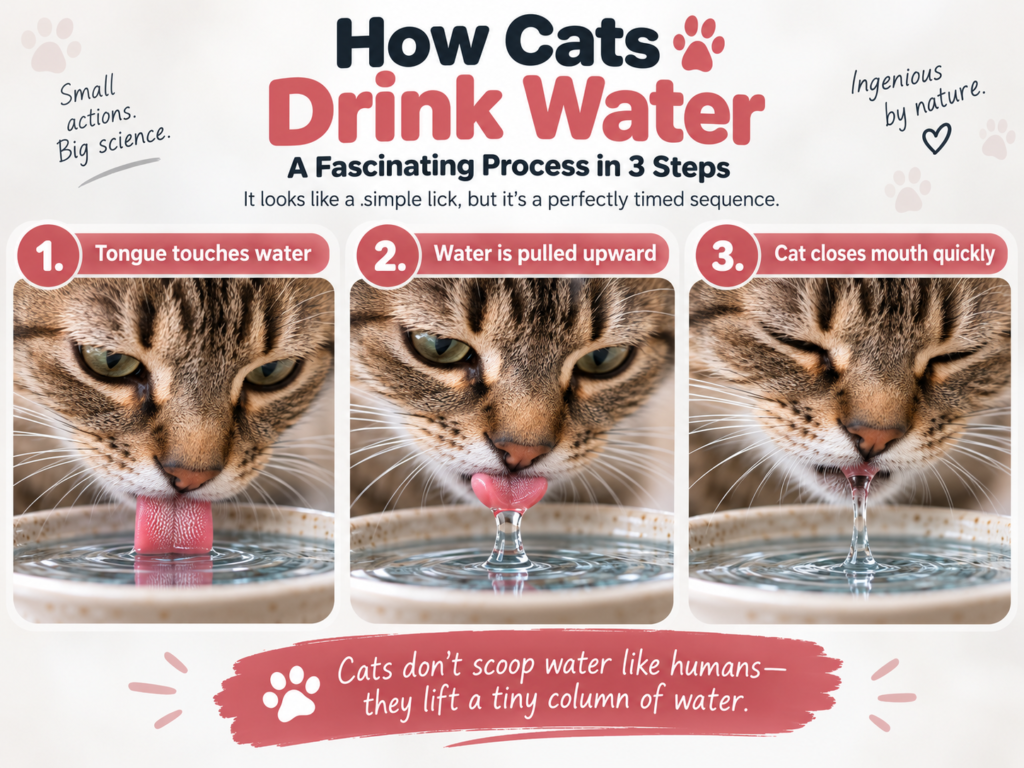
Unlike humans who scoop water into their mouths, cats use their tongue tip to create a water column.
The process happens quickly:
- The cat touches the water surface with the tongue.
- The tongue pulls water upward.
- The cat closes its mouth before gravity pulls the water down.
This method allows cats to drink efficiently while avoiding unnecessary splashing.
Why Cats Drink Differently From Dogs
Dogs often curl their tongues backward like a scoop.
Cats use a more controlled method because they are lighter, quieter hunters that evolved different movement patterns.
Cat Tongue vs Human Tongue
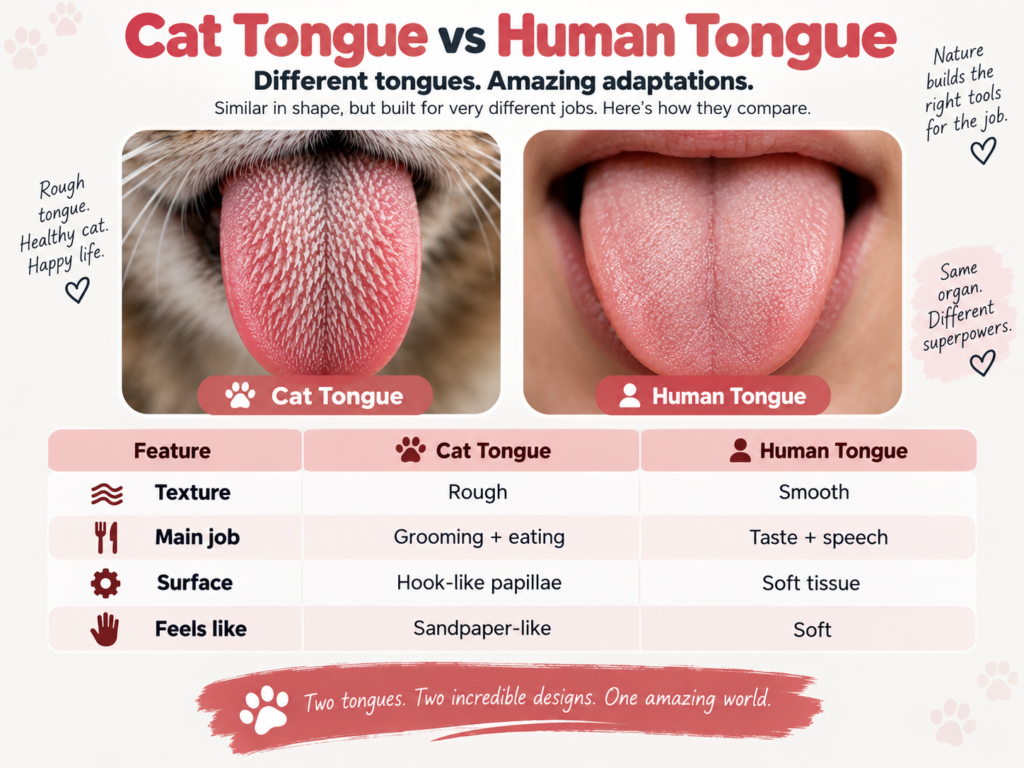
| Feature | Cat Tongue | Human Tongue |
|---|---|---|
| Surface | Rough with papillae hooks | Soft and flexible |
| Main purpose | Grooming, feeding, drinking | Taste, speech, swallowing |
| Keratin structures | Present | Not present in the same way |
| Grooming ability | Removes fur and debris | Cannot perform grooming |
A human tongue helps us communicate and taste food.
A cat tongue acts almost like a grooming tool.
Domestic Cat Tongue vs Lion and Tiger Tongue
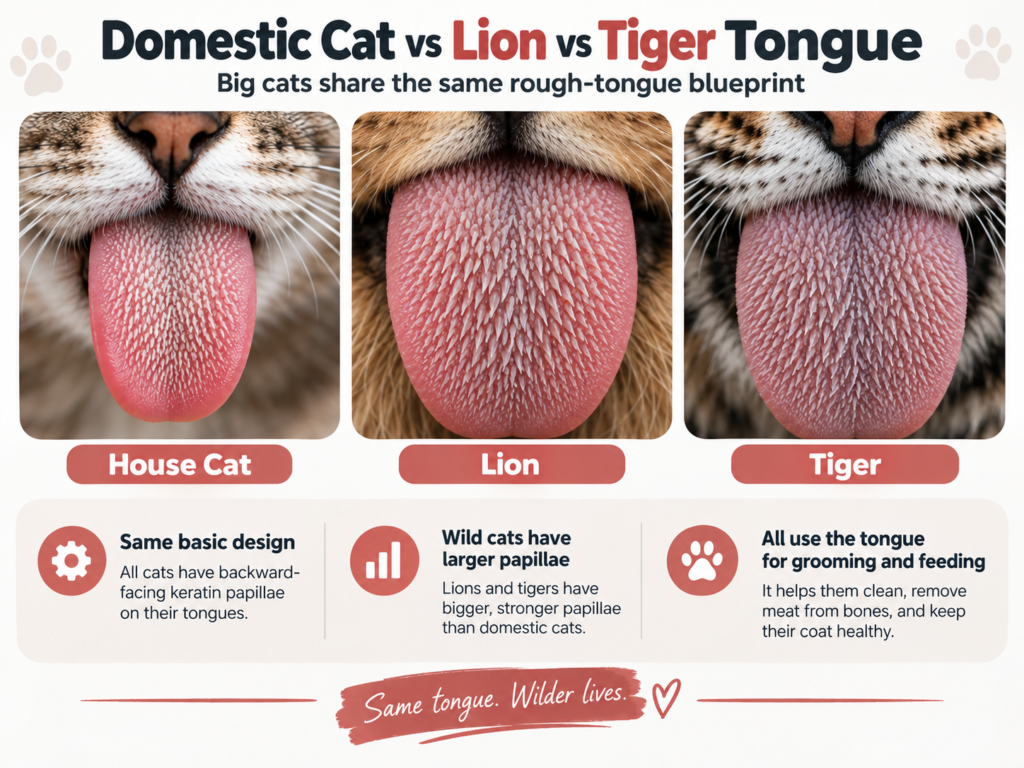
Domestic cats share many tongue features with larger wild cats.
| Animal | Tongue Characteristics |
|---|---|
| House cat | Rough tongue used for grooming |
| Lion | Strong papillae used for grooming and feeding |
| Tiger | Similar rough structure for removing meat and cleaning fur |
The biggest difference is size.
A tiger’s tongue has larger papillae because it needs to handle much larger prey.
Your house cat has the same basic design but in a smaller form.
Common Cat Tongue Problems and Warning Signs
A healthy cat tongue usually has:
- Pink color
- Moist surface
- Normal movement
- No unusual swelling
Changes may indicate a health issue.
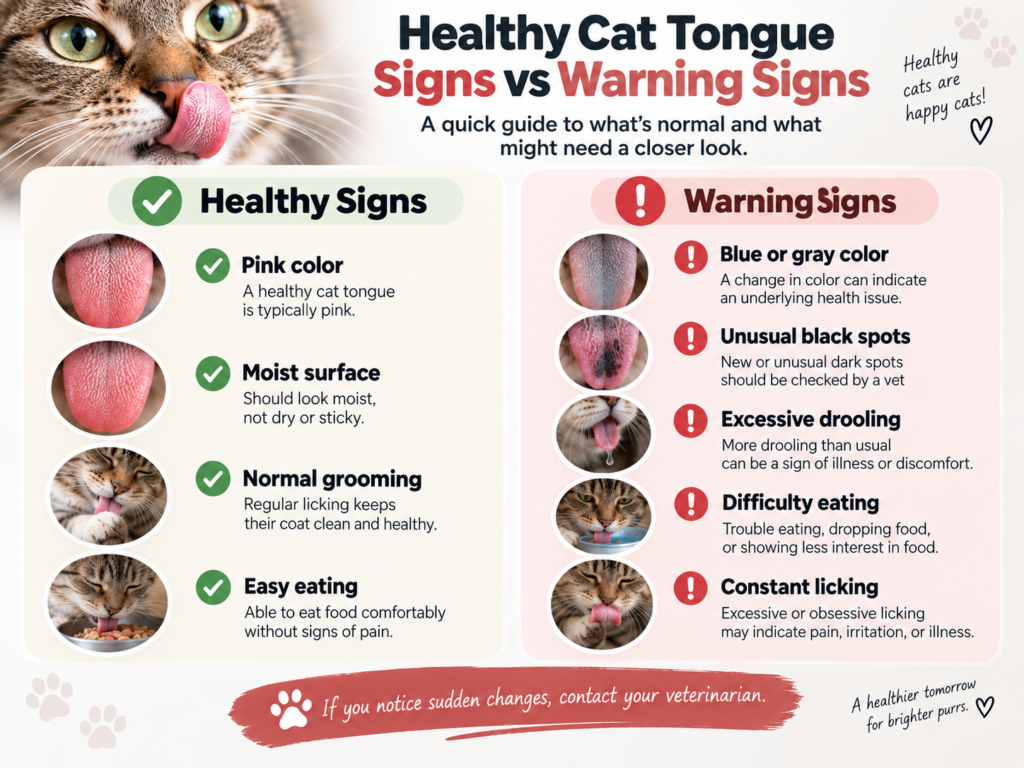
Warning Signs to Watch For
Contact a veterinarian if you notice:
Blue or Gray Tongue
This can indicate oxygen-related problems and requires professional attention.
Excessive Drooling
Possible causes include:
- Dental disease
- Mouth irritation
- Foreign objects
- Certain illnesses
Difficulty Eating
Watch for:
- Dropping food
- Chewing differently
- Avoiding meals
- Pawing at the mouth
Unusual Spots or Growths
Dark spots can sometimes be harmless pigmentation, but new or changing marks should be checked.
Why Does My Cat Lick Me?
Many cat owners wonder why their cat licks their hands, face, or hair.
Common reasons include:
Affection and Bonding
Cats often groom members of their social group.
When your cat licks you, it may be treating you like part of its family.
Seeking Attention
Some cats learn that licking gets a reaction from their owners.
Showing Comfort
A relaxed cat may lick as part of a friendly interaction.
Should You Let Your Cat Lick You?
Occasional licking is usually harmless, but avoid letting cats lick:
- Open wounds
- Sensitive skin areas
- Areas with creams or medications
Why Does My Cat Keep Licking Itself?
Normal grooming is healthy.
However, excessive licking can signal a problem.
Possible reasons include:
- Fleas
- Allergies
- Skin irritation
- Anxiety
- Pain
Example
If a cat repeatedly licks one specific leg, it may be trying to soothe discomfort in that area.
Cat Tongue Myths vs Facts
| Myth | Fact |
|---|---|
| A cat tongue is rough because it is dirty | The roughness comes from specialized papillae |
| Cats never need grooming help | Some cats need regular brushing |
| Cat saliva heals wounds | Saliva does not replace medical treatment |
| All licking is normal | Excessive licking may indicate a problem |
| Black spots always mean disease | Some pigmentation can be normal, but changes should be checked |
Common Mistakes Cat Owners Make
Ignoring Dental Care
A cat’s grooming ability does not protect it from dental problems.
Cats can still develop:
- Plaque
- Gum inflammation
- Tooth discomfort
Brushing Too Rarely
Even clean cats benefit from brushing because it reduces swallowed fur.
Assuming Excessive Licking Is Normal
Frequent licking should be observed carefully, especially if it focuses on one area.
Expert Tips for Cat Tongue and Mouth Health
Follow these simple habits:
✅ Brush your cat regularly
✅ Check the mouth during routine handling
✅ Provide fresh water daily
✅ Schedule veterinary checkups
✅ Pay attention to eating changes
✅ Never use human toothpaste on cats
Pro Tip
Getting your cat comfortable with gentle mouth checks while it is young can make future veterinary visits easier.
Frequently Asked Questions About Cat Tongues
Why does my cat tongue feel like sandpaper?
A cat tongue feels like sandpaper because of tiny keratin-covered papillae that help with grooming and eating.
What are the spikes on a cat tongue called?
They are called filiform papillae. These backward-facing structures help remove loose fur and clean the coat.
Why does my cat lick me?
Cats may lick people as a sign of affection, social bonding, comfort, or attention seeking.
Do cats clean themselves with their tongues?
Yes. Grooming is one of the main functions of a cat tongue.
Why does my cat lick itself constantly?
Excessive licking may be caused by stress, allergies, skin problems, fleas, or pain.
Why does my cat have black spots on its tongue?
Some cats naturally develop pigmentation spots. However, new, raised, or changing spots should be checked by a veterinarian.
Do lions have the same type of tongue as cats?
Yes. Lions, tigers, and domestic cats share similar tongue structures, although wild cats have larger papillae.
Can cats taste sweet flavors?
Most cats cannot taste sweetness the way humans do because their taste system is adapted for a meat-based diet.
Conclusion
A cat’s tongue is much more than a grooming tool. Its rough surface, tiny papillae, and unique movement show how perfectly cats have adapted to their environment.
From cleaning their fur to helping them eat and drink, this small organ performs several important jobs every day.
For cat owners, paying attention to changes in tongue appearance, grooming habits, and eating behavior can provide valuable clues about their pet’s health.
The next time your cat gives you a rough little lick, remember that you are feeling one of nature’s most specialized biological tools.