
Why Does My Cat Come to Me When I Cry? 7 Sweet Reasons
Have you ever started crying and suddenly found your cat sitting beside you, rubbing against your legs, or climbing into your lap? It can feel as though your cat knows exactly what you’re going through.
There may be something behind the behavior, but the explanation isn’t necessarily that your cat understands sadness the way another person would. Cats can notice changes in human voices and behavior, and research suggests they can respond to some human emotional cues. However, the evidence doesn’t show that cats identify human sadness with the same understanding we have of it.
So, why does my cat come to me when I cry? Your cat may be reacting to your unusual voice, body language, facial expression, or behavior. It may also be seeking familiar social contact or simply investigating something that has changed.
Table of Contents
- Why Does My Cat Come to Me When I Cry?
- 7 Reasons Your Cat Comes to You When You Cry
- Do Cats Know When You Are Sad?
- Why Does My Cat Cuddle Me When I’m Sad?
- How to Tell What Your Cat’s Behavior May Mean
- Why Doesn’t My Cat Come to Me When I Cry?
- Should You Encourage Your Cat to Comfort You?
- When Should You Be Concerned?
- Common Mistakes to Avoid
- Frequently Asked Questions
- Conclusion
Why Does My Cat Come to Me When I Cry?
Your cat may come to you when you cry because it notices that something about your usual behavior has changed. Crying can involve unusual sounds, facial expressions, posture, breathing, movement, and vocal tone. Cats are capable of responding to human voices and other social cues, although researchers are still working out exactly how much emotional information cats understand.
Your cat may also already associate you with safety, food, play, affection, or other positive experiences. If you become quiet or sit in one place while crying, your cat may simply decide that this is a good opportunity to approach you.
The important distinction is this: your cat may notice that something is different without understanding exactly why you’re crying.
7 Reasons Your Cat Comes to You When You Cry
1. Your cat notices the unusual sounds of crying
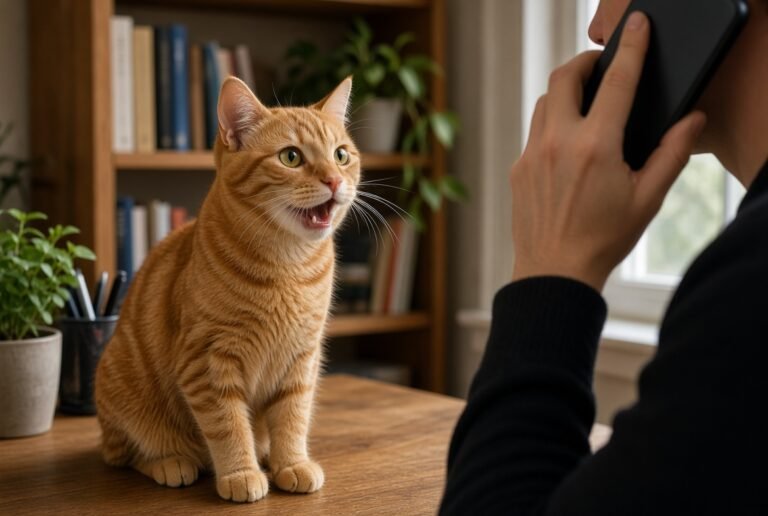
Crying sounds different from ordinary conversation. Your breathing may change, your voice may become quieter or higher-pitched, and you may make sounds your cat doesn’t normally hear.
That change alone can attract your cat’s attention.
Cats are highly responsive to sounds in their environment, and research has shown that they can distinguish familiar human voices from unfamiliar ones.
Your cat doesn’t have to understand the meaning of your tears to notice that your vocal behavior is unusual.
Example: If you normally speak at a steady volume but suddenly start sobbing, your cat may look toward you, approach, sniff you, or sit nearby because the sound is different.
2. Your cat recognizes your voice
Your cat knows more about your voice than you might realize.
Research involving domestic cats found that cats can distinguish their owner’s voice from unfamiliar human voices using vocal cues alone. The cats in that study often responded by orienting their ears or heads toward the sound.
That doesn’t mean your cat understands every word you say. It does mean your voice can carry information that is familiar and meaningful to your cat.
So when you’re crying, your cat may recognize who is making the unusual sound even if it doesn’t understand the reason behind it.
3. Your body language has suddenly changed
Cats don’t experience your crying through sound alone.
Think about what happens when you’re upset. You may:
- Sit or lie down differently
- Cover your face
- Become unusually still
- Move more slowly
- Change your facial expression
- Stop doing whatever you were doing before
- Speak differently
Your cat may notice these changes.
Research on cat-human communication suggests cats can respond to combinations of human social cues, including vocal and visual information. One study found evidence that cats can use their owner’s emotional signals when responding to an unfamiliar object, although the behavioral effects were not necessarily dramatic.
So your cat may be reacting to the overall change in you, rather than recognizing “sadness” as a specific human emotion.
4. Your cat may respond to some emotional cues
This is where things get interesting.
Research has found that cats show some sensitivity to human emotional cues, including facial, postural, and vocal information. But the evidence is much more limited than the popular idea that cats can simply “sense your emotions.”
A newer study examining cats’ responses to human emotional vocalizations found measurable changes in behavior and arousal, but did not find strong evidence that cats reliably distinguished specific emotions from vocalizations alone.
That means the safest explanation is:
Your cat may notice emotional or behavioral changes without necessarily understanding the specific emotion behind them.
This distinction keeps the behavior interesting without turning it into a human-like interpretation of your cat’s mind.
5. Your cat already has a social bond with you
Your cat may approach you during ordinary moments because you’re a familiar and trusted part of its environment.
If your cat normally:
- Follows you around
- Sleeps near you
- Rubs against you
- Sits beside you
- Greets you
- Seeks petting
- Comes when you call
then approaching you while you’re crying may simply fit an existing pattern of social interaction.
Your cat may not be thinking, “My person is sad, so I need to comfort them.”
It could be doing something much simpler: going to a familiar person during an unusual moment.
That doesn’t make the interaction meaningless. It just means we should be careful about assuming exactly what the cat is thinking.
6. Your cat is curious about the unusual behavior
Sometimes curiosity is the simplest explanation.
Imagine your cat is lying on the couch while everything is normal. Suddenly, you start crying. Your voice changes, your posture changes, and you’re behaving differently.
Your cat may come over to investigate.
It might sniff your face, stare at you, touch you with a paw, or sit nearby for a few seconds before walking away.
That doesn’t necessarily mean your cat is providing emotional comfort. It may simply be checking out something unusual in its environment.
Pro tip: Look at what your cat does after approaching you. A cat that investigates briefly and leaves may be showing curiosity, while a cat that settles beside you may be seeking or offering familiar social contact.
7. Your cat has learned that approaching you leads to interaction
Cats learn from repeated experiences.
Suppose your cat approaches you when you’re upset and you immediately pet it, talk to it, pick it up, or give it attention. Over time, approaching you during certain situations may become associated with social interaction.
This doesn’t mean your cat is manipulating you.
It’s normal learning.
The ASPCA notes that cats commonly meow and seek people for attention, social contact, food, and other needs. It also recommends looking at the circumstances surrounding vocal behavior rather than assuming every vocalization has the same meaning.
The same principle can apply to approaching behavior: what happens after your cat comes to you can influence whether it repeats the behavior.
Do Cats Know When You Are Sad?
Cats may notice that you are behaving differently when you’re sad or crying, but there is not enough evidence to say they understand sadness exactly as humans do.
This is an important distinction.
Studies have found that cats can distinguish familiar human voices and respond to certain human emotional or social cues. Some research also suggests cats can use information from their owners when deciding how to respond to something unfamiliar.
However, recognizing a change in your behavior is not the same as understanding the cause of that change.
Your cat may notice:
“My person’s voice sounds different.”
“My person is sitting strangely.”
“Something unusual is happening.”
That is different from:
“My person is experiencing sadness because of a specific event.”
We simply don’t have evidence to make that final leap.
Why Does My Cat Cuddle Me When I’m Sad?
If your cat climbs onto your lap, lies beside you, purrs, or rubs against you while you’re crying, it can certainly feel comforting.
There are several possible explanations.
Your cat may already enjoy close physical contact with you. Your quiet posture may make it easier to approach you. Your unusual behavior may attract its attention. Or your cat may have learned that being close to you leads to pleasant social interaction.
Purring can occur during positive social interactions, but it shouldn’t be treated as a perfect emotional indicator by itself. Look at the whole body-language picture instead.
A relaxed cat with loose muscles, a comfortable posture, normal ears, and voluntary proximity is giving you different information from a cat that is tense, flattened, hiding, or trying to move away.
The best approach is to let your cat choose the interaction.
How to Tell What Your Cat’s Behavior May Mean
No single behavior gives you a perfect translation of what your cat is feeling.
Instead, look at the pattern.
| What your cat does | What it may suggest |
|---|---|
| Comes over, sniffs you, then leaves | Curiosity or investigation |
| Rubs against your legs | Social contact or attention |
| Sits quietly beside you | Comfortable proximity |
| Climbs onto your lap voluntarily | Seeking familiar physical contact |
| Purrs while relaxed beside you | Often associated with positive interaction, but context matters |
| Watches you from a short distance | Monitoring something unusual |
| Approaches but becomes tense | Possible uncertainty or discomfort |
| Becomes more vocal and demanding | Attention-seeking or another unmet need |
These are possible interpretations, not a cat-emotion dictionary.
Context matters more than one isolated behavior.
Why Doesn’t My Cat Come to Me When I Cry?
Your cat not coming to you when you cry does not automatically mean your cat doesn’t care about you.
Cats vary enormously in how they interact with people.
Some cats enjoy sitting on laps. Others prefer staying a few feet away. Some follow their owners around the house but rarely cuddle. Others show their social bond through play, sleeping nearby, greeting behavior, or simply choosing to remain in the same room.
A cat that watches you from across the room may still be responding to you.
Don’t use cuddling as the only measurement of your relationship.
A better question to ask
Instead of:
“Does my cat comfort me?”
look at:
“Does my cat voluntarily choose to spend time around me?”
That gives you a much broader picture of the relationship.
Should You Encourage Your Cat to Comfort You?
You don’t need to train your cat to comfort you.
If your cat voluntarily approaches while you’re crying and you enjoy the contact, you can gently interact with it.
A simple approach is:
- Let your cat approach on its own.
- Watch its body language.
- Pet it if it appears comfortable.
- Stop if it tries to leave.
- Don’t force it to sit on your lap.
- Let the interaction happen naturally.
Your cat’s willingness to leave is just as important as its willingness to approach.
If your cat chooses to sit beside you rather than on you, that’s okay too.
When Should You Be Concerned?
Your cat coming to you when you cry isn’t, by itself, a sign of illness.
The bigger concern is a sudden change in your cat’s overall behavior.
Pay attention if your cat suddenly becomes much more vocal, withdrawn, restless, clingy, aggressive, or unusually quiet, especially if other changes appear at the same time.
For example, a sudden behavioral change accompanied by changes in eating, drinking, litter-box use, grooming, activity, or general behavior deserves attention.
The ASPCA notes that excessive or unusual vocalization can sometimes be associated with medical problems, particularly as cats age.
If your cat’s behavior has changed noticeably and you aren’t sure why, a veterinarian can help determine whether there is an underlying health issue.
Common Mistakes to Avoid
Assuming your cat understands exactly why you’re crying
Your cat may notice that something is different without knowing what caused it.
Treating every cuddle as proof of empathy
A cat can approach you for several reasons, including familiarity, curiosity, attention, or social contact.
Ignoring body language
Don’t focus only on whether your cat approaches. Look at its ears, posture, tail, facial expression, and willingness to stay.
Forcing your cat to cuddle
If your cat walks away, let it go. Voluntary interaction is better than forcing physical contact.
Assuming a distant cat doesn’t care
Some cats prefer proximity without physical contact. Social behavior varies between individuals.
Myth vs. Fact
| Myth | Fact |
|---|---|
| My cat definitely knows I’m sad. | Your cat may notice changes associated with crying, but we can’t assume it understands human sadness as we do. |
| My cat only comes to me because it feels sorry for me. | Comfort is one possible interpretation, but curiosity, familiarity, and social interaction are also possible. |
| A cat that doesn’t cuddle doesn’t love its owner. | Cats show social bonds in different ways. |
| Purring always means happiness. | Purring occurs in different situations, so context and body language matter. |
| Cats can’t recognize their owners’ voices. | Research indicates cats can distinguish familiar human voices from unfamiliar ones. |
Frequently Asked Questions
Why does my cat come to me when I cry?
Your cat may notice changes in your voice, posture, facial expression, movement, or routine. It may also approach because it seeks familiar social contact or wants to investigate unusual behavior.
Do cats know when you are sad?
Cats can notice and respond to some human social and emotional cues, but there isn’t enough evidence to say they understand sadness in the same way humans do.
Why does my cat cuddle me when I’m sad?
Your cat may already enjoy physical contact with you and may be responding to your changed behavior. It could also be seeking familiar social interaction. Cuddling doesn’t prove that your cat understands the reason you’re upset.
Can cats sense when you are crying?
Cats can notice the sounds and behavioral changes associated with crying. They may respond to those changes, but that doesn’t necessarily mean they understand why you’re crying.
Can cats smell tears?
There is not strong evidence that cats can specifically smell “sadness” in human tears. If your cat investigates your face while you’re crying, other changes in your scent, behavior, movement, or voice may also be involved.
Why doesn’t my cat come to me when I cry?
Some cats are less physically affectionate or prefer to observe from a distance. Your cat may still have a strong social bond with you without cuddling when you’re upset.
Does my cat love me if it comforts me?
No single behavior can prove a particular human emotion such as love. However, voluntarily seeking you out, relaxing around you, and choosing to spend time with you can all be consistent with a strong social relationship.
Can cats sense anxiety?
Cats may notice changes in your behavior, voice, routine, or body language when you’re anxious. That doesn’t mean they can diagnose anxiety or identify your exact emotional state.
Why does my cat stare at me when I cry?
Your cat may be monitoring an unusual situation. If your voice, posture, or behavior suddenly changes, watching you may simply be part of your cat’s response to something unfamiliar.
Why does my cat follow me after I start crying?
Your cat may be curious about the change in your behavior, seeking social contact, or responding to a familiar person who is behaving differently. Following you doesn’t necessarily mean your cat understands the reason you’re upset.
Conclusion
So, why does my cat come to me when I cry?
Your cat may be responding to the unusual sounds of crying, recognizing your voice, noticing changes in your posture or behavior, reacting to some emotional cues, seeking familiar social contact, or simply investigating something unusual.
Research gives us good reason to believe cats can recognize familiar human voices and respond to certain human social cues, but it doesn’t justify saying that cats understand human sadness exactly as people do.
That distinction doesn’t make the moment any less special.
If your cat chooses to come sit beside you when you’re having a difficult moment, you can enjoy the companionship without needing to decide exactly what is happening inside your cat’s mind. Sometimes a quiet cat beside you is comforting enough.