Why Does My Puppy Take Toys Into His Crate?
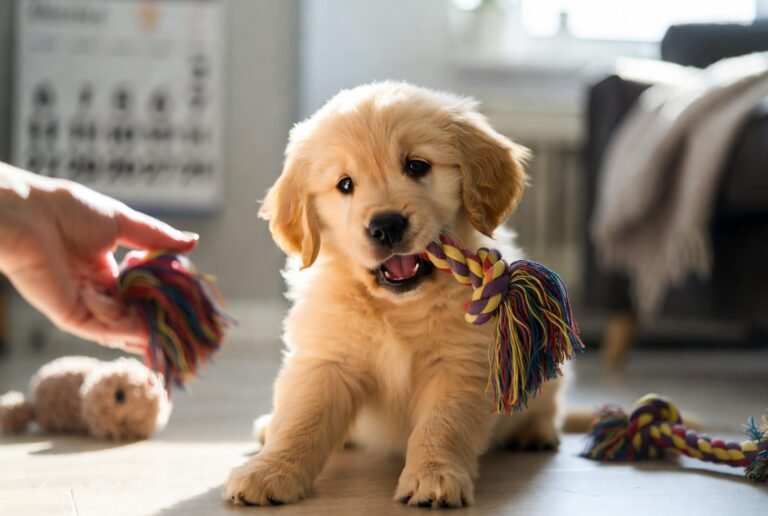
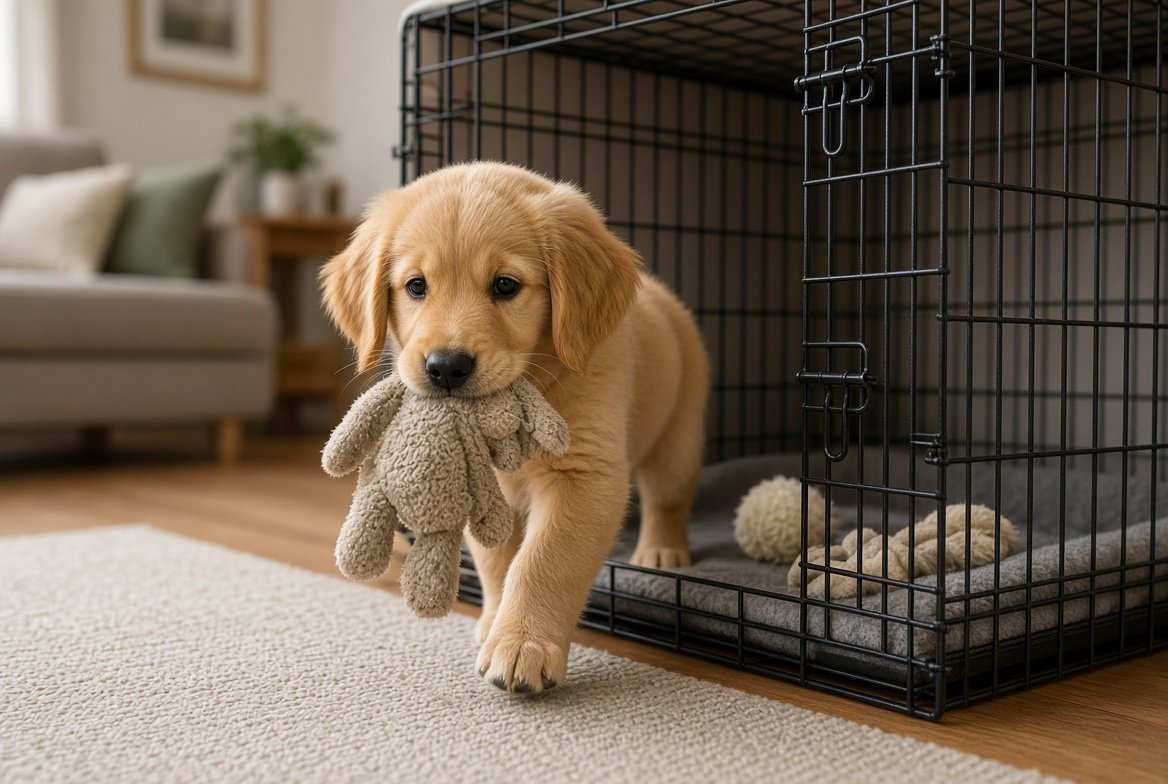
Your puppy grabs a toy, trots across the room, and disappears into the crate with it. A few minutes later, another toy joins the collection. Before long, the crate looks like your puppy’s personal toy box.
So, why does my puppy take toys into his crate?
Usually, there is nothing strange about it. A puppy may carry toys into the crate because it is a comfortable, predictable place to chew, play, rest, or keep something valuable nearby. Some puppies also collect or hide toys. The behavior becomes more important to watch if your puppy starts guarding those toys, destroying them, or swallowing pieces.
Quick Answer
A puppy may take toys into the crate because:
- The crate is a comfortable place to relax and chew.
- Your puppy wants to keep favorite toys nearby.
- The puppy has learned that toys belong in that space.
- The crate offers a quieter place away from people or other pets.
- Your puppy enjoys collecting or hiding objects.
- Certain toys are especially valuable or exciting.
- The behavior may occasionally be connected with resource guarding.
Taking a toy into the crate does not automatically mean your puppy is hiding it or guarding it. The surrounding behavior matters.
VCA recommends making the crate a positive place associated with relaxing experiences, including safe toys and chews. AKC also describes dogs carrying and collecting objects as a behavior that can range from harmless toy hoarding to a resource-guarding concern.
Table of Contents
- Why Does My Puppy Take Toys Into His Crate?
- 7 Common Reasons Your Puppy Carries Toys Into the Crate
- Is It Normal for a Puppy to Put Toys in His Crate?
- Is Your Puppy Carrying, Collecting, or Hiding Toys?
- Could This Be Resource Guarding?
- Should You Remove Toys From the Crate?
- How to Handle Toy Collecting Safely
- What Toys Are Safe for a Puppy’s Crate?
- Common Mistakes to Avoid
- Expert Tips
- Myth vs. Fact
- Frequently Asked Questions
- When to Get Professional Help
- Conclusion
7 Common Reasons Your Puppy Carries Toys Into the Crate
1. The Crate Has Become a Comfortable Place
If your puppy enjoys spending time in the crate, it makes sense that favorite toys may end up there too.
A properly introduced crate can become a predictable place for sleeping, resting, chewing, and quiet activities. VCA specifically recommends associating the crate with positive experiences and lists toys and chews among the things that can be offered there.
Your puppy may simply have discovered that the crate is a good place to settle down with a toy without being interrupted.
Example: Your puppy picks up a stuffed toy after playtime, walks into the open crate, lies down, and starts chewing. If the puppy is relaxed, there may be nothing concerning about the behavior.
2. Your Puppy Wants a Favorite Toy Nearby
Not every toy has the same value to a puppy.
One toy may be ignored while another is carried everywhere. A puppy might choose a particular stuffed animal, ball, chew toy, or tug toy and repeatedly bring that item into the crate.
This does not necessarily mean the puppy is trying to hide it. The toy may simply be especially rewarding or familiar.
Pro tip: Notice which toys your puppy repeatedly carries into the crate. The pattern can tell you more than the number of toys involved.
3. Your Puppy Has Learned a Toy-and-Crate Routine
Puppies learn through repetition.
If you regularly give your puppy a toy when it goes into the crate, your puppy can learn that the crate is where good things happen. Eventually, the puppy may start carrying toys there without any direction from you.
That is not necessarily a problem. In fact, positive associations can make crate training easier.
VCA recommends using treats, toys, and other positive experiences to help puppies adapt to their crates.
4. The Crate Gives Your Puppy a Quieter Place
A busy home can make it difficult for a puppy to settle.
Children may be playing, people may be walking around, or another pet may be nearby. Your puppy may carry a toy into the crate because that space offers a little more separation while still allowing the puppy to enjoy the toy.
VCA describes a crate or confinement area as a place where a dog can rest undisturbed and recommends placing it where the family still spends time rather than isolating the puppy completely.
Real-world scenario: If your puppy carries toys into the crate mostly when the house becomes busy, the environment may be part of the explanation.
5. Your Puppy Enjoys Collecting or Hiding Things
Some dogs naturally collect objects.
A puppy may carry several toys into one location, move them around, or tuck them under bedding or into a corner. AKC describes this type of behavior as hoarding and notes that dogs may gather toys and other objects in a particular place.
There is an important difference between collecting and guarding.
A puppy that happily lets you approach the crate and toys is behaving differently from one that stiffens, growls, snaps, or tries to prevent access.
If your puppy simply gathers toys and then goes about its day, there may be no safety issue.
6. Your Puppy Likes to Chew or Play in the Crate
Sometimes the explanation is straightforward: the crate is where your puppy likes to settle with a toy.
Puppies naturally investigate objects with their mouths, and appropriate chewing outlets are an important part of puppy management. AKC recommends giving puppies suitable chew toys and using appropriate toys as an alternative to household objects.
If your puppy carries a toy into the crate, lies down, and calmly chews it, the behavior may simply be part of the puppy’s normal play and settling routine.
7. Your Puppy May Be Developing Resource-Guarding Behavior
This is the reason that deserves the closest attention, but carrying toys into a crate by itself is not resource guarding.
Resource guarding involves protecting something valuable from another person or animal. AKC lists behaviors such as growling and other attempts to prevent access to prized possessions as warning signs.
Watch what happens when someone approaches the crate.
More relaxed behavior:
- Puppy stays loose and comfortable.
- Puppy allows you to approach.
- Puppy may continue chewing normally.
- Puppy can willingly leave the toy.
Potential guarding behavior:
- Body suddenly becomes stiff.
- Puppy freezes over the toy.
- Puppy growls when approached.
- Puppy snaps or lunges.
- Puppy tries to prevent another pet or person from coming near.
If you see guarding behavior, do not punish the puppy or repeatedly take the toy away by force.
Is It Normal for a Puppy to Put Toys in His Crate?
Yes. Taking toys into the crate can be normal puppy behavior, particularly when the puppy is relaxed and the crate has become a positive resting or activity area.
The behavior itself is less important than the context.
A puppy carrying one or two favorite toys into the crate, chewing them, and falling asleep is very different from a puppy frantically collecting objects and becoming aggressive when anyone approaches.
Think about three questions:
- What does your puppy do with the toys once they are inside?
- How does your puppy react when you approach?
- Are the toys safe for the puppy to have?
Those answers tell you whether this is simply a cute habit or something that needs attention.
Is Your Puppy Carrying, Collecting, or Hiding Toys?
These behaviors can look similar but are not exactly the same.
| Behavior | What you may see | What it may indicate |
|---|---|---|
| Carrying | Puppy takes one toy into the crate and plays with it | Normal play or settling |
| Collecting | Puppy repeatedly gathers several toys in one place | Toy-hoarding or a learned habit |
| Hiding | Puppy pushes toys under bedding or into corners | More deliberate hiding behavior |
| Guarding | Puppy protects toys from people or pets | Possible resource guarding |
There is no need to label every toy-carrying puppy as a hoarder. Look at the complete pattern.
AKC recommends observing the behavior and using positive training rather than creating conflict over objects.
Could This Be Resource Guarding?
It can be, but don’t assume it is.
A puppy can take a toy into the crate simply because the crate is comfortable. Resource guarding becomes a concern when the puppy actively protects the toy from someone who approaches.
Signs to watch for
Pay particular attention if your puppy:
- Freezes when you approach.
- Stiffens over the toy.
- Gives a hard stare.
- Growls.
- Snaps.
- Lunges.
- Attempts to bite.
- Guards the crate itself when a person or pet comes near.
AKC recommends teaching puppies to willingly give up toys through trades rather than forcefully removing valued objects.
Should You Remove Toys From the Crate?
Not automatically.
If the toy is appropriate, the puppy is relaxed, and there is no guarding or destructive behavior, there may be no reason to remove it simply because the puppy carried it into the crate.
The bigger question is whether the particular toy is suitable for unsupervised use.
Some puppies quickly destroy soft toys or chew pieces off them. VCA emphasizes that even recommended chew toys are not completely risk-free and advises supervision while puppies chew.
Remove or replace a toy if:
- Your puppy is tearing it apart.
- Pieces are coming loose.
- The puppy is swallowing pieces.
- The toy has become damaged.
- The toy contains parts your puppy can easily detach.
- The toy is not appropriate for unsupervised use.
How to Handle Toy Collecting Safely
If your puppy is collecting toys but remains relaxed, you generally don’t need to turn the behavior into a battle.
Instead, teach your puppy that giving up a toy can lead to something good.
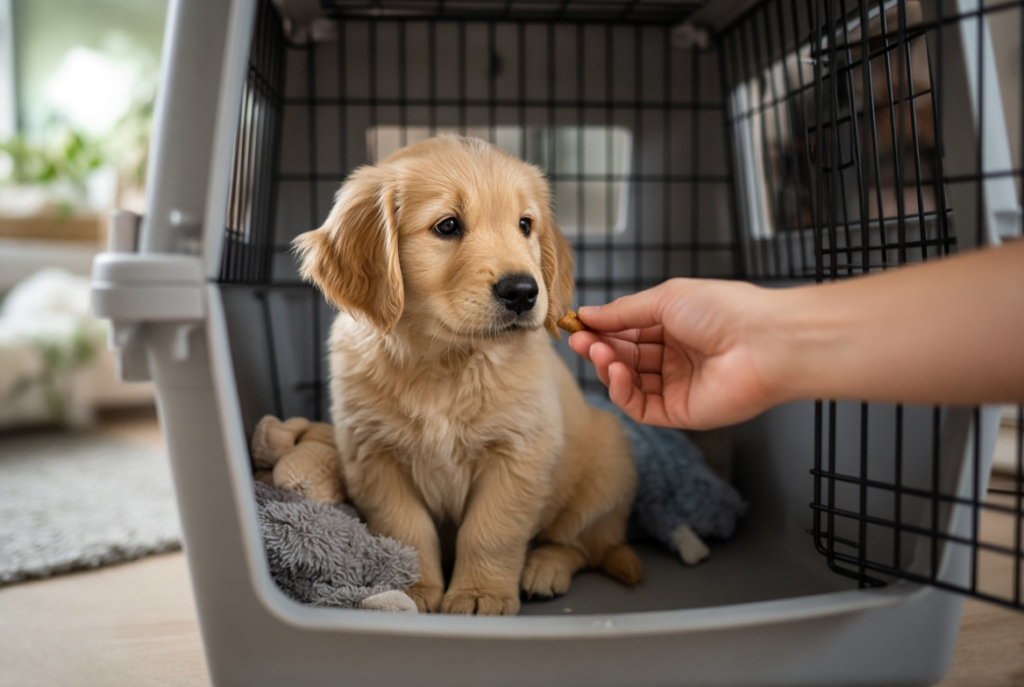
Teach a positive trade
- Let your puppy hold a toy.
- Offer a small, appealing treat.
- When the puppy releases the toy, reward immediately.
- Give the toy back when appropriate.
- Repeat during calm training sessions.
This teaches the puppy that releasing an item does not always mean losing it forever.
AKC specifically recommends trading toys for treats or other toys when teaching puppies to give up possessions.
Common mistake: Chasing a puppy around the house and forcibly grabbing every toy can turn toy removal into a game or create unnecessary conflict around possessions.
What Toys Are Safe for a Puppy’s Crate?
There is no single toy that is safe for every puppy.
The right choice depends on your puppy’s chewing style, age, size, and ability to destroy objects.
Look for toys that:
- Are appropriate for your puppy’s size.
- Do not have easily detachable pieces.
- Are not damaged or breaking apart.
- Are designed for chewing or appropriate play.
- Can be inspected regularly.
Avoid assuming that a toy is safe simply because it is sold as a dog toy.
VCA advises discussing chew-toy choices with your veterinarian and notes that puppies should be supervised even with recommended toys because no toy is completely risk-free.
What about stuffed toys?
Some puppies can enjoy stuffed toys safely, while others immediately tear them open.
If your puppy removes stuffing, chews through fabric, or tries to swallow squeakers or other parts, that toy should not be left unattended.
Common Mistakes to Avoid
Taking every toy away
If your puppy is calmly enjoying an appropriate toy, constantly removing it can create unnecessary conflict.
Assuming toy collecting means aggression
Collecting and resource guarding are not the same thing. Watch the puppy’s body language and reaction to people approaching.
Allowing damaged toys to remain available
A toy that was safe yesterday may become unsafe after your puppy tears it apart.
Using the crate as punishment
The crate should remain associated with positive, calm experiences. VCA specifically recommends positive reinforcement when helping a puppy adapt to confinement.
Ignoring guarding behavior
Growling, snapping, or lunging around toys should not simply be dismissed as a cute puppy habit.
Expert Tips
Watch the pattern, not one incident. A puppy carrying one toy into the crate tells you less than a repeated pattern of collecting, hiding, or guarding.
Notice the timing. If your puppy takes toys into the crate after play, before naps, or when the house gets busy, the context may explain the behavior.
Keep toy choices manageable. You do not need to leave every toy available all the time.
Teach trades early. A puppy that learns to release objects willingly is easier and safer to manage.
Inspect toys regularly. Replace toys when they become damaged or develop loose pieces.
Respect the crate as a resting space. Don’t repeatedly reach into the crate to take possessions from a relaxed puppy just because the toys are inside.
Myth vs. Fact
Myth: A puppy that takes toys into the crate is hiding them.
Fact: Not necessarily. Your puppy may simply prefer playing or chewing in the crate.
Myth: Toy collecting always means resource guarding.
Fact: Guarding involves protecting an item from people or animals. Simple carrying or collecting does not automatically mean guarding.
Myth: You should take toys away to teach your puppy who is in charge.
Fact: Forceful removal can create conflict around valued possessions. Positive trades are a better way to teach a puppy to release objects.
Myth: Every toy is safe to leave in the crate.
Fact: Puppies vary widely in how they chew and destroy toys. Damaged or easily destructible toys can create safety concerns.
Frequently Asked Questions
Why does my puppy collect toys in his crate?
Your puppy may enjoy having favorite toys in one comfortable, predictable location. Some dogs also show collecting or hoarding behavior, particularly with objects they value.
Why does my puppy hide toys in his crate?
If your puppy pushes toys under bedding or into corners, it may be deliberately hiding them. This is different from simply carrying a toy into the crate to chew or play.
Why does my puppy take his favorite toys into his crate?
The crate may be your puppy’s preferred place to settle with valued toys. If the puppy remains relaxed when approached, this is usually less concerning than behavior involving guarding.
Is it normal for a puppy to put toys in his crate?
Yes. It can be a normal part of playing, chewing, settling, or collecting. The important questions are whether the toys are safe and whether the puppy guards them.
Should I let my puppy keep toys in his crate?
You can allow appropriate toys when your puppy is comfortable with them and they are suitable for the level of supervision available. Damaged or easily destroyed toys should be removed.
Why does my puppy keep all his toys in one place?
Some dogs naturally collect valued objects in a preferred location. If that location happens to be the crate, the crate may simply have become the puppy’s chosen toy area.
Is taking toys into the crate a sign of resource guarding?
Not by itself. Resource guarding involves protecting possessions from people or animals, often through stiffening, growling, snapping, lunging, or other threatening behavior.
Should I take a toy away from my puppy if he carries it into the crate?
Not just because he carried it there. If you need the toy back, teach a positive trade rather than grabbing it forcefully.
Why does my puppy take toys into the crate and then sleep?
The crate may have become a comfortable place associated with rest and positive experiences. Puppies can learn to settle in their crates with appropriate toys and chews.
What should I do if my puppy growls when I approach his toys?
Don’t punish the growl or force the toy away. Growling is a warning signal that the puppy is uncomfortable. Because guarding can escalate, seek guidance from your veterinarian or a qualified behavior professional if your puppy is showing aggressive guarding behavior.
When to Get Professional Help
Toy collecting alone usually isn’t a reason to panic.
However, professional guidance is appropriate if the behavior includes:
- Growling or snapping around toys.
- Lunging when someone approaches the crate.
- Attempts to bite when a toy is approached.
- Repeatedly guarding the crate or other possessions.
- Swallowing toy pieces.
- Severe destructive chewing.
- A sudden and significant change in behavior.
If your puppy is showing resource guarding, don’t deliberately test the behavior by repeatedly taking toys away. A veterinarian can help determine whether you need a qualified behavior professional.
Conclusion
If your puppy keeps taking toys into his crate, the simplest explanation may be that the crate has become a comfortable place to enjoy favorite possessions.
The behavior can involve play, chewing, routine, collecting, or hiding. What matters most is what your puppy does once the toy is inside and how the puppy reacts when someone approaches.
A relaxed puppy that carries a toy into the crate and settles down is very different from a puppy that freezes, growls, snaps, or aggressively protects the toy.
Keep appropriate toys available, inspect them regularly, teach positive trades, and let the crate remain a calm and positive space. With those basics in place, your puppy’s little habit of taking toys to the crate may simply be one of those perfectly ordinary things puppies do.