Why Does My Puppy Carry Food Away From the Bowl? What to Know
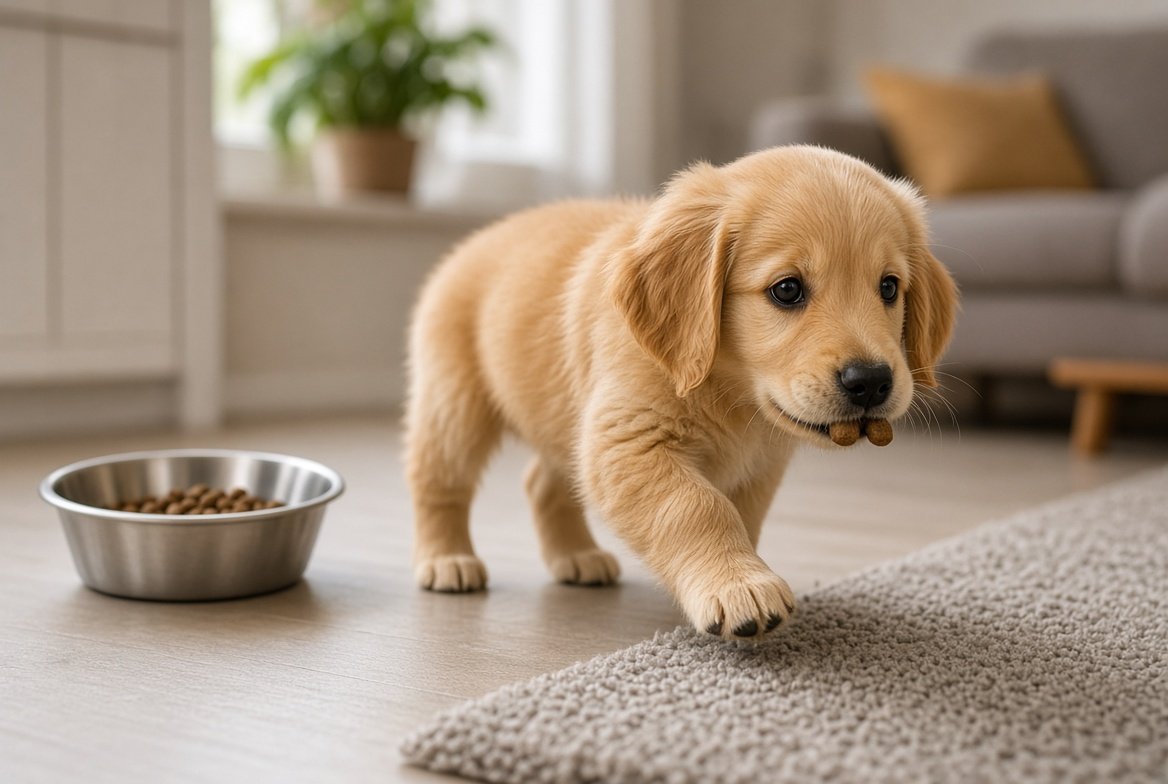
You put your puppy’s meal in the bowl, expecting them to eat normally. Instead, they grab a mouthful of kibble, walk across the room, drop it on the rug, and eat it there.
Then they return for another piece.
If you’re wondering, why does my puppy carry food away from the bowl?, the behavior can have several explanations. Your puppy may prefer a softer surface, dislike the bowl’s noise or movement, feel uncomfortable eating around another pet, want to stay close to you, or simply have developed a familiar mealtime routine.
The behavior itself is not automatically a problem.
What matters is what your puppy does after moving the food, where they take it, what happens around the bowl, and whether anything else about their appetite or behavior has changed.
Table of Contents
- Why Does My Puppy Carry Food Away From the Bowl?
- What Your Puppy’s Eating Pattern May Tell You
- Is Carrying Food Away Normal?
- 8 Reasons Your Puppy Moves Food From the Bowl
- The Feeding Area Feels Too Busy
- Your Puppy Prefers a Different Eating Spot
- Another Pet Makes Mealtime Uncomfortable
- The Bowl Makes Unpleasant Sounds
- The Bowl Moves While Your Puppy Eats
- Carrying Food Has Become a Mealtime Habit
- Your Puppy Wants to Stay Near You
- Eating Has Become Uncomfortable
- How to Tell Whether the Bowl Is the Problem
- A Simple 5-Minute Bowl Test
- What to Do When Your Puppy Eats Away From the Bowl
- Puppy Bowl Training: When and How to Change the Habit
- Common Feeding Mistakes to Avoid
- Myth vs. Fact
- Expert Tips for Better Puppy Mealtimes
- When Should You Call the Vet?
- Puppy Meal Routine Checklist
- Frequently Asked Questions
- Conclusion
Why Does My Puppy Carry Food Away From the Bowl?
The most common reasons are location preference, bowl discomfort, social pressure, learned habits, a desire for company, and possible discomfort while eating.
For example, a puppy that carries kibble from a noisy metal bowl to a quiet rug may have a bowl problem. A puppy that only moves food when another dog approaches may be reacting to social pressure. A puppy that has always carried food to the same spot and eats normally may simply have a preferred routine.
The American Kennel Club has also documented dogs carrying food from a bowl to softer surfaces such as carpet and notes that bowl noise, bowl type, and other dogs in the household can influence the behavior.
So before trying to stop your puppy, look at the pattern.
Where does the food go? When does your puppy move it? Who is nearby? Does your puppy eat normally afterward?
Those clues are usually more useful than the food carrying itself.
What Your Puppy’s Eating Pattern May Tell You
If you want a quick answer, start here.
| What you notice | What it may point to |
|---|---|
| Carries food away and eats normally | Preference or routine |
| Always goes to the same spot | Comfort or location preference |
| Moves food when another pet approaches | Social pressure or resource concern |
| Avoids the bowl but eats from the floor | Bowl-related issue |
| Reacts when the bowl makes noise | Bowl or collar/tag noise |
| Carries food but eats much less overall | Appetite, stress, or health issue |
| Drops food while chewing | Possible mouth or dental discomfort |
| Suddenly changes eating behavior | A new environmental or health issue |
These clues are not a diagnosis. They simply help you decide what to investigate first.
Example: If your puppy takes kibble to a rug, eats it calmly, and returns for more, there may be little cause for concern. If the puppy grabs food and runs whenever another dog enters the room, the social environment deserves more attention.
Is Carrying Food Away Normal?
It can be.
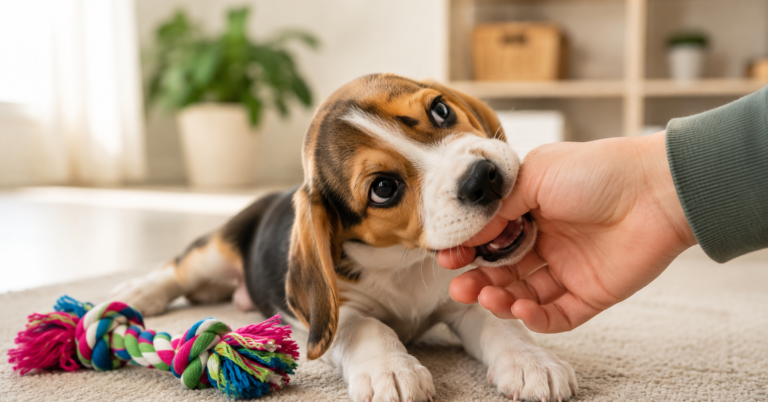
Some puppies develop unusual but harmless eating habits. They may take food out of the bowl, carry it a short distance, and eat it on a rug or in a quiet corner.
If your puppy is eating their normal amount, appears relaxed, has normal energy, and has always behaved this way, the habit may simply be part of their individual puppy eating habits.
That does not mean every food-carrying behavior should be ignored.
A sudden change is more meaningful than a habit that has been consistent since puppyhood. A puppy that previously ate normally but now avoids the bowl, drops food, eats much less, or appears uncomfortable needs a closer look.
The goal is not to make every puppy eat in exactly the same way. The goal is to make sure the puppy can eat safely and comfortably.
8 Reasons Your Puppy Moves Food From the Bowl
1. The Feeding Area Feels Too Busy
Your puppy may not dislike the food or bowl at all. They may simply dislike the place where you have put it.
A bowl beside a busy doorway means people may walk past while your puppy eats. A kitchen can contain appliances, footsteps, dishes, and other distractions. A bowl near another pet’s feeding area can make mealtime feel less private.
Some dogs also prefer eating where they can see what is happening around them rather than being isolated.
Try this: Move the bowl to a quiet, low-traffic area and keep the rest of the setup the same. See whether your puppy starts eating more directly from the bowl.
Real-world example: Your puppy carries every piece of kibble from the kitchen to the living-room rug. After moving the bowl to a quieter corner, the carrying decreases. That points toward the feeding environment rather than the food itself.
2. Your Puppy Prefers a Different Eating Spot
Sometimes your puppy simply likes another surface or location.
A rug may feel more comfortable under their paws than a hard floor. A corner may feel more private. Your puppy may also have learned that a particular place is where they enjoy eating.
The American Kennel Club has described dogs taking food from bowls onto carpet or towels, which shows that this behavior is not necessarily limited to puppies with a feeding problem.
If your puppy calmly carries food to the same place every time and eats normally there, you may not need to correct the behavior at all.
Ask yourself whether the habit actually creates a problem.
If the only downside is a few crumbs on the rug, management may be easier than trying to change a harmless preference.
3. Another Pet Makes Mealtime Uncomfortable
A puppy may carry food away because another dog or cat is nearby.
This can happen even if the other animal never steals the food. Watching, approaching, hovering, or simply being too close can create social pressure around a valuable resource.
The effect can be especially noticeable in homes with multiple dogs.
Example: Your puppy eats from the bowl normally until your older dog walks into the kitchen. The puppy grabs a mouthful and runs behind the sofa.
In that situation, the other dog is an important clue.
Try feeding pets separately, using different areas or rooms when necessary. Puppies that have been raised around littermates may also have learned to eat quickly because of competition for food; veterinary behaviorist Megan Maxwell describes this pattern in puppies in her discussion of food guarding.
If your puppy becomes stiff, freezes, growls, snaps, or aggressively protects food, treat that as a separate resource-guarding concern rather than ordinary food carrying.
4. The Bowl Makes Unpleasant Sounds
Some puppies dislike the sound their bowl makes while they eat.
A metal bowl may clang when kibble hits the bottom. A puppy’s collar tag can also strike the bowl while they lower their head.
Your puppy may discover an easy solution: pick up the food and eat somewhere the annoying sound disappears.
The AKC has specifically described a dog avoiding a stainless-steel bowl because a metal collar tag made a clanging noise against it.
Try this: Watch your puppy closely for one meal.
Does the puppy hesitate when their tag touches the bowl? Do they eat happily once the food is on the floor? Does the carrying decrease with a quieter bowl?
If yes, test a stable bowl made from a different material.
Do not change the food at the same time. You want to know whether the bowl was actually responsible.
5. The Bowl Moves While Your Puppy Eats
A lightweight bowl can slide across a smooth floor every time your puppy takes a bite.
For a puppy, that movement can be irritating or confusing. Instead of chasing the bowl around, they may simply take the kibble somewhere stable.
This is one of the easiest puppy food bowl problems to test.
Place the same meal in a bowl that stays firmly in place. If your puppy begins eating directly from it, the original bowl may have been the issue.
Common mistake: Changing the food immediately because your puppy is not eating directly from the bowl.
Before replacing a perfectly acceptable diet, check whether the bowl is stable, comfortable, and positioned appropriately.
6. Carrying Food Has Become a Mealtime Habit
Sometimes there is no obvious trigger.
Your puppy may have carried a few pieces away one day, discovered that the rug was comfortable, and repeated the behavior at every meal.
Over time, carrying food becomes part of the puppy’s routine.
This is particularly likely when the puppy:
- Always chooses the same location
- Remains relaxed while carrying food
- Eats the food normally
- Returns to the bowl for more
- Shows no signs of fear or guarding
In this situation, the behavior may be more habit than problem.
If you want to change it because of mess or convenience, make the bowl location more appealing rather than punishing the puppy for carrying food.
7. Your Puppy Wants to Stay Near You
Not every puppy wants to eat alone.
Some puppies prefer bringing food closer to their owners. If your puppy consistently carries kibble toward the room where you are sitting, your presence may be part of the pattern.
Veterinary-reviewed guidance also lists social companionship as one possible reason dogs carry food away from their bowls.
This can be easy to test.
Move the bowl closer to where you normally spend time and observe whether your puppy still carries food away.
If the behavior changes when the bowl is nearby, location and social comfort may have been more important than the bowl itself.
8. Eating Has Become Uncomfortable
A change in eating behavior can sometimes have a physical explanation.
If your puppy carries food away but eats it comfortably, that alone does not indicate illness. But if the puppy suddenly changes how they eat, repeatedly drops kibble, chews differently, drools excessively, seems reluctant to eat, or shows other signs of discomfort, do not assume it is just a bowl preference.
Possible warning signs include:
- Reduced appetite
- Difficulty chewing
- Dropping food repeatedly
- Excessive drooling
- Pawing at the mouth
- Vomiting or diarrhea
- Unusual tiredness
- Weight loss
- Obvious discomfort while eating
The American Kennel Club advises contacting a veterinarian when a dog’s appetite changes significantly, with young puppies warranting particular attention if they miss a meal or have a noticeable decrease in appetite.
The key point is the change from your puppy’s normal behavior, not simply the fact that they carry food.
How to Tell Whether the Bowl Is the Problem
Before changing your puppy’s food, work through these five checks.
Check 1: Location
Is the bowl in a busy walkway, beside a noisy appliance, or near another pet?
Check 2: Stability
Does the bowl slide, tip, or rattle when your puppy eats?
Check 3: Sound
Does the bowl or your puppy’s collar make a noticeable noise?
Check 4: Surface
Does your puppy consistently prefer carpet, a mat, or another softer surface?
Check 5: Social Environment
Does the behavior happen mainly when another pet or person is nearby?
If changing one of these factors makes a noticeable difference, you have a useful clue about the cause.
A Simple 5-Minute Bowl Test
If your puppy carries kibble away from the bowl, you can test the setup without turning mealtime into a training battle.
Test 1: Change the Location
Move the bowl to a quiet area.
Test 2: Stabilize the Bowl
Use a bowl that does not slide easily.
Test 3: Reduce Noise
Try a quieter bowl if your puppy reacts to clanging or rattling.
Test 4: Remove Competition
If another pet is involved, feed the animals separately.
Test 5: Compare the Behavior
Watch whether your puppy still carries the food away.
Change one factor at a time when possible. Otherwise, you may fix the problem without knowing what actually helped.
What to Do When Your Puppy Eats Away From the Bowl
If your puppy is eating normally and there are no concerning signs, start with simple management.
- Observe the pattern before correcting it.
- Move the bowl to a calmer location if necessary.
- Make sure the bowl is stable.
- Test whether bowl noise is bothering your puppy.
- Feed other pets separately when competition is possible.
- Keep mealtimes predictable.
- Allow your puppy enough space to eat peacefully.
- Monitor appetite and general behavior.
Do not immediately change the food simply because your puppy carries it away.
If the puppy takes the same food out of the bowl and happily eats it elsewhere, the bowl or environment may be more relevant than the food.
Puppy Bowl Training: When and How to Change the Habit
If the behavior is harmless but inconvenient, you can encourage your puppy to stay closer to the bowl.
Start by making the bowl area comfortable rather than making the puppy feel that carrying food is wrong.
Keep the bowl in a quiet place, make sure it does not slide, and avoid unnecessary interruptions during meals.
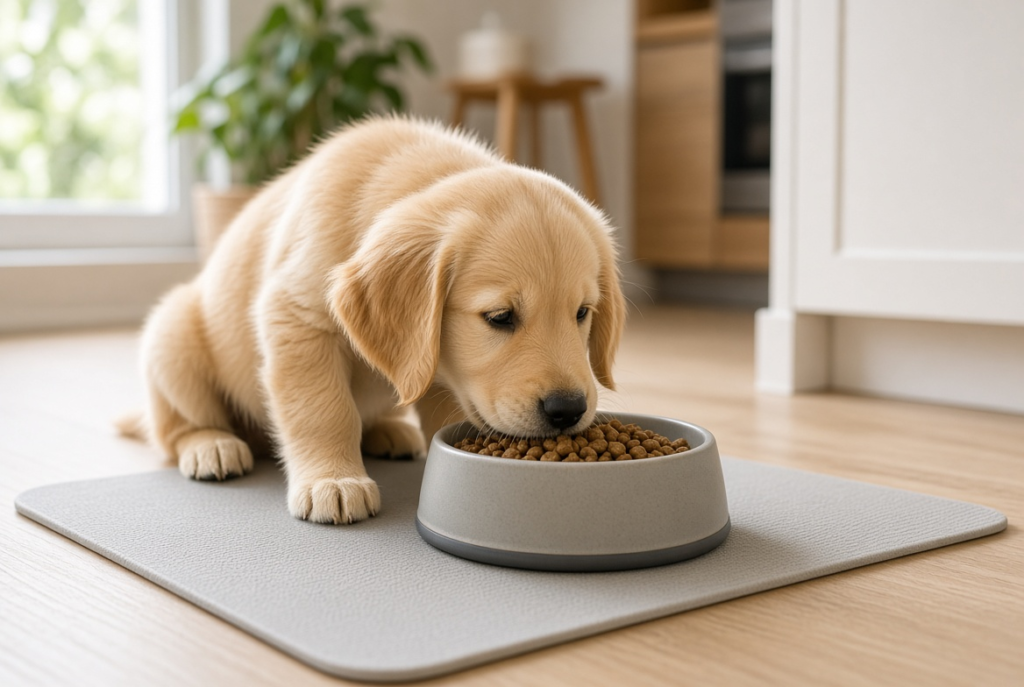
You can also make the preferred eating surface part of the solution. If your puppy loves eating on a mat, for example, place the stable bowl on or beside an easy-to-clean mat and gradually encourage eating there.
The goal of puppy bowl training is not to force perfect behavior. It is to create a setup your puppy willingly uses.
What About Food Guarding?
This deserves a separate distinction.
Simply carrying food away does not prove that a puppy is resource guarding.
Resource guarding can include behaviors such as freezing, stiffening, hard staring, eating faster when someone approaches, growling, showing teeth, snapping, or biting. The American Veterinary Society of Animal Behavior describes food guarding as a continuum that can range from subtle tension to overt aggression.
If your puppy is already showing aggression around food, do not deliberately take food away or repeatedly disturb the puppy to “teach” them a lesson.
AVSAB specifically warns that repeatedly taking food away from an eating dog can create perceived competition and potentially increase defensive behavior.
For a puppy showing genuine guarding or aggression, professional behavior guidance is safer than experimenting with increasingly intrusive exercises.
Common Feeding Mistakes to Avoid
1. Taking the Bowl Away to Test Your Puppy
Repeatedly removing food can create competition around the bowl rather than preventing it.
2. Assuming Food Carrying Means Guarding
Look for the complete body-language picture before labeling the behavior.
3. Changing the Food First
Check the bowl, location, surface, and other pets before assuming your puppy dislikes the food.
4. Feeding Multiple Pets Too Close Together
Even friendly animals can create pressure around meals. Separate feeding areas can make mealtimes calmer.
5. Punishing Your Puppy for Carrying Food
Punishment does not identify the reason for the behavior and can make feeding interactions more stressful.
Myth vs. Fact
| Myth | Fact |
| Carrying food away always means resource guarding. | It can have several explanations, including bowl preference, location, social pressure, and habit. |
| Taking the bowl away prevents guarding. | Repeatedly taking food away can create perceived competition and may increase defensive behavior. |
| Moving food means the puppy dislikes the food. | A puppy may like the food but dislike the bowl, location, noise, or social environment. |
| Every unusual eating habit needs correction. | A harmless, consistent habit may not need changing if the puppy eats normally and remains comfortable. |
Expert Tips for Better Puppy Mealtimes
Look at the whole meal. One piece of kibble does not tell you much. Watch what happens from the moment you put the bowl down until your puppy finishes.
Change one variable at a time. A different bowl, different food, and different location all at once make troubleshooting difficult.
Give your puppy space. Peaceful meals are especially important if another pet is creating competition.
Do not confuse preference with a problem. If your puppy calmly eats on a rug and there are no health or behavior concerns, the habit may not require intervention.
Watch for changes. A puppy that suddenly starts eating differently deserves more attention than one that has always carried food away.
Take guarding seriously. If your puppy freezes, stiffens, growls, snaps, or bites around food, seek qualified professional help rather than testing the behavior yourself.
When Should You Call the Vet?
If you are asking why does my puppy carry food away from the bowl all of a sudden, the word “suddenly” matters.
A long-standing habit in an otherwise healthy puppy is different from a new change accompanied by appetite loss or discomfort.
Contact your veterinarian if your puppy:
- Suddenly eats much less
- Refuses food
- Seems interested in food but struggles to eat it
- Repeatedly drops food while chewing
- Has excessive drooling
- Shows mouth discomfort
- Vomits or has diarrhea
- Becomes unusually tired
- Loses weight
- Shows other significant changes in normal behavior
For puppies, appetite changes deserve particular attention. AKC guidance notes that young puppies with a missed meal or decreased appetite may warrant contacting their veterinarian promptly, especially when other symptoms are present.
If the behavior involves aggression around food, seek veterinary or qualified behavior support rather than attempting to correct guarding through confrontation or punishment.
Puppy Meal Routine Checklist
Before changing your puppy’s feeding setup, ask:
- Does my puppy eat the normal amount?
- Is the puppy relaxed while eating?
- Is the bowl stable?
- Does the bowl make noise?
- Is the feeding area quiet?
- Does my puppy prefer a particular surface?
- Are other pets nearby?
- Does my puppy always carry food to the same place?
- Is the behavior new?
- Does my puppy drop food while chewing?
- Are there signs of mouth discomfort?
- Is there any growling, stiffening, or snapping around food?
The answers can help you separate an unusual but harmless puppy feeding behavior from a problem that needs attention.
Frequently Asked Questions
Why does my puppy carry food away from the bowl?
Your puppy may prefer another eating location, dislike the bowl’s sound or movement, feel uncomfortable around another pet, want to stay near you, or have developed the habit over time. If they eat normally and remain relaxed, the behavior may simply be an individual preference.
Why does my puppy carry kibble away and eat it on the floor?
The floor or another surface may feel more comfortable than the bowl area. Bowl noise, movement, location, or surface preference can all play a role. The AKC has documented dogs moving food from bowls onto carpet and other soft surfaces.
Why does my puppy move food when another dog is nearby?
Your puppy may feel social pressure around the other dog, even if that dog never actually steals food. Separate feeding spaces can reduce competition and give each puppy or dog room to eat comfortably.
Could carrying food away mean my puppy is resource guarding?
Not by itself. Carrying food is not enough to identify resource guarding. Look for additional signs such as freezing, stiffening, hard staring, growling, snapping, or aggressive behavior when someone approaches the food.
Should I stop my puppy from carrying food away?
Not necessarily. If your puppy eats normally, remains relaxed, and the habit does not create a problem, there may be no need to stop it. If the behavior causes a mess or appears linked to the bowl, adjust the feeding setup first.
Should I change my puppy’s food?
Not automatically. First investigate the bowl, feeding area, noise, movement, surface, and other pets. If your puppy happily eats the same food after carrying it away, the food itself may not be the issue.
Why did my puppy suddenly start carrying food away?
A new behavior can follow a change in the feeding area, household, routine, bowl, social environment, or health. If appetite or general behavior has changed too, speak with your veterinarian.
Why does my puppy drop food while chewing?
Repeatedly dropping food can have several explanations, including difficulty handling the food or mouth discomfort. If it is new, frequent, or accompanied by drooling, reluctance to eat, or other signs of discomfort, have your puppy checked by a veterinarian.
Is it okay for my puppy to eat somewhere other than the bowl?
If your puppy is eating safely and normally, the location itself may not be a problem. However, you should make sure the chosen area is clean, safe, and free from hazards or opportunities for the puppy to eat inappropriate objects.
When should I worry about my puppy’s eating behavior?
Pay closer attention when food carrying is accompanied by reduced appetite, difficulty chewing, vomiting, diarrhea, unusual tiredness, weight loss, obvious discomfort, or a sudden major change in normal behavior. Young puppies with appetite changes may need prompt veterinary advice.
Conclusion
So, why does my puppy carry food away from the bowl?
Often, the answer is surprisingly ordinary. Your puppy may prefer a different surface, dislike a noisy or unstable bowl, feel uncomfortable around another pet, want to stay close to you, or simply have developed a familiar mealtime habit.
The behavior itself tells you only part of the story.
Pay attention to where your puppy takes the food, what happens around the bowl, how your puppy behaves while eating, and whether anything else has changed.
If your puppy calmly carries kibble to the same spot and finishes the meal, there may be nothing that needs fixing. If the behavior is sudden, accompanied by reduced appetite or discomfort, or involves growling and other guarding behaviors, take it more seriously.
The best feeding routine is not necessarily the one where every piece of food stays inside the bowl.
It is the one where your puppy can eat comfortably, safely, and without unnecessary stress.