Why Does My Puppy Sit Down During Walks? 9 Common Causes
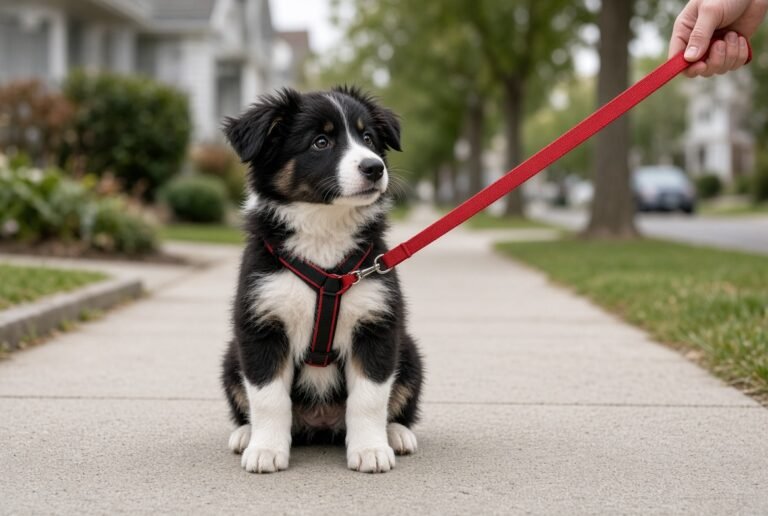
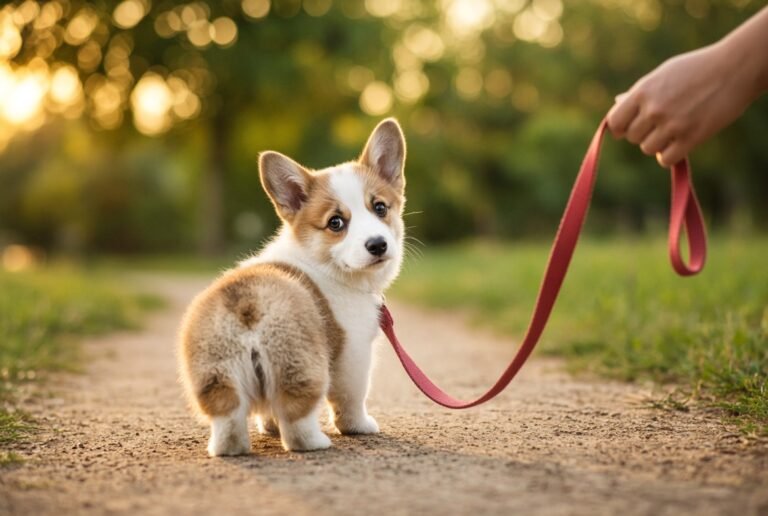
You clip on the leash, step outside, and your puppy suddenly sits down like they have decided the walk is over before it has even started.
If you are asking, “Why does my puppy sit down during walks?”, you are certainly not alone. Puppies are not born knowing how to walk on a leash, and the outside world can be surprisingly overwhelming when everything is new.
The important part is not simply that your puppy stopped. It is why they stopped.
A puppy that sits immediately after the leash goes on may need more leash training. One that freezes when a truck passes could be frightened. Another that walks happily for ten minutes before sitting may simply be tired. And if a puppy suddenly refuses to walk when they previously had no problem, discomfort or illness should not be overlooked.
Once you learn to read the pattern, those confusing stops become much easier to understand.
Table of Contents
- Why Does My Puppy Sit Down During Walks?
- The Quickest Way to Figure Out Why Your Puppy Stops
- 9 Reasons Your Puppy Sits Down During Walks
- The Leash or Harness Feels Unfamiliar
- The Outside World Is Overwhelming
- Something Outside Is Scaring Your Puppy
- Your Puppy Is Tired
- The Walking Surface Feels Strange
- Your Puppy Wants to Sniff and Explore
- A Specific Trigger Keeps Causing the Stop
- Stopping Has Become a Learned Pattern
- Walking Is Uncomfortable or Painful
- Scared, Tired, or in Pain? How to Tell
- What to Do When Your Puppy Refuses to Keep Walking
- What Not to Do When Your Puppy Freezes
- Puppy Leash Training Tips
- How to Make First Puppy Walks Easier
- Common Mistakes
- Myth vs. Fact
- Expert Tips
- When Should You Call the Vet?
- Puppy Walking Checklist
- Frequently Asked Questions
- Conclusion
Why Does My Puppy Sit Down During Walks?
The most common reasons a puppy stops walking are leash unfamiliarity, overstimulation, fear, fatigue, unfamiliar surfaces, curiosity, environmental triggers, learned patterns, and physical discomfort.
So, if you are wondering why does my puppy sit down during walks when they seem perfectly happy at home, start by looking at the circumstances surrounding the behavior.
Ask yourself:
- Did the puppy stop as soon as the leash was attached?
- Did something happen immediately before they sat down?
- Was another dog, person, vehicle, or loud noise nearby?
- Had the puppy already been walking for several minutes?
- Did the surface change from grass to pavement?
- Does the same thing happen in the same location?
- Is your puppy showing any signs of pain or unusual behavior?
Those details can tell you much more than the sitting itself.
Puppies are still learning how to navigate the world, and leash walking is a skill that needs to be taught rather than expected automatically. The American Kennel Club recommends beginning leash work gradually, including practice indoors before progressing to outdoor environments.
The Quickest Way to Figure Out Why Your Puppy Stops
The timing of the stop is one of your best clues.
| When your puppy stops | What to investigate |
|---|---|
| Immediately after the leash goes on | Equipment or leash training |
| As soon as you leave home | Outdoor stimulation or uncertainty |
| When a particular person, dog, or vehicle appears | Fear or a specific trigger |
| After several minutes | Fatigue or overstimulation |
| On one particular surface | Unfamiliarity or discomfort |
| Near an interesting smell | Exploration |
| Suddenly after previously normal walks | Pain, illness, or a new fear |
For example, if your puppy walks happily through the garden but freezes every time a motorcycle passes, the motorcycle is a much more useful clue than the fact that the puppy sat down.
Likewise, if your puppy walks normally for several minutes and then repeatedly sits, fatigue becomes more worth considering.
This is not a diagnosis. It is simply a practical way to decide what to investigate first.
9 Reasons Your Puppy Sits Down During Walks
1. The Leash or Harness Feels Unfamiliar
If you are wondering why does my puppy sit down during walks immediately after leaving the house, start with the equipment.
Puppies do not automatically understand what a leash is supposed to do. A collar, harness, or leash can feel strange, restrictive, or distracting, especially when the puppy has only recently started wearing it.
Some puppies respond by sitting. Others back away, chew the leash, pull backward, or refuse to take even one step.
The solution is to make the equipment familiar before expecting a proper walk.
Start indoors. Let your puppy investigate the leash, reward calm behavior, and practice following you for just a few steps. Once that feels easy, move to a quiet outdoor area.
Try this: Attach the leash indoors, take two or three steps, reward your puppy for following, and stop. Repeat several times rather than immediately trying to walk around the block.
The AKC similarly recommends introducing leash walking gradually, beginning in familiar surroundings and keeping early sessions positive.
2. The Outside World Is Overwhelming
Home is predictable. The street is not.
A puppy walking outside may suddenly encounter cars, bicycles, barking dogs, unfamiliar people, traffic sounds, strong smells, construction noise, strange buildings, and different surfaces.
For an inexperienced puppy, that can be a lot to process at once.
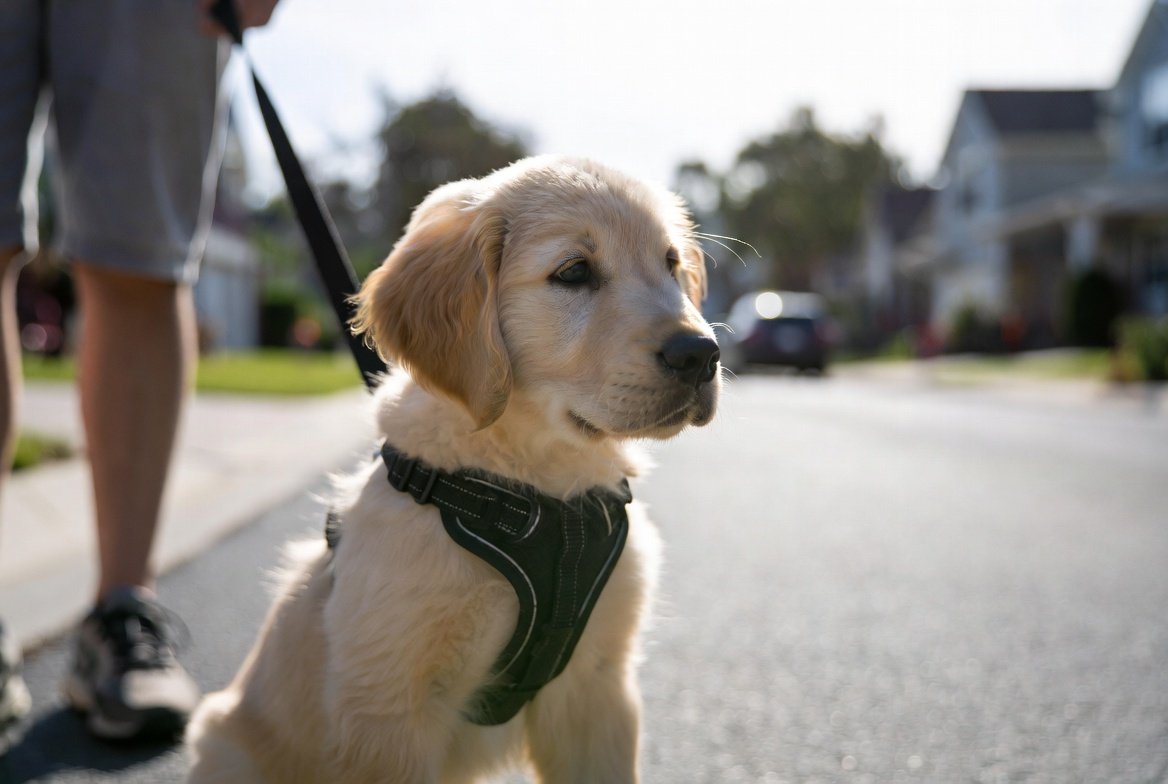
If you are asking why does my puppy sit down during walks after leaving home, look at their body language. Are they looking around constantly? Are they hesitant to move? Do they seem unable to decide where to go?
They may not be refusing the walk. They may simply need more time to understand their surroundings.
Real-world example: Your puppy confidently walks around a quiet yard but sits within seconds of reaching a busy sidewalk. Instead of pulling them forward, choose a quieter route and allow them to observe from a comfortable distance.
Gradually introducing puppies to different environments and pairing new experiences with positive interactions can help build confidence.
3. Something Outside Is Scaring Your Puppy
Sometimes the entire outdoor environment is not the issue. One particular thing is.
A puppy may freeze when they see:
- A motorcycle
- A bicycle
- Another dog
- A stranger
- A skateboard
- A garbage truck
- Fast-moving traffic
- Loud machinery
- An unfamiliar object
If your puppy stops only when a particular trigger appears, fear is worth considering.
A frightened puppy may crouch, tuck their tail, retreat, tremble, stare at the trigger, or try to avoid moving closer.
Do not drag them toward whatever scares them.
Instead, increase the distance and give them enough space to settle. Reward calm behavior when your puppy is comfortable enough to respond. The AKC specifically cautions against using food to lure a frightened puppy closer to a stressor; rewards are more appropriately used when the puppy is calm or showing curiosity at a safe distance.
If you have been asking why does my puppy sit down during walks whenever another dog appears, the answer may be much closer to fear or uncertainty than stubbornness.
4. Your Puppy Is Tired
Sometimes there is no complicated behavioral explanation.
Your puppy may simply be tired.
Young puppies have developing bodies and limited stamina. If your puppy begins the walk enthusiastically but gradually slows down, falls behind, sits repeatedly, or struggles to keep up, fatigue may be contributing.
The AKC advises watching puppies for signs of fatigue, including sitting down or struggling to keep up, rather than assuming they should continue walking.
Try this: Notice whether your puppy tends to stop after roughly the same amount of time. If they consistently slow down near the end of a particular outing, shorten the next walk and see whether they remain comfortable.
There is no universal walking duration that works for every puppy. Age, breed, development, health, weather, pace, and the environment all matter.
A successful puppy walk is not the one that covers the greatest distance. It is the one your puppy can handle comfortably.
5. The Walking Surface Feels Strange
Your puppy may happily walk across grass and then suddenly stop when they reach pavement, gravel, a metal grate, wet ground, or another unfamiliar texture.
That can be confusing for owners because nothing appears to have happened.
But your puppy is experiencing the world through their paws as well as their eyes and nose. A surface can feel unfamiliar or uncomfortable even if it looks completely ordinary to you.
Start with easier surfaces and introduce new ones gradually.
Common mistake: Pulling the puppy across a strange surface because you want them to “get used to it.”
Instead, allow your puppy to approach, investigate, and move at a comfortable pace. If they repeatedly avoid a particular surface or appear physically uncomfortable, do not assume it is simply a training issue.
6. Your Puppy Wants to Sniff and Explore
Not every stop is a problem.
Your puppy’s nose is one of their main ways of gathering information. A smell on the pavement, grass, tree, or nearby object may be fascinating to them.
This is especially relevant during first puppy walks. Your puppy is not simply exercising; they are discovering an unfamiliar environment.
Dogs Trust recommends allowing puppies to stop and sniff during early walks because they are learning and exploring their surroundings.
So if you are thinking why does my puppy sit down during walks even though they look happy, check whether they are simply interested in something.
You can teach your puppy to walk with you while still allowing reasonable opportunities to sniff.
A useful routine is:
Walk together → allow sniffing → calmly move on → reward engagement.
The goal is not to make every second of the walk a strict obedience exercise.
7. A Specific Trigger Keeps Causing the Stop
This is slightly different from general overstimulation.
Here, you notice a repeatable pattern.
Your puppy may stop:
- At the same corner
- Near one particular building
- Whenever bicycles pass
- When another dog approaches
- Near a noisy road
- At the entrance to a busy area
- When someone wearing certain clothing walks toward them
Pay attention to what happens immediately before your puppy sits.
If the same event keeps appearing, you have valuable information.
Example: Your puppy walks normally for ten minutes but sits every time a large truck passes. The useful question is not “How do I make my puppy walk?” It is “How can I help my puppy remain comfortable when trucks pass?”
That change in thinking can lead to a much better training plan.
8. Stopping Has Become a Learned Pattern
Puppies learn from consequences.
If sitting down consistently causes you to stop, talk excitedly, offer several treats, pick the puppy up, or immediately turn around, your puppy may discover that sitting changes the situation.
That does not mean your puppy is being manipulative.
And this should not be your first assumption.
Before treating stopping as a learned pattern, consider fear, fatigue, environmental triggers, equipment problems, and physical discomfort.
If your puppy appears comfortable and healthy, reward the behavior you actually want: looking toward you, standing voluntarily, or taking a few steps in your direction.
9. Walking Is Uncomfortable or Painful
This is the explanation you should not overlook.
If you are asking why does my puppy sit down during walks suddenly when they previously walked normally, consider whether something physical has changed.
Watch for:
- Limping
- Holding one paw up
- Walking differently
- Stiffness
- Difficulty standing
- Difficulty getting up
- Whining or yelping
- Unusual posture
- Shaking or trembling
- Reduced appetite
- Unusual tiredness
Pain can cause dogs to walk more slowly, refuse longer walks, or stop walking altogether.
A puppy that suddenly becomes reluctant to walk should not automatically be labeled stubborn.
If the behavior is persistent, painful, or accompanied by other unusual signs, contact your veterinarian.
Scared, Tired, or in Pain? How to Tell
When a puppy stops walking, these three possibilities can look surprisingly similar.
| Sign | More consistent with |
| Stops when a specific trigger appears | Fear or environmental trigger |
| Tail tucked or body lowered | Fear |
| Constantly scanning surroundings | Overstimulation |
| Walks normally at first, then slows | Fatigue |
| Struggles to keep up | Fatigue or possible discomfort |
| Limping or favoring a leg | Possible pain |
| Sudden change from normal walking | Pain, illness, or new fear |
| Whining during movement | Possible discomfort |
These clues are not definitive by themselves.
If you are unsure whether your puppy is frightened or physically uncomfortable, a veterinarian can help rule out medical causes.
What to Do When Your Puppy Refuses to Keep Walking
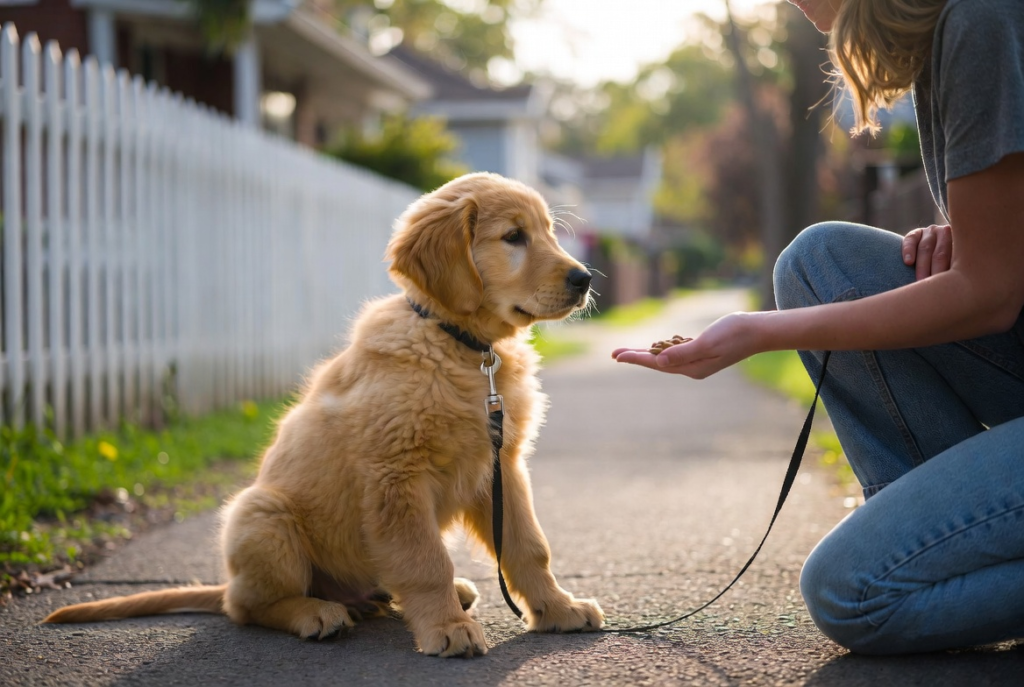
If your puppy sits down, your first response should be observation rather than force.
1. Stop
Give your puppy a moment.
2. Look Around
Identify anything that appeared immediately before the stop.
3. Check Your Puppy
Look for signs of fear, fatigue, or pain.
4. Reduce the Difficulty
If something is frightening your puppy, create more distance.
If the environment is too busy, move somewhere quieter.
5. Reward Small Choices
If your puppy looks at you, stands up, or takes a few steps voluntarily, reward that behavior.
6. Keep the Session Short
If your puppy is tired or overwhelmed, ending the walk may be the right decision.
7. Try Again Later
The next session should be easier rather than simply longer.
This approach is particularly useful when a puppy refuses to keep walking because the environment has become too difficult.
What Not to Do When Your Puppy Freezes
When a puppy freezes, avoid turning the situation into a battle.
Do not:
- Drag the puppy forward
- Keep tightening the leash
- Scold or punish the puppy
- Pull them toward something frightening
- Repeatedly call them when they are overwhelmed
- Continue simply because you planned a longer walk
- Assume every stop is stubbornness
If fear is involved, making the puppy move closer to the trigger can increase the pressure rather than teaching confidence.
A calmer approach is to make the situation easier and reward your puppy when they are able to respond.
Puppy Leash Training Tips
If your puppy is having puppy walking problems, go back to the basics.
Start Indoors
Let your puppy wear the collar or harness and leash in a familiar environment.
Reward Following
Take a few steps and reward your puppy for choosing to follow you.
Move to the Garden or Quiet Area
Once indoor practice feels easy, add a little more environmental stimulation.
Introduce Distractions Gradually
Do not jump from a quiet room to a crowded sidewalk.
Keep Training Short
Several successful minutes can be more useful than one long session where your puppy becomes frustrated.
Reward the Behavior You Want
Reward your puppy for staying near you, responding to your cue, and walking with a loose leash.
The AKC describes leash walking as a learned skill and recommends reinforcing the behavior you want rather than expecting puppies to understand leash walking automatically.
How to Make First Puppy Walks Easier
The first puppy walks should be about building confidence, not covering a certain distance.
Before your puppy’s first public walk, discuss vaccination timing and suitable locations with your veterinarian. Dogs Trust notes that the timing of a first walk depends on completion of the primary vaccination course and veterinary advice.
Once your puppy is cleared for appropriate walks, keep the first outings simple.
Before Leaving
- Use comfortable, properly fitted equipment.
- Choose a quiet route.
- Take treats.
- Keep the outing short.
- Avoid unnecessarily busy locations.
During the Walk
Let your puppy sniff and observe.
Do not worry if they do not immediately walk perfectly on a loose leash. The first outing is a new experience, and Dogs Trust recommends keeping it positive, allowing puppies to stop and sniff, and gradually building up walks over time.
If Your Puppy Freezes
Stop and identify the likely cause.
Give them distance from anything frightening rather than pulling them toward it.
If Your Puppy Gets Tired
Head home rather than insisting on completing your planned route.
Afterward
Think about what went well and what caused difficulty.
For example:
“Walked confidently on grass, but stopped near traffic.”
That is useful information for planning the next session.
Common Mistakes That Make Puppy Walking Problems Worse
Expecting Perfect Walking Immediately
A puppy is learning an entirely new skill. Walking politely on a leash takes practice.
Making Distance the Goal
Longer is not automatically better.
Ignoring Body Language
A puppy that is crouching and trying to retreat may need reassurance and more distance, not stronger leash pressure.
Changing Too Much at Once
If your puppy struggles on quiet streets, moving directly to a crowded park will make the challenge harder.
Treating Every Stop as Disobedience
A stop is information. Find out what caused it before deciding how to respond.
Continuing After Your Puppy Has Had Enough
Once your puppy is exhausted or overwhelmed, pushing for another mile is unlikely to improve the lesson.
Myth vs. Fact
| Myth | Fact |
| Sitting always means stubbornness. | Puppies stop for many reasons, including fear, fatigue, exploration, unfamiliarity, and discomfort. |
| A puppy that stops needs more exercise. | More exercise can be inappropriate if the puppy is already tired or overwhelmed. |
| Every first walk should look like a normal adult-dog walk. | First walks are new experiences and may involve frequent stopping, sniffing, and observing. |
| You should force a puppy to face what scares them. | Gradual exposure at a comfortable distance can be more appropriate for fearful puppies. |
| The farther you walk, the faster leash training improves. | Quality, confidence, and successful practice matter more than simply increasing distance. |
Expert Tips for Easier Walks
Watch the timing. The moment your puppy stops may reveal more than the behavior itself.
Notice what changed. Look for a new sound, person, dog, surface, vehicle, or smell.
Give sniffing a place in the walk. Exploration is part of your puppy’s outdoor experience.
Train below the panic point. If your puppy is too frightened to respond, increase distance and reduce the challenge.
Build confidence before distance. A short successful walk is valuable.
Keep a simple pattern in mind. If your puppy repeatedly stops in the same situation, change that situation rather than simply asking for more obedience.
Do not ignore sudden changes. A puppy that previously walked normally and suddenly refuses to walk deserves closer attention.
When Should You Call the Vet?
Not every puppy that sits down during a walk needs medical attention.
A puppy who pauses to sniff, watches something unfamiliar, or becomes tired near the end of a short outing may simply need more training or a break.
However, contact your veterinarian if your puppy has a sudden or persistent change in walking behavior, especially when accompanied by limping, pain, weakness, unusual posture, difficulty getting up, or other changes in normal behavior.
VCA advises veterinary assessment when pain or limping is significant enough that a pet does not want to walk or use a limb. Emergency care is recommended when a pet cannot stand or walk without assistance or when the problem follows major trauma.
Monitor and Contact Your Vet
Pay attention to:
- Persistent reluctance to walk
- Repeated unexplained stopping
- Limping
- Reduced activity
- Difficulty getting up
- Signs of discomfort
- Changes in appetite or normal behavior
Seek Urgent Care
Get urgent veterinary help if your puppy:
- Cannot stand or walk normally
- Has severe or obvious pain
- Has an obvious serious injury
- Has experienced major trauma
When a young puppy suddenly changes how they move, it is better to investigate than to assume they are simply being difficult.
Puppy Walking Checklist
Before your next walk, ask:
- Is the collar or harness comfortable?
- Is my puppy comfortable with the leash?
- Is the route quiet enough?
- Did something happen immediately before the stop?
- Is there a specific trigger?
- Could my puppy be tired?
- Is the surface unfamiliar?
- Am I allowing time to sniff?
- Am I rewarding voluntary movement?
- Am I avoiding pulling or dragging?
- Does my puppy show fear?
- Does my puppy show signs of pain?
If you can answer these questions, you are much closer to understanding the real reason behind the stopping.
Frequently Asked Questions
Why does my puppy sit down during walks?
A puppy may sit because the leash feels unfamiliar, the environment is overwhelming, something is frightening, they are tired, they want to sniff, a particular trigger is present, or walking is uncomfortable.
Why does my puppy sit down during walks after only a few minutes?
If your puppy begins normally and then starts sitting after several minutes, fatigue or overstimulation may be contributing. Try a shorter, quieter outing and watch whether the behavior changes.
Why does my puppy refuse to keep walking?
A puppy refuses to keep walking for many possible reasons. Fear, unfamiliar surroundings, tiredness, leash training problems, interesting smells, strange surfaces, and physical discomfort can all play a role.
Why does my puppy freeze on walks?
Freezing can happen when a puppy feels frightened, uncertain, or overwhelmed. Look for what appeared immediately before the freeze and increase distance from the trigger if necessary.
Why does my puppy stop walking outside but walk normally at home?
Home is familiar and predictable. Outside contains many more sights, sounds, smells, people, animals, and surfaces. Your puppy may need a gradual transition from indoor leash practice to outdoor walking.
Why does my puppy sit down when I put the leash on?
The equipment may still feel unfamiliar or restrictive. Start leash training indoors, reward calm behavior, and gradually teach your puppy that the leash predicts positive experiences.
Why does my puppy stop at the same place every walk?
A consistent location can point to a specific trigger. Watch for traffic, dogs, unusual sounds, surfaces, people, or objects that appear before your puppy stops.
Should I pull my puppy when they refuse to walk?
Avoid dragging your puppy forward. First determine why they stopped. If fear, fatigue, or discomfort is involved, pulling may make the experience more stressful.
Why does my puppy sit down even when I offer treats?
Treats cannot necessarily overcome fear, fatigue, overstimulation, or physical discomfort. If your puppy normally loves food but refuses to move, pay attention to the situation rather than simply offering more treats.
Why does my puppy sit down during walks but seem happy afterward?
Some puppies stop because they want to sniff, observe, rest, or process something unfamiliar. If they otherwise behave normally and there are no signs of pain or fear, the stop may simply be part of learning to navigate the environment.
Conclusion
So, why does my puppy sit down during walks?
There is no single answer.
Your puppy may still be learning how a leash works, feeling overwhelmed by the outside world, reacting to a particular fear, getting tired, investigating an interesting smell, struggling with a strange surface, or responding to physical discomfort.
The most helpful thing you can do is stop treating the behavior as a simple refusal.
Look at when your puppy stops, what happens immediately before it, and what their body language tells you. That information can point you toward the right response.
Keep early walks short and positive. Give your puppy time to sniff and observe. Reward voluntary movement, introduce distractions gradually, and avoid dragging or punishing a puppy that freezes.
And if your puppy suddenly stops walking after previously normal walks, particularly when there is limping, pain, weakness, or another change in behavior, speak with your veterinarian.
A confident walker is built through many small, successful experiences—not by forcing a puppy to finish one difficult walk.