Why Does My Cat Bring Me Toys? 7 Reasons Explained
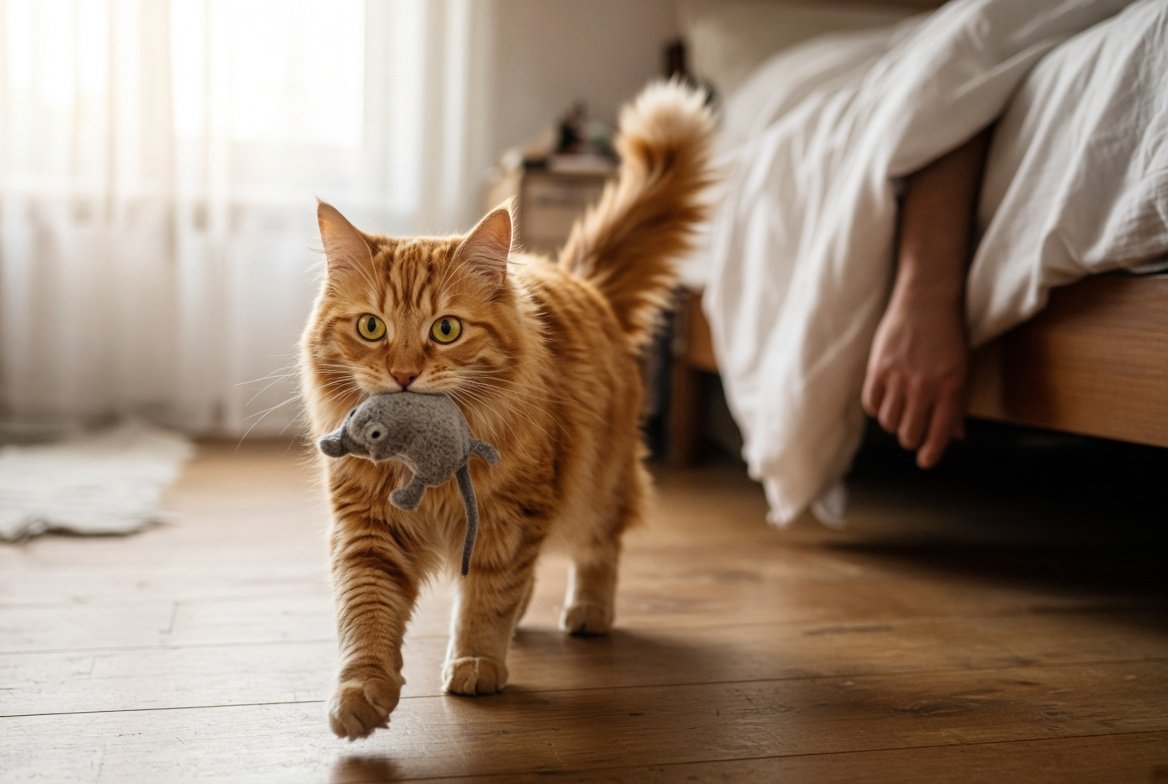
Have you ever woken up to find your cat proudly dropping a toy beside your bed? Or perhaps your cat carries a stuffed mouse into the room, meows at you, and waits as if you are supposed to understand the assignment.
If you have wondered, why does my cat bring me toys, there is no single answer that applies to every cat. Your cat may want to play, enjoy carrying and manipulating the toy, have learned that toys get your attention, or simply be following a familiar routine.
Cats naturally stalk, chase, pounce on, capture, and carry objects during play. But that does not mean we can automatically say a cat is bringing a toy to its owner for one specific reason. The context, your cat’s body language, and what happens after the toy arrives all matter.
Table of Contents
- Why Does My Cat Bring Me Toys?
- 1. Your Cat Wants to Play With You
- 2. The Toy Lets Your Cat Express Predatory Behaviors
- 3. Your Cat Has Learned That Toys Get Your Attention
- 4. Your Cat Enjoys Carrying and Manipulating Objects
- 5. Your Cat Prefers Interactive Play With You
- 6. The Behavior Has Become Part of a Routine
- 7. Your Cat Wants the Game to Continue
- Why Does My Cat Bring Me Toys at Night?
- Why Does My Cat Bring Me a Toy and Then Walk Away?
- Why Does My Cat Bring Toys to My Bed?
- What Does It Mean When a Cat Brings You a Toy and Meows?
- Should You Play When Your Cat Brings You a Toy?
- How to Respond When Your Cat Brings You Toys
- Common Mistakes to Avoid
- Myth vs. Fact
- Expert Tips
- When Should You Be Concerned?
- Frequently Asked Questions
- Conclusion
Why Does My Cat Bring Me Toys?
The most likely explanation is that your cat has connected the toy with something rewarding, such as play, attention, interaction, or enjoyable object play.
Cats have natural predatory behaviors that include stalking, chasing, pouncing, capturing, and carrying. Toys give indoor cats an appropriate way to express many of these behaviors.
However, there is an important distinction: natural hunting or play behavior does not prove why a cat specifically carries a toy to its owner.
Your cat may simply enjoy the toy, want you to interact with it, or have learned that bringing it to you gets a response.
The easiest way to understand the behavior is to look at what your cat does immediately after delivering the toy.
1. Your Cat Wants to Play With You
Sometimes the simplest explanation is the right one.
Your cat may bring a toy because it wants you to interact with it. If it drops a mouse at your feet, looks directly at you, waits for you to pick it up, or immediately chases it when you move it, the toy may be an invitation to play.
Interactive play gives cats an outlet for normal chasing and pouncing behaviors while also providing physical and mental stimulation.
Signs your cat may be asking to play
Watch for a combination of behaviors such as:
- Carrying a toy directly to you
- Dropping the toy near your feet
- Looking between you and the toy
- Pouncing when you move it
- Running away and expecting you to follow
- Returning after you throw the toy
- Becoming excited when you pick it up
For example, your cat may carry a toy mouse from another room, drop it beside your chair, and then crouch as soon as you reach for it. In that situation, the behavior is fairly clear: your cat is interested in an interactive game.
2. The Toy Lets Your Cat Express Predatory Behaviors
A toy can give your cat an outlet for behaviors associated with hunting.
Cats naturally stalk, chase, pounce, capture, and carry moving or prey-like objects. This is true even when they have regular access to food. Indoor cats can benefit from toys and activities that allow them to seek, stalk, chase, and catch.
That may explain why your cat carries a toy after catching it.
However, carrying a toy as part of play does not prove that your cat is intentionally bringing “prey” to you. We cannot know the exact motivation behind every toy delivery.
A safer interpretation is that your cat may enjoy carrying and manipulating the toy after catching it.
What this can look like
Your cat spots a toy, stalks it across the floor, pounces, grabs it, bites it, and carries it into another room.
That entire sequence fits normal predatory-style play. The fact that the toy ends up beside you may simply be where your cat happens to continue playing.
The key point is that the hunting behavior is well established; the specific meaning of bringing the toy to you is less certain.
3. Your Cat Has Learned That Toys Get Your Attention
Cats can learn that particular behaviors reliably lead to attention, play, or another rewarding outcome.
If your cat brings you a toy and you immediately stop working, talk to it, pet it, throw the toy, or start playing, your response can make that behavior worth repeating.
The pattern may become:
Cat brings toy → owner responds → cat gets attention or play → behavior is repeated.
This does not mean your cat is being manipulative. It means the behavior has produced a result your cat values.
A real-world example
Imagine your cat brings you a toy every evening while you are watching television.
The first few times, you throw it across the room. Your cat chases it and comes back. After enough repetitions, the cat may start bringing the same toy to you without any prompting.
The behavior has become useful because it reliably starts an interaction.
If you do not want the behavior at a particular moment, you can simply redirect your cat and provide play at another suitable time.
4. Your Cat Enjoys Carrying and Manipulating Objects
Not every cat that carries a toy is asking you to throw it.
Some cats simply seem to enjoy picking up, carrying, batting, biting, and manipulating small objects.
Many cats are particularly interested in toys they can chase, attack, carry, or move around on their own.
This can explain a common situation: your cat brings a toy to you, drops it, and then walks away.
The toy may have been interesting to carry without being an invitation for a game of fetch.
Why the toy itself can matter
Your cat may prefer a particular toy because of its:
- Size
- Texture
- Weight
- Movement
- Familiar smell
- Ease of carrying
If your cat repeatedly chooses one small toy over everything else, there is no need to assume it has a symbolic meaning. It may simply be the toy your cat finds most enjoyable to manipulate.
5. Your Cat Prefers Interactive Play With You
Some cats are more interested in playing with a person than playing alone.
Interactive play can give cats an opportunity to chase, pounce, and capture something that another person controls. This can also make a familiar toy much more interesting than when it is sitting still on the floor.
For example, a toy mouse sitting beside the sofa may receive no attention. The moment you drag it slowly across the floor, your cat starts stalking it.
The important part may not be the toy itself. It may be the interaction and movement you add to it.
A useful approach
Try different types of play and see what your cat actually prefers.
One cat may enjoy a toy mouse thrown across the hallway. Another may prefer a wand toy that moves unpredictably. Another may enjoy batting a lightweight ball around independently.
There is no requirement that every cat enjoy the same game.
6. The Behavior Has Become Part of a Routine
Cats can develop predictable daily routines around feeding, sleeping, attention, and play.
If your cat regularly brings a toy after dinner, when you return home, or before bedtime, the behavior may have become part of that routine.
For example:
Dinner ends → cat brings toy → owner plays → cat settles down.
After many repetitions, your cat may begin anticipating the interaction.
This is also why a cat may suddenly appear with a toy at almost exactly the same time every day.
The routine itself may be reinforcing the behavior.
7. Your Cat Wants the Game to Continue
Some cats enjoy a version of fetch.
If you throw a toy and your cat runs after it, catches it, and brings it back, the message is fairly straightforward: the cat may want another round.
Your cat may even learn that returning the toy is what makes you throw it again.
If your cat brings the toy back
Try this:
- Toss the toy a short distance.
- Let your cat chase it.
- Allow your cat to catch it.
- Wait to see whether it returns.
- Repeat if your cat remains interested.
Letting cats successfully catch toys is an important part of predatory-style play. A cat should have opportunities to capture its toy rather than being expected to chase something that can never be caught.
You do not need to make every play session a perfect imitation of hunting. Simply giving your cat opportunities to chase and successfully catch an appropriate toy can make the activity more satisfying.
Why Does My Cat Bring Me Toys at Night?
If your cat brings toys to you at night, it may simply be ready for activity while you are trying to sleep.
Cats often show increased activity around dawn and dusk, although individual schedules vary. This can make evening and early-morning periods particularly interesting for some cats.
There is another possibility: your cat may have learned that nighttime toy deliveries get your attention.
If your cat drops a toy on your bed and you immediately sit up, talk to it, or start playing, the interaction can become part of the nighttime routine.
How to reduce nighttime toy deliveries
If the behavior is disrupting your sleep, focus on providing appropriate enrichment at more convenient times.
Try:
- Scheduling interactive play in the evening
- Providing suitable independent toys
- Rotating toys to maintain novelty
- Offering several short play opportunities during the day
- Keeping interactive string or wand toys safely stored when unsupervised
- Avoiding turning every nighttime toy delivery into an exciting play session
Nighttime toy carrying is not automatically a problem. The goal is to make sure your cat has appropriate outlets for activity without making your sleep schedule the entertainment program.
Why Does My Cat Bring Me a Toy and Then Walk Away?
This is surprisingly common, and it does not necessarily mean your cat is confused.
Bringing a toy does not always mean, “Throw this for me.”
Your cat may enjoy carrying the toy, want a brief moment of attention, be following a familiar routine, or simply be interested in the object itself.
For example, your cat may carry a plush mouse into your office, drop it beside your chair, look at you, and then wander away.
You do not have to chase after the cat or force a game.
Instead, watch what happens next. If your cat returns and engages when you move the toy, play may have been the goal. If it ignores the toy and settles down, it may simply have finished what it wanted to do.
Why Does My Cat Bring Toys to My Bed?
A cat may bring toys to your bed because the bedroom is a familiar place where you spend time, because the cat has learned that you respond there, or because nighttime is when your cat becomes more interested in activity.
There is no single proven meaning behind bringing toys specifically to a bed.
If your cat repeatedly brings the same toy to your pillow, watch what happens after delivery.
Does your cat meow?
Does it wait for you to wake up?
Does it want you to throw the toy?
Or does it simply drop the toy and leave?
Those details can tell you much more about the behavior than the location alone.
What Does It Mean When a Cat Brings You a Toy and Meows?
A cat that carries a toy while meowing may be trying to attract your attention or encourage interaction.
But a meow does not have one universal translation.
Your cat may be communicating something like:
- “Play with me.”
- “Look at this.”
- “Pay attention.”
- “Come here.”
- “I want something to happen.”
Consider the whole picture rather than interpreting the meow by itself.
A relaxed cat carrying a familiar toy and behaving normally is very different from a cat that suddenly starts vocalizing intensely while also showing signs of distress or illness.
Should You Play When Your Cat Brings You a Toy?
If your cat is showing normal playful behavior and you have time, yes.
Interactive play can provide exercise, mental stimulation, and an appropriate outlet for predatory behavior.
You do not need to play every time your cat brings you a toy, though.
If you are working, sleeping, or otherwise unavailable, it is fine to redirect your cat and provide interactive play later.
Let your cat catch the toy
Do not make the game an endless chase in which your cat never succeeds.
Allow your cat to catch the toy regularly instead of keeping it permanently out of reach.
A simple sequence can be:
stalk → chase → pounce → catch → carry
Your cat does not have to follow that sequence every time, but these are all normal components of feline predatory play.
How to Respond When Your Cat Brings You Toys
You can use the behavior as a simple way to understand what your cat wants.
1. Look at your cat’s body language
Is your cat relaxed and playful, or tense and distressed?
2. See what happens after the toy is dropped
Does your cat stare at you, wait, run away, or immediately start playing alone?
3. Offer an appropriate toy
Use toys designed for chasing, batting, pouncing, or carrying.
4. Let your cat catch it
Successful captures are an important part of satisfying predatory-style play.
5. Stop when your cat loses interest
You do not need to continue a game once your cat has had enough.
6. Store risky interactive toys safely
Do not leave wand toys, strings, or similar items available for unsupervised play. Cats can become tangled in them or swallow string and other parts.
Common Mistakes to Avoid
Playing with your hands
Avoid teaching your cat that fingers and toes are toys.
Moving hands and feet can trigger chasing and pouncing, but this can become painful or lead to scratches and bites as the cat gets older. Direct predatory play toward appropriate toys instead.
Punishing your cat for bringing toys
There is usually no reason to punish a cat for bringing an appropriate toy.
If you want less nighttime activity, changing the routine and increasing appropriate enrichment is a better approach than making the toy delivery frightening or stressful.
Assuming every toy is a gift
Calling every toy a “gift” makes the behavior sound more certain than the evidence allows.
Some cats may have social motivations for bringing toys, but there is no single explanation that applies to every cat.
Never rotating toys
Leaving the same toys available all the time can reduce novelty.
Keep several options available and rotate them so different toys become interesting again.
Making every nighttime delivery exciting
If every 2 a.m. toy delivery results in a long play session, your cat may learn that nighttime is a particularly effective time to request attention.
Myth vs. Fact
| Myth | Fact |
|---|---|
| Every cat that brings a toy is giving its owner a gift. | Toy carrying can have several possible motivations, including play, attention, routine, and object manipulation. |
| Cats bring toys because they think their owners cannot hunt. | There is no good reason to treat this as a universal explanation. |
| Bringing a toy always means the cat wants to play fetch. | Some cats enjoy carrying or manipulating toys without wanting an interactive game. |
| Cats should chase toys without ever catching them. | Cats should have opportunities to successfully capture appropriate toys during predatory-style play. |
| Playing with your fingers is harmless. | It can encourage cats to target hands and feet during predatory play. |
| Bringing toys at night automatically means something is wrong. | Nighttime activity can be normal, although sudden behavioral changes should be evaluated in context. |
| Indoor cats do not need hunting-style play. | Indoor cats benefit from appropriate outlets for seeking, stalking, chasing, and catching. |
Expert Tips
Rotate toys instead of leaving everything out
You do not need every toy on the floor at once.
Keep several options available and rotate them so that different toys become interesting again.
Match the toy to your cat
Some cats prefer small toys they can carry. Others prefer balls, moving toys, or wand toys.
Your cat’s preference is useful information.
Use interactive play when your cat is naturally active
Morning and evening can be productive times for play because activity commonly increases around dawn and dusk.
Give your cat successful catches
Let your cat catch the toy regularly instead of keeping it permanently out of reach.
This supports the natural predatory elements of play and can make the game more satisfying.
Keep interactive toys supervised
Wand and string toys should be put away after play.
For independent play, choose toys that are appropriate for your cat to use without direct supervision, and check them regularly for damage or loose pieces.
Don’t assume you know exactly what your cat is thinking
This may be the most useful tip of all.
You can identify patterns and likely motivations, but a toy delivery does not come with a guaranteed translation.
Look at the behavior around the toy.
When Should You Be Concerned?
Bringing toys by itself is not usually a medical concern.
The reason to contact a veterinarian is a sudden or significant change in behavior, especially when it happens alongside other physical or behavioral symptoms.
Pay attention to changes such as:
- A sudden increase in vocalization
- Reduced appetite
- Hiding more than usual
- Unusual aggression
- Signs of pain
- Changes in litter-box habits
- Marked changes in normal activity
- Confusion or unusual behavior
- Other signs that your cat is unwell
A cat that has brought you toys every evening for years is very different from a cat that suddenly develops unusual behavior along with other symptoms.
New or persistent changes should be discussed with your veterinarian when you are concerned.
Frequently Asked Questions
Why does my cat bring me toys?
Your cat may bring toys because it wants to play, enjoys carrying the object, wants attention, prefers interactive play, or has learned that bringing a toy leads to a rewarding interaction. There is no single proven explanation for every cat.
Why does my cat bring me toys at night?
Your cat may be naturally more active at night, particularly around dawn or dusk, or it may have learned that bringing toys gets your attention. A consistent evening play routine can provide a better outlet for this activity.
Why does my cat carry toys around the house?
Carrying can be part of normal object and predatory-style play. Cats often enjoy toys they can chase, attack, manipulate, and carry.
Why does my cat bring toys to me but not other people?
Your cat may have learned that you are the person most likely to play, respond, or provide attention. Individual cats can develop different routines with different household members.
Why does my cat bring me a toy and then walk away?
The toy delivery does not necessarily mean “throw this.” Your cat may simply enjoy carrying the object, want brief attention, or be following a familiar routine.
Why does my cat bring toys to my bed?
Your bed may simply be a familiar place where your cat expects to find you or get a response. If the behavior happens at night, your cat’s normal activity pattern may also contribute.
Does my cat bringing me toys mean it loves me?
It may be consistent with a positive relationship and a desire for interaction, but toy carrying alone cannot prove exactly what a cat is feeling.
Should I throw the toy when my cat brings it?
If your cat enjoys chasing and retrieving it, you can throw the toy a short distance and allow your cat to catch it. If the cat walks away, let the game end.
Should I reward my cat for bringing toys?
You do not necessarily need food rewards. Play and attention can already be rewarding. If you want to encourage appropriate toy play, simply engaging with the toy can make the behavior worthwhile.
Is it normal for an indoor cat to bring me toys?
Yes. Indoor cats can show strong predatory play behaviors, and appropriate opportunities for play can provide useful physical and mental enrichment.
Why does my cat bring me the same toy every day?
Your cat may particularly enjoy that toy because it is easy to carry, has an appealing texture or movement, or has become associated with a favorite play routine. If bringing it to you consistently results in play or attention, that can also reinforce the habit.
Conclusion
So, why does my cat bring me toys?
There is no single answer, and that is actually the most accurate way to understand the behavior.
Your cat may want to play with you. It may enjoy carrying and manipulating a favorite toy. It may be expressing normal predatory behaviors through play, seeking attention, following a routine, or asking you to continue a game that has worked before.
The important distinction is that we can confidently describe the behaviors cats naturally perform during play—such as stalking, chasing, pouncing, capturing, and carrying—without pretending we know exactly why every cat delivers a toy to its owner.
So the next time your cat drops a toy at your feet, look at what happens next.
If your cat waits expectantly, start a short game. If it walks away, let it. If it brings the same toy every evening, you may simply be seeing a favorite routine develop.
And if your cat keeps delivering toy mice to your bed at 2 a.m., you may have discovered your feline alarm clock.