Why Does My Cat Stare at Me While I Sleep? 7 Key Reasons
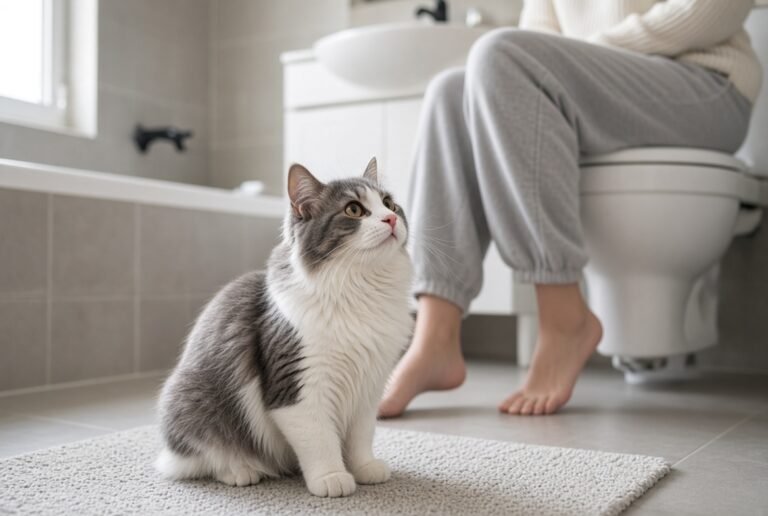
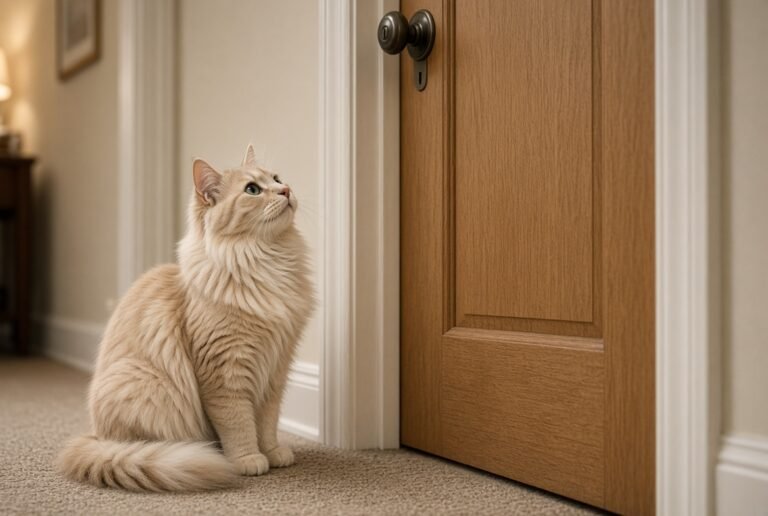
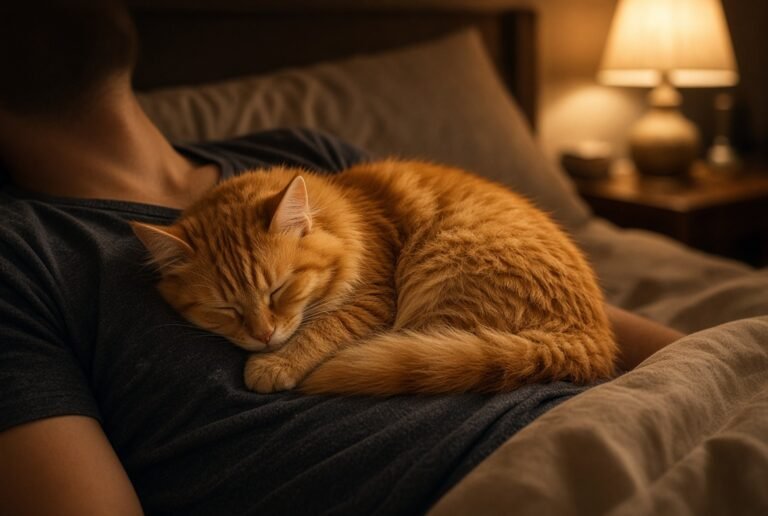
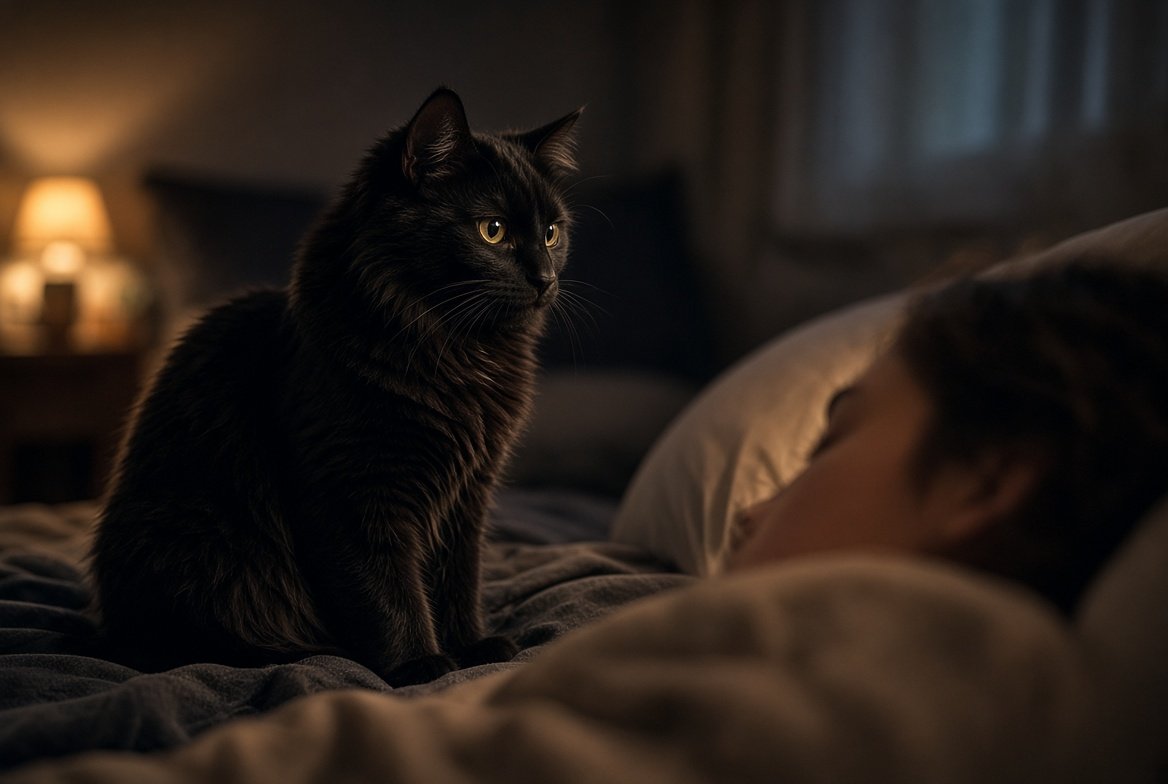
You wake up in the middle of the night, open your eyes, and find your cat sitting nearby, quietly watching you. Sometimes they are at the foot of the bed. Other times, they are inches from your face, looking as though they have been waiting for you to wake up.
So, why does my cat stare at me while I sleep?
Usually, there is a simple explanation. Your cat may be awake while you’re sleeping, watching for movement, waiting for breakfast or attention, observing the room, or simply keeping an eye on you because you’re part of their familiar nighttime environment.
The stare itself doesn’t tell you exactly what your cat wants. Their posture, ears, eyes, tail, vocalizations, and what they do afterward provide much better clues. Veterinary behavior guidance also emphasizes looking at the entire body and context rather than interpreting eye contact by itself.
Table of Contents
- Why does my cat stare at me while I sleep?
- Why does my cat watch me sleep at night?
- Is my cat checking if I’m awake?
- Does staring mean my cat loves me?
- What does my cat’s body language mean?
- Why does my cat stare at me without blinking?
- When should nighttime staring concern you?
- How to stop your cat from waking you at night
- Common mistakes
- Expert tips
- Myth vs. Fact
- Frequently Asked Questions
- Conclusion
Why Does My Cat Stare at Me While I Sleep?
There isn’t one universal reason. Cats may stare at people to communicate, request food or attention, seek interaction, observe something interesting, or respond to their surroundings. A veterinary behaviorist writing for PetMD notes that staring can have several meanings, and the rest of the cat’s body language helps determine which interpretation makes the most sense.
Here are seven common possibilities.
1. Your Cat Is Awake While You’re Sleeping
Your cat may simply be awake at a time when you’re not.
Cats are generally most active around dawn and dusk, although individual cats vary. A cat that sleeps for part of the evening may become alert while you are still comfortably asleep.
That creates an unusual situation from your perspective: you’re lying completely still while your cat is awake and looking for something to observe.
Your cat might sit on the bed, look at you for a while, then wander around the room, groom themselves, play with a toy, or settle somewhere else.
Example: If your cat stares at you at 4 a.m. but soon loses interest and starts exploring the bedroom, there may be nothing more complicated happening than a difference in sleep schedules.
2. Your Cat Is Waiting for You to Wake Up
Some cats learn the sequence of their household routines surprisingly well.
If you normally wake up, feed your cat, open a door, make coffee, or start playing with them, your waking becomes a predictable event.
Your cat may therefore watch for signs that you’re about to get up.
A small movement under the blanket, a change in breathing, or you opening your eyes may signal that the next part of the routine is coming.
This doesn’t mean your cat is consciously thinking, “I need to monitor my human until breakfast.” It’s more reasonable to view the behavior as learned anticipation.
Practical clue: If your cat watches you shortly before the time you normally get up and then heads toward the kitchen or food area, your morning routine may be part of the explanation.
3. Your Cat Wants Food or Attention
Sometimes the answer is straightforward: your cat wants something from you.
Cats can learn that looking at their person, meowing, approaching them, or rubbing against them gets a response. Food is an especially strong part of many cats’ daily routines. Veterinary guidance lists attention-seeking and food requests among common reasons cats stare at people.
Look at what happens after the stare.
Your cat may:
- Walk toward their food bowl
- Meow
- Rub against the bed
- Sit beside you
- Touch you with a paw
- Bring a toy
- Follow you when you get up
The follow-up behavior often tells you more than the stare itself.
If your cat stares at you at 6 a.m., then leads you toward the kitchen, food is a much more likely explanation than some mysterious nighttime ritual.
4. Your Cat Feels Comfortable Around You
A relaxed cat may choose to stay close to a person they feel comfortable with.
That can include resting nearby, sleeping on the same bed, making soft eye contact, or watching you quietly.
Cats can use eye contact as part of social communication. A relaxed cat may look at you with soft eyes or slow blinks, which is very different from a tense, hard stare. PetMD notes that relaxed eye contact and slow blinking can occur during affectionate interactions.
Still, don’t treat staring alone as proof of affection.
A cat that is calmly watching you with relaxed posture is giving you a very different message from one with wide pupils, flattened ears, a tense body, or a rapidly moving tail.
5. Your Cat Is Monitoring the Room
Your cat may not be focused entirely on you.
They could be watching the bedroom while also keeping track of sounds, movement, doors, windows, or other pets.
Cats use their senses to monitor their surroundings, and staring can be part of information gathering. Veterinary sources emphasize that the meaning of a stare depends heavily on the surrounding context and body language.
For example, imagine your cat sitting at the end of your bed. They look at you for a few seconds, then turn toward the hallway when they hear a noise.
In that situation, your cat may be paying attention to the entire environment rather than specifically studying you.
6. Your Cat Is Curious About What You’re Doing
Sleeping changes your normal behavior.
You’re quiet. You’re not walking around, talking, preparing food, or interacting with your cat. From your cat’s perspective, this is a different version of you.
That can be interesting enough to watch.
Your cat may also notice movements that you don’t realize you’re making. If you shift under the blankets, turn over, make a sound, or suddenly move your hand, your cat may focus on you for a moment.
Curiosity is especially plausible when the cat watches briefly and then returns to whatever they were doing.
7. Your Cat Has Learned That Nighttime Staring Gets a Reaction
Cats learn from repeated experiences.
If your cat watches you, you wake up, talk to them, pet them, feed them, or get out of bed, the behavior may become part of a familiar pattern.
The cat doesn’t need to understand the concept of reinforcement. They only need to learn that a particular behavior tends to produce something they want.
This can become especially noticeable when staring is followed by meowing or pawing at you.
If you respond every time, your cat may keep trying the same approach.
That doesn’t mean you caused a behavioral problem. It simply means your response has become part of the routine.
Why Does My Cat Watch Me Sleep at Night?
Nighttime can make the behavior much more noticeable.
The bedroom is quiet, you’re mostly motionless, and there are fewer distractions. If your cat becomes alert during the night, you may be the most interesting thing in the room.
Your cat might watch you for a few minutes and then:
- Groom themselves
- Walk around the room
- Look out the window
- Play
- Drink water
- Return to sleep
- Wait for you to move
So when you ask, “why does my cat watch me at night?”, don’t assume the nighttime stare has a completely different meaning from daytime staring.
The timing simply gives your cat more opportunity to observe you while you’re unusually still.
Is My Cat Checking If I’m Awake?
Possibly, but there is no reliable way to know that a cat is consciously checking whether you’re awake.
A more cautious explanation is that your cat may be watching for movement or other signals that tell them you’re becoming active.
If your cat consistently watches you shortly before you wake up and then follows you out of the bedroom, the behavior may be connected to your morning routine.
A useful way to think about it:
You sleep → your cat becomes active → your cat watches for movement → you wake up → something rewarding happens.
Over time, your cat may learn that watching you is associated with the beginning of the day’s activities.
Does My Cat Stare at Me Because It Loves Me?
It can be part of a close bond, but staring by itself doesn’t prove what your cat is feeling.
Look for a relaxed combination of behaviors instead.
A cat that:
- Has relaxed ears
- Has a loose body posture
- Slow-blinks
- Rests comfortably near you
- Rubs against you
- Purrs during calm interaction
- Chooses to stay close
is giving you a very different picture from a cat that is rigid, crouched, hissing, growling, or trying to create distance.
Cats communicate through a combination of facial expressions, posture, tail position, and vocalization. Looking at the whole picture is more reliable than assigning one meaning to eye contact.
What Does My Cat’s Body Language Mean?
The same stare can mean different things depending on what the rest of the cat is doing.
| What you notice | What it may suggest |
|---|---|
| Relaxed body and soft eyes | Comfort or calm social interaction |
| Slow blinking | Relaxed, friendly interaction |
| Staring followed by meowing | Attention or another request |
| Staring followed by walking to the food bowl | Food anticipation |
| Wide pupils with a tense posture | Arousal, fear, or excitement |
| Flattened ears and crouched body | Fear or stress |
| Hard stare with stiff body and raised fur | Possible defensive or aggressive behavior |
| Staring followed by play behavior | Invitation or anticipation of play |
These are clues rather than diagnoses. Veterinary behavior guidance recommends interpreting a cat’s gaze together with posture, ears, pupils, tail, and vocalizations.
Why Does My Cat Stare at Me Without Blinking?
A prolonged, unblinking stare deserves more context.
A relaxed cat quietly watching you from the bed is not necessarily showing aggression. But an intense stare combined with a stiff body, flattened ears, raised fur, growling, or hissing is a different situation.
PetMD describes a hard, unblinking gaze alongside tense body language as a potential warning signal. In that situation, give the cat space rather than trying to force interaction.
If your cat is relaxed, sitting comfortably, and simply observing you, there may be little reason for concern.
When Should Nighttime Staring Concern You?
Nighttime staring is usually more concerning when it represents a new or significant change in your cat’s normal behavior.
The stare itself doesn’t tell you that your cat is sick. What matters is whether other changes appear at the same time.
Pay closer attention if you also notice:
- Reduced or increased appetite
- Changes in drinking or urination
- Vomiting or diarrhea
- Weight loss
- Unusual vocalization
- Restlessness or pacing
- Hiding more than usual
- Difficulty jumping or walking
- Changes in sleep patterns
- Confusion or disorientation
- Signs of pain
- Unusual aggression
If several of these changes appear together, especially in an older cat, contact your veterinarian.
Older cats can develop medical and age-related problems that affect nighttime behavior. Persistent nighttime restlessness, confusion, vocalization, or changes in normal sleep patterns deserve veterinary assessment rather than being dismissed as a quirky habit.
The important distinction is normal behavior versus a noticeable change from your cat’s baseline.
How to Stop Your Cat From Waking You at Night
If your cat quietly watches you and doesn’t disturb your sleep, you may not need to change anything.
The problem is different when staring is followed by meowing, pawing, walking across you, knocking things over, or repeatedly waking you.
Try these steps.
1. Give Your Cat Appropriate Activity During the Day
Interactive play, climbing opportunities, scratching areas, and food-based enrichment can give your cat appropriate ways to use their energy.
The goal isn’t to exhaust your cat artificially. It’s to provide regular opportunities for normal feline behavior.
2. Keep the Evening Routine Predictable
Cats often respond well to predictable routines.
Try to keep feeding, play, and bedtime reasonably consistent rather than changing everything from one night to the next.
3. Don’t Reward Every Nighttime Wake-Up
If your cat learns that staring, meowing, or pawing always results in food or attention, the behavior may become more persistent.
When appropriate, avoid turning every nighttime interruption into an interaction.
4. Provide a Comfortable Alternative
If your cat doesn’t need to sleep directly beside you, give them another appealing location.
A comfortable bed, blanket, perch, or quiet sleeping area can provide a place to settle.
If your cat already likes something that smells familiar, placing a safe item carrying your normal household scent nearby may make the alternative more appealing.
5. Check for an Underlying Need
Before ignoring nighttime behavior, make sure your cat has access to fresh water, a clean litter box, a comfortable environment, and their normal food routine.
If the behavior is new or unusually persistent, don’t assume it’s merely attention-seeking.
Common Mistakes
Assuming every stare means affection
Your cat may be comfortable with you, but staring can also involve food, attention, curiosity, environmental monitoring, fear, or play.
Assuming your cat is definitely checking that you’re alive
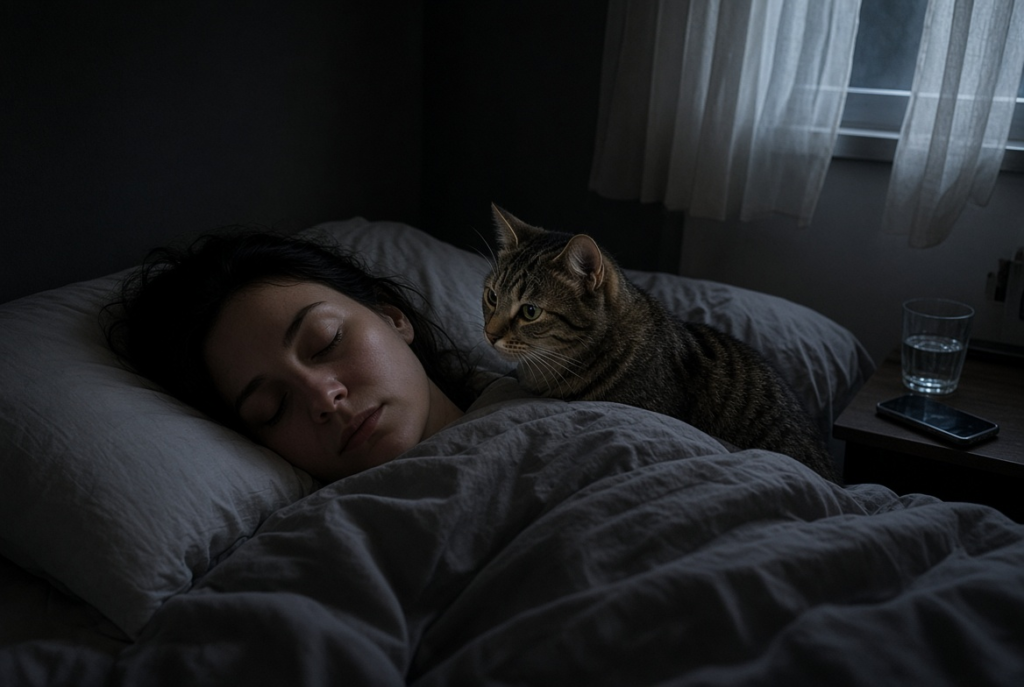
It’s an entertaining explanation, but staring alone cannot establish that your cat is deliberately checking whether you’re breathing or alive.
Assuming every nighttime stare is a health problem
A healthy cat can simply be awake while you’re asleep.
The concern rises when the behavior is sudden, excessive, or accompanied by other changes.
Responding every time your cat wakes you
If every nighttime stare gets food, petting, conversation, or play, your cat may learn that waking you works.
Ignoring body language
Never interpret the eyes alone. Ears, posture, pupils, tail, vocalizations, and the situation all add important context.
Expert Tips for Figuring Out Why Your Cat Watches You
You don’t need to guess. Watch the pattern for a few nights.
Notice the timing
Does the staring happen at midnight, 3 a.m., or shortly before breakfast?
Timing can reveal whether food or your morning routine is involved.
Watch where your cat looks next
If your cat looks at you and then turns toward the kitchen, food could be relevant.
If they look toward the doorway after hearing a sound, environmental monitoring is more likely.
Pay attention to what happens after you move
Does your cat immediately approach you?
Do they lead you toward the food bowl?
Do they walk away and go back to sleep?
Those small details can narrow down the possibilities.
Compare nighttime and daytime behavior
If your cat stares at you in exactly the same relaxed way during the day, the nighttime behavior may simply be part of their normal social communication.
If nighttime behavior is completely new, investigate what else has changed.
Keep a short behavior log
For a few nights, note:
- Time of the stare
- What your cat was doing beforehand
- Body posture
- Vocalization
- What happened afterward
- Whether food or attention followed
Patterns become much easier to recognize when you stop relying on memory.
Myth vs. Fact
Myth: My cat stares at me while I sleep because it is guarding me.
Fact: Your cat may be observing you or the surrounding room, but there isn’t enough evidence to say that every cat watching a sleeping owner is acting as a protector.
Myth: Cats are awake all night.
Fact: Cats can be active during the night, but they aren’t simply awake continuously. Individual sleep and activity patterns vary.
Myth: A cat staring at you always means affection.
Fact: A relaxed stare can occur during friendly interaction, but staring can also relate to food, attention, curiosity, fear, play, or other needs. Context matters.
Myth: If my cat suddenly starts watching me at night, it’s just a new habit.
Fact: It may be harmless, but a sudden behavioral change deserves attention, particularly if other physical or behavioral changes appear at the same time.
Frequently Asked Questions
Why does my cat watch me sleep every night?
Your cat may simply be awake while you’re sleeping, or they may have learned that your waking signals breakfast, attention, or another familiar part of the daily routine. Look at what your cat does after watching you.
Why does my cat stare at me at 3 a.m.?
Your cat may be awake and active while you’re still asleep. If the staring happens around the same time each night, check whether feeding, play, household sounds, or another routine is connected to it.
Why does my cat stare at me when I’m sleeping but not when I’m awake?
You behave differently when you’re asleep. You’re quieter and less responsive, which can make you more interesting to observe. Your cat may also be awake during a period when you’re normally inactive.
Why does my cat stare at me from the foot of the bed?
The foot of the bed gives your cat a comfortable place to observe you while maintaining some distance. Your cat may also be watching the bedroom rather than focusing exclusively on you.
Why does my cat stare at me without blinking while I sleep?
Look at the rest of the body. A relaxed cat may simply be watching you, while a stiff posture, flattened ears, raised fur, growling, or hissing can indicate fear, stress, or defensive behavior.
Is my cat checking whether I’m breathing?
You can’t know that from staring alone. Your cat may notice your movements or breathing, but there is not enough evidence to conclude that a cat consciously checks whether a sleeping person is alive.
Does my cat stare at me because it trusts me?
A relaxed cat choosing to remain near you can be consistent with comfort and a positive relationship. However, staring by itself isn’t proof of trust. Consider the rest of your cat’s body language and behavior.
Why does my cat suddenly stare at me while I sleep?
A sudden change can have a simple explanation, such as a changed routine or increased nighttime activity. If it continues or comes with appetite changes, restlessness, unusual vocalization, pain, confusion, or other changes, contact your veterinarian.
How can I stop my cat from waking me at night?
Provide regular daytime activity, keep the evening routine predictable, avoid rewarding repeated nighttime interruptions, and give your cat a comfortable alternative sleeping location. If the behavior is new, first consider whether an underlying problem could be contributing.
Should I worry if my older cat starts staring at me at night?
Don’t panic, but don’t automatically dismiss it either. New nighttime staring accompanied by pacing, confusion, vocalization, sleep changes, or other unusual behavior warrants a conversation with your veterinarian.
Conclusion
So, why does my cat stare at me while I sleep?
There may be nothing mysterious behind those late-night eyes. Your cat could simply be awake while you’re sleeping, watching for signs that you’ll get up, waiting for food or attention, observing the room, or enjoying being near you.
The most useful clue is what happens around the stare.
If your cat watches you and then heads toward the food bowl, the morning routine may be driving the behavior. If they remain relaxed beside you, social comfort may be part of it. If they stare toward the doorway whenever they hear a sound, they may be paying more attention to the environment than to you.
And if the behavior suddenly changes or comes with other signs that something isn’t right, that’s when it’s worth looking beyond the cute nighttime habit and speaking with your veterinarian.
Sometimes your cat really is just awake before you—and apparently has decided you’re worth watching.