
How to Make a Cat Poop Instantly: Safe Steps & Vet Timeline
No safe instant fix exists. Safe steps to help a constipated cat poop, red-flag timeline, kitten and senior rules, and when to see a vet now.
If your cat is straining in the litter box and nothing is coming out, you need safe help that works quickly — not a risky trick.
Quick Answer
There is no safe instant laxative for cats at home. For a mildly constipated adult cat that is still eating, drinking and passing urine, the fastest safe support is more water through wet food, a little plain pumpkin, gentle play, and a clean, easy litter box. If your cat cannot pass urine, is vomiting, is in pain, has stopped eating, or passes blood, skip home steps and see a vet now.
PetCavo is not a vet. This is general information, not a diagnosis. If you are worried about your pet, see a vet promptly.
STOP: Poop or Pee?
Before you try any home step, work out what your cat is straining to pass. Straining to poop and straining to pee look very similar, but a blocked bladder is an emergency. The Cornell Feline Health Center calls a urinary blockage an absolute emergency, and a blocked cat can become very ill and can die quickly without treatment.
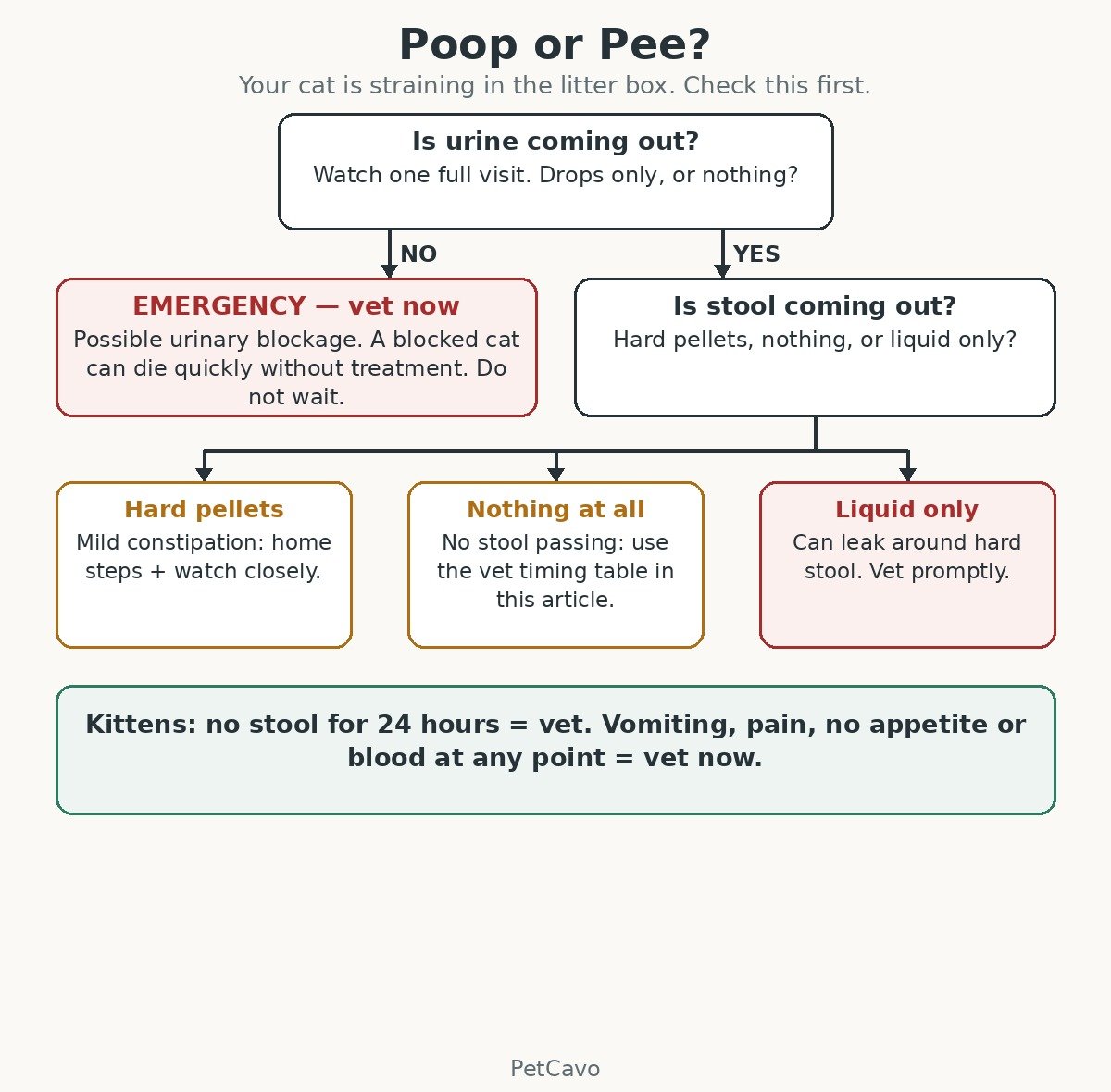
Watch one full litter box visit. Is fresh urine coming out, even a small amount? Has your cat passed urine today? If no urine is passing, or only drops appear while your cat keeps straining, treat it as urgent and contact a vet straight away. If urine is passing normally, the problem is more likely stool — then use the steps and timing table below.
Cat Not Pooping but Eating Normally?
A good appetite is reassuring, but it does not rule out constipation. A cat can keep eating for a while even when stool is building up. Check that urine is still passing, watch for vomiting, pain or a swollen belly, and note when stool last appeared. Published timing advice differs, from 24 to 72 hours — see the table below.
Why Is My Cat Constipated?
Constipation usually has a cause, and finding it matters as much as passing one stool. PetMD, Cornell and VCA list these common causes:
- Dehydration — not drinking enough water (PetMD symptoms page; Cornell).
- Diet change — a new food, or a food your cat does not tolerate well (PetMD treatment page).
- Hairballs — swallowed fur can block the gut (Cornell; VCA).
- Litter-box avoidance — dirty, stressful or hard-to-reach boxes (PetMD symptoms page).
- Extra weight — obesity can contribute to constipation (PetMD treatment page; VCA).
- Arthritis pain — sore cats may struggle to squat or climb into the box (PetMD symptoms page; VCA).
- Kidney or thyroid disease — underlying illness can cause constipation (PetMD symptoms page).
- Megacolon — the colon stretches and loses strength (PetMD symptoms page; Cornell).
- Bowel obstruction — something blocking the gut (PetMD symptoms page; Cornell).
- Some medications — side effects of various drugs can cause constipation (Cornell).
How Can I Help My Cat Poop at Home?
You can support a mildly constipated adult cat at home with water, wet food, a little plain pumpkin, gentle play and an easy litter box — as long as urine is passing and your cat seems otherwise well.
These steps support normal bowel movement; they do not treat a blockage, megacolon or another illness. If your cat seems unwell in any way, see a vet instead.
1. Add water through wet food
Dry stool is harder to pass, so water comes first. Offer wet food, add a little extra water to meals if your cat accepts it, and keep fresh water in easy reach. A clean bowl away from the litter box helps, and some cats drink more from a fountain. Do not syringe water into the mouth unless a vet has shown you how.

2. Offer a little plain pumpkin
Plain pumpkin adds fibre and moisture and is widely suggested for mild cases. Use plain 100% canned pumpkin only — never pumpkin pie filling, which contains sugar and spices. PetMD’s pumpkin page says many cats respond to 2–4 teaspoons of canned pumpkin added to wet food for a mild case. Start with the smaller amount, mix it into wet food, and stop and call a vet if diarrhoea or vomiting starts. Psyllium is sometimes mentioned for fibre too — ask your vet for the amount rather than guessing.
3. Encourage gentle play
Short, calm play supports normal activity and gut movement. Try a wand toy or ball for a few minutes at a time. Stop if your cat hides, cries, pants or seems sore, and do not chase a cat that wants to rest.
4. Make the litter box easy
Scoop promptly and keep litter fresh, so you can see clearly what is passing. Make sure your cat can reach the box easily, with no high sides to climb if they are stiff or sore. PetMD’s treatment page advises at least one more litter box than you have cats, with one box on every floor your cat uses.
What About Probiotics, Oils and Hairball Gels?
Ask your vet first. PetMD’s treatment page mentions trying fibre or probiotics for some cats, but it does not list olive, coconut or fish oils as home remedies. Hairball gels exist, but they are not a treatment for constipation — ask your vet before using one. This guide gives no doses for any of these.
About belly massage: People suggest it online because gentle pressure is thought to help the gut move, but belly massage is not listed as a home treatment on the PetMD, Cornell or VCA constipation pages we checked. Pressing on a painful or blocked belly could hurt your cat, so do not use massage as a treatment. Coconut oil is not listed as a home remedy on those pages either, and the same caution applies. Ask your vet first if you are unsure.
About the “7-second poop method”: it is a human routine, not for cats — see the FAQ below.
Mild cases often improve once hydration, fibre and movement increase. If nothing passes, use the timing table below. While you try these steps, note appetite, water intake, urine, stool, vomiting and behaviour. If nothing improves, or your cat gets worse, stop home care and see a vet.
When to See a Vet: Signs, Meaning and Timing
Use this table to decide. Published timing advice differs, so each threshold is shown with its source rather than blended into one rule.
| Sign | What it may mean | Action |
|---|---|---|
| No urine, or only drops, while straining | Possible urinary blockage | Emergency — vet now. Cornell calls a urinary blockage an absolute emergency. |
| Constipation lasting more than 24 hours | Needs veterinary evaluation | See a vet. PetMD symptoms page: “Constipation lasting more than 24 hours should be evaluated by a veterinarian.” |
| No stool for 48–72 hours | Constipation is not resolving | Contact your vet immediately. PetMD treatment page: “If your cat has not defecated in 48–72 hours or if they are acting uncomfortable, contact your vet immediately.” VCA: call your veterinarian if your cat fails to produce a bowel movement within 48 to 72 hours. |
| Unable to pass stool despite straining | Possible obstipation (severe constipation) | Vet promptly. Cornell defines obstipation as a condition characterised by permanent loss of function of the affected colon; Cornell gives no hour threshold — severe cases need vet care. |
| Any constipation signs at all | Your cat needs advice | Contact your vet. PDSA advises always contacting your vet if your cat is showing signs of constipation. |
| Repeated vomiting | Possible blockage, severe constipation or another illness | Vet promptly — do not keep trying home steps. |
| No appetite, hiding, lethargy or pain | Your cat is unwell, not just constipated | Vet promptly. |
| Blood in stool, or black tarry stool | Bowel irritation, injury or other disease | Vet promptly. See our guide to blood in cat stool. |
| Kitten with no stool for more than 24 hours | Kittens dehydrate quickly | Vet today — see the kitten section below. |
Normal frequency varies between cats. A change from your cat’s own normal pattern, plus any sign above, matters more than one exact number.
Is It Really Constipation?
Constipation means stool is hard, dry, infrequent or difficult to pass. Signs include straining, small hard pellets, crying in the box, and going outside the box. Obstipation is severe constipation where stool cannot pass. Megacolon is a long-term problem where the colon stretches and loses strength. Passing only liquid does not rule out constipation: liquid can leak around hard stool that is blocking the colon, so it still needs a vet. PetMD’s symptoms page says most cats poop at least once a day, with a normal bowel movement every 12–24 hours.
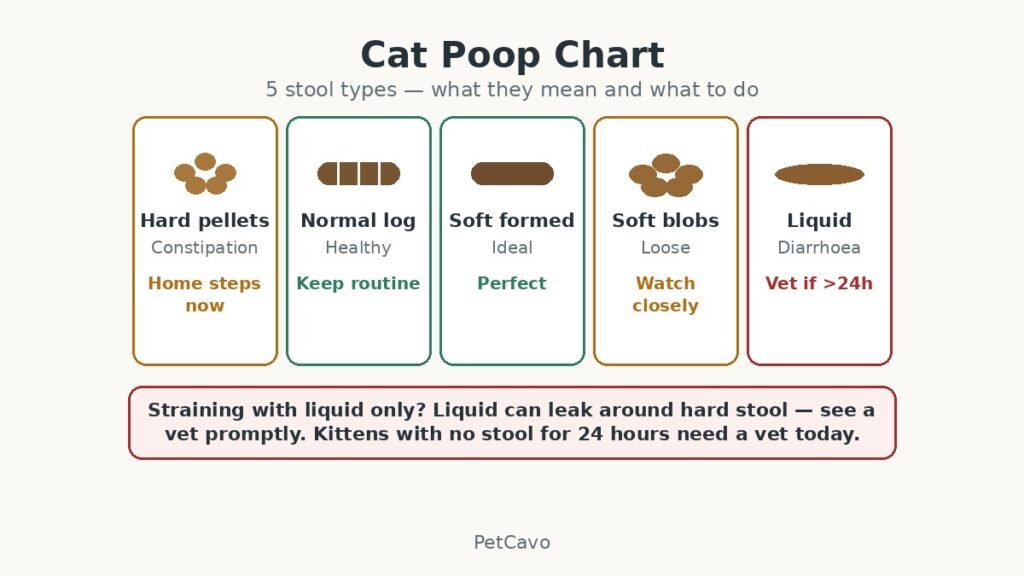
| Type | Looks like | What to do |
|---|---|---|
| Hard dry pellets | Small separate hard lumps | Constipation likely — increase water and see a vet if it persists |
| Normal log | One smooth formed log | Normal — keep monitoring |
| Soft formed | Soft but holds shape | Often normal — monitor if new |
| Soft blobs | Soft pieces with clear edges | Loose stool — monitor, see a vet if frequent or with other signs |
| Liquid only | Watery stool with no form | See a vet promptly — liquid can leak around hard stool |
Never Do These
- Never use human enemas, including Fleet or phosphate enemas. They can be toxic to cats. Only a vet should give an enema.
- Never dose laxatives at home. This guide gives no laxative doses because safe dosing depends on the cat and the cause. Ask your vet.
- Never force oils by syringe. Forcing oil into the mouth can lead to aspiration into the lungs.
- Never use milk as a remedy. Milk can upset digestion and cause diarrhoea without fixing constipation.
- Never wait out straining with no urine. If urine is not coming out, waiting at home is dangerous.
Kittens
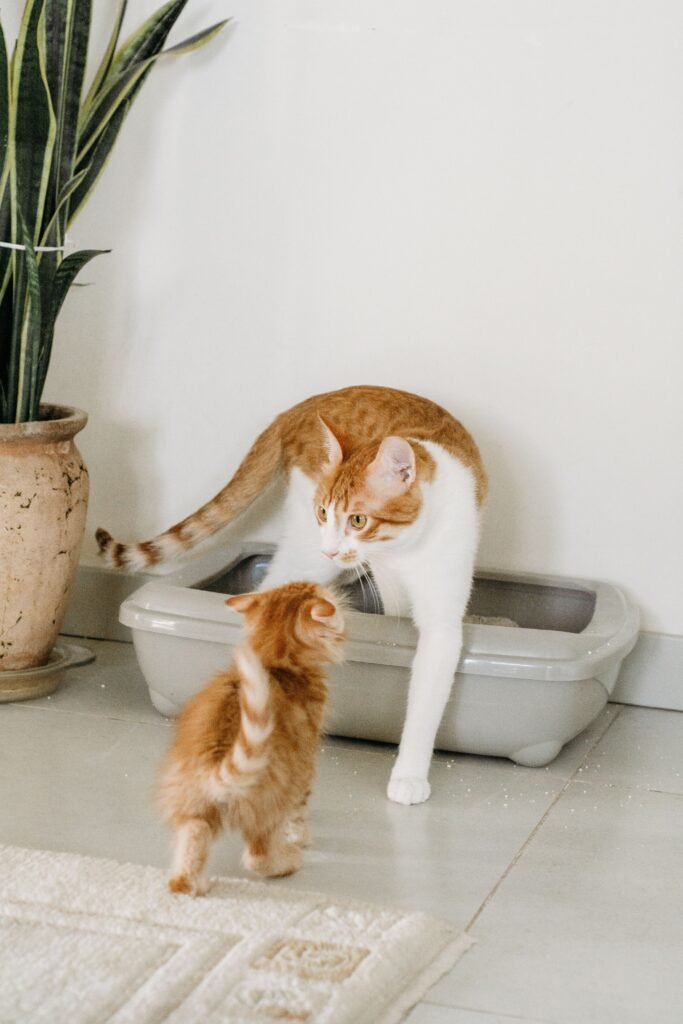
Kittens need a vet-first approach, and age matters. PetMD’s kitten constipation page explains that kittens start to use the bathroom on their own at about 3–4 weeks old. Younger kittens cannot poop on their own — their mother stimulates them to urinate and defecate. Orphaned kittens need vet guidance on care and feeding; do not guess.
For kittens using a tray, use one clear rule: if a kitten has passed no stool for more than 24 hours, see a vet today. The same applies sooner if your kitten is not eating, is vomiting, has a swollen belly or seems weak. Ask your vet before using any syrup or home remedy on a kitten, and do not give olive oil to kittens — the same caution as for adults applies. For age checks, see our kitten age chart.
Senior Cats
Senior cats become constipated more easily. Dehydration, kidney problems, arthritis pain, extra weight and some medicines can all play a part. Use a low-sided litter tray (PetMD’s symptoms page advises low-sided boxes for cats with mobility issues) and keep a tray on every floor your cat uses, so it stays easy to reach. Ask your vet about kidney and thyroid screening with blood tests, and about reviewing any medicines your cat takes, since some drugs can cause constipation (Cornell). Do not add fibre products or supplements without asking your vet first.
What the Vet Will Do
Your vet will ask when stool last passed and carry out a physical exam, including the belly. PetMD’s symptoms page describes diagnosis with X-rays to look for a blockage or megacolon, plus bloodwork to check for underlying disease. Treatment depends on severity and may include fluids, an enema or manual removal under sedation, and a diet plan chosen by the vet. Never try these at home.
How Can I Stop Constipation Coming Back?
You lower the risk by keeping water, weight, activity, grooming and vet checks steady — and by spotting changes early.
- Keep fresh water available at all times and include wet food in the diet.
- Keep your cat at a healthy weight and encourage daily gentle activity.
- Scoop the litter box daily so you spot changes early.
- Groom long-haired cats regularly to reduce swallowed hair.
- Book regular vet checks, especially for senior cats.
Key Takeaways
- Check urine first — straining with no pee is an emergency.
- Water, wet food, plain pumpkin, play and a clean box are the safe home basics.
- Human enemas, home laxative doses, milk and forced oils are never safe.
- Adult timing rules differ by source — use the table above, not a single guess.
- Kittens: no stool for more than 24 hours means a vet today.
Frequently Asked Questions
My cat is not pooping but eating — is that OK?
Eating normally is reassuring, but it does not rule out constipation that needs help. Watch urine output, vomiting, pain and when stool last passed. Published timing advice differs, from 24 to 72 hours — see the table above.
Can I give my cat olive oil?
Do not use olive oil as a home remedy without veterinary advice. PetMD’s treatment page does not list olive oil among its home remedies, and forcing oil by mouth can cause aspiration. Ask your vet what is safe for your cat.
Can I give my cat milk?
No. Milk is not a safe or effective remedy for feline constipation and can upset digestion, causing diarrhoea without fixing the problem. Offer water and wet food instead, and see a vet if signs continue.
Can I give my cat Miralax or human laxatives?
No. Do not give Miralax or any human laxative at home, and do not copy doses from online forums. Safe treatment depends on the cause and your cat’s health, so ask your vet.
Can I give my cat an enema at home?
Never give an enema at home. Human enemas, especially phosphate products, can be toxic to cats and can injure the bowel. Only a vet should give an enema.
My cat is straining but nothing comes out — what now?
First check urine, because straining for poop and pee look similar. If no urine is passing, or only drops appear, treat it as an emergency and contact a vet now. If urine is passing but stool is not, use the timing table above.
What if my kitten is constipated?
Contact your vet promptly and do not use adult home remedies or amounts. If a kitten has passed no stool for more than 24 hours, see a vet today. Kittens dehydrate quickly and need vet-first care.
What is a natural laxative for cats?
Plain pumpkin is the food most often suggested for mild cases. PetMD’s pumpkin page says many cats respond to 2–4 teaspoons of canned pumpkin added to wet food for mild constipation. Add water through wet food too, start with the smaller amount, use plain canned pumpkin never pie filling, and ask your vet first.
How do I get impacted poop out of my cat?
Never try to remove impacted stool at home. Pushing, pulling or giving an enema yourself can tear or injure the bowel and cause serious harm. Only a vet should remove impacted faeces, often with fluids, sedation and close monitoring. If your cat is straining with nothing passing, contact your vet promptly.
How long before constipation causes permanent damage?
There is no single safe number of hours. PetMD’s treatment page says constipation must be treated as soon as possible to reduce the risk of permanent damage due to prolonged distension of the colon. Left untreated, constipation can progress to megacolon, where the colon stretches and loses strength. Use the timing table above.
What is the 7-second poop method?
The 7-second poop method is a human bathroom routine shared online for people, not a treatment for cats. Do not use human tricks, positions or routines on a cat. They will not help constipation and may cause stress or injury. Use the safe home steps above, or see a vet.
Sources
Photo Credits
- Cat poop chart: original PetCavo graphic.
- Poop or pee flowchart: original PetCavo graphic.
- Cat drinking water photo: by Aibek Skakov on Pexels.
- Kitten photo: by Nadiye Odabaşı on Pexels.
- Featured photo: by Nicholas Fu on Pexels.



6 Comments