
Kitten Age Chart: Week-by-Week Milestones & Care Guide
Found a kitten and not sure of its age? This week-by-week kitten age chart reveals age from weight, eyes, ears and teeth — with a quick-look table.
How Old Is This Kitten? Start Here
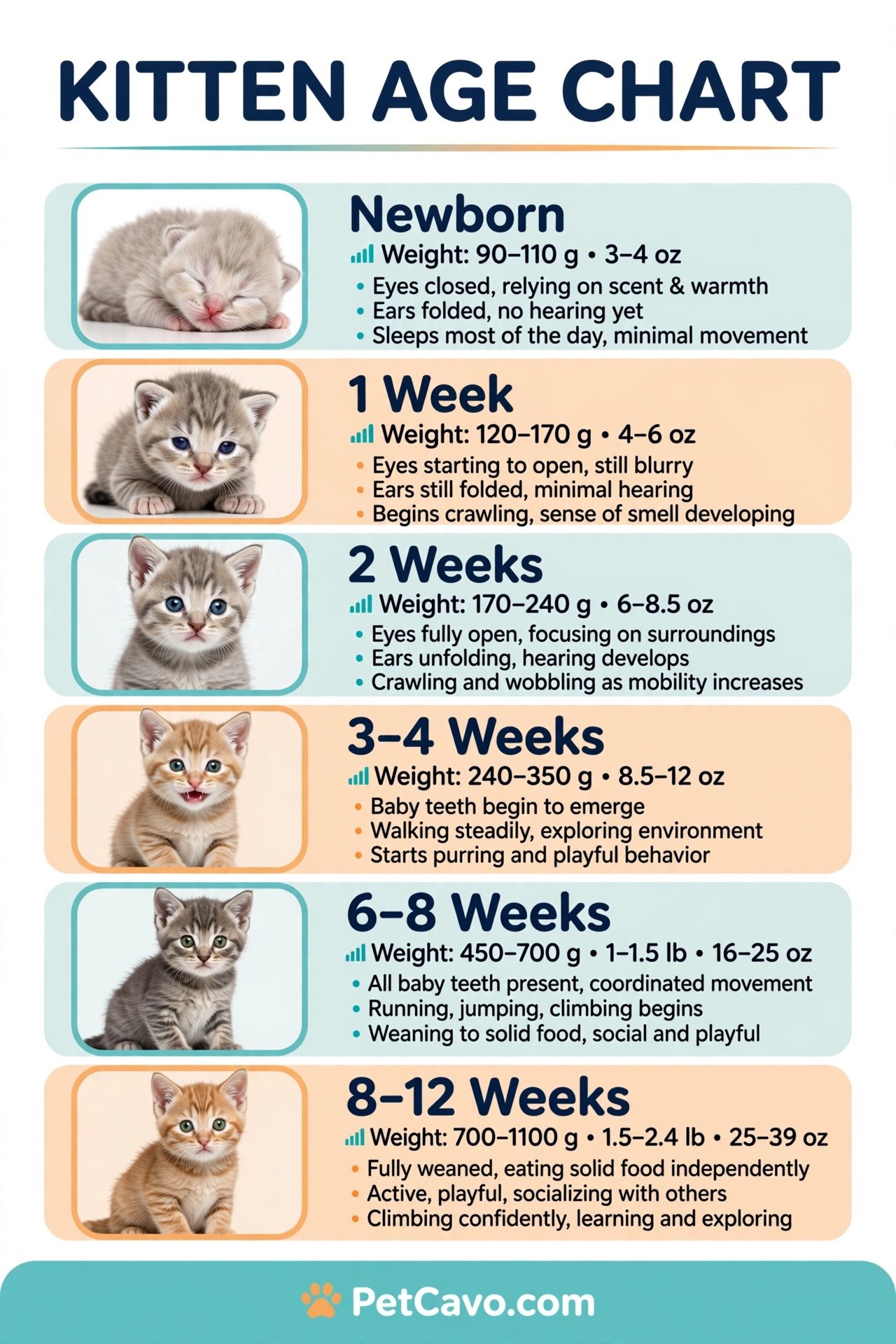
If you’ve found a kitten or just brought one home and don’t know its age, this kitten age chart will get you surprisingly close. Check four things — weight, eyes, ears, and teeth. A newborn weighs about 100 grams. By 8 weeks, most kittens weigh around 750 to 900 grams. Between those points, each week brings visible changes — eyes opening, ears unfolding, teeth appearing — that act like a built-in calendar.
The kitten age chart below gives you the quick reference. The sections after it explain exactly what to look for each week, plus the milestones that matter for feeding, weaning, and vet visits.
The 60-Second Kitten Age Estimator
Weigh the kitten on kitchen scales, find the closest match below, and you’ll have a 60-second estimate plus the care that matters most right now. As a rough guide, expect about 1 lb at 4 weeks, 2 lbs at 8 weeks, 3 lbs at 12 weeks, and 4 lbs at 16 weeks — but weight alone can mislead: runts often sit below the chart and large breeds such as the Maine Coon can sit well above it, so always confirm with teeth, eyes, ears, and behaviour.
- Under 150 g (about 5 oz) — under a week old. Keep the kitten warm, bottle-feed kitten milk replacer every 2 hours round the clock, help it toilet after feeds, and get a vet check within 24 hours.
- 150–250 g — about 1–2 weeks. Eyes starting to open (never pry them open). Bottle-feed every 3–4 hours; keep the kitten warm between feeds.
- 250–450 g — about 2–4 weeks. Eyes open and blue; ears unfolding. Bottle-feed every 4–5 hours; from week 4, offer gruel and a shallow litter tray.
- 450–900 g — about 4–8 weeks. Teeth arriving; weaning to gruel and wet food. Confine the kitten to one safe room, play gently, and book the first vet visit.
- 900 g–1.5 kg — about 8–12 weeks. Eating solid food and using the litter tray. First vaccinations around 8–9 weeks; ask the vet about spaying/neutering (usually from 8 weeks, once the kitten reaches 2 lb / 900 g).

Kitten Age Chart (Weeks 0–12)
| Age | Weight (approx.) | Eyes | Ears | Teeth | Key milestone |
|---|---|---|---|---|---|
| 0–1 week | 100–150 g | Closed | Folded flat | None | Sleeps almost constantly; needs warmth |
| 1–2 weeks | 150–250 g | Starting to open (7–10 days) | Still folded | None | Crawls weakly toward warmth |
| 2–3 weeks | 250–350 g | Open, blue | Starting to unfold | None | First wobbly steps |
| 3–4 weeks | 350–450 g | Blue, clearer | Upright | Tiny incisors appear | Starts exploring; litter habits begin |
| 4–5 weeks | 450–550 g | Blue | Upright | Canines appear | Weaning can start |
| 5–6 weeks | 550–650 g | Blue, changing | Upright | Premolars coming in | Eating gruel confidently; very playful |
| 6–7 weeks | 650–750 g | Eye colour changing | Upright | Nearly full set | Running, climbing, wrestling |
| 7–8 weeks | 750–900 g | Adult colour emerging | Upright | Full set | Ready for first vaccinations |
| 8–12 weeks | 900 g–1.5 kg | Adult colour | Upright | Full set | Socialisation window; ready for new home at 12+ weeks |
A useful rule of thumb: a healthy kitten gains roughly 100 grams per week for the first month, then around 450–500 grams per month after that. Weight alone isn’t precise — a small or underfed kitten can lag behind — so always combine it with the physical signs below.
Kitten Teeth Timeline
Teeth are the most reliable ageing clue once the newborn stage passes, because they arrive on a strict timetable. Use this tooth chart alongside the main kitten age chart above:
| Tooth type | Baby teeth appear | Adult teeth replace them |
|---|---|---|
| Incisors (front) | 3–4 weeks | 3–4 months |
| Canines (fangs) | 4–5 weeks | 4–5 months |
| Premolars (side) | 5–6 weeks | 4–6 months |
| Molars (back) | None in the baby set | 5–7 months |
In total, kittens grow 26 baby teeth (a full set by about 7–8 weeks) and 30 adult teeth (complete by about 6 months).
Newborn to 1 Week: Eyes Closed, Ears Folded
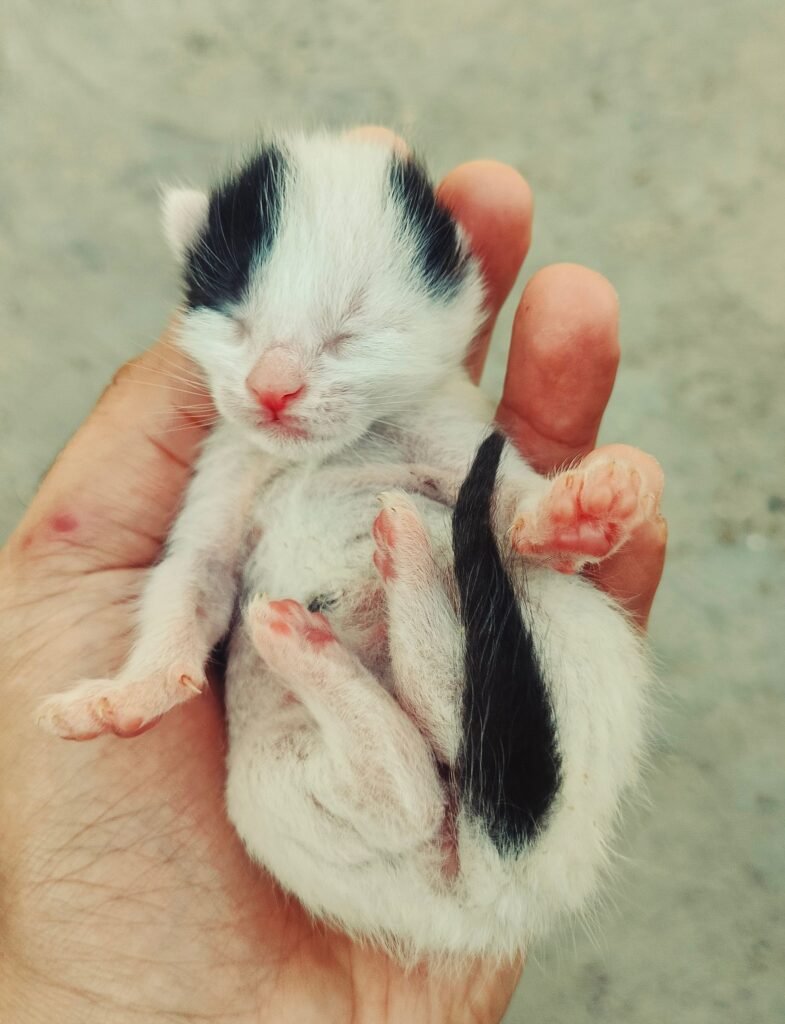
A kitten under a week old is easy to recognise: eyes sealed shut, ears pressed flat against the head, and the umbilical cord stub may still be attached (it usually falls off within the first three to five days). The kitten can’t regulate its own body temperature yet, so it stays curled against its mother or littermates and sleeps nearly all day.

What matters now: warmth and feeding. If you’re caring for an orphaned newborn, it needs kitten milk replacer every 2–3 hours, round the clock — never cow’s milk. Keep the kitten warm (around 29–32°C) with a heat pad set on low, wrapped in a towel so there’s no direct contact. As the kitten grows, stretch the feeds: roughly every 2 hours in week 1, every 4 hours in week 2, and every 5 hours in week 3; from week 4, start offering gruel (kitten milk replacer mixed with a little wet kitten food) alongside the bottle.
When you bottle-feed, always keep the kitten belly-down on your lap or a warm towel — never feed a kitten on its back like a human baby. Milk can flow into the lungs instead of the stomach when a kitten is fed on its back, causing aspiration pneumonia, which can be fatal. Belly-down is how kittens nurse from their mother, letting them suckle and swallow safely at their own pace.
1–2 Weeks: Eyes Start to Open
Between 7 and 10 days, the eyes begin to open — usually the inner corners first. Don’t be alarmed if they look a little gummy; that’s normal. All kittens are born with blue eyes at this stage, and the ears remain folded. The kitten will start crawling with more purpose, usually toward warmth or the mother’s scent.
What matters now: the eyes should open on their own. Never try to pry them open. If an eye looks swollen, crusted shut, or is producing discharge after day 10, that’s worth a vet call — eye infections are common and treatable in young kittens.
2–3 Weeks: Blue Eyes, Unfolding Ears
By the third week, the eyes are fully open (still blue) and the ears start standing up. You’ll see the first genuinely wobbly attempts at walking. The kitten is becoming aware of its surroundings and may startle at loud noises — hearing is developing rapidly now.
What matters now: this is when many carers introduce a shallow litter tray. Kittens often start imitating their mother, so placing them in the tray after meals can kick-start the habit early.
3–4 Weeks: Teeth Arrive, Personality Emerges
The tiny incisors (front teeth) push through around week 3–4, and the ears are now upright. The kitten starts venturing away from the nest, playing clumsily with littermates, and showing the first real glimpses of personality. Balance is still terrible — expect plenty of face-plants.

What matters now: you can begin offering gruel — kitten milk replacer mixed with a little wet kitten food into a soupy texture. Most kittens walk straight through the bowl at first. That’s normal and, frankly, funny.
4–6 Weeks: Weaning in Earnest
The canine teeth appear around week 4, followed by premolars. By week 5–6, the kitten should be lapping gruel confidently and nursing less. Play becomes the main event: stalking, pouncing, wrestling, and ambushing anything that moves, including your ankles.
What matters now: gradually thicken the gruel until it’s mostly wet food by week 6–7. Fresh water should always be available. This is also the prime socialisation window — gentle handling by different people, exposure to household sounds, and positive experiences now shape a confident adult cat.
6–8 Weeks: The Full Kitten Experience
All 26 baby teeth are in by around 7–8 weeks, and the eyes are shifting from blue toward their adult colour (green, gold, copper — though some cats keep blue eyes). The kitten can run, climb, and get into everything. Weight is roughly 650–900 grams.

What matters now: first vaccinations are typically given at 8–9 weeks, so this is the time to book a vet appointment if you haven’t already. The vet will also check for fleas, worms, and general development.
8–12 Weeks: Almost Ready for the World
The kitten now looks like a miniature cat. Eye colour settles, coordination is sharp, and social skills are developing fast through play with littermates — this is where kittens learn bite inhibition and boundaries.

What matters now: most experts and breeders recommend kittens stay with their mother and littermates until 12 weeks (not 8). Those extra weeks teach crucial social skills that prevent behaviour problems later. If you’re adopting, 12+ weeks is ideal, though 8 weeks is the widely accepted minimum. Spaying or neutering is often possible from around 8 weeks, once the kitten reaches about 2 lb (900 g) — your vet will advise on the right timing at the first vaccination appointment.
Beyond 12 Weeks: Ageing a Kitten From 3 to 12 Months
The kitten age chart above stops at 12 weeks because that is when the week-by-week changes slow down. Ageing an older kitten is less exact, but several clues still narrow it down.

Teeth remain the best guide. Baby teeth start falling out from about 3–4 months as the 30 adult teeth push through, and the full adult set is usually complete by 6 months. A kitten with a mouthful of clean, white adult teeth and no tartar is typically between 6 and 12 months old.
Size and weight help too, though breed and sex matter. Growth slows after about 4 months: many kittens weigh roughly 2 kg at 4 months and 3–4 kg at 6 months, and by 8–10 months most look like small adults.
Two more clues: eye colour is final by about 3 to 4 months, and sexual maturity arrives at 4–6 months — females can come into season surprisingly early, which is why most vets recommend neutering around 4–6 months. Behaviour stays kittenish well into the first year, with peak play, climbing and boundary-testing.
The difference between spaying and neutering
Past 6 months, only a vet can usually pin the age down, using teeth condition and overall development. It is worth a visit anyway: vaccinations, parasite treatment and neutering advice all fall due in this window.
How to Age a Kitten You’ve Found: A Quick Method
- Weigh the kitten with kitchen scales. Under 150 g suggests under a week; around 400–500 g suggests 4–5 weeks; near 1 kg suggests 8+ weeks.
- Check the eyes. Closed = under 7–10 days. Blue and open = 2–6 weeks. Changing colour = 6–8 weeks.
- Check the ears. Flat = under 2 weeks. Unfolding = 2–3 weeks. Upright = 4+ weeks.
- Check the teeth. Gently lift the lip. No teeth = under 3 weeks. Tiny front teeth = 3–4 weeks. Pointy canines = 4–5 weeks. Full set of small sharp teeth = 6+ weeks.
Combine all four rather than relying on one. A malnourished kitten may weigh less than its age suggests, but teeth and ears don’t lie as easily. For a visual cross-check, compare your kitten with the week-by-week photos in Alley Cat Allies’ kitten progression guide.
When to See a Vet Regardless of Age
- Eyes that won’t open by day 14, or any swelling/discharge
- Not gaining weight over several days — for kittens under 8 weeks, a weight plateau is an emergency (weigh daily for orphans under 4 weeks)
- Constant crying, lethargy, or refusal to eat
- Diarrhoea, vomiting, or laboured breathing
- A kitten found alone that feels cold — warm it gradually and seek advice promptly
Two of these warning signs deserve a closer look. Our guide to blood in cat stool explains what different colours and consistencies mean and when to call the vet, while our coughing cat guide covers the breathing warning signs to watch for.
Frequently Asked Questions
How can you tell a kitten’s age by its weight?
Weight is a helpful starting point: roughly 100 g at birth, gaining about 100 g per week for the first month. But it’s only an estimate — always cross-check with eyes, ears, and teeth, since underfed or small-breed kittens can weigh less than expected for their age.
At what age do kittens open their eyes?
Most kittens open their eyes between 7 and 10 days old. If the eyes aren’t open by day 14, or if they look swollen or produce discharge, contact a vet.
When do kittens get teeth?
Incisors appear around 3–4 weeks, canines at 4–5 weeks, and the full set of 26 baby teeth is usually in by 7–8 weeks. Adult teeth start replacing them around 4 months.
What age can kittens leave their mother?
12+ weeks is ideal. While 8 weeks is the widely accepted minimum for kittens to leave their mother, kittens separated at 8 weeks miss critical social learning from their mother and littermates, which can lead to biting, fearfulness, and litter-box problems.
How old is a kitten with blue eyes?
All kittens are born with blue eyes. The colour typically starts changing around 6–7 weeks and settles by 3–4 months. A kitten with fully blue, open eyes is most likely between 2 and 6 weeks old.
Can you tell a kitten’s age from its weight alone?
Not reliably. Weight is a helpful starting point — roughly 100 g per week of age for the first month — but breed, sex, and nutrition all cause variation. A small breed or underfed kitten will weigh less than its age suggests. Always cross-check with teeth, eyes, and ears using the kitten age chart above.
How accurate is a kitten age chart?
Within about a week for kittens under 8 weeks old, when the milestones are most distinct — eyes opening, ears unfolding, and teeth arriving on a strict timetable. After 8 weeks the ranges widen because weight varies by breed, sex, and nutrition. Treat the chart as a solid estimate and ask your vet to confirm at the first check-up.
My kitten is smaller than the chart says — is something wrong?
Not necessarily. Runts, naturally small breeds, and kittens that had a rough start often sit below the averages. What matters most is steady, daily weight gain. If your kitten stops gaining for several days, seems lethargic, or refuses food, see a vet promptly — those are the real warning signs, whatever the chart says.
How do I tell if a kitten is a boy or a girl?
Lift the tail gently and look at the two openings underneath. In females they sit close together, like a semicolon or lowercase ‘i’; in males the gap is noticeably wider, like a colon. From 6–10 weeks you may also see two tiny testicles in the gap.
When can kittens eat solid food?
You can offer gruel — kitten milk replacer mixed with wet kitten food — from about 4 weeks. Most kittens are eating mostly wet food by 6–7 weeks and are fully weaned by 8 weeks.
When do kittens get their first vaccines?
First vaccinations are typically given at 8–9 weeks, followed by boosters your vet will schedule. Book the first vet visit around 8 weeks so vaccinations, flea and worm treatment, and neutering plans are all covered.
When is a kitten officially an adult cat?
Most vets and cat organisations consider a kitten an adult at 12 months old. By their first birthday, cats have their full adult teeth, have usually reached their adult size, and are sexually mature — though large breeds like the Maine Coon can keep growing until 18 months or even 2 years. Behaviourally, many one-year-olds are still wonderfully kittenish, but nutritionally they should move from kitten food to adult cat food around 12 months.
Kitten Age in Human Years
Once your kitten moves past the 12-week mark on the kitten age chart above, the week-by-week clues fade — and a new question usually pops up: how old is that in human years? It is more than curiosity. Knowing whether your six-month-old counts as a toddler or a teenager in human terms helps you make sense of the chaos.
Vets commonly use a simple formula: the first year of a cat’s life equals about 15 human years, the second year adds about 9, and every year after that counts as roughly 4. On that maths:
- 6 months ≈ 10 human years
- 8 months ≈ 13 human years
- 1 year ≈ 15 human years
- 18 months ≈ 21 human years
- 2 years ≈ 24 human years — then about 4 per year after that
Treat these as rough equivalents rather than exact science; a kitten’s development does not map neatly onto ours. Below about six months, vets usually stick to weeks and months anyway, because the changes come so fast that ‘human years’ stops being useful. Your vet can map your cat’s age precisely against their growth records at a check-up.
Boy or Girl? How to Tell a Kitten’s Sex
Ageing a kitten usually raises a second question within minutes: is it a boy or a girl? It is worth finding out early. It helps you choose a name, and it lets your vet plan ahead — neutering is usually discussed from around four months.
The check itself is simple but needs a gentle hand. Wait until the kitten is calm — just after a feed, when it is sleepy, is ideal — then lift the tail softly and look at the two openings underneath:
- Female: the anus and the vulva sit close together, so the pair looks a bit like a semicolon or a lowercase ‘i’.
- Male: the gap between the anus and the penis opening is noticeably wider, so the pair looks more like a colon. From about six to ten weeks you may also see — or gently feel — two tiny testicles in that gap.
Keep it brief: young kittens chill quickly, so do not keep one belly-up for long, and wash your hands before and after. If the kitten wriggles too much or you genuinely cannot tell, do not guess — your vet can confirm it in seconds at the first check-up.
Kitten Weight in Pounds and Ounces
The kitten age chart above uses grams, which suits most of the world — but if you think in ounces and pounds, here is the same weight guide converted. A handy rule of thumb: a healthy kitten gains about 3½ oz a week, so a one-pound kitten is roughly a month old and a three-pound kitten roughly three months old.
- Under 1 week: 3–5 oz
- 1–2 weeks: 5–9 oz
- 2–3 weeks: 9–12 oz
- 3–4 weeks: 12 oz–1 lb
- 4–6 weeks: 1–1.5 lb
- 6–8 weeks: 1.5–2 lb
- 8–12 weeks: 2–3.3 lb
How to Tell If a Kitten Is Under a Week Old
The youngest kittens are the easiest to age — and the most urgent to help. A kitten under a week old has its eyes sealed shut and its ears pressed flat to its head, and it cannot regulate its own body temperature yet. But the clearest single clue is the umbilical cord: if a dried stump is still attached to the belly, the kitten is almost certainly under a week old, as the stump usually shrivels and drops off within the first three to five days. A kitten this young needs warmth and feeding every couple of hours — work through the newborn rows of the kitten age chart above to confirm.
Photo Credits
Photographs in this guide come from Wikimedia Commons contributors: the three-hour-old newborn (Mrmiscellanious, public domain); the three-week-old kitten (Broc, CC BY); the four-week-old kitten (Broc, CC BY 3.0); six-week-old Charlie (P4l4d1um, CC BY-SA 3.0); the eight-week-old Himalayan Blue Point kitten (Asilverstein, CC BY-SA 3.0); and the three-month-old blue kitten (Andrew, CC BY 2.0). Additional photographs: young kitten with blue eyes (Gizem Gökce via Pexels, free licence); newborn kitten resting in a human hand (Orkhan Sweden via Pexels, free licence).







4 Comments