

How Do Cats See Humans? What You Look Like to Your Cat
Your cat sees you as a tall, blurry shape — and knows you by your voice and scent, not your face. How cats see humans, what they think of you.
Your cat watches you all day. It follows you from room to room, stares at you while you sleep, and comes running when you call. So it is natural to ask how do cats see humans — what do you actually look like through your cat’s eyes?
Quick Answer
The short version is humbling. You are a tall, soft-edged shape in muted colours, with a face your cat can barely make out. But your cat knows exactly who you are. It just does not use its eyes to work it out.
How Do Cats See Colour?
Short answer: muted blues and yellows. Reds and greens blur together.
Cats have two kinds of colour sensors in the eye. We have three. That one missing sensor changes the whole picture.
Blues and yellows come through clearly. Reds and greens do not. A bright red toy looks dull and greyish to your cat, while a blue or yellow toy stands out. It is a little like red-green colour blindness in people.

Researchers put the neutral point — where blue and green meet and look grey — at around 505 nanometres (Clark and Clark, 2016). Cornell’s Dr Bruce Kornreich puts it simply: cats “do well with blues and yellows, but have a little more trouble distinguishing greens and reds.”
So no, your cat does not see in black and white. It sees a softer version of your world — blue and yellow in focus, red and green washed out.
Can cats see ultraviolet light?
A cat’s lens lets through about 59% of UVA light (Douglas and Jeffery, 2014, Proceedings of the Royal Society B), far more than a human lens, so ultraviolet light reaches a cat’s retina. That may help a cat spot things we cannot see. Urine marks reflect UV, so a cat may follow a scent trail by sight, and white fur reflects UV strongly, so a white patch may look brighter to your cat than it does to you. The behaviour is unproven, but the eyes are built for it.
How Sharp Is a Cat’s Vision?
Short answer: much softer than yours. What you read at 100 feet, your cat needs to be within about 20 feet to read.
A cat’s vision is usually measured at about 20/100 to 20/200. That means a cat standing 20 feet from something sees it about as clearly as you would from 100 to 200 feet away.
Sources give different figures because they measure sharpness differently: PetMD, quoting veterinary ophthalmologist Paul Miller, puts it at about 20/30, while other sources give 20/100 to 20/200.
Fine detail — the lines on your face, the print in a book — is lost on them.
The numbers online are muddled, so here is the honest version. Some pages say a cat focuses best at 6 to 20 inches. Others say its best vision is 6.5 to 19 feet. Both cannot be the “best range”.
A cat sees sharpest at close range — a few feet from its face, about 2 to 3 feet at best. Things closer than about 10 inches turn blurry, because a cat cannot focus that near. And beyond about 20 feet, detail fades fast.
So the “6 to 20 inches” line mixes up two different facts: the near-focus limit (under about a foot, things blur) and the best range (a few feet out). The 6.5 to 19 feet figure is the outer part of that same sharp range.
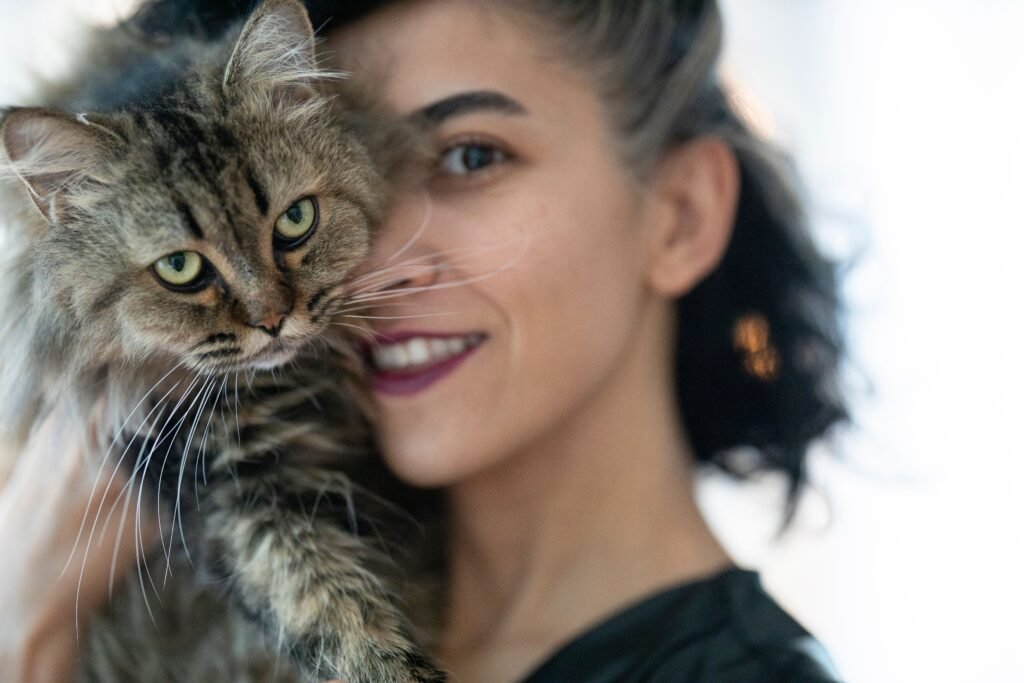
What does that mean for your face? At normal talking distance your cat sees you at its sharpest — and still without fine detail. Nose to nose, your face is a blur. That is why a cat that comes in close switches to sniffing and headbutting. Its nose takes over where its eyes give up.
How Do Cats See at Night?
Short answer: no true night vision, not in total darkness. But in dim light they see far better than you: Cornell puts a cat’s sensitivity to light at about six times greater than a human’s.
We cover the full detail — the numbers, the glowing eyes, kittens and seniors, and when poor night sight needs a vet — in our guide to whether cats have night vision.
How Do Cats See Movement?
Short answer: they spot small movements at the edges of their sight — and in dim light they beat you. In bright daylight, you beat them.
A cat’s field of view is about 200 degrees, against about 180 degrees for you. That wider view helps it catch movement at the edges, where your sight stops.
Movement is what a cat’s eyes are built for. A flick of a hand, a twitch at the edge of the room, a moth crossing a dim hallway — a cat notices all of it. A still face across the room holds far less interest.
In bright light, humans are 10 to 12 times better than cats at spotting motion, according to the vet eye specialist Miller, cited by PetMD. In dim light the balance flips, and the cat’s rod-packed retina takes over.
So your cat may ignore you standing still and snap to attention the moment you move. It is watching the way a hunter watches — for movement first, detail second.
Do Cats Recognise Your Face?
Short answer: probably not. Your cat knows your size, shape, walk and voice — not your features.
This is the part most owners find hardest to believe. A 2005 study in the Journal of Vision tested 12 cats and 12 dogs. Each animal had to pick its handler’s face from a pair of photos.
The cats picked their handler’s face 54.5% of the time — barely better than chance. The dogs picked theirs 88.2% of the time. The same cats were far better with cat faces: they picked a familiar cat’s face 90.7% of the time. So cats can tell faces apart. Human faces just do not matter much to them.
Cats Protection puts it plainly: “It’s unlikely your cat will know you by your face. Cats are likely to see their owners as grey and blurry shapes.” Dogs are better at human faces, they add, because dogs have lived alongside people for much longer than cats have.
What your cat does know is your shape. You are tall, you move a certain way, you sound a certain way, you smell a certain way. Change your outline suddenly — a big hat, a major haircut, new glasses — and your cat may hesitate until your voice or scent gives you away.
That is how cats see humans: not as faces, but as shapes, sounds and smells.
If your cat holds your gaze for a long time, our guide to why cats stare at you explains the nine most common reasons — and when a stare is worth a vet visit.

Does Your Cat Know Your Voice?
Short answer: yes. Your voice is the most reliable “face” your cat has.
In a 2013 study in Animal Cognition, researchers played recordings of owners calling their cat’s name, mixed with strangers’ voices. Twenty cats took part. The cats could tell their owner’s voice from a stranger’s using sound alone. They answered with small movements — an ear turn, a head turn — not by meowing back.
Cats also know their own name. In a 2019 study in Scientific Reports, 77 house cats picked their own name out from similar-sounding words, even when a stranger said them. Knowing a name is not the same as obeying it.
Cats even notice how you talk to them. Cats Protection notes that cats can detect the small changes in an owner’s voice when they are being spoken to directly, rather than overhearing a conversation with someone else.
So talk to your cat before you touch it. Your voice reaches it before your face does — and it is the sound your cat trusts most.
Your voice is the giveaway, your face is not. In Saito’s 2013 study, 20 cats reacted more to their owner’s voice than a stranger’s, and de Mouzon’s 2023 study of 16 cats found they picked their owner’s voice from a stranger’s. With faces alone, cats failed: in a 2005 photo test, they could not reliably pick their owner from a stranger. Voice first, face second.
How Does Your Cat Smell You?
Short answer: your scent is your ID. A cat’s nose is its main way of knowing who you are.
VCA Animal Hospitals puts a cat’s nose at 45 to 80 million scent receptors — possibly up to 200 million — against about 5 million in a person. They call a cat’s sense of smell about 14 times more sensitive than ours.
Cats also carry a second smell system: the vomeronasal organ, or Jacobson’s organ, in the roof of the mouth. It picks up chemical signals that have no smell at all, including pheromones. The open-mouthed grimace a cat makes after sniffing something — the flehmen response — is that organ at work.
Your scent is personal. A cat that sniffs you when you come home is checking where you have been. It can tell you have been near another cat, or a vet clinic, or a new place.
Scent is how cats see humans best. Your face may be a blur, but your smell is a signature.
Can Cats Read Your Emotions?
Short answer: a little — and mostly from your voice and posture, not from reading your mind.
In a 2016 study in Animal Cognition, researchers showed cats happy and angry human faces and postures, then played happy and angry voices. The cats were only modestly sensitive to the difference, and more so with their own owner than with a stranger. They behaved more positively when their owner looked and sounded happy.
A 2020 review in the journal Animals found the same pattern across studies: cats combine what they see and hear to work out human feelings, matching a happy face to a happy voice and an angry face to an angry voice.
But noticing a change is not the same as understanding it. Your cat can tell your voice, posture and scent have changed. There is no good evidence it understands sadness the way you do.
That is part of why cats come to you when you cry — they have noticed something unusual and come to check it, not because they have diagnosed your feelings.
What Are We to Our Cats — Big Cats or Family?
Short answer: neither, quite. They treat us much as they treat other cats — but they know we are not cats.
You may have read that cats see us as “big, stupid cats” or as oversized kittens. There is no study behind either line.
The “big cats” idea comes from John Bradshaw, a cat behaviour specialist and author of Cat Sense. In a 2014 interview he said: “We’ve yet to discover anything about cat behavior that suggests they have a separate box they put us in when they’re socializing with us.” He corrected the “stupid” part himself: cats rub against us, which they do not do to a cat they see as inferior, though he did say cats think we are clumsy: “Not many cats trip over people, but we trip over cats.”
If there is a closer word than “big cat”, it is family. In a 2019 study in Current Biology, researchers tested attachment in cats the same way it is tested in human babies and dogs. Of 70 kittens, 64.3% were securely attached to their person. Of 38 adult cats, 65.8% were. Human babies score about 65%.
What Is Your Cat Telling You?
Short answer: watch the whole cat. The eyes start the story, but the body finishes it.
Your cat’s behaviour towards you is the other half of how it sees you. Each of these is a message, not a mystery.
The headbutt. Your cat presses its head and cheeks against you. Scent glands sit on the cheeks, chin and forehead, so a headbutt marks you with your cat’s scent — the same way cats rub on other cats they trust.
The slow blink. Your cat looks at you and closes its eyes slowly, then opens them again. In a 2020 study from the Universities of Sussex and Portsmouth, cats narrowed their eyes more when their owner slow-blinked at them, and were more likely to approach an unfamiliar person after a slow blink than after a neutral face. The researchers think it may be a form of positive communication — though the samples were small and more work is needed.
Kneading. Your cat pushes its paws in and out on your lap or a blanket. Kittens knead their mother while nursing, and many cats keep the habit for life. It is a sign of comfort, not a demand.
Grooming you. Your cat licks your hand, your hair or your face. Cats groom cats they are bonded with. A cat that grooms you is treating you as part of its social group.
Gifts. Your cat leaves a dead mouse — or a toy — at your feet. Bringing prey home is normal hunting behaviour. The popular idea that your cat is teaching you to hunt, or thinks you are a bad hunter, is a guess, not a finding.
The meow. Adult cats rarely meow at each other. Kittens meow to call their mother, then mostly stop by four or five months old. The meow you hear is a sound cats kept for people, shaped by what works on you. Many cats start talking the moment you pick up the phone — our guide to why cats meow when you are on the phone explains the six most common reasons.
Cat Vision vs Human Vision
Short answer: your cat trades detail and colour for dim light, movement and smell.
| Cat | Human | |
|---|---|---|
| Colour | Muted blues and yellows; reds and greens hard to tell apart | Full colour range |
| Sharpness | About 20/100 to 20/200 (about 20/150) | 20/20 |
| Best distance | Sharpest at a few feet (about 2–3 feet); clear up to about 20 feet; blurry closer than about 10 inches | Sharp at any distance; fine detail at 100–200 feet |
| Field of view | About 200° | About 180° |
| Night and low light | About six times more sensitive to light (Cornell); still needs some light | Needs far more light to see clearly |
| Movement | Spots small movements; better in dim light; in daylight humans are 10–12× better at spotting motion | Better at spotting motion in daylight |
| Hearing | Hears from about 45 hertz to about 85 kilohertz (Zoetis Petcare) — over three times the upper limit of human hearing | About 64 hertz to about 23 kilohertz |
| Scent | 45–80 million scent receptors, possibly up to 200 million (VCA); about 14× more sensitive | About 5 million scent receptors |
How to Be Recognised by Your Cat
Short answer: use your voice first, let your cat sniff you, and keep your shape and routine steady.
You cannot make your cat see your face better. But you can make yourself easier to recognise, using the senses your cat actually trusts.
How do you say hello to a cat?
Do not stare. A long, hard stare can read as a threat to a cat. Try the slow blink instead.
- Catch your cat’s eye softly, with a relaxed face. Do not lean in.
- Close your eyes slowly, over about a full second.
- Hold them shut for a beat, then open them slowly and look slightly away.
- Wait. Many cats slow-blink back, look away contentedly, or come closer.

If your cat flattens its ears or walks off, no harm done. Try again another time, when it is relaxed.
How do you help your cat recognise you?
- Talk before you touch. Say your cat’s name as you approach, so your voice arrives first.
- Offer a hand to sniff. Let your cat come to your hand rather than reaching over its head.
- Get down to its level. Crouch instead of looming — you are very tall from a cat’s point of view.
- Keep your routine and places steady. The same feeding spot, the same bed, the same morning pattern all help your cat know it is you.
- Do not change your scent or shape all at once. A new perfume, a strong soap, a big hat, new glasses or a major haircut can all make you look — and smell — like a different person. If you change your look, let your cat sniff you first.

What should a new person do?
- Let the cat approach. Do not chase it or reach for it.
- Speak softly and move slowly.
- Offer a hand to sniff, then wait. If the cat rubs against the hand, it has accepted the greeting.
- Give the cat an escape route. A cat that can leave will relax faster than one that feels cornered.
What if you have been away on holiday?
Your cat will very likely still know you — Cats Protection says cats recognise their owners even after time apart, through smell and voice. But give it a moment.
- Let your cat sniff you first when you walk in.
- Do not force cuddles. Sit down and let it come to you.
- A reunion at home works better than one in a strange place, where new smells and sounds compete.
- Your cat will not have been thinking about you while you were away. Cats live in the moment. It will remember you when it sees, hears and smells you again.
Do cats worry while you are away? Some do. Cats can develop separation anxiety (Cornell CatWatch): a few cry, pace, groom too much or toilet outside the box when their person is gone. Most cats simply sleep and wait, and a cat that rests calmly while you are out is coping, not sulking.
What if your cat comes home from the vet?
Your cat smells of the clinic, not of home. The cats it lives with may act as if they do not know it at first — hissing, avoiding it, or refusing to share a bed.
- Keep the cats apart briefly until the returning cat smells like home again.
- Swap bedding between them so the home scent spreads.
- Let them re-sniff each other in their own time. Do not force them together.
This usually settles within a day. If the tension lasts longer, ask your vet.
When does poor vision need a vet?
Most vision loss in cats builds slowly, over years, and mostly in middle-aged and older cats. Early checks matter, because some causes can be treated if they are caught in time.
See your vet the same day if your cat:
- Suddenly bumps into walls or furniture, or seems blind in a room it knows well
- Has one pupil much wider than the other, or a pupil that stays wide in bright light
- Has cloudy eyes, or eyes that look hazy when they used to be clear
- Suddenly stops recognising you, or stares blankly into space
- Has a red, swollen or watery eye, or holds one eye shut
Cornell’s feline vision page lists the causes, from cataracts and eye pressure problems to high blood pressure, an overactive thyroid and kidney disease. In some cases prompt treatment can restore partial vision — but in most cases, once vision is gone, it does not come back.
That is how cats see humans — not as a face to study, but as a familiar shape, voice and scent to trust.
This article explains research and general cat behaviour. It is not veterinary advice. If your cat’s sight or behaviour changes suddenly, ask your vet.
Key Takeaways
- You look like a tall, soft-edged shape in muted blues and yellows. Your face is a blur to your cat.
- A cat sees sharpest at a few feet. Closer than about 10 inches, and beyond about 20 feet, detail fades.
- Cats cannot see in total darkness. In dim light their eyes are about six times more sensitive than ours (Cornell).
- Your cat almost certainly does not know you by your face. In a 2005 study, cats picked their handler’s face only about half the time.
- Your cat knows your voice (Saito 2013) and its own name (Saito 2019) — and it can tell when you are talking to it.
- A cat’s nose carries 45 to 80 million scent receptors, possibly up to 200 million (VCA). Scent is its main ID check.
- Cats behave towards us much as they do towards other cats, but they know we are a different species (Cats Protection; Bradshaw).
- Say hello with a slow blink, not a stare. Let a new person be sniffed first. See a vet fast if your cat suddenly bumps into things or its eyes cloud over.
Frequently Asked Questions
Do cats see us with cat faces?
No. Cats see a tall human shape, not a cat face. Their vision is too soft for fine facial detail, and a 2005 study found cats picked their handler’s face only about half the time. They treat us much as they treat other cats, but they know we are a different species — and a much bigger one.
Can cats see in the dark?
No, not in total darkness. A cat’s eyes need light to work, just like yours. In dim light they do far better than us — Cornell puts their sensitivity to light at about six times ours. In a room with no light at all, they feel their way with whiskers, hearing and memory.
What colours can cats see?
Cats see muted blues and yellows best, and have trouble telling reds from greens — a little like red-green colour blindness in people. They have two kinds of colour sensors in the eye, where we have three. A bright red toy looks dull and greyish to a cat, while a blue or yellow toy stands out clearly.
Do cats see better or worse than dogs?
It depends what you mean by better. Dogs read human faces far better — in one study dogs picked their handler’s face 88% of the time, cats only about 55%. Cats rely more on scent and voice than on faces, while dogs watch faces closely. Each species sees the world its own way, tuned to the life it evolved for.
Do cats see us as big cats, or as family?
Neither, quite. Cats behave towards us much as they do towards other cats — headbutts, kneading, slow blinks — but they know we are a different species, and a bigger one. The closest word is family: most cats form an attachment bond with their person, much like a kitten with its mother.
Should I meow back at my cat?
You can — it will not harm your cat, and many cats answer back. But your cat does not hear words, only sounds, so a meow back is just another noise to them. A slow blink, a soft voice and a hand to sniff say far more to a cat than any meow you can make.
Does my cat know my face?
Probably not well. In a 2005 study, cats picked their handler’s face only about half the time — barely better than chance — while they picked a familiar cat’s face almost every time. Your cat knows you by your voice, your scent, your size and your walk. Your face is the least useful part of you to a cat.
Will my cat recognise me after a long holiday?
Very likely, yes. Cats have a good memory for the people they are bonded with, and they recognise a familiar smell and voice even after weeks apart. They may need a moment when you walk in — let them sniff you first. A reunion at home works better than one in a strange place, where new smells and sounds compete.
Do cats recognise themselves in a mirror?
No. A cat that sees its reflection does not realise it is looking at itself. It will either ignore the mirror or treat the reflection as another cat — which can be stressful. Never force your cat to look in a mirror, and always give it a way to walk away from the ‘other cat’ if it wants to.
How far away can my cat recognise me?
Close, then further than you think. Your cat focuses sharpest at 2–3 feet, about arm’s length, and things blur closer than about 10 inches. But it can still make you out across the room: its sight stays clear out to about 20 feet, and the 6.5 to 19 feet figure is the outer part of that same sharp range. PetMD, quoting veterinary ophthalmologist Paul Miller, puts feline acuity at about 20/30, so a cat sees clearly from 20 feet what you see clearly from 30 feet. But your face is only one clue: your voice, your walk and your smell tell it who you are from further still.
Sources
- Saito, A. & Shinozuka, K. (2013). Vocal recognition of owners by domestic cats (Felis catus). Animal Cognition, 16(4), 685–690. https://pubmed.ncbi.nlm.nih.gov/23525707/
- Saito, A. et al. (2019). Domestic cats (Felis catus) discriminate their names from other words. Scientific Reports, 9, 5394. https://pubmed.ncbi.nlm.nih.gov/30948740/
- Galvan, M. & Vonk, J. (2016). Man’s other best friend: domestic cats and their discrimination of human emotion cues. Animal Cognition, 19(1), 193–205. https://pubmed.ncbi.nlm.nih.gov/26400749/
- Quaranta, A. et al. (2020). Emotion Recognition in Cats. Animals, 10(7), 1107. https://www.mdpi.com/2076-2615/10/7/1107
- Vitale, K. R., Behnke, A. C. & Udell, M. A. R. (2019). Attachment bonds between domestic cats and humans. Current Biology, 29(18), R864–R865. https://doi.org/10.1016/j.cub.2019.08.036
- Humphrey, T. et al. (2020). The role of cat eye narrowing movements in cat–human communication. Scientific Reports, 10, 16503. https://doi.org/10.1038/s41598-020-73426-0
- Lomber, S. G. & Cornwell, P. (2005). Dogs, but not cats, can readily recognize the face of their handler. Journal of Vision, 5(8), 849. https://doi.org/10.1167/5.8.49
- Cats Protection. Do cats recognise their owners? https://www.cats.org.uk/cats-blog/do-cats-recognise-their-owners
- Cornell University College of Veterinary Medicine. Feline Vision Problems: A Host of Possible Causes. https://www.vet.cornell.edu/departments-centers-and-institutes/cornell-feline-health-center/health-information/feline-health-topics/feline-vision-problems-host-possible-causes
- VCA Animal Hospitals (Williams, K., Llera, R. & Buzhardt, L.). Why Cats Sniff Rear Ends. https://vcacanada.com/know-your-pet/pet-health-articles/why-cats-sniff-butts
- Zoetis Petcare (Brandley, M.). How Do Cats See Humans? https://www.zoetispetcare.com/blog/article/how-cats-see-humans
- Bradshaw, J. (2014). “What Do Cats Think About Us?” National Geographic interview.
- (Quotes verified from the interview text; no link captured.)
- Douglas, R. H. & Jeffery, G. (2014). The spectral transmission of ocular media suggests ultraviolet sensitivity is widespread among mammals. Proceedings of the Royal Society B, 281(1780), 20132995. https://pmc.ncbi.nlm.nih.gov/articles/PMC4027392/
- de Mouzon, C., Gonthier, M. & Leboucher, G. (2023). Discrimination of cat-directed speech from human-directed speech in a population of indoor companion cats (Felis catus). Animal Cognition, 26(2), 611–619. https://pubmed.ncbi.nlm.nih.gov/36280656/
- Cornell CatWatch Newsletter. Separation Anxiety in Cats. https://www.catwatchnewsletter.com/behavior/separation-anxiety-in-cats/
- PetMD. How Cats See the World. https://www.petmd.com/cat/general-health/cat-vision
Photo Credits
- Featured simulation: base photo “Helena Lopes (Pexels 7980681)” — the simulation is a derivative of her photo.
- White cat playing with a bright red toy mouse: Liisbet Luup (Pexels 40061529).
- Woman holding a fluffy tabby cat against her cheek: Engin Akyurt (Pexels 3356488).
- Woman sitting on a couch with a tablet and a ginger cat: Helena Lopes (Pexels 5921738).
- Close-up of a tabby cat with half-closed eyes: Abdel Achkouk (Pexels 30601949).
- Woman feeding a tabby cat: Pitipat Usanakornkul (Pexels 16597601).




One Comment