
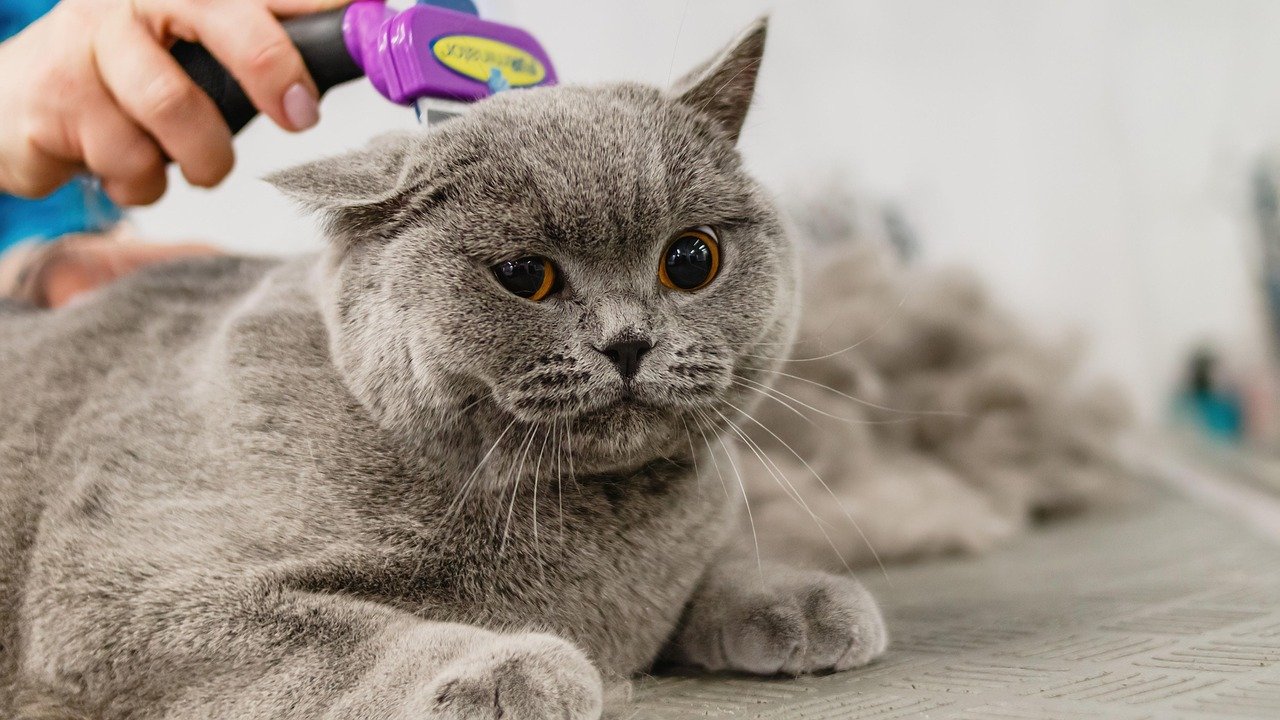
Why Does My Cat Shed So Much? What’s Normal & How to Help
Why does my cat shed so much? What’s normal vs a problem, a 5-minute home check, brushing by coat type, and the signs that need a vet.
Fur on the sofa, fur on your clothes, fur in your coffee. Every cat owner eventually asks why does my cat shed so much — and whether it is normal, or a sign something is wrong.
Usually, it is normal. Shedding is how a cat renews its coat. But some shedding patterns do signal skin disease, parasites, or illness. This guide shows you how to tell the difference with a 5-minute home check.
Quick Answer: Why Does My Cat Shed So Much?
Cats shed to replace old hair with new. Outdoor cats shed heavily in late spring and late autumn; indoor cats shed at low levels all year round (VCA Animal Hospitals). Shedding with a full, even coat is normal. Bald patches, a thinning coat, red or flaky skin, or scratching mean a vet visit.
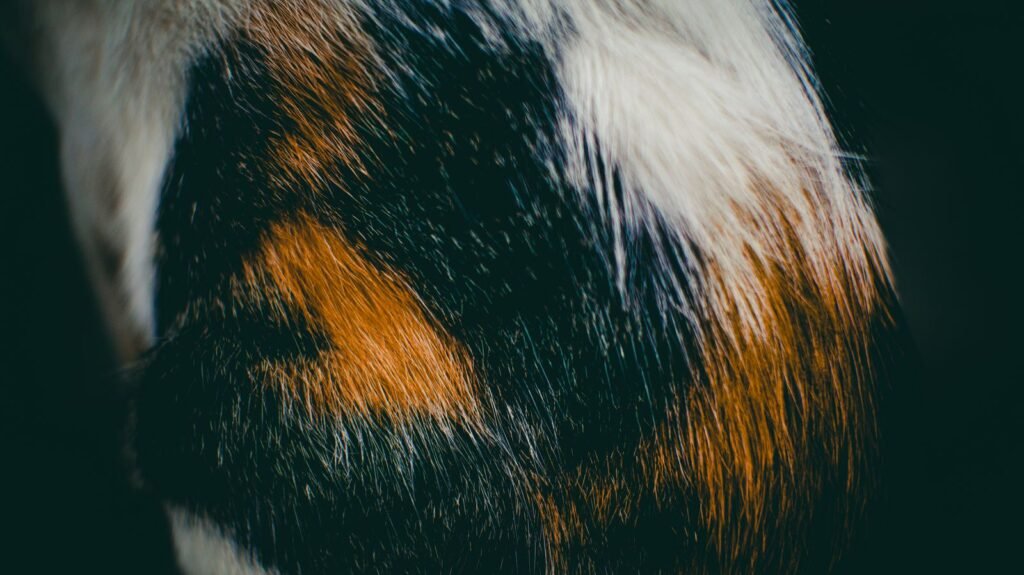
Most cats have a smooth outer coat of guard hairs and a fine, soft undercoat that helps keep them warm (VCA). Hair is shed and replaced several times a year (VCA). Shedding is the loss of dead hair, and new hair grows in its place (PDSA).
Between the guard hairs and the undercoat sit awn hairs, a middle layer that protects the undercoat (National Kitten Coalition). Each hair grows in a cycle: a growth phase (anagen), a short changeover (catagen), then a resting phase (telogen), after which the old hair falls out and a new one grows (Ohio State veterinary histology text).
How Much Shedding Is Normal?
No source gives an exact number of hairs. Use these benchmarks instead:
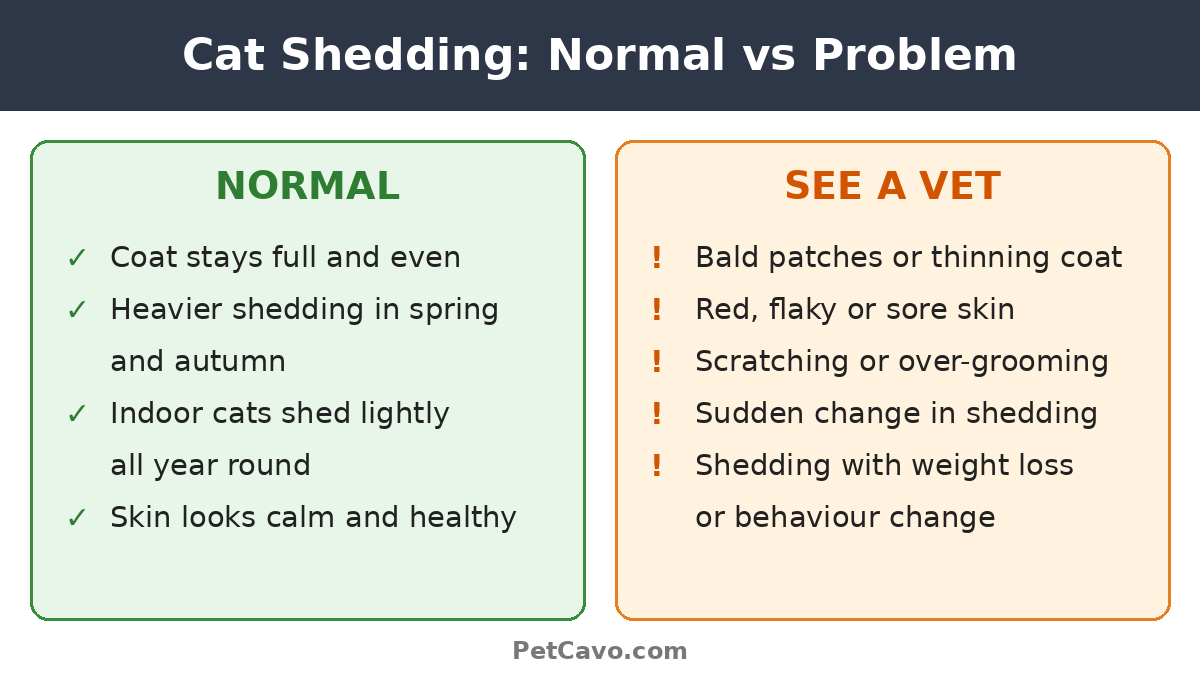
- The coat stays full and even, with no patchy loss or visible thinning.
- Shedding rises in spring and autumn, or stays steady in indoor cats.
- The skin underneath looks calm — no redness, flakes, scabs or sores.
- Your cat is not scratching, over-grooming, or behaving differently.
If all four hold, you have a normal shedder and a housekeeping problem, not a health problem.

Normal Shedding vs Problem Shedding
| Normal shedding | Problem shedding — see a vet |
|---|---|
| Even hair loss all over, coat stays full | Bald patches, patchy loss, or a generally thin coat |
| Seasonal peaks or steady indoor shedding | Sudden heavy loss outside the usual pattern |
| Calm skin, no scratching | Red, flaky, scabby or sore skin; scratching or over-grooming |
| Bright cat, normal appetite | Weight change, lethargy, appetite change with the shedding |
| Hair comes out whole from the root | Hair looks broken off, or skin shows through in one area |
The 5-Minute Home Check
- Look at the pattern. Even all over? Or patches — one side, belly, legs, tail base? Patchy or one-sided loss points to skin disease, parasites, or over-grooming.
- Part the fur and check the skin in a few places: back, belly, behind the ears. Look for redness, flakes (dandruff), scabs, bumps, or sores.
- Do a flea-comb check. Comb the back and tail base over white paper. Black specks that turn reddish on wet paper can be a sign of flea dirt (VCA).
- Watch grooming. Is your cat licking one spot raw, or grooming far more than usual? Over-grooming from itch, stress or pain removes hair in patches.
- Think about recent changes. New food, new home, new pet, new litter, illness, medicines, season change — note anything from the last few weeks.
Write down what you find. If you see a vet, these notes help.
Why Indoor Cats Shed All Year
Outdoor cats take their cue from daylight and temperature, shedding heavily in late spring and late autumn. Indoor cats live under artificial light and steady temperatures, so the seasonal signal blurs — they shed at low levels all year round instead (VCA).
Hair growth responds to daylight and temperature, so a steady indoor routine gives a weaker seasonal cue. That is why indoor fur turns up on bedding and clothes in every month, rather than in two clear peaks.
Steady shedding is only reassuring if the coat stays full and the skin stays calm. Use the home check above if the amount suddenly rises, the coat thins, or scratching starts.
Why Short-Haired Cats Can Shed So Much
Short hair can be easy to see on clothes and furniture, so shedding may feel heavier than it is. With long hair, you may notice more loose hair in the brush than around the home.
Most cats have both outer guard hairs and a soft undercoat, even when the coat looks short. Short hairs also move through their growth cycle faster than long hairs, so loose hairs appear often in small amounts.
Long hairs tend to come away in larger, more visible clumps. Short hairs spread widely and cling to fabric, which can make a normal amount look like a lot. Regular brushing still helps, though short coats need it less often than long coats.
Shedding When Petted, After Brushing, and With Dandruff
“My cat sheds when I pet him”
Stroking loosens hair that was already ready to fall — petting does not pull healthy hair out. A cloud of fur during petting usually means loose coat is built up and a proper brushing session is overdue.
“He still sheds right after brushing”
Brushing removes loose hair, but during peak shedding the coat releases hair continuously, so some shedding right after brushing is normal. If heavy shedding never eases outside shedding season, run the home check above.
“Shedding with dandruff”
Flakes with shedding point to dry or irritated skin — possible causes include parasites, allergies or skin infection, and diet can play a part. Persistent dandruff with scratching, redness or patches belongs to the vet, not the shampoo shelf.
Brushing: How Often, by Coat Type
Based on VCA guidance:
| Coat type | Brushing |
|---|---|
| Long, silky or curly coats | Daily — prevents mats and removes trapped loose hair |
| Short coats | A few times a week; more during seasonal peaks |
| Senior or overweight cats | Short, gentle sessions more often — they cannot reach everything themselves |
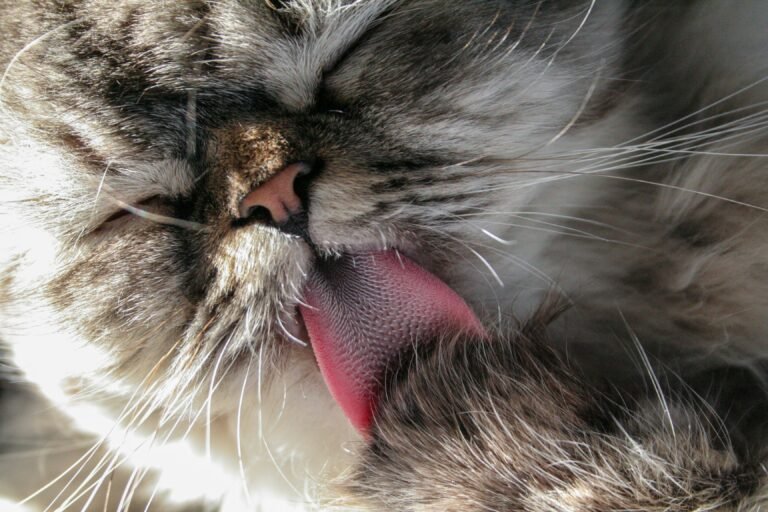
Regular brushing does more than tidy the sofa: it reduces the hair your cat swallows while grooming, which means fewer hairballs (VCA, Cornell). Hairballs are more frequent in shedding seasons, and a large clump can occasionally block the gut (Cornell). Frequent hacking can signal a breathing problem, not just hairballs (Cornell). Our guide to how a cat’s tongue works explains why so much hair gets swallowed in the first place.
Loose undercoat that is not brushed out stays in the coat and comes away in clumps (VCA). That loose hair ends up around the house, so shedding can look heavier than it is (PDSA). A professional groomer or your vet can help if tangles are severe (VCA).
Match the tool to the coat: a stiff bristle brush for short coats, and a long-toothed metal comb for medium and long coats (VCA). Keep sessions short and stop if your cat objects; many stressed cats groom more, not less (PDSA).
Diet and Coat Condition
Coat condition reflects health and nutrition (VCA). A complete, balanced diet supports a healthy coat; dull, brittle fur with heavy shedding can be one sign the diet — or the cat — needs a vet’s look. Do not add supplements at random; fix the base diet first, with your vet’s input if the coat stays poor.
Cats need nutrients that come from animal-based foods, including essential amino acids and fatty acids. Cornell Feline Health Center guidance on feeding advises choosing a food labelled complete and balanced, with meat, meat by-products or seafood among the first ingredients.
Protein quality matters because protein supplies the building blocks for body tissues, including skin and hair. ASPCA nutrition guidance notes that animal-based proteins provide complete amino acid profiles, and that certain omega-6 fatty acids help maintain skin and coat. Omega-3 and omega-6 fatty acids also help the body manage inflammation, including in the skin.
Water supports overall health and coat condition. Keep clean, fresh water available at all times. Wet food contains far more moisture than dry food, so cats fed mainly dry food rely more on drinking water.
Senior and Overweight Cats
Older, arthritic or overweight cats often cannot reach parts of their coat to groom (VCA). Ungroomed areas shed loose hair around the house and can mat. Gentle, frequent brushing of the back and rear helps — and a sudden grooming drop in a senior cat is worth mentioning at the next vet visit, as pain can prevent proper grooming (VCA).
Visible age-related changes often appear from about seven to twelve years. While you brush, part the fur on the back and rear legs and look for mats, flakes, lumps or sore areas that grooming may have missed.
Ask your vet about joint pain, weight and skin health together, rather than brushing harder. If weight loss is needed, follow a vet-led plan.
How to Reduce Shedding: A Simple Plan
Loose hair is easier to manage when you remove it before it spreads. Work through these steps in order.
- Brush to a routine. Brush long coats daily and short coats a few times a week, in short, gentle sessions at a similar time each day. Stop if your cat objects. National Kitten Coalition grooming guidance recommends gentle strokes in the direction the hair grows, with extra care behind the ears, in the armpits and at the back of the rear legs.
- Feed and water well. Feed a complete, balanced diet and keep fresh water available at all times. Ask your vet before adding supplements or changing to a special diet.
- Clear loose fur at home. Vacuum floors and sofas often, use a lint roller on clothes, and wash cat bedding regularly. Brush your cat in one easy-to-clean place, such as on a washable blanket.
- Keep stress low. Keep feeding and play times steady, provide quiet resting and hiding places, and introduce changes slowly. Stress can trigger over-grooming, so note any recent move, new pet or other change.
- Check while you brush. Look for bald patches, scabs, fleas, heavy flakes or sore skin. Book a vet visit if you find any of these, or if shedding suddenly increases.
Shedding vs Hair Loss (Alopecia)
Shedding is even hair renewal with a full coat. Alopecia is hair loss that shows as bald spots, patchy fur or a generally thin coat, and it usually signals an underlying condition — over-grooming from itch, stress or pain, or fur falling out from infection, hormone disease or ringworm (PDSA). If you can see skin where fur should be, that is alopecia, and it needs a vet.
Common medical causes of problem shedding include fleas, bacterial or fungal infection (including ringworm), food allergies and atopy (allergic skin disease), hormone disease such as an overactive thyroid, stress over-grooming and pain (PDSA). Fur usually grows back once the cause is treated.
When to See a Vet
- Patchy loss or a thinning coat.
- Red, flaky, scabby or sore skin, or persistent dandruff.
- Scratching, over-grooming, or licking one area raw.
- Sudden heavy shedding with weight, appetite or behaviour change.
- Fleas found on the comb check that you cannot clear.
- Shedding that never eases, in a cat whose coat looks worse month by month.
More Questions About Shedding
What breed of cat sheds the most?
No single breed is proven to shed the most in every home. Cats with long, thick double coats usually leave the most visible fur. For example, VCA notes that the Maine Coon sheds a lot, while the Sphinx and Rex shed very little. Coat length and thickness matter more than breed name alone.
At what age do kittens start shedding?
Kittens are born with soft baby fur. Most kittens begin to shed that baby fur between six and twelve months, as the adult coat grows in (National Kitten Coalition). Heavy shedding much earlier, or any bald patches, should be checked by a vet.
Do cats eventually stop shedding?
No. Healthy cats shed throughout life, because each hair grows, rests, then falls out and is replaced. Shedding may slow between seasonal peaks, but it does not stop. Bare patches or a coat that keeps thinning is hair loss, not normal shedding.
How can I tell if my cat has fur mites?
Fur mites (Cheyletiella) often cause heavy, dandruff-like scaling, most often on the back and upper body. The condition is sometimes called walking dandruff, because pale mites move through the fur and flakes. Itching varies, so a cat may scratch a lot or hardly at all. VCA guidance on Cheyletiella mites explains that a vet confirms the diagnosis by examining skin and fur under a microscope, so book a vet visit if you see this pattern.
What month do cats shed the most?
There is no single month that fits every cat. Cats that follow changing daylight usually shed most in late spring and late autumn. Indoor cats often shed steadily all year, with no clear peak month. Judge shedding by coat fullness, skin and behaviour, not by the calendar alone.
Can medication make a cat shed more?
Yes. Some medicines can affect hair health and cause extra shedding or hair loss. For example, VCA guidance on hydroxyurea, a cancer medicine sometimes used in cats, lists loss of hair coat as a possible side effect. If shedding or thinning starts after a new medicine, tell your vet promptly and do not stop prescribed medicine without veterinary advice.
Key Takeaways
- Shedding is normal coat renewal (VCA).
- Full, even coat + calm skin = housekeeping problem, not a health problem.
- Patchy loss or thinning = alopecia — vet (PDSA).
- Brush long coats daily, short coats a few times a week (VCA); brushing cuts hairballs.
- Senior and overweight cats need help reaching their coats (VCA).
- Fur usually grows back once the cause is treated.
FAQs
How do I get my cat to stop shedding so much?
You cannot stop shedding — it is how the coat renews. You can reduce the mess: brush on a coat-appropriate schedule, feed a complete diet, keep flea control current, and run the home check for skin problems. Patchy loss or thinning needs a vet, not more brushing.
How much shedding is normal for a cat?
There is no exact hair count. Normal means an even, full coat with calm skin, seasonal peaks for outdoor cats, and steady low-level shedding for indoor cats (VCA). Patchy loss, thinning, or skin changes are not normal at any amount.
Is it normal for indoor cats to shed a lot?
Yes. Artificial light and steady indoor temperatures blur the seasonal cycle, so indoor cats shed at low levels all year round (VCA). It is only a concern if the coat thins, patches appear, or the skin looks unhealthy.
Why does my cat shed so much when I pet her?
Petting loosens hair that was already ready to fall. Lots of fur during petting usually means loose coat has built up — a proper brushing session will remove it in one go instead of all over your clothes.
Does bathing reduce shedding?
Most healthy adult cats rarely need a bath (VCA). If you do bathe, use only cat-formulated shampoo — cat skin differs from human skin and human shampoo is too harsh. Brushing, not bathing, is the main shedding tool.
Why is my cat shedding so much all of a sudden?
Sudden heavy shedding can follow a seasonal change, stress, a poor diet, or skin trouble such as allergies (VCA, PDSA). If the coat thins, patches appear, or appetite, weight or behaviour change, see a vet promptly. Brush gently, keep flea control current, and note any recent changes at home.
Sources
- VCA Animal Hospitals — Grooming and Coat Care for Your Cat
- VCA Animal Hospitals — Cheyletiellosis (Cheyletiella mites)
- VCA Animal Hospitals — Hydroxyurea
- Cornell Feline Health Center — The Danger of Hairballs
- Cornell Feline Health Center — Feeding Your Cat
- PDSA — Hair loss (alopecia) in cats
- ASPCA — Cat Nutrition Tips
- Ohio State Veterinary Histology via LibreTexts — Dermal Adnexa – Follicles
- National Kitten Coalition — Hair: The Long and Short of It (Part 1)
- National Kitten Coalition — Hair: The Long and Short of It (Part 3)
Photo Credits
Featured photo: alektas via Pixabay. Lint roller photo: cottonbro studio via Pexels. Coat photo: Nothing Ahead via Pexels. Chart: PetCavo


One Comment