
Why Does My Dog Keep Throwing Up? Causes & When to Worry
Repeated vomiting in dogs ranges from a simple stomach upset to an emergency. Learn the red flags, what each vomit colour means, and the home steps that are safe.
One vomit is common in dogs and often means nothing. But if you keep asking ‘why does my dog keep throwing up?’, the answer matters — repeated vomiting can be a simple stomach upset, or the first sign of a blockage, poisoning or organ disease.
Quick Answer
Dogs keep throwing up for many reasons, from an empty stomach to serious illness. Call a vet now if vomiting repeats within a few hours, lasts over 24 hours, or comes with blood, a swollen or painful belly, lethargy, or your dog cannot keep water down. A single vomit in a bright, normal dog can usually be watched at home.
Call a Vet Now If You See These Signs
Do not wait and see if any of these are present. VCA Animal Hospitals, PetMD and the PDSA all list the same red flags:
- Vomiting again and again within a few hours, or vomiting that goes on for more than 24 hours
- Blood in the vomit, or vomit that looks like coffee grounds (digested blood)
- A swollen, hard or painful belly
- Trying to vomit but nothing comes up (retching) — this can signal bloat, which is an emergency
- Lethargy, weakness, collapse, pale gums or fever
- Cannot keep water down
- Vomiting with diarrhoea, appetite loss or weight loss
- You know or suspect your dog ate something toxic, or swallowed an object
Cornell’s Riney Canine Health Center adds a warning worth remembering: unresolved vomiting can cause dehydration and electrolyte imbalance, which can become life-threatening. Their full guidance is on the Cornell vomiting page.
How Many Times Is Too Many?
One vomit in a bright, normal dog can be watched at home. Three or more vomits in a few hours, vomiting over 24 hours, or vomiting that keeps returning over 1–2 days needs a vet. Vet sources do not all use the same number, so here is the honest version, built from what VCA, Cornell, the PDSA and the American Kennel Club actually say:
| Pattern | What to do |
|---|---|
| One vomit, dog bright and normal | Watch at home. Rest the stomach, offer small sips of water, and monitor. |
| Twice in 24 hours, otherwise well | Watch closely. If a third vomit happens, or any red flag appears, call your vet. |
| Three or more times in a few hours | Call a vet now. Repeated vomiting in a short window needs same-day advice. |
| Vomiting for more than 24 hours | Call a vet. Cornell and the PDSA both use 24 hours as the limit for home watching. |
| Still vomiting after 1–2 days, even if the dog seems well | See a vet. VCA warns that dehydration and electrolyte problems build up quietly. |
| Vomiting once a week or more, over weeks | Book a vet appointment. Cornell notes that vomiting even once a week may indicate disease. |
Puppies, very small dogs, senior dogs and dogs with diabetes, kidney disease or other conditions dehydrate faster. For them, lower every threshold above and call sooner. If your dog has also stopped eating, our guide to why a dog stops eating explains which combinations matter most.
What Does the Colour of Vomit Mean?
Colour gives clues, not a diagnosis. PetMD’s breakdown is the clearest, and it matches what vets see in practice:
| Colour | Often means | What to do |
|---|---|---|
| Yellow | Bile on an empty stomach, often first thing in the morning | Note the timing; ask your vet about meal gaps |
| White foam | Stomach acid and saliva, usually on an empty stomach | Monitor if it happens once and the dog seems well |
| Clear liquid | Mostly water and saliva, often after drinking | Watch for repeated vomiting or not keeping water down |
| Undigested food | Ate too fast or too much, or food came back up soon after eating | Smaller, slower meals; vet if it keeps happening |
| Green | Bile, or grass the dog has eaten | Check what was eaten; vet if repeated or unwell |
| Blood / coffee grounds | Fresh blood, or digested blood that looks like coffee grounds | Call a vet now |
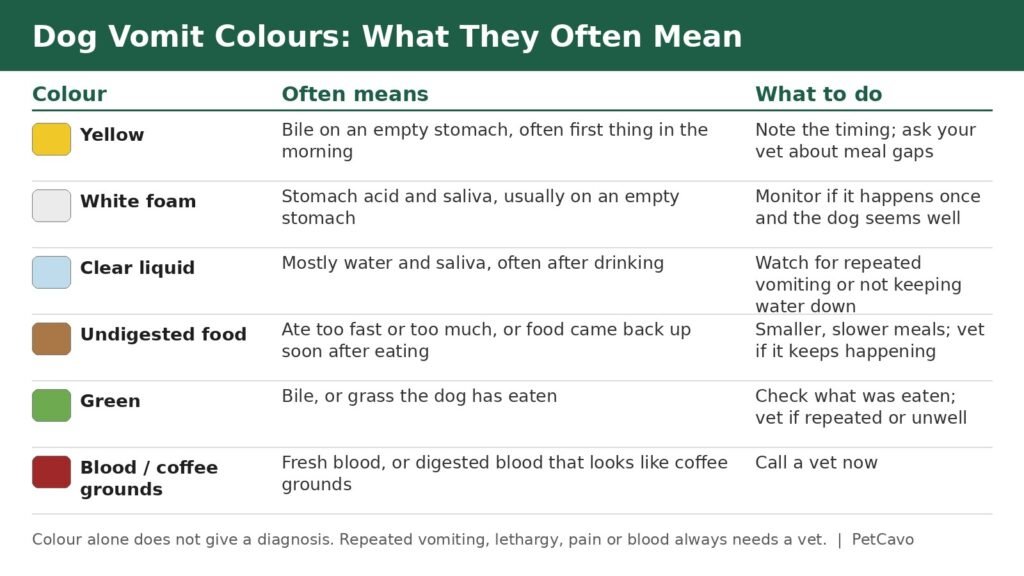
Timing matters as much as colour. Vomit straight after eating points to eating too fast, too much, or food coming back up (regurgitation, which is passive and different from vomiting). Vomit many hours after eating, or on an empty stomach, points to stomach irritation or the bile pattern below.
Why Does My Dog Throw Up Yellow Bile in the Morning?
This pattern has a name: bilious vomiting syndrome. The American Kennel Club describes it as yellow vomit in the morning in an otherwise healthy dog, linked to an empty stomach and a long gap between meals. Bile builds up overnight, irritates the empty stomach, and the dog vomits yellow foam — then often seems fine and wants breakfast.
It is often managed by changing feeding times: smaller, more frequent meals, or a small late-evening meal so the stomach is not empty for so long. Make these changes with your vet’s input, especially if your dog has any medical condition or takes medication with food.
Yellow vomit is not always “just bile”. If it happens several times a day, comes with lethargy, diarrhoea, appetite loss or weight loss, or your dog cannot keep food or water down, it needs a vet — the same yellow colour can appear with liver or pancreas problems.
Some dogs also eat grass on an empty stomach in the morning — see why dogs eat grass.
Common Causes of Repeated Vomiting
Vets split causes into two groups. Mild, short-lived causes include:
- Eating something they should not have (rubbish, rich food, a new treat)
- Eating too fast or too much
- A sudden change of food
- An empty stomach (the morning bile pattern above)
- Motion sickness or stress
Serious causes that need a vet include:
- A swallowed object or blockage in the gut
- Poisoning (human medicines, chocolate, xylitol, chemicals, some plants)
- Pancreatitis
- Stomach or gut inflammation, infection or parasites
- Kidney, liver or other organ disease
- Bloat (a twisted, gas-filled stomach) — retching with nothing coming up is the classic sign
My Dog Is Vomiting but Acting Normal — Should I Worry?
A bright dog that vomits once, then plays, drinks and asks for food, is usually fine to watch at home. The American Kennel Club makes the same point: one episode in a dog that is not acting sick is not normally an emergency.
The picture changes if “acting normal” stops being true. Lethargy, a painful or swollen belly, pale gums, refusing water, or vomiting that repeats within hours all move your dog out of the watch-at-home group — even if the first vomit looked harmless. Trust the trend, not the first hour.
What to Do at Home
Home care is only for a mild case: one or two vomits in an otherwise bright, healthy adult dog with no red flags. The steps below follow Cornell and PDSA guidance:
- Rest the stomach. Withhold food (not water) for about 12 hours. Cornell describes this for an isolated case; the PDSA uses the same 12-hour rule for a dog that is otherwise well.
- Offer small sips of water often. A few laps at a time, or ice chips. If your dog cannot keep water down, stop home care and call a vet.
- Then feed bland, small and often. Plain white rice and boiled skinless chicken in small frequent meals for about two days, as Cornell describes, then mix normal food back in gradually over several days.
- Keep notes. Time of each vomit, colour, what came up, appetite, water intake, stools and energy. This is exactly what your vet will ask about.
Two safety limits. Do not fast puppies, diabetic dogs, dogs on medication that must be given with food, or very small dogs without vet advice — they can go downhill fast. Never give human medicines for vomiting unless your vet tells you to. And never try to make your dog vomit unless a vet directs it; with some poisons and objects, vomiting causes more harm.
Should you make your dog vomit? No. The ASPCA Animal Poison Control Center advises never to induce vomiting at home unless a vet or poison-control service tells you to — with some poisons and sharp objects, vomiting causes more harm, and vomit can go into the lungs. If your dog has eaten something dangerous, call your vet or an emergency vet straight away and follow their instructions.
What Will the Vet Do?
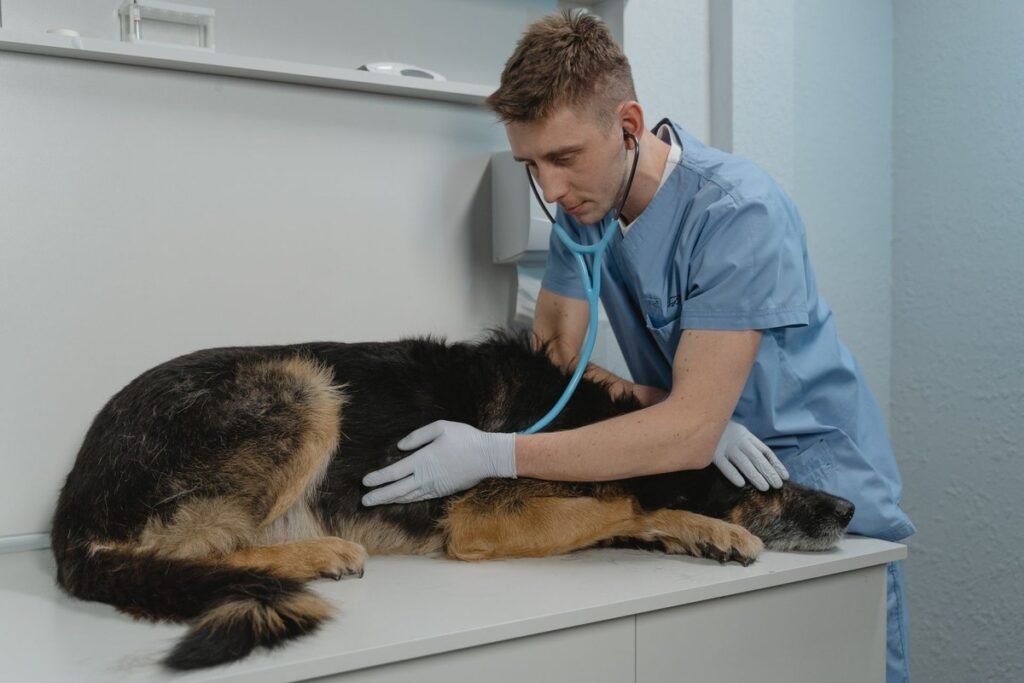
The vet will examine your dog, check hydration and belly pain, and ask about diet, scavenging, medicines and anything swallowed. VCA lists blood and urine tests, X-rays or ultrasound, and faecal tests as the usual next steps. Treatment follows the cause — fluids, anti-nausea or stomach-coating medicine, all prescribed, never guessed at home. VCA expects improvement within a couple of days, and advises reassessment if there is no improvement within 48 hours.
How to Prevent It Happening Again
- Feed smaller, slower meals if your dog gulps food; a slow-feeder bowl can help.
- Change foods gradually, not overnight.
- Keep rubbish, bones, cooked scraps and human medicines out of reach.
- Keep worming and vaccinations up to date.
- If morning bile is the pattern, ask your vet about meal timing before changing it yourself.
Key Takeaways
- One vomit in a bright dog is usually nothing; repeated vomiting is a pattern to act on.
- Call a vet now for vomiting over 24 hours, blood or coffee-ground vomit, a swollen or painful belly, retching with nothing coming up, lethargy, or not keeping water down.
- Yellow morning vomit is often bile on an empty stomach — but repeated yellow vomit with other signs is not “just bile”.
- Vomiting even once a week may indicate disease (Cornell).
- Home care means rest the stomach, small sips of water, then bland food — only for mild cases in healthy adult dogs.
- Never give human medicines, and never make your dog vomit, unless a vet tells you to.
Frequently Asked Questions
How many times should a dog throw up before going to the vet?
There is no single magic number. One vomit in a bright dog can be watched at home. Three or more vomits in a few hours, vomiting over 24 hours, or vomiting returning over 1–2 days all need a vet. Any blood, pain, lethargy or inability to keep water down means call now, whatever the count.
Should I give my dog water after vomiting?
Yes — small amounts, often. Offer a few laps at a time or ice chips rather than a full bowl, which a nauseous dog may gulp and bring back up. Cornell advises withholding food, not water, in an isolated case. If your dog cannot keep even small sips down, that is a red flag: call a vet.
Should I feed my dog again if he throws up his food?
Not straight away. For a mild case in a healthy adult dog, rest the stomach for about 12 hours, then offer small, frequent bland meals such as plain white rice and boiled skinless chicken for about two days before mixing normal food back in. Puppies, diabetic dogs and dogs on medication need vet advice before any fasting.
What can I give my dog for vomiting?
At home: rest, small sips of water, and later a bland diet. That is the safe list. Anti-nausea medicines, stomach-coating medicines and antacids exist, but VCA is clear they should only be used as prescribed. Never give human vomiting or pain medicines — some are toxic to dogs. If vomiting is repeated, the right “remedy” is a vet visit.
My dog has vomited twice in 24 hours. Should I be worried?
Twice in 24 hours in a dog that is drinking and acting normally can be watched at home. It becomes a vet call if a third vomit follows, if vomiting passes 24 hours, or if you see lethargy, diarrhoea, appetite loss, blood, a painful belly, or your dog stops keeping water down. Puppies and small dogs should be checked sooner.
Why does my dog keep throwing up undigested food?
Undigested food usually means the food came back up soon after eating — the dog ate too fast, ate too much, or the food never really settled. Food that returns without retching or effort may be regurgitation rather than vomiting, which can point to a swallowing or oesophagus problem. Smaller, slower meals help simple cases; repeated episodes need a vet.
Is it normal for a dog to vomit once a week?
No. An occasional vomit after eating grass or scavenging can be a one-off, but Cornell’s Riney Canine Health Center states plainly that vomiting even once a week may indicate disease. A weekly pattern deserves a vet appointment, with your notes on timing, colour, food and stools to help find the cause.
Photo Credits
Featured photo: dog resting on a blanket by Helena Jankovičová Kováčová via Pexels (free licence). Vet examination photo by Tima Miroshnichenko via Pexels. Vomit colour chart: PetCavo.



5 Comments