
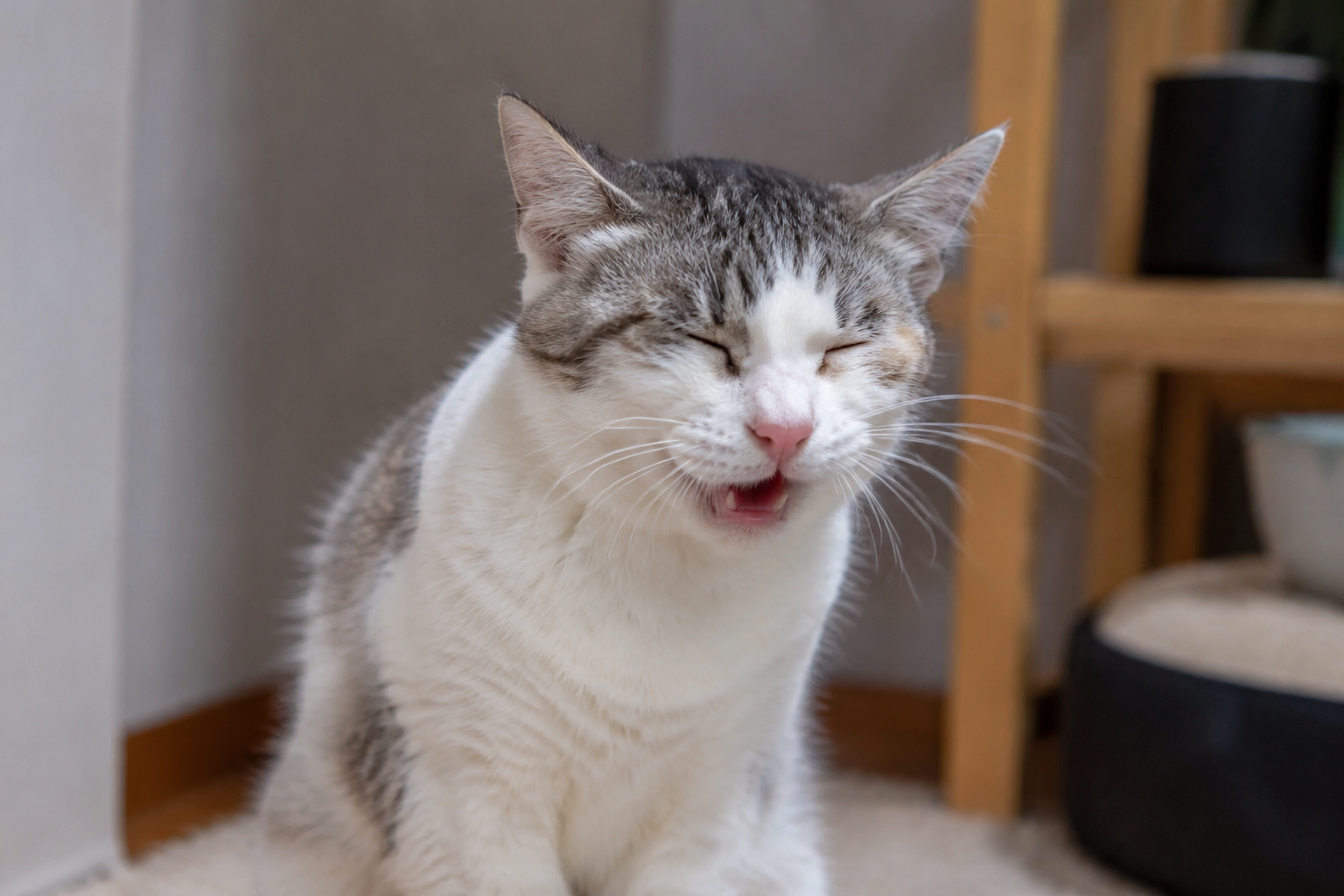
Why Does My Cat Keep Sneezing? Causes & When to Worry
Why does my cat keep sneezing? The common causes, what discharge colour means, safe home care for tonight, and the signs that need a vet.
One sneeze is nothing. But when your cat sneezes again and again — in fits, through the day, with watery eyes or a runny nose — it is natural to worry. Is it just dust, or is your cat ill?
Most repeated sneezing in cats comes from a “cat cold” (an upper respiratory infection) or something irritating the nose.
Quick Answer: Why Does My Cat Keep Sneezing?
The most common cause is an upper respiratory infection, usually feline herpesvirus or calicivirus. Dust, scented litter, sprays and smoke can also set off repeated sneezing. Occasional sneezing is normal, but sneezing with discharge, blood, breathing trouble, or no appetite needs a vet promptly.
Is Sneezing Normal for Cats?
A single sneeze now and then is normal — it is how a cat clears dust or a tickle from the nose. Sneezing becomes a concern when it is repeated over hours or days, comes in long fits, or arrives with other signs: discharge from the nose or eyes, pawing at the face, noisy breathing, or going off food.
Is It Really a Sneeze?
Owners often mix up several different sounds:
- Sneeze: a sudden burst of air through the nose, often with a head shake.
- Reverse sneeze: a snorting, honking sound as the cat breathes in sharply. True reverse sneezing is uncommon in cats and is mainly described in dogs (Cats Protection). Peak Veterinary Referral Center considers reverse sneezing, coughing, wheezing, retching and hiccuping abnormal and in need of a veterinary visit.
- Cough: a hacking sound from the chest, often with the neck stretched out. Coughing has different causes — see our guide to a coughing cat.
- Gagging: retching movements, often before bringing up a hairball.
- Hiccuping: a short, repeated sound that can be mistaken for a sneeze.
- Retching: heaving movements without a sneeze.
- Wheezing: a whistling sound on breathing out. Sneezing with wheezing can point to lower respiratory disease (PetMD).
If you are not sure which sound you are hearing, record a short phone video for your vet.
Sudden bouts of sneezing or retching can be caused by an object stuck in the nose or throat (Cats Protection).
Common Causes of Repeated Sneezing
1. Cat Cold (Upper Respiratory Infection)
This is the most common cause. Feline herpesvirus and calicivirus together cause approximately 90% of these infections (VCA Animal Hospitals). Signs usually start 2–10 days after exposure and include sneezing, nasal discharge, watery eyes, congestion, fever and reduced appetite. Calicivirus can also cause ulcers in the mouth. An uncomplicated case typically lasts 7–14 days, sometimes up to 21.
Cornell notes that up to 97% of cats are exposed to herpesvirus in their lifetime, and the virus causes a lifelong infection in up to 80% of exposed cats. Stress can trigger flare-ups later. See “Feline Herpesvirus and Chronic Sneezing” below.
Influenza is a viral infection that can also contribute to cat sneezing, alongside calicivirus (PetMD).
Bacterial, viral, fungal or parasite infections can affect the airways and cause sneezing (Cats Protection).
2. Feline Herpesvirus and Chronic Sneezing
Once a cat is infected, feline herpesvirus stays in the body for life (Ashby Animal Clinic). Most cats carry it without showing symptoms, but stress, illness or a change in the environment can cause a flare-up. Indoor cats can carry feline herpesvirus from kittenhood and experience flare-ups throughout their lives, especially during stress or illness. Cats with chronic herpesvirus infection may have recurrent bouts of sneezing, eye discharge and nasal congestion throughout their lives. There is no cure, but your vet can help you manage flare-ups and keep your cat comfortable.
3. Environmental Irritants and Allergies
Cats can sneeze in response to airborne irritants and allergens. Common triggers include perfume, air fresheners, scented candles, cigarette smoke, cleaning products, dusty litter, pollen and mould (PetMD).
Cats with allergies may sneeze seasonally or consistently, depending on what they are reacting to. Allergic rhinitis can cause itchy, watery eyes with coughing, sneezing and wheezing, especially in cats with asthma.
Symptoms may be seasonal with outdoor pollen, or year-round with indoor dust and mould, and are managed with customised vaccines, medicines and diet through a veterinary dermatology specialist (BluePearl).
Sources differ on whether skin or breathing signs come first, so do not rule out allergies from one sign alone (Ashby Animal Clinic). A clue: the sneezing starts in one room, after cleaning, or after a new litter or spray is used, and stops elsewhere.
Sneezing due to allergies is less common in cats than people, but could be a possible cause (Cats Protection).
4. Something Stuck in the Nose
A grass blade, seed or bit of dust can lodge in the nose. The classic sign is sudden, repeated sneezing with pawing at the face, often with discharge from one nostril only. This needs a vet — do not try to pull anything out yourself.
5. Dental Disease
The roots of the upper teeth sit right next to the nasal passages. A tooth root infection can therefore cause sneezing and one-sided nasal discharge (Ashby Animal Clinic). If the barrier between the tooth socket and the nose is penetrated, food can enter the nose when the cat eats, causing sneezing during or shortly after eating and making chewing difficult. Bad breath, pawing at the mouth, facial swelling and reluctance to eat can also point to dental disease. Cats often hide oral pain, so your vet will check the mouth if sneezing does not settle. Drooling alongside sneezing can also point to a dental problem — see cat drooling.
6. Nasal Polyps or Tumours
Growths in the nose usually cause persistent discharge from one side, sometimes with blood. Nasal polyps are more common in younger cats, while nasal tumours, though rare, are more commonly seen in older cats (Ashby Animal Clinic).
7. Fungal Infection
Less commonly, a fungal infection such as Cryptococcus can affect the nose. The nasal form can cause nasal or facial swelling, sneezing and long-lasting nasal discharge that may become bloody (Cornell). Noisy breathing or snoring, a change in voice tone, weight loss and spread to other parts of the body can also occur. A lump on the bridge of the nose can be a sign of fungal disease.
8. Bacterial Infection
Bacterial infections almost always play a secondary role in upper respiratory symptoms in cats (PetMD). Bordetella, mycoplasma and chlamydia are common bacterial causes. Yellow or green discharge can be a sign of bacterial infection.
9. Chronic Rhinitis
Chronic rhinitis means long-term inflammation inside the nose. Inflammation itself can cause sneezing, creating a feedback loop where cats keep sneezing long after the first problem is addressed (PetMD).
A bad infection or severe inflammation can permanently damage tiny nose structures called turbinates, and chronic rhinitis may be a permanent condition (Peak Veterinary Referral Center).
Rhinitis and sinusitis often occur together as rhinosinusitis, a common complication of upper respiratory infections (BluePearl).
Signs can include sneezing fits, a stuffy or runny nose, thick yellow discharge, drooling or difficulty swallowing, and eye discharge (BluePearl).
There are no cures for chronic upper respiratory conditions in cats, so treatment usually involves managing symptoms.
Other than a nasal biopsy under anaesthesia, there is no good test for inflammation as the sole cause, so it is usually identified only after other causes are ruled out. Your vet may use oral steroids or NSAIDs (PetMD).
What Does the Discharge Mean? A Quick Decision Table
Use the colour, the side the discharge comes from and how your cat is acting to decide how quickly to act — not to name the disease.
| What you see | What it often means | What to do |
|---|---|---|
| Clear, watery discharge, both sides, cat otherwise bright | Early cold or mild irritation | Home care and monitoring. |
| Thick, cloudy, yellow, green or brown discharge | Cloudy discharge can contain pus, and yellow or green discharge can suggest infection. Thick green, brown, yellow or bloody discharge needs a vet (Cats Protection). | Book a vet. |
| Blood in the discharge | Inflammation, foreign object, growth, injury, or broken skin inside the nose caused by excessive sneezing (Cats Protection) | Vet promptly — photograph blood for your vet (PetMD). |
| Discharge from one nostril only, lasting days | Foreign object, dental disease, polyp or tumour | Vet visit needed; home care will not fix it. |
| Sneezing + pawing at face, sudden start | Something may be stuck in the nose | Vet promptly. Do not poke into the nose. |
| Sneezing + not eating, lethargy, breathing effort | More serious illness | Vet the same day. |
What to Do Tonight: Safe Home Care
- Remove irritants. Keep sprays, scented litter and smoke away from your cat.
- Add steam. Run a humidifier near your cat’s resting spot, or sit with your cat in a steamy bathroom for 10–15 minutes several times a day.
- Keep the nose and eyes clean. Gently wipe discharge away with cotton wool dampened with warm water. Since cats with a respiratory infection will have a decreased sense of smell, they often have a decreased appetite (VCA Animal Hospitals). Loss of taste, inability to breathe through the nose and difficulty swallowing can also reduce appetite. Do not try to make a cat sneeze to clear its nose.
- Tempt the appetite. Offer warm, smelly wet food in small amounts. A cat’s body goes into starvation mode after only 2–3 days without eating, which can result in hepatic lipidosis (fatty liver disease). In these cases, intravenous fluids and additional nutritional support are often needed, followed by prescriptions such as antibiotics, anti-nausea medicines and appetite stimulants (BluePearl).
- Keep water close. Put fresh water near the resting spot and change it often.
- Separate from other cats if you suspect a cold, and wash hands between cats. Respiratory infections spread easily in multi-cat homes.
- Note the pattern. Note the time of day, room, family activities, which side any discharge comes from, appetite and energy. Sneezing more when you clean the bathroom, or after using the litter tray, can point to cleaning chemicals or litter dust (BluePearl).
Do not give Benadryl or other human antihistamines, cold medicines or decongestants unless your vet advises it — Benadryl needs specific diagnostic and dosing advice from your vet, and many over-the-counter options made for people should be avoided (PetMD). PetMD lists antihistamines and decongestants among treatments with variable levels of effectiveness, so they are vet-only options.
How Many Days of Sneezing Is Too Many?
Use this simple timeline:
- First couple of days: if your cat is bright, eating and breathing easily, home care and monitoring are reasonable.
- Beyond a couple of days with no improvement, or getting worse: book a vet.
- Any time: blood, breathing difficulty, not eating, eye ulcers or squinting, facial swelling or deformity, or one-sided discharge means do not just monitor.
When to See a Vet
- Sneezing for more than a couple of days without improvement.
- Thick, coloured or bloody discharge, or discharge from one side only.
- Laboured, noisy or open-mouth breathing.
- Sneezing with wheezing or coughing.
- Nosebleeds.
- Not eating, or marked lethargy.
- Weight loss.
- Squinting, red or cloudy eyes, or visible eye sores.
- Facial swelling or deformity around the nose or cheeks.
- Sudden violent sneezing with pawing at the face.
Kittens, Seniors and Cats with Weakened Immunity
Kittens are highly prone to upper respiratory infections. Kittens born to infected mothers, or raised in groups such as shelters, can meet herpesvirus and calicivirus very early in life (Ashby Animal Clinic).
Older cats and cats with weakened immune systems are also more likely to be badly affected by cat flu and cat colds. They are also more vulnerable to dehydration and becoming unwell quickly, so always seek veterinary advice promptly for a sneezing kitten.
What Will the Vet Do?
Most sneezing cats need only a basic exam. CT, MRI and rhinoscopy are only for sneezing that does not settle or keeps coming back.
Expect an exam of the nose, eyes, mouth, chest and lymph nodes, plus questions about onset, frequency, discharge and other signs (Harvester Veterinary Hospital).
A vet may then do an oral exam to look for dental disease or check whether the soft palate is lengthened or thickened. Your cat’s temperature will also be checked, and the vet may feel for enlarged lymph nodes (BluePearl).
Imaging may include X-rays or advanced imaging (CT or MRI) of the nose, pharynx and chest (BluePearl).
If your cat keeps sneezing or nasal discharge continues, your vet may take a closer look inside the nose with a small camera (rhinoscopy).
Other tests include blood tests, a nasal swab or a bacterial culture (PetMD).
A small sample of tissue from inside the nose (a biopsy) may also be taken and sent to a lab for testing (Peak Veterinary Referral Center).
CT scans help vets find disease deep inside the nose and see how far it has spread, which helps plan treatment (BluePearl). Rhinoscopy carries a risk of bleeding and nosebleeds, especially in cats with a tumour.
Treatment depends on the cause. Many viral cases need supportive care only: warmth, fluids under the skin, nutritional support and help eating (BluePearl).
Antibiotics may be used for bacterial infections, and antifungals for fungal infections.
L-lysine needs a balanced note. Cornell notes several studies suggest lysine supplementation is not effective for FHV-1, and some studies suggest it could even make things worse.
Harvester Veterinary Hospital notes L-lysine is not a standard treatment, and that it could worsen herpesvirus infections in some cats. PetMD lists famciclovir, an antiviral, as the treatment of choice for herpesvirus.
The following are vet-only options, not home remedies. PetMD notes that several of these have variable evidence or need a diagnosis first:
- Famciclovir, an antiviral sometimes used for herpesvirus (PetMD).
- Oral steroids or NSAIDs for inflammation (PetMD).
- Antihistamines, decongestants, anti-nausea medicines and nebulisers (PetMD).
- Oral anti-fungal medicines, nasal infusions of anti-fungal medicines and, in some cases, surgery for fungal infections (PetMD).
- Nasal flush with broad-spectrum antibiotics and steroids for rhinosinusitis (BluePearl).
- Dental surgery or tooth extraction for dental disease, and referral to a veterinary oncologist if cancer is suspected (Peak Veterinary Referral Center).
- Intravenous fluids, nutritional support and appetite stimulants in severe cases (BluePearl).
Prevention
- Keep core vaccinations up to date. They do not fully prevent herpesvirus or calicivirus infection, but they reduce severity. Certain vaccines, like those used to prevent upper respiratory infections, may also cause sneezing for a few days (BluePearl).
- Reduce stress and keep consistent routines, as stress can trigger a herpesvirus flare-up in a cat that already carries it (Harvester Veterinary Hospital). Check for stressors such as boredom, bullying from other pets, home construction or repairs, or moving furniture.
- Safe, quiet hiding spaces and calm environments help (Harvester Veterinary Hospital).
- Use unscented litter and fragrance-free cleaning products to cut nose irritation (Harvester Veterinary Hospital).
- Brush your cat’s teeth regularly to help prevent dental disease (PetMD).
- Isolate a new cat from other cats for at least 1–2 weeks, and have the new cat checked by a vet before mixing (VCA Animal Hospitals).
- Ask your vet to check your cat’s teeth and gums at least once a year (AVMA). Tooth root problems can cause sneezing.
Key Takeaways
- Feline herpesvirus and calicivirus cause approximately 90% of all feline upper respiratory infections (VCA Animal Hospitals).
- A cat cold often settles on its own, but it should be improving after the first few days.
- Clear discharge and a bright cat usually mean home care and monitoring.
- Coloured or bloody discharge — vet promptly.
- Steam, gentle cleaning, warm food and removing irritants are the safe home steps.
- Human cold medicines are unsafe for cats.
FAQs
Is it normal for a cat to sneeze 10 times in a row?
A short fit can happen when something tickles the nose. Repeated long fits through the day are not normal. If fits keep happening, or come with discharge, pawing at the face or loss of appetite, book a vet check.
How many sneezes is too much for a cat?
What matters is the pattern, not a set number. A brief fit now and then, with your cat otherwise well, is often normal. Repeated bouts through the day, sneezing that lasts for days, or sneezing that is getting worse need a vet — especially with discharge, breathing trouble or loss of appetite.
Why does my cat keep sneezing but seems fine?
Mild irritation or the start of a cold can cause sneezing while a cat still looks well. If your cat is eating, active and breathing easily and the sneezing settles in a couple of days, monitoring is reasonable. If the sneezing is frequent or persists, or there are changes in appetite, breathing or discharge, seek veterinary advice.
Why does my cat sneeze more at night?
Note the pattern instead: check irritants in the bedroom, bedding or litter area, and whether a cold draught from open windows or an air conditioner is blowing near your cat. Night sneezing on its own does not name a disease. Book a vet if it lasts beyond a couple of days or comes with discharge, blood, breathing trouble or not eating.
What should I do if my cat keeps sneezing?
Remove likely irritants such as sprays, scented litter and smoke. Add steam or a humidifier, keep the nose clean, offer warm food and water, and note the pattern. See a vet promptly if there is blood, breathing trouble, discharge, or your cat stops eating.
Is it normal for indoor cats to sneeze a lot?
Indoor cats meet plenty of irritants, including cleaning sprays, perfumes, dust and scented litter. See a vet if sneezing lasts more than a couple of days, or comes with discharge, coughing or loss of appetite.
Is sneezing a symptom of feline leukaemia?
Not directly. Sneezing usually comes from an upper respiratory infection or an irritant, not from feline leukaemia itself. Cornell notes that feline leukaemia virus may lead to a state of immune deficiency that hinders a cat’s ability to protect itself against other infections. Book a vet if sneezing comes with discharge that is coloured or bloody, or your cat stops eating.
Do cat colds go away on their own?
Often, yes. An uncomplicated cat cold usually settles on its own with home care. Book a vet if it gets worse, lasts beyond a couple of days, or comes with discharge, breathing trouble or loss of appetite.
Do cat sneezes mean anything?
A sneeze by itself is not a diagnosis. It becomes more meaningful when it repeats, lasts for days, or comes with discharge, coughing, loss of appetite or changes in behaviour.
Why is my cat sneezing so much all of a sudden?
Sudden, frequent sneezing is most often caused by an upper respiratory infection, a nasal irritant, or something stuck in the nose. Book a vet promptly if it comes with discharge, breathing trouble, loss of appetite, or if it does not settle.
What does it mean when a cat sneezes with discharge?
Clear discharge with sneezing often points to irritation or a viral infection. Yellow, green or bloody discharge needs a vet promptly, as does one-sided discharge, breathing trouble or loss of appetite. Note the colour and the side.
When should I take my sneezing cat to the vet?
Call your vet promptly if sneezing comes with coloured or bloody discharge, nosebleeds, not eating, lethargy, breathing trouble, eye problems or facial swelling.
Why does my cat keep sneezing and have a runny nose?
Judge it by the discharge colour. Clear discharge is often mild, while thick, yellow, green or bloody discharge needs a vet. See a vet if the runny nose lasts more than a couple of days, or if your cat stops eating or seems unwell.
Why does my cat keep sneezing and coughing?
Postnasal drip can irritate the throat and cause coughing alongside the sneezing. See a vet if the coughing keeps going, breathing is laboured or noisy, or your cat stops eating.
Why does my cat keep sneezing and have watery eyes?
The same infection that irritates the nose can also affect the eyes, making them watery. See a vet if the eyes are red, swollen or sore, or if discharge becomes thick or coloured.
My kitten keeps sneezing but seems fine
Kittens are highly prone to upper respiratory infections, and a cold can worsen quickly, sometimes leading to dehydration. Book a vet promptly for a sneezing kitten, especially if it is not eating, is lethargic, or has discharge or breathing trouble.
Photo Credits
Featured photo: Faizan




One Comment