Why Does My Cat Meow When I’m on the Phone?
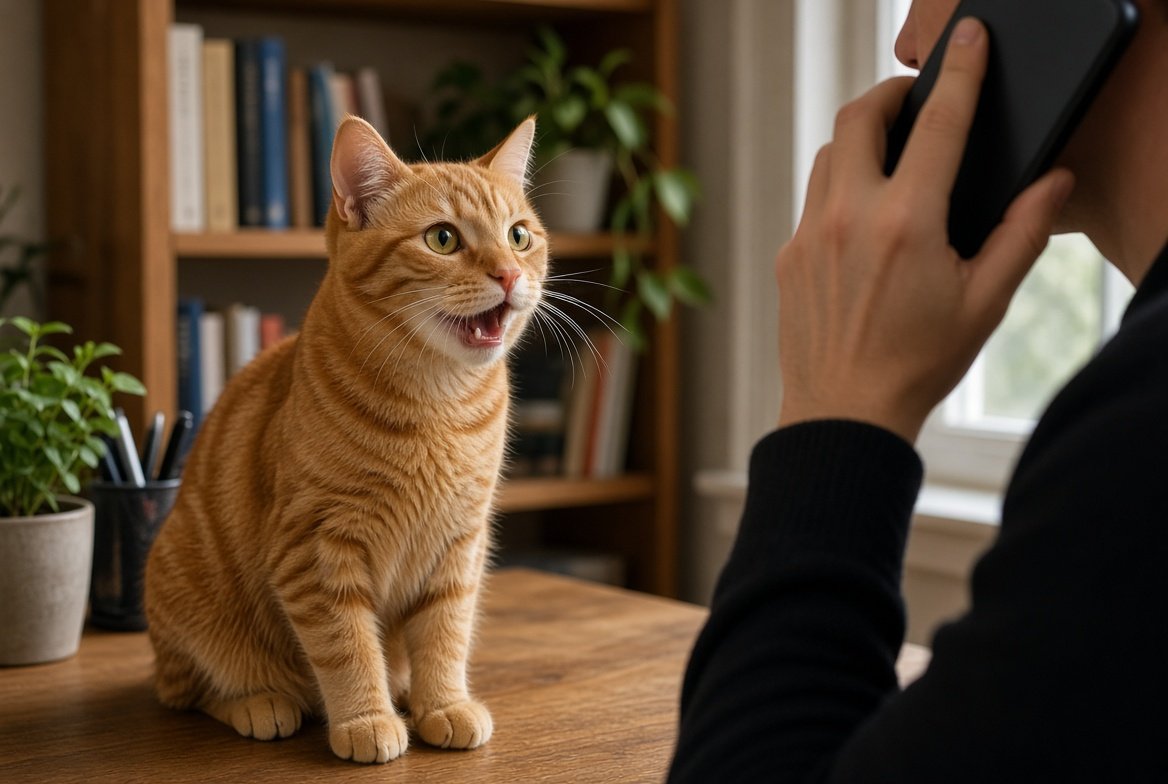
You sit down, answer a phone call, and suddenly your cat has something to say.
They may meow beside you, rub against your legs, climb onto your lap, walk across your desk, or become louder every time you speak. If this happens regularly, you may wonder whether your cat is trying to get your attention, reacting to the voice coming from the phone, or even feeling jealous.
So, why does my cat meow when I’m on the phone?
Usually, your cat is responding to a change in your attention, voice, routine, or environment. Cats commonly use meowing to communicate with people, including to request attention, food, play, or interaction. A phone call can create the perfect situation for a cat that has learned that vocalizing gets a response.
If your cat otherwise behaves normally, occasional phone-call interruptions are usually a behavior to understand rather than something to punish. The key is to look at what happens before, during, and after the meowing.
Table of Contents
- Why Does My Cat Meow When I’m on the Phone?
- 6 Reasons Your Cat Meows During Phone Calls
- Is My Cat Jealous When I’m on the Phone?
- How to Tell What Your Cat’s Meowing May Mean
- How to Stop Your Cat From Interrupting Phone Calls
- Common Mistakes to Avoid
- When Should You Worry About Increased Meowing?
- Myth vs. Fact
- Frequently Asked Questions
- Conclusion
Why Does My Cat Meow When I’m on the Phone?
Your cat may meow when you’re on the phone because your attention suddenly shifts away from them, your voice changes, the phone produces interesting sounds, or your cat has learned that interrupting you gets a response.
Cats don’t need to understand your conversation to notice that something different is happening. When you’re on a call, you may sit still, speak continuously, laugh, gesture, or focus on a device instead of interacting with your cat.
That change can be enough to trigger a response.
Some cats are also naturally more vocal than others. Meowing is a normal part of cat-human communication, and individual cats can develop different vocal habits.
The behavior becomes easier to understand when you look at the pattern rather than assuming every meow has the same meaning.
6 Reasons Your Cat Meows During Phone Calls
1. Your Cat Wants Your Attention
This is one of the most straightforward explanations.
When you’re on the phone, your attention is occupied by someone else. Your cat may notice that you’re no longer responding to them in the usual way and try to regain your focus.
Cats may vocalize specifically to solicit attention, including wanting to be stroked, played with, or simply talked to.
For example, imagine you’re sitting at your desk during a 30-minute call. Your cat walks over and starts meowing. You stop talking, look down, and pet them. The meowing stops.
That pattern suggests that social attention may be part of the reason.
Your cat isn’t necessarily being “difficult.” They’re using a behavior that has worked before.
2. Your Cat May Respond to Your Voice
Your cat doesn’t have to understand the conversation to notice that you’re speaking.
Meowing is largely a human-directed form of feline communication, so your voice itself can be a social cue. Your cat may respond because they hear you talking and interpret the interaction as an opportunity to communicate with you.
This can be especially noticeable with cats that already “talk back” when you speak to them.
Example: You say something to the person on the phone, and your cat immediately gives you a short meow. You continue speaking, and the cat answers again.
That doesn’t prove your cat understands the words. It simply shows that your vocal interaction may be prompting a response.
3. Your Phone Call Changes Your Normal Routine
Sometimes the phone isn’t the main attraction.
You are.
Think about what happens when you receive a call. You might:
- Stop walking around
- Sit in one place
- Look at your phone
- Speak more frequently
- Use a different tone of voice
- Laugh or become more animated
- Stop responding to your cat
Your cat may notice this sudden change.
A cat that normally follows you around the house may see your phone call as an unusual period when you’re sitting still and easier to approach.
This is one reason a cat may interrupt phone calls even though they don’t normally vocalize much.
4. Your Cat Has Learned That Meowing Gets a Response
Cats can learn from what happens immediately after a behavior.
Suppose your cat meows during a call and you respond by:
- Looking at them
- Talking to them
- Petting them
- Giving them a treat
- Picking them up
- Ending the call to deal with them
Your cat may learn that vocalizing during your calls can produce something they value.
Veterinary behavior guidance specifically notes that attention, affection, food, and play can unintentionally reinforce vocalization when they are repeatedly provided after the behavior.
The pattern can look like this:
Phone call → cat meows → you respond → cat gets attention → meowing becomes more likely next time.
This doesn’t mean your cat is deliberately manipulating you. They are simply learning from consequences.
5. Your Cat Wants Play or Social Interaction
A cat that already wants attention, play, or interaction may choose the moment you’re on the phone to ask for it.
This is particularly likely when your cat hasn’t had enough appropriate activity or social interaction earlier in the day.
Veterinary behavior guidance recommends providing opportunities for play, exploration, and predictable positive interaction as part of a healthy feline environment.
Before a long call, you might therefore give your cat:
- A short interactive play session
- A suitable food puzzle
- A comfortable resting area
- Access to a scratching surface
- A safe place to watch the surroundings
- An appropriate toy
The goal isn’t to distract your cat indefinitely. It’s to give them appropriate ways to spend their time while you’re temporarily unavailable.
6. Sounds From the Phone May Attract Your Cat
Your cat may also be reacting to the sounds coming from the device.
A phone call can introduce:
- An unfamiliar voice
- Sudden changes in volume
- Laughter
- Repeated speech
- Sounds from a video call
- Speakerphone audio
These sounds may attract your cat’s attention, especially if they’re unusual in your normal household environment.
That doesn’t mean your cat believes another person is literally inside the phone. It’s safer to say that the sounds and changes in your behavior may act as stimuli that attract your cat’s attention.
This may be particularly noticeable with speakerphone or video calls, where the other person’s voice is coming from the room rather than directly from the phone held against your ear.
Is My Cat Jealous When I’m on the Phone?
You may jokingly call it jealousy when your cat interrupts a conversation.
And the behavior can certainly look that way.
Your cat may walk between you and the phone, climb onto your lap, meow repeatedly, or demand attention while you’re speaking to someone else.
But it’s better not to assume that your cat is experiencing human-style jealousy.
Attention-seeking is usually a more useful way to describe the behavior.
Your cat sees that your attention has shifted and may try to bring it back.
If the behavior happens mainly when you’re on the phone and your cat is otherwise relaxed, eating normally, playing normally, and using the litter box normally, that pattern points more toward a situational behavior than an obvious medical problem.
How to Tell What Your Cat’s Meowing May Mean
There isn’t a reliable dictionary where one meow always means one thing. Context matters.
Watch what your cat does along with the vocalization.
| What your cat does | Possible explanation |
|---|---|
| Meows and rubs against you | Seeking social contact or attention |
| Meows while staring at you | Requesting interaction or something they want |
| Meows when you begin speaking | Responding to your voice or the change in interaction |
| Meows and touches your phone | Curiosity or attention toward the device |
| Gets louder after you respond | The response may be reinforcing the behavior |
| Meows only during calls | The call may have become a predictable trigger |
| Suddenly meows much more throughout the day | Consider stress, environmental change, or a medical cause |
These are possible explanations, not diagnoses.
Body language matters too. A relaxed cat approaching you is giving you different information from a cat that is hiding, crouching, pacing, or showing other signs of distress.
How to Stop Your Cat From Interrupting Phone Calls
You don’t need to punish your cat for meowing.
A better approach is to make the situation predictable and avoid accidentally rewarding repeated interruptions.
1. Check your cat’s basic needs first
Before assuming your cat is simply demanding attention, check:
- Water is available
- The litter box is accessible and clean
- Your cat has access to its normal food
- The cat isn’t trapped somewhere
- The environment is comfortable
- There isn’t an obvious source of stress
ASPCA recommends determining the reason for vocalization before attempting to reduce it.
2. Give appropriate interaction before the call
If you know you’ll be on the phone for a while, build some interaction into the period before the call begins.
A short play session can be useful for a cat that enjoys interactive play.
The timing matters. You don’t want your cat to learn:
Meow → human starts playing with me.
Instead, make play and attention part of a predictable routine before you’re unavailable.
3. Create a comfortable phone-call spot
Give your cat a place where they can stay near you without needing to climb onto your keyboard or walk across your phone.
This could be:
- A cat bed
- A blanket
- A nearby chair
- A window perch
- A favorite resting area
You can practice using this spot when you’re not on a call first.
Reward your cat for calmly settling there, then gradually use the same routine during calls.
4. Reward calm behavior
If your cat settles quietly while you’re talking, give attention at an appropriate time.
The goal is to make calm behavior worthwhile.
Veterinary behavior guidance recommends reinforcing desirable behaviors rather than rewarding unwanted vocalization.
5. Don’t turn every interruption into a conversation
If your cat’s needs are met and the behavior is clearly attention-seeking, repeatedly answering every meow can maintain the pattern.
You don’t have to yell or scold.
Instead, wait for an appropriate moment of quiet and then provide attention when practical.
ASPCA similarly recommends rewarding quiet behavior rather than giving attention during attention-seeking vocalization.
6. Stay consistent
This is often the hardest part.
If you ignore the meowing for five minutes but then give your cat a treat because they become louder, your cat may learn that persistence eventually works.
Consistency helps your cat understand which behavior produces the result they want.
Common Mistakes to Avoid
Punishing your cat
Yelling, hitting, or frightening your cat isn’t a good solution.
Physical punishment can increase fear and doesn’t address why the cat is vocalizing. ASPCA specifically advises against scolding or hitting cats for excessive meowing.
Assuming every meow is attention-seeking
Don’t automatically ignore vocalization.
Your cat could be hungry, trapped, uncomfortable, stressed, or experiencing a medical problem.
Check their basic needs first.
Giving attention at the loudest moment
If you’re trying to change an attention-seeking pattern, repeatedly responding when the meowing becomes louder can make persistence more rewarding.
Look for a brief period of calm instead.
Changing everything at once
You don’t need to introduce five new routines simultaneously.
Start with one predictable pre-call routine and a comfortable nearby resting spot. Then see whether the behavior changes.
When Should You Worry About Increased Meowing?
If your cat has always meowed during phone calls but otherwise behaves normally, the behavior may simply be part of their individual communication style.
A sudden increase in vocalization, however, deserves more attention.
Veterinary sources recommend considering medical causes when a cat becomes unusually vocal, particularly when other changes occur. Potential causes can include pain, illness, sensory changes, cognitive dysfunction, and other conditions.
Contact your veterinarian if you notice increased meowing along with signs such as:
- Changes in appetite or thirst
- Weight loss
- Changes in litter-box habits
- Restlessness or unusual pacing
- Hiding or withdrawal
- Poor grooming
- Changes in activity
- Vocalizing at unusual times
- A noticeable change in the sound of the meow
- Signs of pain or discomfort
Older cats deserve particular attention because increased vocalization can sometimes occur alongside age-related sensory or cognitive changes.
The important distinction is between a long-standing habit that happens during phone calls and a new pattern of vocalization that is happening more broadly or with other behavioral changes.
Myth vs. Fact
| Myth | Fact |
| My cat is definitely jealous of the person I’m talking to. | Your cat may be competing for your attention, but attention-seeking is a more cautious explanation than assuming human-style jealousy. |
| My cat understands everything I’m saying on the phone. | Your cat can respond to your voice without understanding the conversation itself. |
| Every phone-call meow means my cat is upset. | Some cats simply seek attention or respond to changes in their environment. |
| Ignoring every meow is always the answer. | First make sure your cat’s needs are met and consider whether the vocalization is new or unusual. |
| My cat is deliberately trying to ruin my call. | Cats respond to their environment and learned consequences; they’re not trying to sabotage your conversation. |
| Punishment will stop the behavior. | Physical punishment can create fear and is not recommended for managing meowing. |
Frequently Asked Questions
Why does my cat meow when I talk on the phone?
Your cat may be seeking attention, responding to your voice, reacting to changes in your behavior, or responding to sounds from the phone. If you’ve responded to the behavior in the past, your cat may also have learned that meowing gets a reaction.
Why does my cat interrupt phone calls?
Phone calls can temporarily make you less available to your cat. If your cat wants attention, play, or social interaction, they may vocalize or physically approach you to regain your attention.
Is my cat jealous when I talk on the phone?
It may look like jealousy, but it’s better to describe the behavior as attention-seeking or a response to your changed interaction. We can’t assume that cats experience human jealousy in exactly the same way people do.
Why does my cat get louder when I don’t respond?
If your cat has learned that meowing produces attention, they may increase their vocalization when the expected response doesn’t happen. Consistently rewarding calm behavior can help change that pattern.
Why does my cat meow at my phone when nobody is calling?
Your cat may associate the phone with your voice and attention, or may simply be interested in sounds or movements coming from the device. The phone can become part of the situation that predicts interaction.
Why does my cat meow during video calls?
Video calls combine your voice, another person’s voice, sounds from the device, and changes in your behavior. Any of these may attract your cat’s attention. Your cat doesn’t need to understand the screen for the sounds and activity to be interesting.
Why does my cat meow when I talk to another person?
Your cat may be responding to your voice or trying to regain your attention. Cats commonly use vocalization when communicating with people, so a conversation can become an opportunity for your cat to interact with you too.
How can I stop my cat from meowing during important calls?
Check your cat’s basic needs, give appropriate interaction before the call, provide a comfortable nearby resting spot, and reinforce calm behavior. If the meowing is clearly attention-seeking, avoid repeatedly rewarding the interruptions with attention.
Should I worry if my cat suddenly starts meowing more?
A sudden increase in vocalization can have behavioral or medical causes. If your cat becomes much more vocal than usual, particularly alongside changes in appetite, weight, litter-box habits, grooming, activity, or behavior, contact your veterinarian.
Conclusion
If you’re asking, “Why does my cat meow when I’m on the phone?”, your cat is probably reacting to something about the situation rather than the phone call itself.
Your attention suddenly changes. Your voice may become more animated. The phone may produce unfamiliar sounds. And if your cat has learned that meowing gets a response, a phone call can become the perfect opportunity to try it.
The best response is to look at the pattern.
If your cat meows, gets attention, and then stops, attention may be part of the explanation. If the behavior starts when you speak, your voice may be the trigger. If your cat suddenly becomes vocal throughout the day rather than only during calls, that’s a different situation and deserves closer attention.
Meet your cat’s needs, provide appropriate interaction, reward calm behavior, and avoid punishment. Most importantly, don’t assume that every meow means the same thing.
Your cat is communicating. The useful question isn’t simply “How do I make my cat stop meowing?” It’s “What is my cat trying to communicate in this particular situation?”