Why Does My Cat Sleep Beside Me but Not Touch Me?
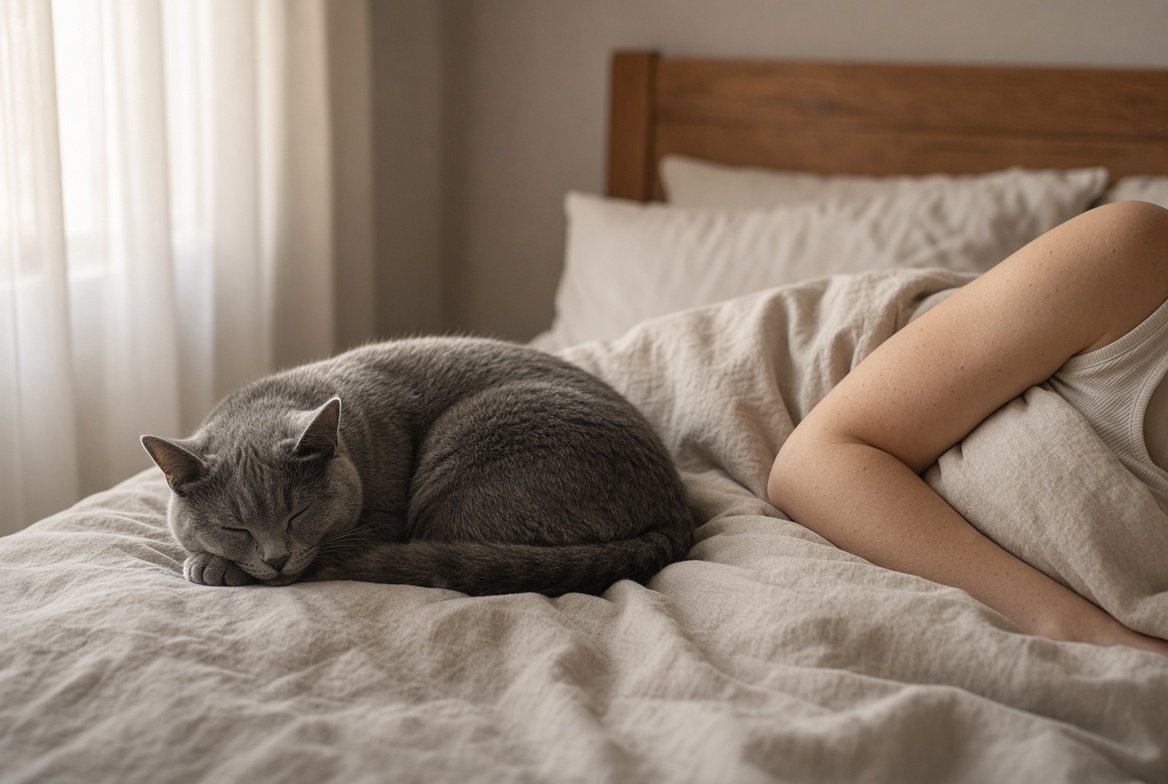
Have you ever noticed your cat choosing a spot right beside you at bedtime, only to leave a small gap between you?
Your cat may sleep next to your hip, curl up near your feet, or settle beside your pillow without actually touching your body. It can seem strange, especially if you expected a cat that wanted to be close to also want cuddles.
But sleeping near you and wanting physical contact are not the same thing.
Cats have individual preferences for petting, handling, lap sitting, and other interactions with people. Some actively seek physical contact, while others are perfectly content to share space without being touched.
So if you’re wondering, why does my cat sleep beside me but not touch me? the answer may simply be that your cat enjoys being near you while still preferring its own personal space.
Table of Contents
- Why Does My Cat Sleep Beside Me but Not Touch Me?
- Your Cat Enjoys Being Near You
- Your Cat Prefers Personal Space
- Your Cat May Not Want Physical Contact While Sleeping
- Your Cat Has an Individual Personality
- Your Cat May Prefer Control Over Physical Contact
- Your Cat May Prefer the Sleeping Spot, Not the Contact
- Your Cat’s Preferences Can Change
- Does My Cat Still Like Me If It Doesn’t Touch Me?
- Cat Affection Signs That Don’t Involve Cuddling
- Why Does My Cat Move Away When I Touch It?
- Cat Sleeps Next to Me vs. Cat Sleeps on Me
- How to Encourage More Physical Contact
- Common Mistakes to Avoid
- Practical Checklist
- Myth vs. Fact
- When a Change in Sleeping Behavior Matters
- Frequently Asked Questions
- Conclusion
Why Does My Cat Sleep Beside Me but Not Touch Me?
The most likely explanation is that your cat likes being close to you but doesn’t necessarily want direct body contact.
Cats don’t all have the same preferences when it comes to human interaction. Veterinary feline guidance specifically recognizes that individual cats can differ in how much they enjoy petting, being picked up, playing, grooming, and sitting or lying on a person’s lap.
That means a cat can choose your bed, sofa, or chair because it likes being in the same space as you while still wanting a little room around its body.
For example, imagine your cat jumps onto your bed every night and settles six inches from your legs. If it remains relaxed, sleeps normally, and continues choosing that spot, there may be nothing wrong at all.
Your cat may simply have found the distance that feels comfortable.
1. Your Cat Enjoys Being Near You
One simple explanation is that your cat enjoys your company.
That doesn’t necessarily mean your cat wants to lie directly against you. Cats can seek social contact in different ways, and some prefer being close without continuous physical interaction.
FelineVMA guidance encourages owners to understand their individual cat’s preferences rather than assuming that every cat wants the same type or amount of human contact.
Your cat may be saying, “I’m comfortable here”
Suppose your cat has several places to sleep but repeatedly chooses the bed while you’re there.
It may settle beside your legs, stretch out near your pillow, or curl up at the foot of the bed. It isn’t necessarily asking to be petted. It may simply prefer sharing the space with you.
That’s why cat sleeps next to me can be a more useful observation than trying to interpret the exact distance between your bodies.
Pro tip
Look at what your cat does when you’re not trying to touch it.
If it voluntarily approaches you, rests near you, plays with you, or returns to your company, consider the whole pattern rather than judging the relationship by cuddling alone.
2. Your Cat Prefers Personal Space
Some cats enjoy companionship but dislike being physically crowded.
Think about the difference between sitting beside someone on a sofa and sitting directly on their lap. Both involve being together, but one gives you considerably more freedom to move.
Cats can have similar preferences.
A cat may choose to sleep next to you because it can stretch, turn around, groom itself, or leave whenever it wants. That extra space can be especially appealing to a cat that doesn’t enjoy prolonged physical contact.
Feline behavior guidance emphasizes giving cats choice and respecting individual interaction preferences.
What to look for
Your cat may prefer more space if it:
- Moves away when you pull it closer
- Sleeps beside you but rarely on you
- Approaches for attention and then leaves
- Becomes restless when held
- Chooses to sit beside you rather than on your lap
None of these automatically means your cat dislikes you.
They may simply show where your cat’s boundaries are.
3. Your Cat May Not Want Physical Contact While Sleeping
Your cat may be comfortable with you without wanting to be touched while it rests.
Sleeping is different from being awake and looking for attention. A cat that enjoys petting during the day may still choose a separate sleeping position at night.
Physical contact can also make it harder for a cat to reposition itself.
If you roll over, move your legs, pull the blanket around you, or change position, your cat may prefer having a little space rather than being pressed against you.
A common example
Your cat falls asleep beside your legs.
Later, you notice it has moved several inches away.
That doesn’t necessarily mean your cat became less affectionate during the night. It may simply have moved to a more comfortable position.
Don’t overinterpret the distance
There is no universal rule that says a cat that sleeps two inches away is more affectionate than one that sleeps ten inches away.
The sleeping location is only one piece of the behavior puzzle.
4. Your Cat Has an Individual Personality
Some cats are naturally more social and physically affectionate. Others prefer limited contact and may want to initiate interaction themselves.
VCA notes that cats have different personalities and that shy cats may prefer limited physical contact that they initiate, while independent cats may be secure without craving much attention.
This is one reason comparing your cat with someone else’s can create unnecessary worry.
Your friend’s cat might sleep on their chest every night.
Your cat might sleep beside their feet.
Neither behavior automatically tells you which cat has a better relationship with its person.
Independent cat behavior is not automatically rejection
An independent cat can still enjoy human company.
It may show that preference by:
- Staying in the same room
- Sleeping near you
- Following you around the house
- Approaching you for play
- Rubbing against you
- Choosing your bed or sofa
- Greeting you when you return
The important question is not whether your cat behaves like a cuddly cat.
It’s whether your cat is comfortable and voluntarily chooses interaction with you.
5. Your Cat May Prefer Control Over Physical Contact
Some cats seem happiest when they can decide when contact starts and when it ends.
A nearby sleeping position gives your cat that freedom.
Your cat can move closer if it wants attention and leave if it has had enough. By contrast, being held against your body or placed on your lap limits its ability to control the interaction.
FelineVMA recommends allowing cats to approach people and watching for signs that they are becoming uncomfortable. It also advises against forcing cats to accept petting.
Research presented through the American Association of Feline Practitioners also highlights the importance of recognizing individual cat preferences and the possibility of a mismatch between what a person wants and what a cat wants—for example, a caregiver wanting a cat on their lap while the cat prefers lying beside them.
This is an important distinction
Your cat may not be rejecting you.
It may be rejecting a particular type of physical interaction.
That difference can completely change how you interpret the behavior.
6. Your Cat May Prefer the Sleeping Spot, Not the Contact
Sometimes the answer has less to do with affection and more to do with the environment.
Your bed may offer a comfortable combination of:
- A familiar surface
- A quiet location
- A preferred temperature
- Easy access to other parts of the room
- A predictable nighttime routine
- A place where your cat already feels comfortable
Feline environmental guidance emphasizes providing cats with familiar environments and spaces that accommodate their individual needs and preferences.
So if your cat consistently chooses a spot beside you, it doesn’t necessarily mean the physical distance itself has emotional significance.
It could simply be the best sleeping location available.
Try this simple test
Place a comfortable cat bed or folded blanket near your usual sleeping position.
If your cat chooses it instead of your body but still stays close to you, that gives you a useful clue: your cat may value proximity and comfort, without needing direct physical contact.
7. Your Cat’s Preferences Can Change
A cat’s preferred amount of physical contact isn’t necessarily fixed forever.
Preferences can vary with age, experience, environment, and the individual cat. Feline behavior guidance notes that interaction preferences can vary between cats and even according to context.
A cat that once slept on your lap may eventually prefer the cushion beside you.
Likewise, a cat that rarely cuddled as a younger adult may become more interested in resting close to you later.
That doesn’t mean you should try to force a change.
Instead, give your cat opportunities to choose comfortable interaction and observe what it actually prefers.
Does My Cat Still Like Me If It Doesn’t Touch Me?
Yes, a lack of physical contact does not automatically mean your cat dislikes you.
But it’s also important not to go too far in the other direction and claim that sleeping nearby definitely proves love or trust.
One behavior cannot tell you exactly what a cat feels.
A better approach is to look at the complete pattern.
Does your cat voluntarily spend time around you? Does it approach you? Does it relax in your presence? Does it seek play or attention? Does it return after walking away?
Those behaviors give you much more information than whether its fur touches your arm while it sleeps.
Cat Affection Signs That Don’t Involve Cuddling
Cats can interact socially without becoming lap cats.
Choosing to stay nearby
If your cat repeatedly chooses the same room or resting area as you, proximity is part of its normal social behavior.
Rubbing against you
Rubbing can involve social interaction as well as scent exchange. FelineVMA notes that cats may rub against caregivers when seeking attention or after being reunited with them.
Approaching voluntarily
A cat that comes to you for play, attention, or interaction is making an active choice.
Relaxing around you
A relaxed cat may stretch out, groom, nap, or simply settle down in your presence.
Returning after leaving
If your cat walks away and later comes back to the same area, don’t automatically interpret the departure as rejection.
It may simply have wanted a break.
Seeking play
Some cats show more interest in interactive play than cuddling. Play can be an important part of positive human-cat interaction.
Why Does My Cat Move Away When I Touch It?
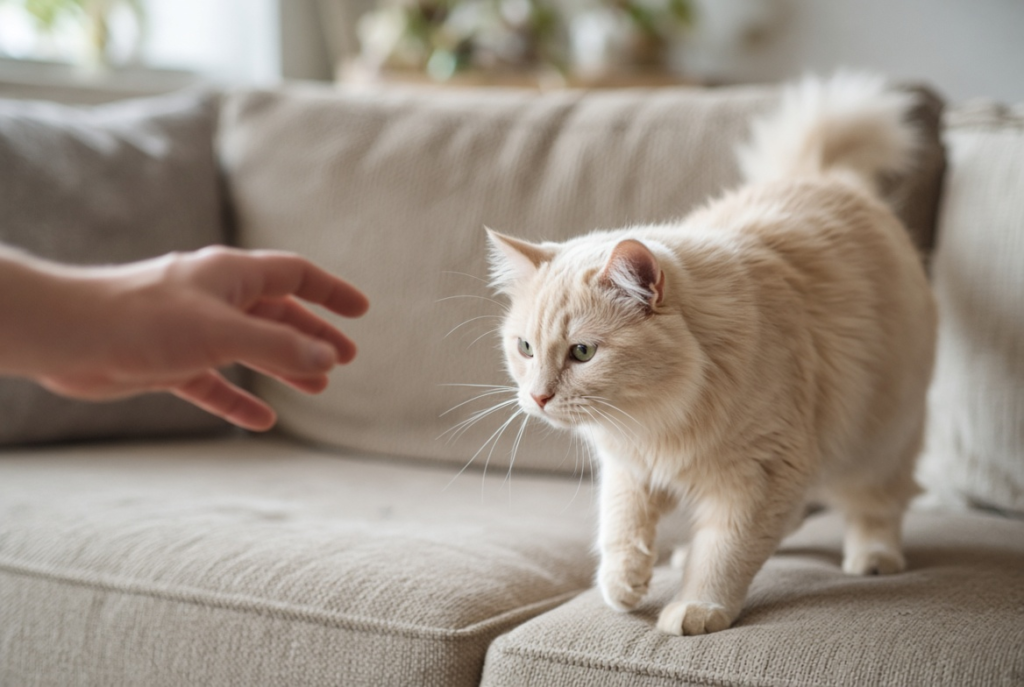
This is one of the most useful clues to watch.
Your cat may want to sleep near you but not want to be petted at that particular moment.
Some cats enjoy brief petting but become uncomfortable when the interaction lasts too long or happens in a less preferred area. FelineVMA advises watching for signs of discomfort and allowing the cat to determine when the interaction ends.
Cornell also describes petting-induced aggression as a situation in which some cats become uncomfortable with prolonged petting or handling, sometimes showing warning signals before escalating.
Watch for signs such as
- Tail lashing
- Ears moving backward
- Tensing of the body
- Dilated pupils
- Moving away
- Turning toward your hand
- Vocalizing
You don’t need to wait for your cat to become irritated.
If it moves away, simply let it go.
Cat Sleeps Next to Me vs. Cat Sleeps on Me
| Behavior | Possible interpretation |
|---|---|
| Sleeps beside you | May enjoy being near you while preferring personal space |
| Sleeps against your legs | May be comfortable with closer contact in that position |
| Sleeps on your lap | More direct physical contact is comfortable at that time |
| Sleeps on your chest | Chooses a particularly close resting position |
| Sleeps at the foot of the bed | May prefer the bed while keeping more distance |
| Sleeps nearby but moves when touched | May want proximity without petting |
These are possible interpretations, not fixed translations.
Cats don’t come with a universal behavior dictionary. The same behavior can have different explanations depending on the individual cat and the situation.
How to Encourage More Physical Contact
You can make physical contact easier for your cat to choose, but you cannot guarantee that your cat will become a cuddler.
The goal is to make interaction comfortable, predictable, and voluntary.
Try these steps
- Let your cat approach you.
- Offer gentle contact when your cat is relaxed.
- Start with brief petting rather than long sessions.
- Pay attention to your cat’s response.
- Stop when your cat shows that it has had enough.
- Allow your cat to leave without following or grabbing it.
- Use the type of reward your individual cat actually enjoys.
Rewards don’t always have to be food. FelineVMA notes that cats can have individual preferences for food, play, petting, or other rewards.
What if your cat chooses the space beside you?
Don’t move it onto your lap.
Instead, make that nearby space comfortable.
If your cat eventually wants to move closer, let that be its decision.
Common Mistakes to Avoid
Forcing your cat onto your lap
If your cat repeatedly leaves when placed on your lap, continuing to put it back may make physical interaction less comfortable.
Petting after your cat has said “enough”
A cat may enjoy a few strokes and then want the interaction to end.
Respecting that signal is better than waiting for a swat or bite.
Assuming every approach means “pet me”
A cat may approach because it wants food, play, companionship, warmth, or something else.
Watch the body language instead of automatically reaching for it.
Comparing your cat with another cat
Personality differences are normal. VCA specifically describes cats that prefer limited physical contact as well as cats that actively seek human company.
Trying to make your cat more affectionate
There is no need to turn an independent cat into a lap cat.
A healthier goal is to build interactions around the contact your cat willingly accepts.
Practical Checklist
If you’re still wondering what your cat’s sleeping behavior means, ask yourself:
- Has my cat always slept this way?
- Does it choose to sleep near me regularly?
- Does it relax when I’m nearby?
- Does it approach me when it wants attention?
- Does it enjoy certain types of petting?
- Does it move away when it has had enough?
- Does it still play normally?
- Has its appetite stayed normal?
- Is its grooming routine unchanged?
- Has its activity level changed suddenly?
The last five questions matter because a sudden change is more informative than a long-standing preference.
Myth vs. Fact
| Myth | Fact |
|---|---|
| My cat doesn’t touch me, so it doesn’t like me. | Cats can enjoy being near people while preferring limited physical contact. |
| An affectionate cat should sleep on its owner. | Cats have individual preferences for human interaction. |
| Sleeping beside me proves my cat loves me. | Proximity can be meaningful, but one behavior cannot prove a specific emotion. |
| I should hold my cat on my lap until it gets used to cuddling. | Cats generally benefit from having choice and control over physical interaction. |
| Independent cats don’t care about people. | Independent behavior and social interaction can coexist. |
| A sudden change in sleeping habits is always just personality. | A sudden behavioral change can warrant veterinary attention, particularly when other changes occur. |
When a Change in Sleeping Behavior Matters
If your cat has always slept beside you without touching you and otherwise acts normally, the behavior itself usually isn’t a reason to worry.
The situation deserves more attention if the behavior suddenly changes.
For example, if your normally social cat suddenly stops sleeping near you and also begins hiding, eating less, moving differently, grooming differently, or reacting negatively to touch, don’t assume it’s simply becoming independent.
Cornell notes that pain and illness can contribute to changes in behavior, including withdrawal, reduced activity, reluctance to move, and negative reactions to handling.
Contact your veterinarian if you notice a significant change along with signs such as:
- Reduced appetite
- Unusual hiding
- Reduced activity
- Difficulty jumping or moving
- Changes in grooming
- Increased irritability
- Unusual reactions to touch
- Other noticeable changes in normal behavior
The sleeping distance itself isn’t necessarily the problem.
The important clue is a meaningful change from your cat’s normal behavior.
Frequently Asked Questions
Why does my cat sleep beside me but not touch me?
Your cat may enjoy being near you while preferring some personal space. Cats have individual preferences for physical contact, and not every cat enjoys sleeping directly against a person.
Does my cat sleeping next to me mean it trusts me?
It can be consistent with comfort around you, but sleeping position alone cannot prove exactly what your cat feels. Look at the wider pattern of voluntary interaction.
Why does my cat sleep near me but not on me?
Your cat may prefer the freedom and space of sleeping beside you rather than directly on your body. It may also simply prefer that particular sleeping surface or position.
Why won’t my cat sleep on my lap?
Some cats simply don’t enjoy lap sitting. Personality and individual preferences influence how cats respond to physical contact, and some prefer to initiate contact themselves.
Why does my cat move away when I touch it?
Your cat may have decided that it wants company but not petting at that moment. It may also dislike prolonged contact or prefer being touched in specific areas.
Is an independent cat still affectionate?
Yes. A cat can prefer independence while still choosing to spend time near its caregiver. Some cats show social interest through proximity, play, rubbing, or voluntary interaction rather than cuddling.
How can I get my cat to cuddle more?
Give your cat opportunities to approach voluntarily, keep physical contact brief and comfortable, and stop when your cat wants space. You can encourage positive interactions, but you cannot guarantee that a cat will become a lap sleeper.
Should I move my cat closer when it sleeps beside me?
Usually, there’s no need. If your cat has deliberately chosen a spot beside you, letting it keep that position respects its preference and gives it control over the interaction.
Why did my cat suddenly stop sleeping beside me?
A sudden change can have many explanations. If it occurs alongside changes in appetite, activity, grooming, mobility, hiding, or sensitivity to touch, speak with your veterinarian.
Is it normal for a cat to sleep close without touching?
Yes. Cats can prefer proximity without direct body contact. Individual cats differ considerably in how they like to interact with people.
Conclusion
If you’ve been asking why does my cat sleep beside me but not touch me, the simplest answer is that your cat may enjoy your company without wanting constant physical contact.
Sleeping beside you can provide companionship while still giving your cat room to stretch, reposition, or leave whenever it wants.
Your cat’s personality matters, too. Some cats actively seek cuddles, while others prefer sitting nearby, following their person around, playing together, or simply sharing the same room.
So don’t use physical contact as the only measure of your relationship.
If your cat voluntarily chooses to sleep near you, remains relaxed around you, and continues its normal social and daily behaviors, that nearby spot may simply be your cat’s preferred way of being close.
And sometimes, for an independent cat, a few inches of space is its version of cuddling.