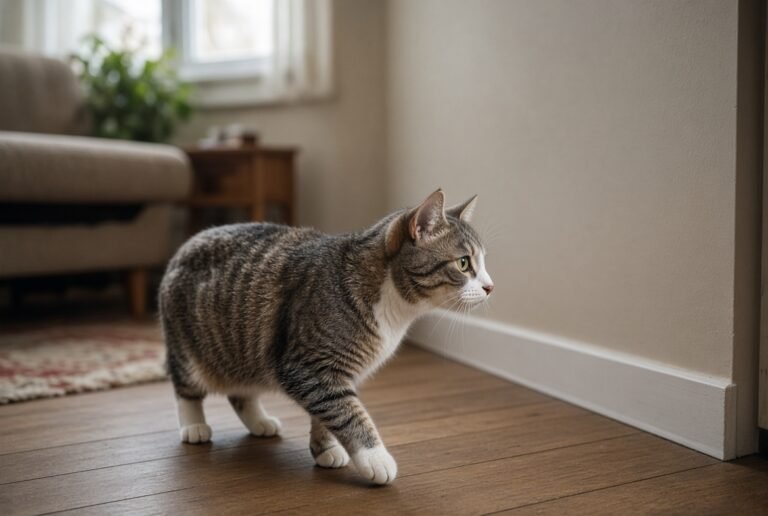
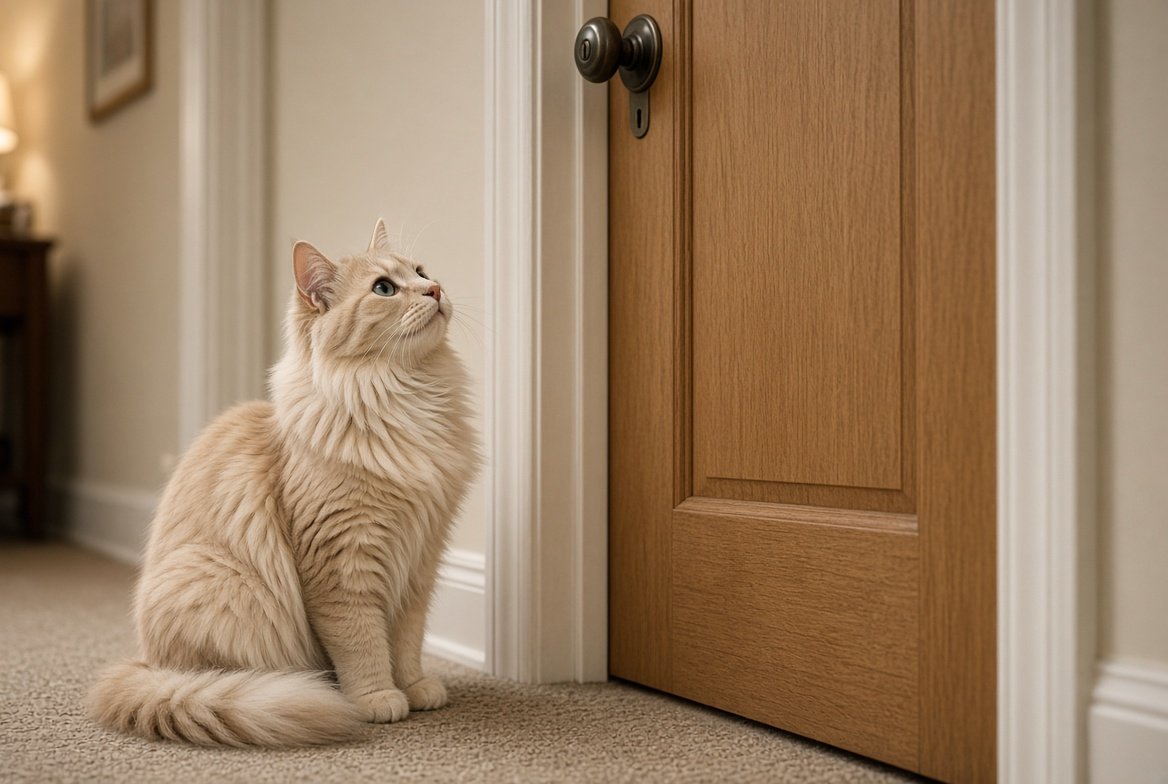
Why Does My Cat Wait Outside My Bedroom Door? 7 Reasons
You close your bedroom door at night, settle into bed, and notice your cat sitting quietly on the other side. Maybe they wait there until morning. Maybe they meow, scratch at the door, or walk away and return a few minutes later.
So, why does my cat wait outside my bedroom door?
In many cases, the reason is simple: your cat wants to be near you, expects access to the room, anticipates food or attention, or has learned that your bedroom routine predicts something interesting. Cats commonly follow their people because of bonding, curiosity, hunger, attention, or routine.
The behavior itself is usually less informative than the pattern around it. A relaxed cat sleeping outside your door is very different from a cat that suddenly becomes restless, unusually vocal, or clingy.
Table of Contents
- Why does my cat wait outside my bedroom door?
- Why does my cat sit outside my bedroom door?
- Why does my cat wait for me outside?
- Why does my cat stay outside my bedroom at night?
- Why does my cat meow outside my bedroom door?
- Why does my cat scratch the bedroom door?
- Does my cat want to sleep with me?
- How to figure out why your cat is waiting
- Should you let your cat into the bedroom?
- How to stop your cat waiting outside the door
- Common mistakes to avoid
- Expert tips
- When should you worry?
- Myth vs. fact
- Frequently asked questions
- Conclusion
Why Does My Cat Wait Outside My Bedroom Door?
There isn’t one explanation that fits every cat. Your cat’s age, personality, routine, environment, and what they do when the door opens all provide useful clues.
Here are seven common reasons your cat may be waiting outside your bedroom.
1. Your Cat Wants to Be Near You
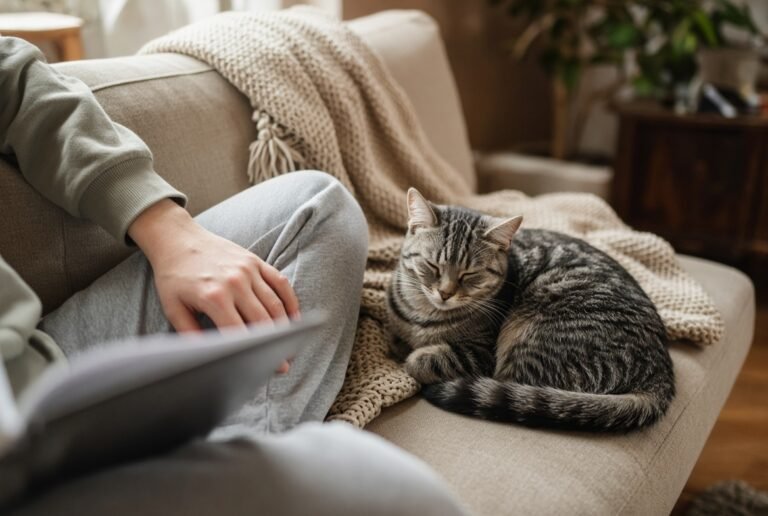
Your cat may simply enjoy your company.
Although cats have a reputation for being independent, many form close social bonds with their caregivers. PetMD notes that cats may follow people because they want companionship or feel more secure when they are close to their family.
If your cat follows you around the house, sits beside you while you work, or regularly joins you when you move from one room to another, waiting outside your bedroom may be another expression of that social attachment.
For example: your cat follows you upstairs, watches you enter the bedroom, and then curls up outside the closed door. If their body is relaxed and they eventually fall asleep, companionship may be all they’re after.
Pro tip: Look at the rest of your cat’s daily behavior. A cat that consistently chooses to stay near you is more likely seeking company than communicating a specific problem.
2. Your Cat Wants Access to the Bedroom
Sometimes, the attraction is simply the closed door.
A closed bedroom can become interesting because your cat can no longer investigate a space that is normally available. Cats are naturally inclined to explore their surroundings, and PetMD specifically notes that cats may investigate when a person opens a room or space they want to explore.
This is especially easy to spot if your cat immediately enters once you open the door, sniffs around, looks under furniture, and then loses interest in you.
In that situation, your cat may not have been waiting specifically for you. They may have been waiting for the opportunity to investigate the room.
3. Your Cat Has Learned Your Routine
Cats can learn predictable patterns in their environment.
If you go to bed at roughly the same time every night and usually get up at a similar time each morning, your cat may learn that your bedroom routine predicts what happens next.
A simple pattern might look like this:
You enter the bedroom → the door closes → night passes → you wake up → breakfast or attention follows.
Your cat doesn’t need to understand the clock to learn the sequence.
PetMD identifies routine as one reason cats may follow their owners, while veterinary behavior guidance recommends considering a cat’s daily schedule and changes in that schedule when assessing behavior.
Practical example: If your cat starts waiting outside the bedroom around the same time every morning and then leads you toward the kitchen, the waiting may be connected to your established morning routine.
4. Your Cat Wants Attention
Your cat may be hoping you’ll interact with them.
Following people can be a way for cats to seek attention, affection, play, or social interaction. PetMD also lists attention-seeking among common reasons cats follow their owners.
The clues can be fairly obvious. Your cat might meow, rub against your legs, paw at the door, or immediately follow you when you come out.
Don’t assume, however, that every vocal cat is asking for food. VCA explains that cats may meow for several reasons, including hunger, greeting, attention, boredom, and stress.
Common mistake: Responding to every meow by offering food. If your cat actually wants attention or play, feeding may not address the reason for the behavior.
5. Your Cat Expects Breakfast
Morning waiting can have a very practical explanation: your cat knows breakfast is coming.
If you normally wake up, leave your bedroom, and prepare your cat’s meal, your cat may begin waiting outside the door before you get up.
Cats can learn that their human controls access to food, so following or approaching their caregiver around feeding times can become part of their routine.
Watch what happens when you open the door.
If your cat immediately heads toward the kitchen, checks their food bowl, or waits near their feeding area, food anticipation may be part of the picture.
Pro tip: Don’t judge the reason from the waiting alone. The destination your cat chooses afterward can provide a much better clue.
6. Your Cat Is Looking for Stimulation or Interaction
Your bedroom may be the place where something interesting happens.
When you wake up, you move around, open curtains, make the bed, get dressed, and eventually leave for the day. For a curious cat, that routine can be worth investigating.
Cats have behavioral needs that include play, exploration, climbing, scratching, and opportunities to engage with their environment.
If your cat spends much of the day with little interaction and then becomes especially interested when you emerge from the bedroom, they may simply be looking for something to do.
Try adding appropriate play and enrichment during the day rather than treating the bedroom door as the only source of stimulation.
7. A Change in Routine or Environment May Be Driving It
A cat that has always waited outside your bedroom is different from a cat that suddenly starts doing it.
Changes in your schedule, household, environment, relationships, or your cat’s health can affect behavior. Veterinary guidance recommends considering the timing, frequency, intensity, and circumstances of a new behavior rather than viewing it in isolation.
The behavior itself is not usually the concern; the change from your cat’s normal behavior is what deserves attention.
For example, if your cat suddenly becomes much more clingy at night and also starts eating less, hiding more, vocalizing unusually, or behaving differently around the litter box, don’t assume they simply became more affectionate.
Why Does My Cat Sit Outside My Bedroom Door?
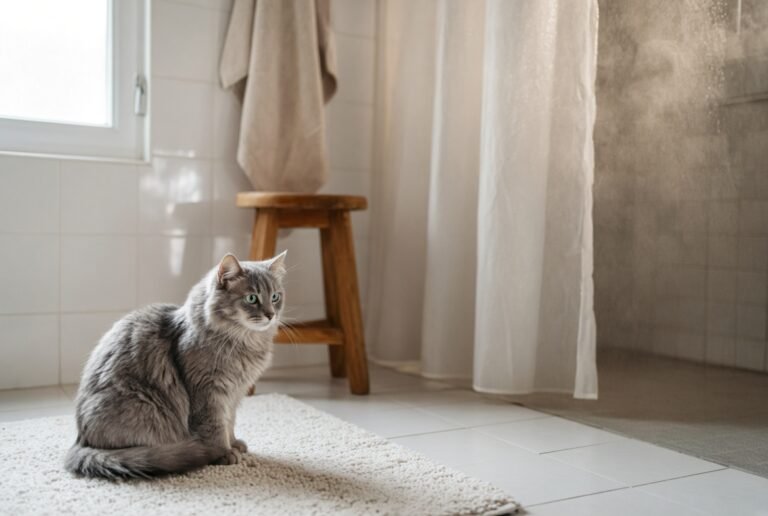
If your cat sits outside your bedroom door quietly, the behavior may be completely normal.
Your cat might be waiting for you, waiting for access, or simply choosing the hallway as a comfortable resting place.
The most useful clue is body language.
Signs your cat is probably relaxed
Your cat may:
- Lie down comfortably
- Stretch or groom
- Rest with a loose body
- Slowly blink
- Sleep while waiting
- Walk away and return casually
Signs your cat may be uncomfortable or distressed
A cat that may be more uncomfortable or distressed can show signs such as:
- Repeated pacing
- Persistent or unusual vocalization
- Excessive scratching
- Restlessness
- Hiding
- A sudden change in normal behavior
One sign alone doesn’t establish the cause. Veterinary behavior assessments consider what happened before the behavior, what the cat actually did, what happened afterward, and whether the pattern has changed.
Why Does My Cat Wait for Me Outside?
If you’re wondering why does my cat wait for me outside, watch what your cat does when you appear.
That response can tell you more than the waiting itself.
| What your cat does | Possible explanation |
|---|---|
| Greets you and stays close | Companionship or attention |
| Leads you toward the kitchen | Food or feeding routine |
| Enters the bedroom immediately | Wants access |
| Plays or asks for interaction | Stimulation or attention |
| Walks away after the door opens | Curiosity or interest in the closed room |
These aren’t strict rules. They’re clues.
Merck Veterinary Manual recommends looking at the antecedent, behavior, and consequence—the events before and after a behavior—to understand why it occurs.
Why Does My Cat Stay Outside My Bedroom at Night?
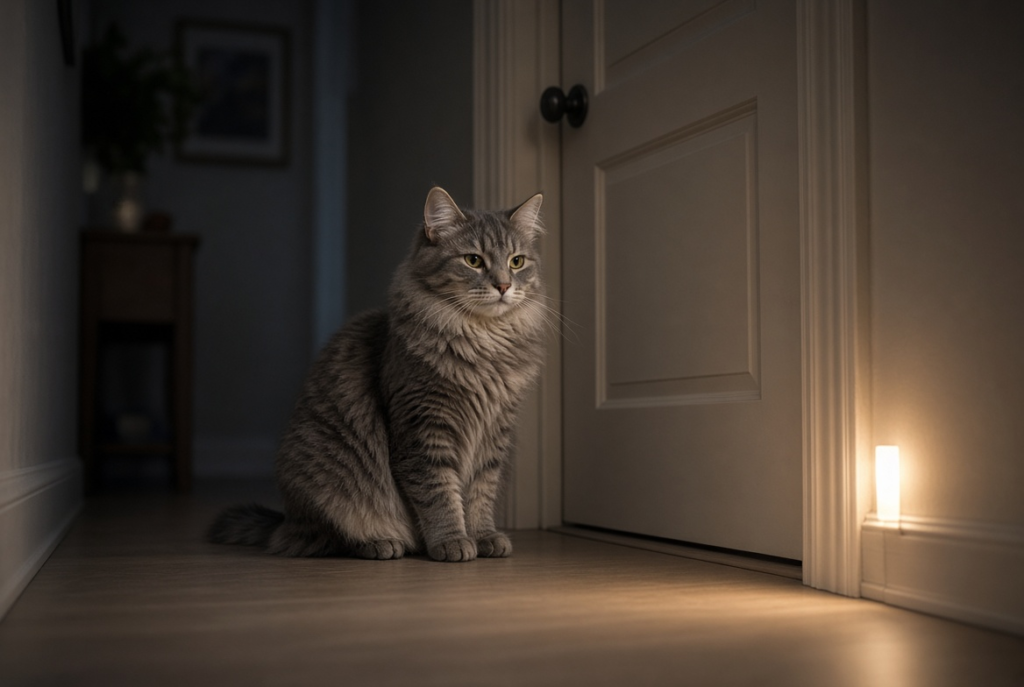
Nighttime can make the behavior more noticeable because your household becomes quiet and your cat’s usual evening routine changes.
Your cat may be accustomed to having access to you during the evening and then find themselves separated when you close the bedroom door.
The timing can provide another clue.
If your cat appears outside your door at almost exactly the same time each morning, a learned routine is a reasonable possibility.
If the behavior suddenly begins in the middle of the night and comes with unusual vocalization, pacing, or other changes, pay closer attention to the overall pattern.
Don’t assume nighttime waiting automatically means your cat is lonely. It can have several explanations.
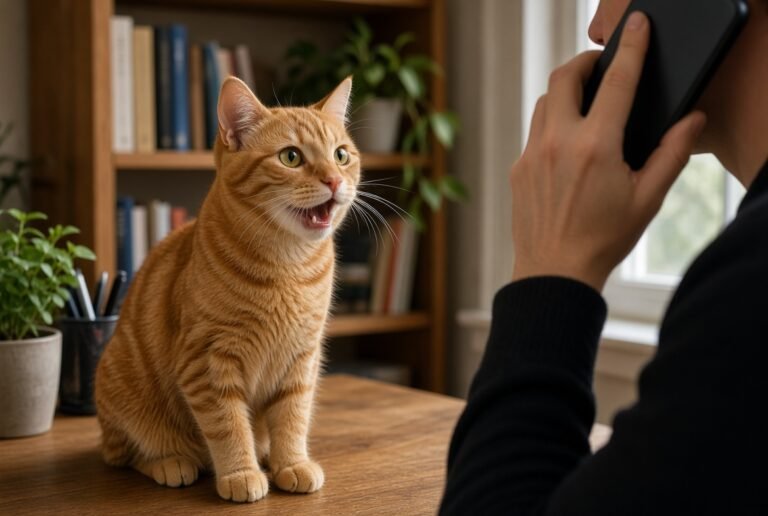
Why Does My Cat Meow Outside My Bedroom Door?
Meowing can serve several purposes when cats communicate with people.
VCA explains that cats may meow when they are hungry, greeting someone, seeking attention, bored, stressed, or trying to communicate another need.
So when your cat meows outside the bedroom, possible messages include:
- “Open the door.”
- “Pay attention to me.”
- “I’m hungry.”
- “I want to interact.”
- “Something has changed.”
The tone and context matter.
A short greeting meow when you wake up is different from persistent, unusually intense vocalization that appears alongside other behavioral changes.
Why Does My Cat Scratch the Bedroom Door?
Scratching can be an attempt to gain access or get your attention.
If scratching repeatedly gets the door opened or earns attention, your cat can learn that scratching works.
That doesn’t mean your cat is being deliberately difficult. The behavior may simply be reinforced by what happens afterward.
What can you do?
If you want your bedroom to remain off-limits:
- Make sure your cat has access to their normal resources.
- Provide a comfortable place to rest outside the bedroom.
- Offer appropriate play and enrichment during the day.
- Keep your bedtime routine predictable.
- Avoid repeatedly opening the door specifically because your cat scratches.
- Give your cat another appropriate outlet for scratching.
Consistency is important. If the bedroom is sometimes accessible after scratching but closed on other nights, your cat may have difficulty learning the boundary.
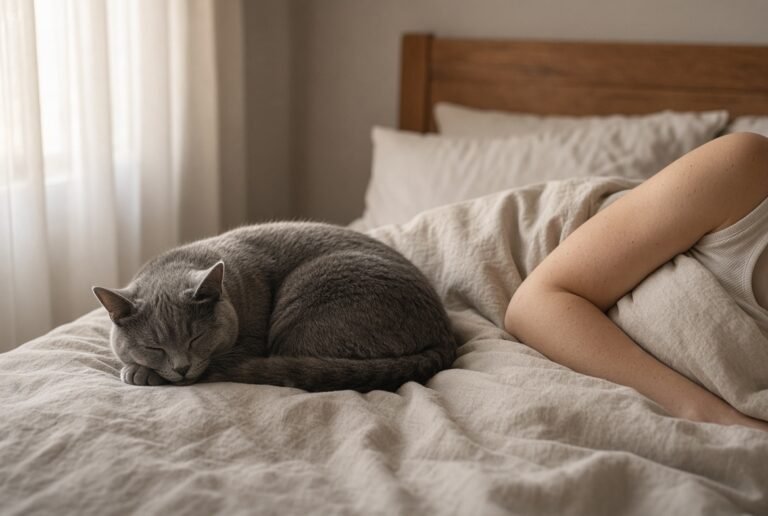
Does My Cat Want to Sleep With Me?
Possibly, but waiting outside the bedroom doesn’t prove that your cat wants to sleep on your bed.
Your cat may want access to the room, want to investigate it, or simply want to know where you are.
Watch what happens when the door opens.
If your cat walks straight to the bed and settles beside you, sleeping near you may be part of the motivation.
If they enter, investigate for a few seconds, and then leave, access or curiosity may have mattered more.
Cats are individuals, so avoid assuming that one behavior has one universal meaning.
How to Figure Out Why Your Cat Is Waiting
Rather than guessing, observe the pattern for several days.
Use the before-during-after method
Before: What happens immediately before your cat goes to the bedroom door?
During: What does your cat actually do while waiting?
After: What happens when the door opens?
For example:
You go to bed → your cat waits outside → you open the door → your cat walks straight to the kitchen.
That pattern makes food or morning routine more plausible than simply assuming your cat wants to sleep with you.
Keep a short behavior diary
For three to five days, record:
- Time the behavior starts
- What happened immediately beforehand
- Whether your cat meowed
- Whether your cat scratched
- How long they waited
- Where they went afterward
- Whether the behavior is new
This is similar to the behavioral history veterinarians use when evaluating behavior problems, which can include timing, duration, frequency, environmental changes, and what happens before and after the behavior.
Should You Let Your Cat Into the Bedroom?
There is no universal requirement to let your cat into your bedroom.
If you and your cat are comfortable sharing the room, allowing access can be perfectly reasonable.
If you prefer to keep the bedroom closed, that’s also a valid household boundary.
The important thing is that your cat still has access to their normal needs.
If your cat stays outside the bedroom, provide:
- A comfortable resting area
- Fresh water
- Appropriate litter-box access
- Scratching opportunities
- Safe toys
- Opportunities for play and exploration
- A quiet place where they can retreat
Cats have environmental and behavioral needs that include security, play, exploration, climbing, perching, scratching, eating, drinking, and elimination.
The goal isn’t to punish your cat for waiting. It’s to make the alternative comfortable and predictable.
How to Stop Your Cat Waiting Outside the Door
The best approach depends on why your cat is waiting.
If food is the trigger
Keep meals predictable and avoid turning every demand at the bedroom door into an extra feeding opportunity.
If breakfast is always the immediate reward for waking you, your cat may continue anticipating that sequence.
If attention is the trigger
Give your cat regular interaction during the day.
Interactive play can provide an appropriate outlet for a cat seeking attention or stimulation. PetMD specifically recommends interactive play when following behavior is related to attention needs.
If access is the trigger
Make your bedroom boundary consistent.
If you don’t want your cat inside, don’t make scratching the thing that reliably opens the door.
If boredom is the trigger
Improve daytime enrichment.
Provide appropriate opportunities to play, explore, climb, scratch, and work for food. Environmental management is an important part of feline behavior care.
If the behavior is new
Don’t focus only on stopping it.
First consider what changed in your cat’s routine, environment, social relationships, or general behavior.
Common Mistakes to Avoid
Assuming it’s always affection
Your cat may enjoy your company, but food, curiosity, access, attention, and routine can also explain the behavior.
Assuming every meow means hunger
Cats use vocalization for many purposes. Hunger is only one possibility.
Punishing the behavior
Yelling, banging on the door, spraying water, or physically pushing your cat away doesn’t explain what caused the behavior and may increase stress or conflict.
Changing the rules every night
If your cat is allowed into the bedroom sometimes after scratching but not at other times, the boundary becomes harder to understand and maintain.
Ignoring a sudden change
A cat that has waited outside your door for years is different from one that suddenly becomes intensely clingy.
Changes in behavior can sometimes accompany medical problems or stress, so the broader picture matters.
Expert Tips for Understanding the Behavior
Compare weekdays with weekends
If your cat waits outside your bedroom only on workdays, your morning schedule may be part of the explanation.
If it happens every day regardless of your schedule, companionship or access may be more relevant.
Notice whether the closed door is the trigger
Leave the bedroom door open on a safe, appropriate occasion and observe what happens.
If your cat no longer waits there, the restriction itself may have been part of the attraction.
Watch where your cat goes next
This is one of the simplest clues.
Bedroom → bed may suggest companionship or sleeping.
Bedroom → kitchen may suggest food or routine.
Bedroom → toy area may suggest interaction.
Bedroom → quick inspection → leaves may suggest curiosity.
Look for changes across several days
A single unusual night isn’t enough to explain a behavior.
Patterns are much more useful than isolated moments.
When Should You Worry?
Waiting outside your bedroom by itself is usually not enough to suggest that something is medically wrong.
The bigger concern is a sudden or significant change from your cat’s normal behavior, particularly when other physical or behavioral signs appear.
Contact your veterinarian if the change occurs alongside signs such as:
- Reduced appetite
- Noticeable weight change
- Changes in drinking
- Vomiting or diarrhea
- Trouble walking
- Breathing changes
- Marked decrease or increase in activity
- Increased hiding
- Unusual or persistent vocalization
- Changes in litter-box behavior
- Signs of pain or difficulty settling
Veterinary guidance recommends considering medical causes when behavior changes unexpectedly, because illness and pain can sometimes produce changes in activity, social behavior, vocalization, appetite, or other normal patterns.
Don’t try to diagnose the cause from bedroom-door behavior alone.
Myth vs. Fact
Myth: My cat is guarding my bedroom.
Fact: Waiting at the doorway doesn’t prove that your cat is guarding you. Access, companionship, curiosity, food, attention, and routine are more straightforward explanations.
Myth: Cats don’t form strong bonds with people.
Fact: Many cats form close relationships with their caregivers and may seek their company or follow them around the home.
Myth: A cat outside the bedroom is always lonely.
Fact: Your cat may simply want access to the room, anticipate breakfast, seek attention, or enjoy being close to you.
Myth: You must open the door when your cat cries.
Fact: You can keep the bedroom closed if you prefer, provided your cat has access to their normal resources and a suitable environment.
Frequently Asked Questions
Why does my cat wait outside my bedroom but not other rooms?
The bedroom may have become associated with you, bedtime, morning activity, food, or access. If the behavior happens specifically when the bedroom door is closed, the restriction itself may also be part of the attraction.
Why does my cat follow me but not my partner?
Cats can develop different relationships with different people. Your cat may associate you more strongly with food, play, attention, or other parts of their daily routine.
Why does my cat wait outside only at certain times?
Timing can reveal a learned routine. If your cat waits before breakfast or around your normal bedtime, they may have learned what usually happens at that point in the day.
Should I let my cat sleep in my bedroom?
That’s your choice. If everyone is comfortable, your cat can have bedroom access. If you prefer the door closed, provide a comfortable and safe alternative area outside the room.
Why has my cat suddenly become more clingy at night?
A change in routine, environment, social relationships, stress, or health can affect behavior. If increased clinginess is sudden or occurs with other unusual signs, speak with your veterinarian.
When should nighttime meowing concern me?
Pay closer attention when the vocalization is new, unusually intense, persistent, or accompanied by changes in appetite, activity, litter-box behavior, mobility, or other signs that your cat may be unwell.
Conclusion
So, why does my cat wait outside my bedroom door?
Your cat may be waiting because they want to be near you, want access to the room, expect breakfast, seek attention, or have learned that your bedroom routine predicts something they enjoy.
The most useful clue is what happens next.
A relaxed cat that curls up outside the door may simply enjoy being near you. A cat that scratches and meows may be asking for access or attention. A cat that immediately heads toward the kitchen may have breakfast on their mind.
The behavior deserves more attention when it represents a sudden change from your cat’s normal routine or appears alongside other signs of stress, pain, illness, or behavioral change.
Rather than treating the bedroom door as a mystery, watch the pattern around it. Your cat may not understand why you want the door closed, but they may have learned that something worth waiting for happens on the other side.