Why Does My Cat Suddenly Freeze and Stare?
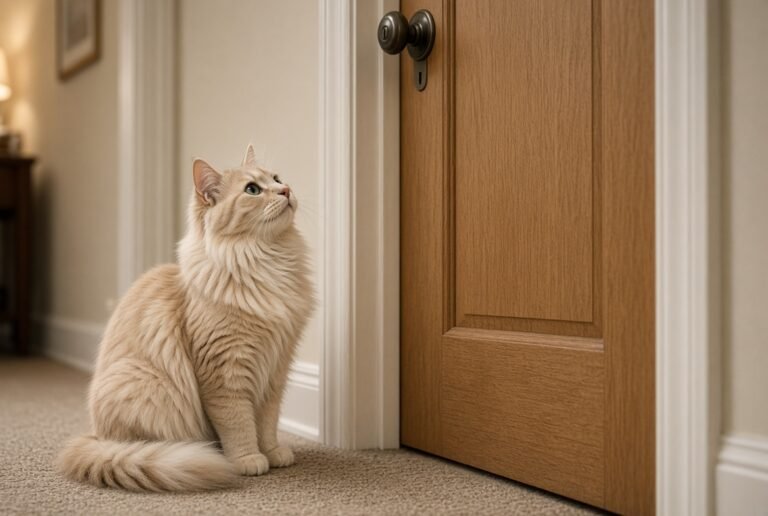
Have you ever watched your cat suddenly stop moving, become completely still, and stare intensely at something you cannot see?
Most of the time, a cat suddenly freezes and stares because it has noticed a sound, movement, insect, reflection, or another detail you cannot detect. However, repeated episodes involving unresponsiveness, twitching, confusion, or other unusual symptoms may need veterinary attention.
The most useful clue is not the staring itself, but what happens before, during, and after the episode.
A cat that briefly freezes while listening and then continues playing is very different from a cat that repeatedly becomes unresponsive or seems confused afterward.
Table of Contents
- Why cats freeze and stare
- 9 possible reasons
- When freezing is normal
- Could it be a seizure?
- Normal behavior vs. warning signs
- How to observe and record an episode
- Common mistakes
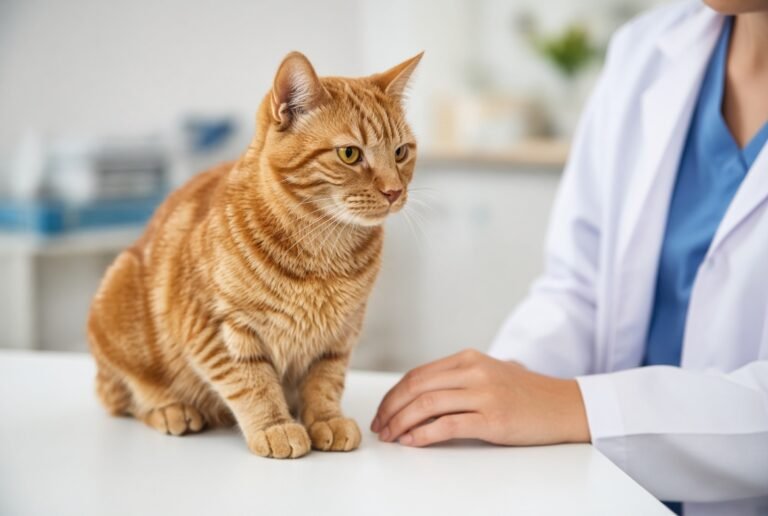
- When to contact a veterinarian
- Myth vs. fact
- Frequently asked questions
Why Do Cats Suddenly Freeze and Stare?
Cats naturally pause and become still when they are trying to understand something in their environment.
They may be listening for a faint sound, tracking tiny movement, preparing to pounce, or deciding whether something is safe.
Cats can also notice environmental details that people easily miss. A faint sound behind a wall, a tiny insect, movement outside a window, or shifting light may be enough to capture a cat’s full attention.
The behavior becomes more concerning when the pattern changes. Repeated episodes, apparent loss of awareness, abnormal movements, confusion, or difficulty walking deserve closer attention.
9 Possible Reasons Your Cat Suddenly Freezes and Stares
1. Your Cat Is Listening to Something
Cats may freeze when they hear something faint and want to determine where it is coming from.
You may not hear anything, but your cat could be responding to:
- Movement behind a wall
- A small animal outside
- Pipes or household appliances
- Another pet moving nearby
- A high-pitched or distant sound
What normal listening behavior may look like
Your cat may:
- Rotate its ears toward different sounds
- Turn its head in a particular direction
- Remain aware of its surroundings
- Resume normal activity shortly afterward
Pro tip: Watch your cat’s ears. Active ear movements often suggest your cat is listening and processing sounds.
2. Your Cat Has Spotted Something Small
If your cat freezes and stares at apparently nothing, there may actually be something there that is easy for you to miss.
Cats may focus on:
- Tiny insects
- Movement near the floor
- Shadows or reflections
- Activity outside a window
- Small changes in their environment
A cat may remain completely still while deciding whether to investigate or pounce.
Real-world example
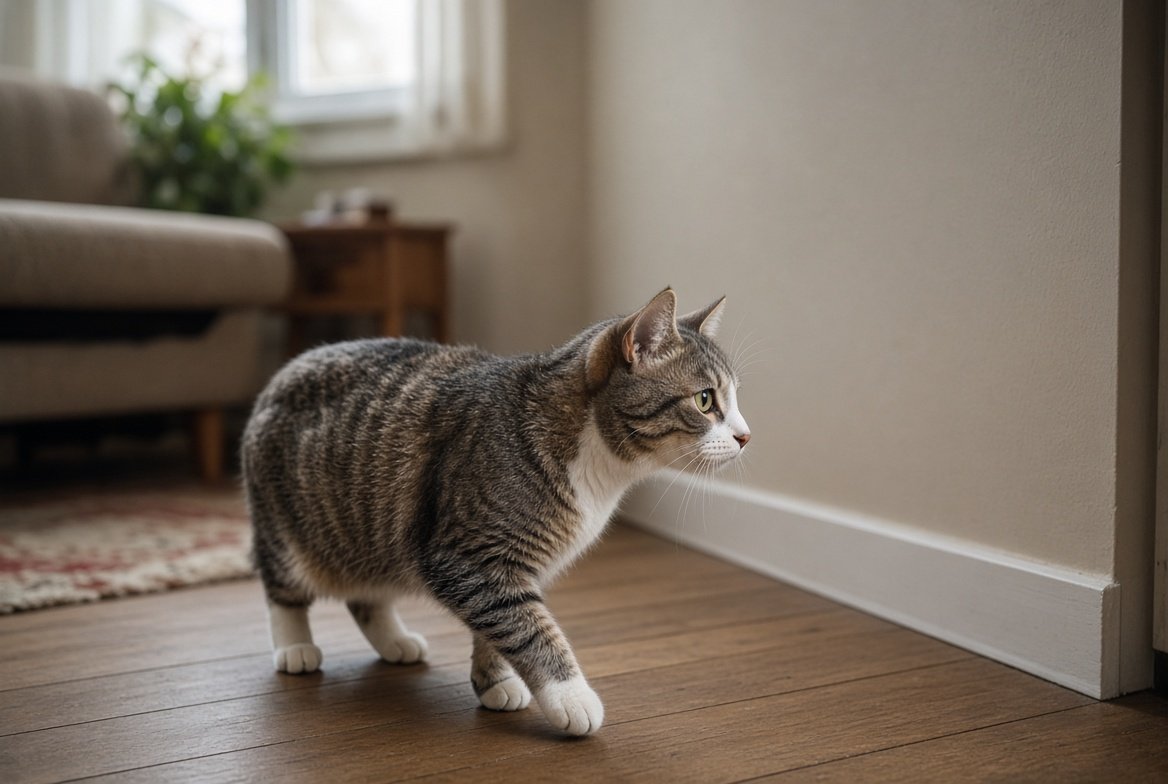
Your cat suddenly stops in the hallway and stares at one corner.
You see nothing at first.
A few minutes later, you notice a tiny insect near the baseboard.
Your cat may simply have noticed it before you did.
3. Your Cat Is Assessing Something Unfamiliar
Freezing can be part of a cat’s natural response to uncertainty.
A sudden sound, unfamiliar person, new object, or another animal may cause your cat to stop and observe before deciding what to do next.
Look for signs of tension such as:
- Dilated pupils
- Flattened ears
- A crouched posture
- A tucked or low tail
- Sudden hiding
If these signs are present, fear or uncertainty may explain why your cat suddenly stopped.
4. Your Cat Is Concentrating During Play or Hunting
If your cat suddenly freezes mid play, the behavior may simply be part of its natural hunting sequence.
Cats often pause while focusing on a toy before stalking or pouncing.
For example, your cat may:
- Chase a toy.
- Suddenly stop.
- Stare intensely.
- Adjust its body position.
- Pounce.
This type of pause is usually consistent with normal play and predatory behavior.
| Situation | More Likely Explanation |
|---|---|
| Freezes while watching a toy | Hunting or play behavior |
| Freezes before pouncing | Normal predatory behavior |
| Stares at movement near a window | Environmental awareness |
| Repeatedly becomes unresponsive | Veterinary assessment may be appropriate |
| Freezes with unusual twitching | Possible medical or neurological concern |
| Appears confused afterward | Should be discussed with a veterinarian |
5. Your Cat May Simply Be Calm or Quietly Observing
Not every stare has an obvious explanation.
Sometimes a cat may simply sit quietly and observe its surroundings without reacting dramatically to anything.
This is generally less concerning when your cat:
- Appears relaxed
- Responds normally
- Moves normally afterward
- Eats and drinks normally
- Shows no other behavioral changes
The surrounding context matters more than staring alone.
6. Stress or Anxiety May Cause Freezing
Cats may freeze when they feel overwhelmed, uncertain, or frightened.
Possible triggers include:
- Moving to a new home
- Visitors
- A new pet
- Loud noises
- Construction
- Changes in routine
Avoid forcing a frightened cat to move or investigate what it is watching.
Giving your cat space is usually better than adding more pressure to an already stressful situation.
7. Pain or Discomfort Can Cause Sudden Changes in Movement
Pain does not usually explain staring by itself.
However, discomfort can cause a cat to suddenly stop, hesitate, or become unusually still, particularly when movement triggers pain.
Pay attention to additional changes such as:
- Limping
- Avoiding jumps
- Moving differently
- Hiding more often
- Reduced activity
- Sensitivity when touched
- Changes in appetite
- Changes in litter box habits
A cat that freezes and stares once is not necessarily in pain. The concern increases when sudden stillness occurs alongside other noticeable changes.
8. Vision Problems Can Cause Confusion and Freezing
A cat experiencing vision problems may become uncertain about its surroundings and hesitate or freeze.
Cornell University College of Veterinary Medicine describes behavioral changes associated with sudden vision loss, including confusion, fear, bumping into familiar objects, and freezing when alarmed.
Possible warning signs include:
- Bumping into furniture
- Difficulty finding familiar objects
- Hesitating in familiar spaces
- Increased fearfulness
- Cloudy-looking eyes
- Unequal-looking pupils
Sudden changes in vision should be assessed promptly by a veterinarian.
9. Neurological Problems, Including Seizures, Are Possible
Neurological causes are generally less common explanations for an otherwise normal cat that briefly freezes and remains responsive.
The pattern of the episodes and accompanying symptoms are more important than staring alone.
Some seizures can involve changes in awareness or behavior. VCA notes that seizure activity may sometimes include a dazed appearance, aimless staring, lip licking, or localized twitching, while focal seizures can present differently from generalized seizures.
That does not mean that every staring episode is a seizure.
Could My Cat’s Freezing and Staring Be a Seizure?
It is possible, but staring alone cannot diagnose a seizure.
Seizures in cats can look different depending on the type of seizure and the part of the brain involved.
Some episodes are dramatic and may involve collapse, stiffening, paddling movements, or loss of consciousness. Others can be subtler and involve behavioral or localized changes.
Signs that deserve veterinary attention
Contact your veterinarian if episodes involve:
- Repeated apparent unresponsiveness
- Facial or body twitching
- Unusual repetitive movements
- Excessive drooling
- Lip licking during an unusual episode
- Collapse
- Stiffness
- Difficulty walking afterward
- Confusion or disorientation
- Episodes that are becoming more frequent
A video of the episode can be particularly useful because unusual behaviors may not happen again during a veterinary appointment.
How to Tell Normal Freezing From a Possible Medical Problem
More likely to be normal
- Your cat freezes briefly
- Your cat remains aware of its surroundings
- Your cat responds normally afterward
- Your cat appears to be listening or watching something
- The episode happens during play or hunting
- There are no unusual movements
- Your cat otherwise behaves normally
Worth discussing with a veterinarian
- Episodes happen repeatedly
- Your cat appears unresponsive
- The behavior is new or worsening
- Your cat seems confused afterward
- Twitching or unusual movements occur
- Your cat collapses
- Balance or walking changes
- Other sudden behavioral changes appear
The key question is not simply, “Did my cat stare?”
It is:
“Was my cat behaving normally and responding normally during and after the episode?”
How to Observe and Record a Freezing Episode
If your cat suddenly freezes and stares, try to observe the episode without panicking.
1. Stay calm
Do not immediately assume the worst.
A calm observation is more useful than trying to interrupt the behavior.
2. Notice what happened immediately before
Ask yourself:
- Was your cat playing?
- Did a sound occur?
- Was your cat near a window?
- Did another animal move nearby?
- Was your cat waking up or settling down?
Context can help identify possible triggers.
3. Observe responsiveness safely
Notice whether your cat naturally responds to its surroundings.
Avoid shaking or forcefully disturbing your cat to test its reaction.
4. Note how long the episode lasts
There is no single duration that proves an episode is harmless or serious.
Instead, focus on whether episodes are unusual for your cat, repeated, prolonged, or accompanied by other symptoms.
5. Record a video if possible
Try to capture:
- Your cat’s face
- Eye movements
- Body posture
- Any twitching
- The surrounding environment
- Behavior after the episode
6. Keep an episode log
Write down:
- Date and time
- What happened before
- Approximate duration
- Whether your cat responded
- Any unusual movements
- What happened afterward
A clear pattern can help your veterinarian evaluate the situation.
Common Mistakes to Avoid
Assuming your cat is staring at literally nothing
Cats may notice sounds, insects, movement, and other environmental details that humans miss.
Assuming every episode is a seizure
Normal hunting, listening, fear, and curiosity can all involve freezing and intense staring.
Ignoring repeated changes
A new or recurring pattern is more important than one isolated moment of staring.
Shaking or forcefully moving your cat
If your cat appears unusually still or disconnected, avoid physically shaking it.
Observe calmly and focus on keeping your cat safe.
Putting something in your cat’s mouth during a seizure
Do not put your fingers or an object in a cat’s mouth during a seizure.
VCA explains that cats do not swallow their tongues during seizures, and attempting to place something in the mouth can cause injury.
When Should You Contact a Veterinarian?
Arrange a veterinary consultation if your cat’s freezing and staring episodes:
- Happen repeatedly
- Become more frequent
- Include apparent unresponsiveness
- Occur with twitching or abnormal movements
- Are followed by confusion
- Occur with balance or walking changes
- Are accompanied by other signs of illness
- Represent a sudden and unexplained behavioral change
When Is It an Emergency?
Seek emergency veterinary care if your cat has a seizure lasting five minutes or longer, if seizures occur repeatedly without normal recovery between them, or if your cat has serious breathing difficulty or cannot safely recover.
If you are unsure whether what you observed was a seizure or another medical problem, contacting a veterinarian for guidance is the safest approach.
Myth vs. Fact
| Myth | Fact |
| Cats staring at nothing are always seeing something supernatural | Cats may be responding to subtle sounds, movement, insects, or environmental changes |
| Every freezing episode is a seizure | Freezing and staring can occur during normal listening, hunting, curiosity, or fear |
| Seizures always involve violent shaking | Some seizure activity can involve subtler changes in awareness or behavior |
| You should put something in a cat’s mouth during a seizure | Do not put your fingers or objects in the cat’s mouth |
| If my cat seems normal afterward, the episode must have been harmless | Some medical episodes can be brief, so repeated or unusual episodes should still be discussed with a veterinarian |
Frequently Asked Questions
Why does my cat suddenly freeze and stare at me?
Your cat may be watching your movements, waiting for food, seeking attention, or reacting to something associated with you. If your cat otherwise behaves normally, this is generally less concerning than repeated episodes involving apparent unresponsiveness or abnormal movement.
Why does my cat freeze and stare into space?
Your cat may have noticed a sound, movement, insect, reflection, or another environmental detail you cannot detect. Repeated episodes involving unusual movements or changes in awareness should be discussed with a veterinarian.
Why does my cat suddenly stop and freeze?
Cats may stop suddenly to listen, observe, hunt, or assess something unfamiliar. A repeated or unexplained pattern, especially with other symptoms, deserves closer attention.
Why does my cat suddenly freeze mid play?
A pause during play is often part of normal hunting behavior. Cats may freeze while focusing on a toy before stalking or pouncing.
Can cats have staring seizures?
Some seizures can involve changes in awareness or behavior, including staring. However, staring alone is not enough to diagnose a seizure.
How long should a normal staring episode last?
There is no single duration that can reliably classify every episode. Context, responsiveness, repetition, and accompanying symptoms are more useful clues.
Should I try to wake my cat when it freezes and stares?
Avoid shaking or forcefully disturbing your cat. Observe calmly, note what happens, and record the episode if possible.
Why does my older cat stare at walls?
Older cats may stare for ordinary reasons, but persistent blank staring combined with disorientation or other behavioral changes should be discussed with a veterinarian.
Can stress cause my cat to freeze?
Yes. A frightened or overwhelmed cat may become still while assessing an unfamiliar or stressful situation.
When is cat freezing and staring an emergency?
Seek urgent veterinary help if the episode involves collapse, serious breathing difficulty, a seizure lasting five minutes or longer, or repeated seizures without normal recovery.
Final Thoughts
If your cat suddenly freezes and stares, the explanation is often something ordinary: a sound, tiny movement, insect, reflection, or another environmental detail that you have not noticed.
What matters most is the overall pattern.
A brief pause during play or while listening is very different from repeated episodes involving apparent unresponsiveness, confusion, twitching, collapse, or other sudden behavioral changes.
Observe what happens before, during, and after the episode. If the behavior is new, recurring, worsening, or accompanied by other symptoms, record what you see and discuss it with your veterinarian.
That approach helps you avoid unnecessary panic while still taking potentially important changes in your cat’s behavior seriously.