Why Does My Puppy Sit Down When He Sees Other Dogs?
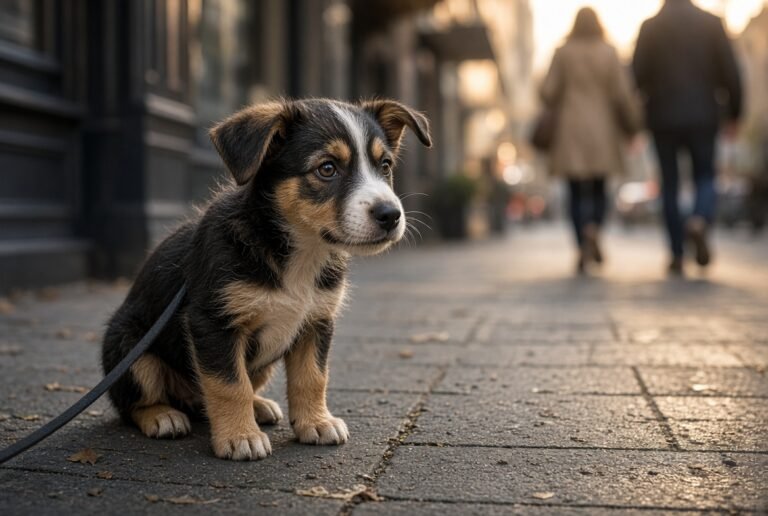
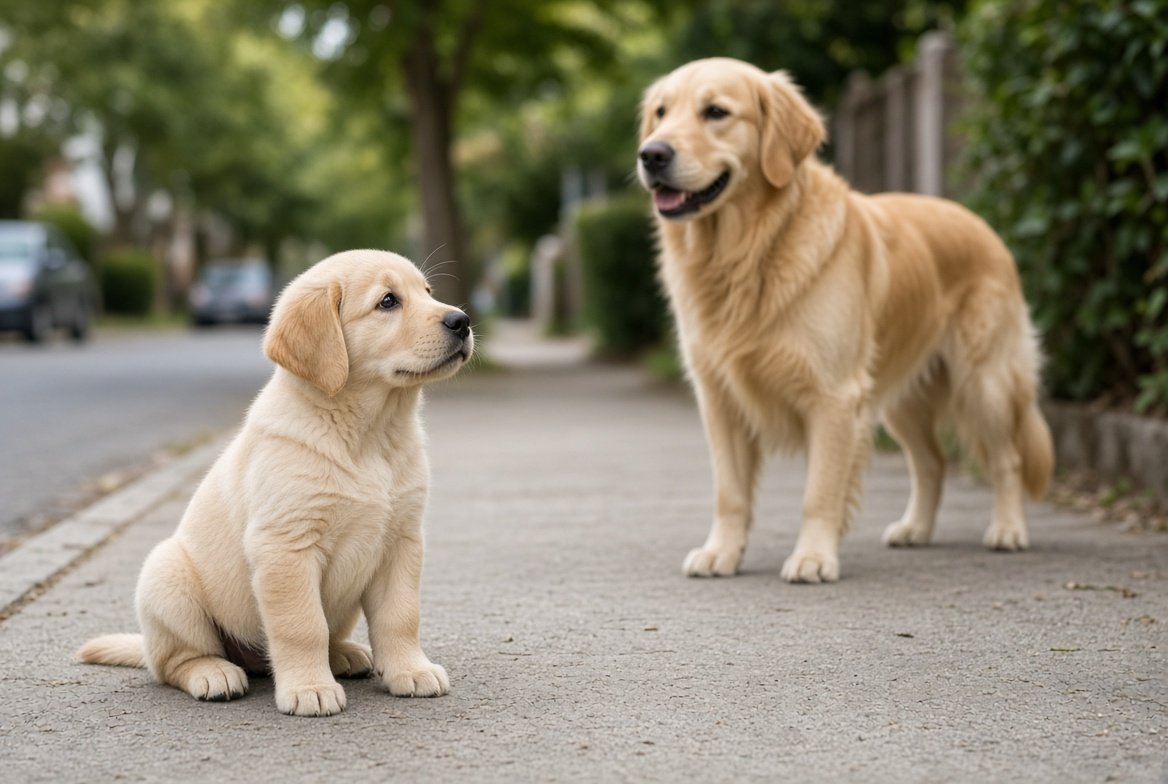
You’re walking your puppy when he suddenly spots another dog, stops, and sits down. Maybe he stares, leans forward, pulls toward the dog, or freezes completely.
So, why does my puppy sit down when he sees other dogs?
The sitting itself doesn’t tell you enough. Your puppy could be excited about meeting the dog, unsure what to do, frustrated by the leash, curious, or uncomfortable. The most useful clue is what he does in the few seconds after he sits.
A loose body, forward movement, and interest in the other dog suggest something very different from a stiff body, tucked tail, freezing, or trying to hide. Dogs communicate a great deal through posture, facial expression, tail position, and movement, so the whole picture matters.
Table of Contents
- Why does my puppy sit down when he sees other dogs?
- Watch what your puppy does next
- Is my puppy excited or scared?
- Why does my puppy freeze when seeing other dogs?
- Why does my puppy stop walking when seeing other dogs?
- What should I do when my puppy sits?
- How to teach your puppy to stay calm around other dogs
- Does my puppy need to greet other dogs?
- Common mistakes to avoid
- Real-world examples
- Expert tips for easier walks
- When should you get professional help?
- Frequently Asked Questions
- Conclusion
Why Does My Puppy Sit Down When He Sees Other Dogs?
There are several possible reasons your puppy sits when another dog appears. The important thing is not to assume that every puppy who stops is afraid or every puppy who sits wants to play.
Here are the most common explanations.
1. Your puppy wants to meet the other dog
Some puppies become intensely interested when they see another dog.
They may sit and watch, lean forward, wag their tail, whine, or try to move closer. The leash prevents them from approaching at their own pace, so stopping can become part of their response.
This can develop into leash frustration. A dog that normally enjoys other dogs may become frustrated on walks because the leash prevents him from going over to greet them.
Example: Your puppy sees a friendly dog across the street, sits down, leans forward, and keeps trying to move toward it. His body stays loose and he happily takes a treat from you. That looks much more like interest than fear.
2. Your puppy feels nervous or uncertain
A young dog may not know what to make of an unfamiliar dog approaching.
Instead of running away, he may stop and watch. Sitting can give him time to assess what is happening, especially if he has limited experience around unfamiliar dogs.
Look for signs such as a lowered body, tucked tail, ears held back, avoiding eye contact, lip licking, trembling, hiding, or attempting to retreat. Freezing and hiding are recognized signs that a dog may be frightened or stressed.
3. The leash is creating frustration
Your puppy may want to approach but cannot.
That restriction can make the sight of another dog especially exciting. Some dogs respond by pulling, whining, barking, or lunging; others simply plant themselves on the ground and stare.
Leash walking is a skill puppies have to learn. They are not born understanding that they should calmly walk beside a person while ignoring interesting distractions.
4. Your puppy is overwhelmed
Sometimes the other dog is simply too much information at once.
Your puppy sees movement, hears sounds, smells the dog, notices your reaction, and has to decide whether to approach, retreat, or continue walking. Stopping can be a sign that he is struggling to process the situation.
This is especially worth considering if your puppy can calmly watch dogs from a distance but becomes stiff, distracted, or unresponsive when they get closer.
5. Sitting has become a learned behavior
Your puppy may also have discovered that sitting changes what happens next.
Perhaps you stop walking when he sits. Maybe the other dog comes closer. Maybe you talk to him, offer a treat, or allow him to greet the dog.
If sitting repeatedly produces an interesting result, your puppy may continue doing it.
That doesn’t mean he is being deliberately difficult. He has simply learned that sitting can influence the situation.
Watch What Your Puppy Does Next
This is one of the easiest ways to understand why your puppy sits.
Don’t focus only on the fact that his bottom is on the ground. Watch the next five seconds.
Sits + loose body + leans forward
Your puppy is likely interested or excited.
He may be hoping to approach the other dog, particularly if his tail and body remain loose and he is eager to move forward.
Sits + stares + pulls forward
This can fit excitement or leash frustration.
Your puppy may want to greet the dog but doesn’t understand how to handle being restrained.
Sits + stiff body + freezes
This is more concerning for discomfort or fear.
A frightened dog may become still rather than immediately trying to escape. Other signs can include a tucked tail, lowered body, pinned-back ears, looking away, or attempts to hide.
Sits + backs away or hides behind you
Give him more space.
A puppy who is trying to create distance is telling you that the interaction may be too intense.
Sits + looks at the dog + looks back at you
That’s a useful training opportunity.
If your puppy can notice another dog and then voluntarily check in with you, reward that choice. You are teaching him that seeing another dog doesn’t automatically mean he has to approach it.
Is My Puppy Excited or Scared?
The easiest way to tell the difference is to stop looking at the sit itself and watch the rest of your puppy.
| Behavior | More consistent with interest or excitement | More concerning for fear or stress |
|---|---|---|
| Body | Loose and relaxed | Stiff, crouched, or tense |
| Movement | Leans or moves toward dog | Moves away or freezes |
| Tail | Loose or naturally wagging | Tucked or held very low |
| Face | Curious and relaxed | Tense, worried, or avoiding |
| Eyes | Watches normally | Repeatedly looks away or becomes fixed and tense |
| Food | Usually still interested | May refuse food when overwhelmed |
| Recovery | Quickly returns to normal | Remains unsettled after the dog passes |
These are clues rather than absolute rules. A wagging tail, for example, does not automatically mean your puppy is happy. Body language needs to be interpreted as a whole.
Pro tip: If you’re unsure, create a little more distance and see what changes. A puppy who relaxes once the other dog is farther away is giving you useful information.
Why Does My Puppy Freeze When Seeing Other Dogs?
A puppy who sits is not necessarily freezing.
Freezing usually looks more like an abrupt loss of movement. Your puppy may become very still and focus intensely on the other dog.
A worried puppy may:
- Become stiff or motionless
- Lower his body
- Tuck his tail
- Pin his ears back
- Avoid eye contact
- Lick his lips or yawn
- Tremble
- Try to hide
- Attempt to retreat
- Stop accepting food
Fear can produce a freeze response as well as attempts to flee or avoid the situation.
If your puppy freezes, don’t assume he needs to be encouraged to “be brave” by moving closer.
Instead, give him room.
Sitting versus freezing
A relaxed puppy may sit simply because he wants to observe another dog.
A puppy who freezes may be struggling to cope with the situation.
The difference isn’t the position of his body. It’s the quality of his body language and his ability to respond.
If your puppy can look at you, take a treat, move with you, and recover quickly, that’s very different from a puppy who becomes rigid and appears unable to respond.
Why Does My Puppy Stop Walking When He Sees Another Dog?
If your puppy stops walking when he sees another dog, the dog has probably become more important to him than whatever was happening a moment earlier.
The reason could be excitement, curiosity, uncertainty, fear, or leash frustration.
The immediate response should depend on his body language.
If your puppy looks relaxed
Give him a moment to notice the dog, then calmly encourage him to move with you.
You can use a cue such as “let’s go” if you’ve already taught it. Reward him for turning away from the distraction and walking with you.
If your puppy looks worried
Don’t pull him toward the dog.
Increase the distance instead. Cross the street, turn around, step behind a parked car, or move to another part of the path if necessary.
Distance is not failure. It is a practical way to keep your puppy comfortable enough to learn.
What Should I Do When My Puppy Sits?
If your puppy sits when another dog appears, don’t immediately drag him forward.
Use this simple five-step approach:
- Pause and observe. Look at his whole body rather than assuming what the sit means.
- Check the distance. If he looks tense, the other dog may be too close.
- Avoid forced greetings. Your puppy doesn’t need to meet every dog.
- Redirect if he is relaxed. Use a familiar cue such as “let’s go” and reward him for moving with you.
- Create distance if he is worried. Give him enough space to relax before asking for more.
The goal is to respond to what your puppy is communicating rather than treating every sit as disobedience.
How to Teach Your Puppy to Stay Calm Around Other Dogs
If your puppy regularly stops, freezes, or becomes overly excited around dogs, work on the behavior before the reaction becomes intense.
Step 1: Start farther away
Find a distance where your puppy can notice another dog but still respond to you.
There is no magic distance that works for every puppy. One dog might remain relaxed at 40 feet while another needs considerably more space.
The important part is that your puppy can still think, move, and engage with you.
Step 2: Reward the sight of another dog
The moment your puppy notices another dog without becoming overwhelmed, reward him.
For example, he spots a dog down the sidewalk, looks at it, and then looks back at you. Mark that moment and give him something he values.
This is the basic idea behind counterconditioning: pairing the trigger with something positive while keeping the dog at an intensity where he can remain comfortable.
Step 3: Teach “let’s go” away from dogs
Don’t wait until you’re standing next to another dog to teach your puppy how to follow you.
Practice at home first.
Say “let’s go,” take a few steps, and reward your puppy for coming with you. Practice in the yard or a quiet area before introducing bigger distractions.
Directional cues and rewarding a puppy for staying with you are useful parts of loose-leash training.
Step 4: Keep the distance manageable
If your puppy can calmly watch another dog from 30 feet away, don’t immediately move to 10 feet.
Make progress gradually.
If he starts freezing, staring intensely, refusing food, barking, or pulling, increase the distance again. Desensitization works by starting at a manageable level and gradually increasing the challenge while keeping the dog comfortable.
Step 5: Reward recovery
Don’t only reward your puppy for never reacting.
Notice how quickly he recovers.
If he sees a dog, briefly watches, then turns back to you and continues walking, that’s valuable progress.
You are teaching him a practical skill: notice the dog, then return to normal.
What If Your Puppy Won’t Take Treats?
This is an easy detail for owners to overlook.
If your puppy normally loves treats but suddenly refuses them when another dog appears, don’t assume he’s being stubborn.
The situation may simply be too intense for him at that moment.
Increase the distance and see whether he can eat again.
A dog who can calmly accept food and respond to familiar cues is generally in a better position to learn than one who is completely overwhelmed. Training should be adjusted to keep the dog below the point of a major reaction.
Does My Puppy Need to Greet Other Dogs?
No.
Your puppy does not need to say hello to every dog to become well socialized.
Good socialization is about helping a puppy have positive, manageable experiences with the world. That includes learning how to behave around other dogs, but it does not mean every dog on the sidewalk needs to become a playmate.
Controlled interactions are especially important because puppies can become frightened or overwhelmed by poorly managed encounters. Reading their body language and allowing them to take things at an appropriate pace helps keep experiences positive.
A calm walk past another dog is a successful social experience too.
When a greeting may be appropriate
Before allowing your puppy to approach another dog, consider:
- Is the other dog relaxed?
- Is the other owner comfortable?
- Is your puppy relaxed?
- Can both dogs be safely controlled?
- Is the environment suitable?
- Can either dog move away if uncomfortable?
If the answer to those questions isn’t reassuring, simply continue walking.
Four Real-World Puppy Scenarios
Scenario 1: The enthusiastic greeter
Your puppy spots another dog, sits down, leans forward, wags loosely, and starts whining.
As the dog gets closer, your puppy tries to move toward it.
Likely picture: excitement or frustration about being unable to greet.
What to do: Increase your distance if needed and practice turning his attention back to you rather than allowing every dog to become a greeting opportunity.
Scenario 2: The nervous puppy
Your puppy sees another dog and immediately becomes stiff. His tail drops, his ears move back, and he refuses a treat he normally loves.
Likely picture: the situation is too intense.
What to do: Create distance. Don’t force the interaction.
Scenario 3: The curious observer
Your puppy sits down, watches the other dog for several seconds, sniffs the air, looks back at you, and then happily continues walking.
Likely picture: normal curiosity.
What to do: You may not need to “fix” anything. Reward calm observation and continue your walk.
Scenario 4: The leash-frustrated puppy
Your puppy spots a dog, sits and stares, then suddenly pulls forward and whines because the leash prevents him from reaching the dog.
Likely picture: excitement combined with frustration.
What to do: Work on attention and loose-leash skills at greater distances instead of allowing repeated frustrated greetings. Leash frustration can occur when dogs want to approach another dog but are physically prevented from doing so.
Common Mistakes to Avoid
Pulling your puppy toward the other dog
If your puppy is worried, forcing him closer removes his ability to create distance.
That can make an already uncomfortable situation harder.
Waiting until he reacts
Don’t wait for:
sit → stare → freeze → bark → lunge
before deciding what to do.
If you notice your puppy becoming intensely focused on another dog, create space while he can still respond to you.
Forcing greetings
A puppy doesn’t become social by being forced to interact with every dog.
Let interactions be controlled and appropriate.
Punishing fear-based behavior
If your puppy is frightened, punishment doesn’t address the reason he is uncomfortable. Reward-based training and gradual exposure are preferred approaches for changing emotional responses.
Moving closer too quickly
One successful encounter does not mean your puppy is ready to walk directly past every dog.
Increase difficulty gradually.
Assuming every sit is a problem
Sometimes a puppy simply wants to watch.
If his body is loose, he remains responsive, accepts treats, and quickly resumes walking, there may be nothing wrong that needs correcting.
Expert Tips for Easier Walks
Don’t wait for the sit
If your puppy notices another dog from a distance, you can start your “let’s go” routine before he plants himself on the ground.
Use the sidewalk strategically
Crossing the street before a difficult encounter is not failure. It is smart management.
Reward the check-in
When your puppy notices a dog and then looks back at you, reward that choice.
Over time, you want that check-in to become familiar.
Measure recovery, not perfection
Your puppy doesn’t have to ignore every dog.
A better sign of progress may be that he notices a dog, stays relaxed, looks at you, and continues walking.
Keep training sessions short
If every walk turns into repeated stressful encounters, your puppy gets fewer opportunities to practice calm behavior.
Choose quieter routes or quieter times when possible and create easy wins.
Myth vs. Fact
Myth: Sitting means my puppy is stubborn.
Fact: Sitting can be caused by excitement, curiosity, uncertainty, fear, leash frustration, or learned behavior. The rest of the body language gives you more useful information.
Myth: A wagging tail means my puppy is happy.
Fact: Tail movement should be interpreted alongside posture, facial expression, ears, movement, and the situation. A wag alone doesn’t tell you exactly how a puppy feels.
Myth: A well-socialized puppy should greet every dog.
Fact: Socialization isn’t a requirement to interact with every dog. A puppy can learn to calmly observe dogs and walk past them without saying hello.
When Should You Get Professional Help?
You don’t need to wait for aggression before asking for help.
Consider working with a qualified, reward-based trainer or veterinary behavior professional if your puppy:
- Repeatedly panics around other dogs
- Tries to escape
- Trembles or freezes frequently
- Cannot recover after a dog passes
- Regularly lunges or snaps
- Becomes increasingly difficult to walk
- Cannot remain responsive around dogs even at a substantial distance
- Shows behavior that is getting worse rather than better
Fear-based responses can escalate when a dog repeatedly feels unable to avoid an uncomfortable interaction, so early support can be worthwhile.
If the behavior appears suddenly or seems unusual for your puppy, speak with your veterinarian as well.
Frequently Asked Questions
Why does my puppy sit when he sees another dog?
Your puppy may sit because he is excited, curious, nervous, overwhelmed, or frustrated by the leash. Watch his posture and what he does immediately afterward to understand the likely reason.
Why does my puppy sit when he sees another dog but not people?
Dogs can be especially exciting or concerning to a puppy. He may want to greet them, be unsure around unfamiliar dogs, or find it difficult to manage the movement and social signals involved.
Why does my puppy freeze when seeing other dogs?
Freezing can be a sign of fear or stress, particularly when accompanied by a stiff body, tucked tail, lowered posture, pinned-back ears, hiding, or attempts to retreat. Give your puppy more distance rather than forcing him closer.
Why does my puppy stop walking when he sees another dog?
He may be interested in the dog, excited to greet it, frustrated by the leash, or uncomfortable with the approaching dog. His body language and ability to respond to you can help distinguish these possibilities.
Should I pull my puppy away when he sits?
Don’t automatically pull him. First check whether he is relaxed or worried. If he’s comfortable, calmly redirect him and continue walking; if he’s anxious, create more distance.
Should my puppy greet every dog?
No. Your puppy can learn excellent social skills without greeting every dog he encounters. Calmly walking past another dog is an important skill in itself.
What if my puppy sits and then pulls toward the other dog?
That can happen when a puppy is excited or frustrated because the leash prevents him from approaching. Work on attention and loose-leash walking at a distance where he can still respond to you.
Is sitting around other dogs a sign of aggression?
No. Sitting alone does not indicate aggression. Fear, excitement, curiosity, uncertainty, and leash frustration can all affect how a puppy responds to another dog.
What should I do if my puppy won’t take treats around other dogs?
Increase the distance and make the situation easier. If your puppy is too overwhelmed to eat, continuing to work at that same distance is unlikely to be productive. Desensitization should begin at an intensity the dog can comfortably handle.
How long does it take to teach a puppy to stay calm around other dogs?
There is no fixed timeline. Some puppies improve quickly with consistent practice, while fear-based reactions can require much more gradual work. The important thing is to progress according to your puppy’s ability to remain relaxed rather than trying to reach a particular distance by a particular date.
Conclusion
If you’ve been wondering, “why does my puppy sit down when he sees other dogs?”, don’t judge the behavior by the sit alone.
Look at what happens next. A puppy who sits with a loose body and wants to move closer may be excited. A puppy who becomes stiff, freezes, hides, or tries to retreat may be overwhelmed or afraid. Another puppy may simply be curious and taking a moment to watch.
Your response should match what your puppy is telling you.
Give him space when he needs it, reward calm choices, teach him how to move with you, and avoid forcing him into greetings or situations he cannot comfortably handle.
The goal isn’t to make your puppy ignore every dog. It’s to teach him that seeing another dog doesn’t mean he has to stop, stare, panic, or rush over.