
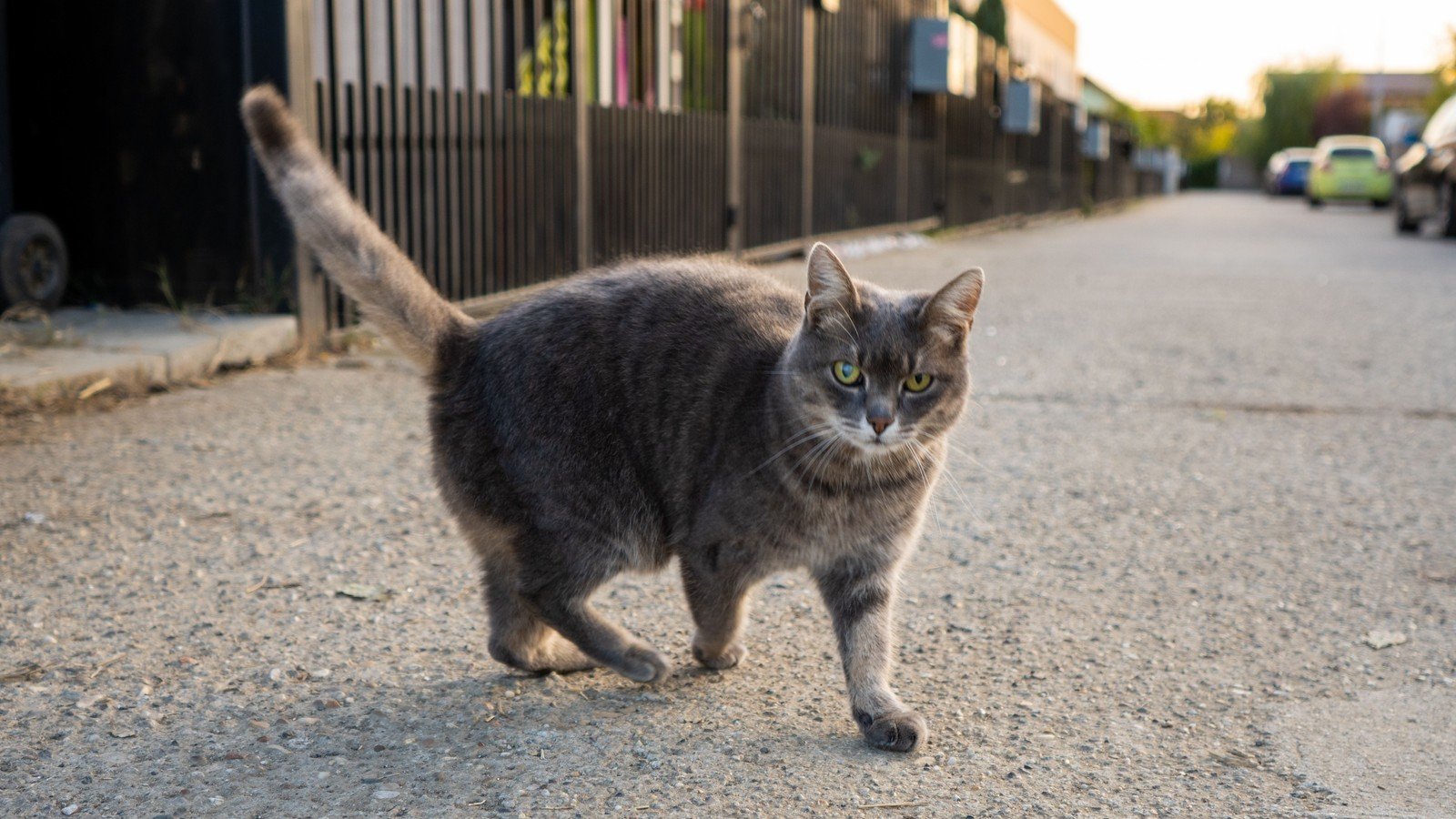
Why Do Cats Wag Their Tails? 9 Meanings + the Stop Signal
Read nine tail movements by speed and height, learn the hands-off signal, and see when a change needs a vet.
Why do cats wag their tails? It is one of the most misread signals in cat behaviour. This guide decodes nine movements by speed plus height.
Quick answer
Cats wag their tails to communicate, not just when happy. Read speed plus height: a slow, loose, high tail usually means friendly; a fast, low, thumping tail means aroused or annoyed. If your cat purrs but the tail starts flicking faster while you stroke, stop — a swat or bite can follow if you carry on.
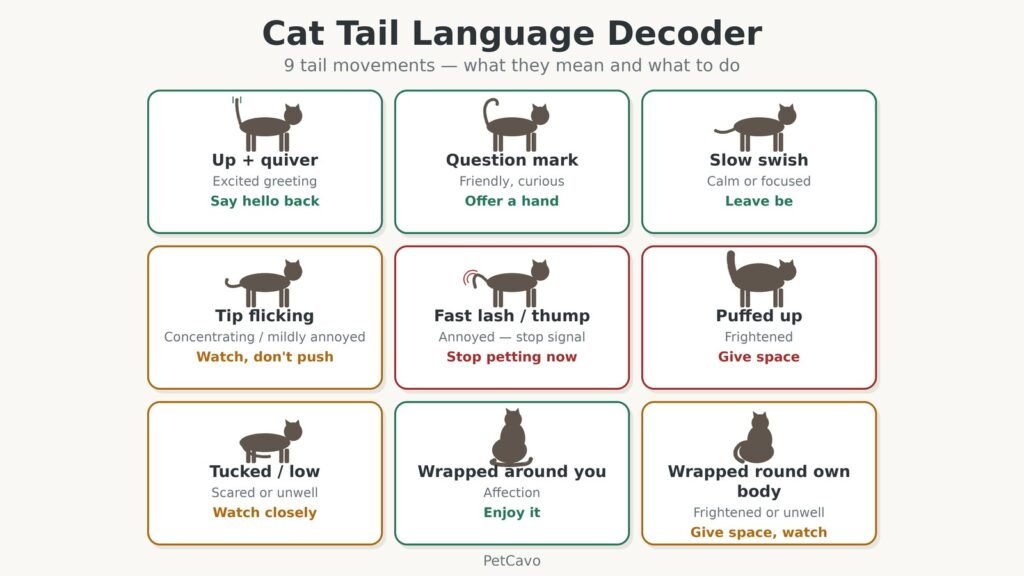
The 3-Second Decoder
Use this chart first: find the movement, then check what to do. Slow, loose movement means calm or focused; fast flicking, lashing or thumping means arousal or a warning. A sudden change in speed matters most.
| Movement | What it usually means | What to do |
|---|---|---|
| Up + quiver | Excited greeting | Say hello back |
| Question mark | Friendly, curious | Offer a hand |
| Slow swish | Calm or focused | Leave be |
| Tip flicking | Concentrating or mildly annoyed | Watch, don’t push |
| Fast lash or thump | Annoyed — stop signal | Stop petting now |
| Puffed up | Frightened | Give space |
| Tucked or low | Scared or unwell | Watch closely |
| Wrapped around you | Affection | Enjoy it |
| Wrapped round own body | Frightened or unwell | Give space, watch |
Why Do Cats Wag Their Tails? (Not Like Dogs)
A cat wag does not mean what a dog wag means. A dog wag signals friendly excitement, but a cat wag means the cat is stirred up — pleased, focused, irritated or overexcited.
A tail held straight up and still is a greeting posture, not a wag. A question-mark curve often means friendly and playful, but only with ears forward and a loose body. PetMD describes a loose tail held high as a confident greeting, and ASPCA Pet Health Insurance gives the same advice to read the whole body. International Cat Care treats a tail held up as a friendly signal too.
Why Does My Cat Wag Its Tail When They See Me?
When your cat walks towards you with the tail straight up, often with a small curve or quiver at the tip, that is a friendly greeting. International Cat Care describes the tail-up posture as a sign of friendly intent, and ASPCA Pet Health Insurance notes that a cat who approaches this way views the person as a friend. Look for ears forward and a relaxed body to confirm it. Let your cat close the gap and sniff first. A tail-up greeting is an invitation to say hello, not a promise that your cat wants to be picked up.
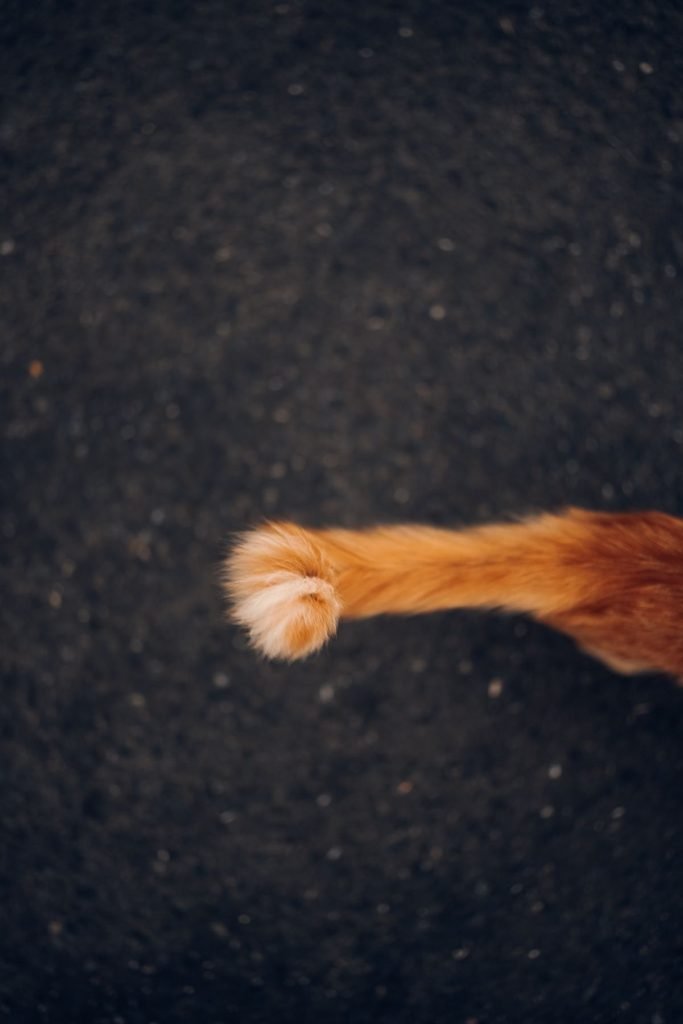
Do Cats Wag Their Tails When Happy?
Yes, but a wag on its own does not prove happiness. A content cat often holds the tail up or lets it rest loose, with ears forward and a relaxed body. Slow blinks, head-bunts and kneading can sit alongside that picture. Purring alone is not proof either, as cats purr in other contexts too. Judge the whole cat: if the body is soft and your cat leans in, the mood is likely good. If the tail starts to flick faster, treat that change as your cue to pause. International Cat Care describes relaxed eyes, head-bunting and purring in detail.
Why Does My Cat Wag Its Tail While Lying Down?
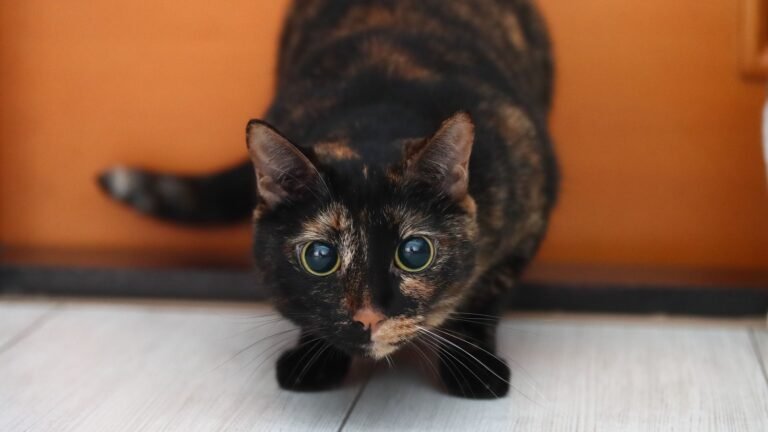
A cat lying down with a slowly moving tail is usually relaxed but still taking things in — resting without fully switching off.
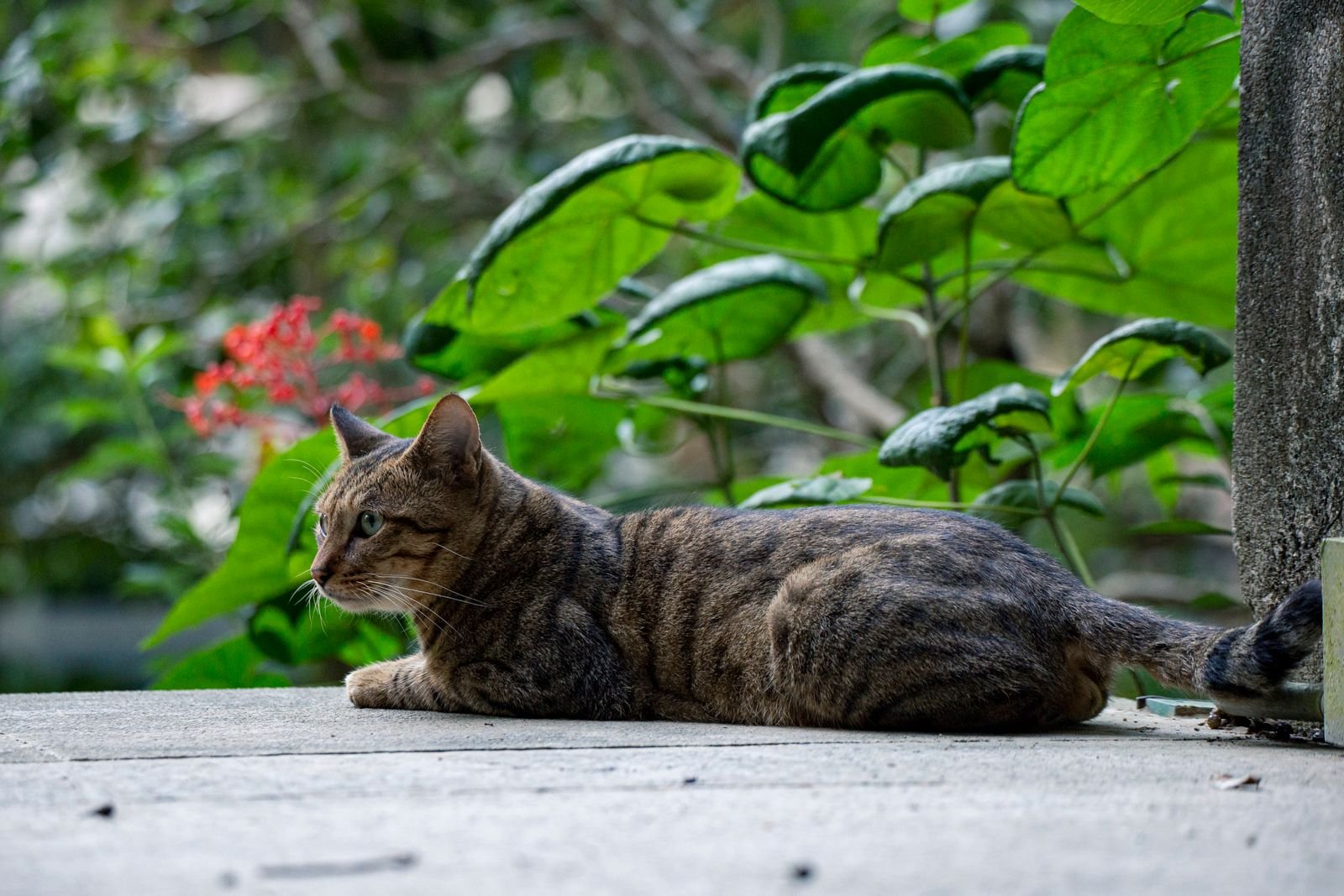
Add purring to a soft, slow tail and it usually means contentment. Many cats knead at the same time; our guide to kneading and purring explains why that habit starts in kittenhood.
Why Does My Cat Slap or Thump Its Tail While Lying Down?
A single soft thump on the floor while your cat lies down can be a brief sign of focus or mild frustration. Repeated thumping is different. International Cat Care lists a thumping tail with a crouched body as a defensive posture, so stop stroking and give space. Check the ears and skin too: ears turned back, rippling skin or a fixed stare mean your cat wants the fuss to end. If thumping is new and comes with hiding, appetite change or sensitivity along the back, book a vet check.
Why Does My Cat Wag Its Tail When I Pet Them?
Tail movement during petting is feedback. A tail that stays still or moves gently at first can start to flick as fuss goes on. That build-up often means your cat has had enough, even if the purring continues. Warnings often build in a common order:
| Signal | What it tells you |
|---|---|
| Tail flicks speed up | Tolerance is fading |
| Ears turn back | Irritation is rising |
| Purring stops | Late warning (varies by cat) |
| Swat or bite | You missed the earlier signals |
Not every cat follows this order, so treat any single sign as reason to pause. Keep stroking through the warnings and many cats will end it with an overstimulation bite.
Should You Stroke Your Cat’s Tail?
Most cats would rather not have their tail stroked. The spots cats usually enjoy are around the face — cheeks, chin and next to the ears. If your cat walks off, flicks the tip or turns to look at your hand, take the hint and move back to the head.
Some cats lift the rump and lean in when they enjoy brief fuss near the base of the tail. Keep it short and stop if the tail starts to flick or the skin ripples. Many cats dislike having the tail itself held or pulled, so never grip it to keep your cat still.
Why does my cat flick its tail while cuddling?
Flicks during a cuddle often mean mixed feelings. Your cat may enjoy being close but not want more stroking. If flicks speed up, stop stroking and keep your hand still. Let your cat stay for warmth or move away as it chooses. Purring does not overrule the tail, so follow the change in speed.
Why Does My Cat Wag Its Tail While Sleeping?
Small tail movements in sleep are normal, and are often linked to dreaming. The tip may twitch while the body stays loose.
A bigger thump on its own does not prove a vivid dream; it may follow a noise that half-woke them. Most cats settle again without help. It is not normal if your cat wakes distressed, cries out, or the episodes keep repeating — mention that pattern to a vet. And if your cat stares at you while you sleep instead, that fixed look has its own meanings.
Why Does My Cat Wag Its Tail While Sitting?
A sitting cat whose tail sways slowly is usually calm and watching the room. The same slow sway while watching birds through the window means focused and relaxed.
Sitting nearby is social, even without contact. If yours sits near you but won’t be touched, that distance is often the point — company on their terms.
Why does my cat wag its tail while looking out the window?
A cat at the window is often watching birds, insects or passers-by. ASPCA Pet Health Insurance notes that a slow, even back-and-forth movement often means the cat is focused on something, such as a bird out the window. You may also see tip flicks, chattering or a crouched hunting posture. Let your cat watch in peace. If the movement turns fast with ears back, your cat may be frustrated by prey it cannot reach, so offer a toy to chase instead.
Why Does My Cat Wag Its Tail When I Talk to Them?
When you talk to your cat, a slow tail sway often means they are listening and relaxed.
Slow blinks while you speak suggest your voice is welcome. If the eyes stay fixed and the flicks keep coming, wait and let your cat settle before you reach out. The same listening is at work if your cat meows when you’re on the phone — many cats notice a change in your voice.
Tail Wagging While Playing or Hunting
During play and hunting, the tail swishes slowly while the body stays low and still. That sweep helps the cat focus — it is concentration, not friendliness.
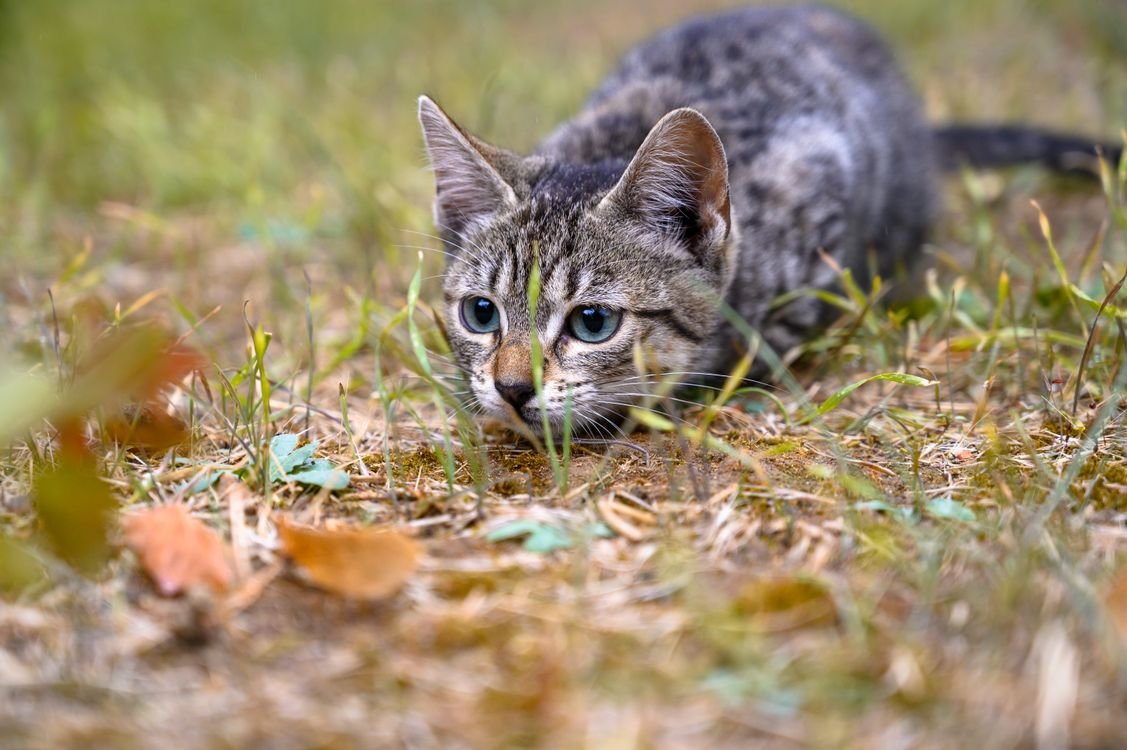
The kitten above shows the classic shape: crouched, staring, tail extended and ready. The same hunting drive is why cats bring you toys — the tail stays low and focused through the whole sequence.
Why Does Only the Tip of My Cat’s Tail Flick?
When only the tip flicks, your cat is usually concentrating or mildly annoyed. A hunting cat flicks the tip while locked onto a toy; a stroked cat flicks it when the fuss starts to grate. Ears decide: forward means focus, turned back means irritation.
Tip flicks often come with a fixed look, so read the stare with the tail before you reach out. A fixed stare with a flicking tip usually means focus, not affection. If the ears turn sideways and the flicks keep coming, pause and give space.
Why does my cat wag its tail all the time?
Some cats move their tails a lot in play or while watching the room. Constant back-and-forth movement on its own is not a diagnosis. Check the pattern: does it happen only in play, or also at rest, during fuss and when your cat is alone? A sudden increase, or movement paired with skin rippling, tail-chasing, hiding or appetite change, needs a vet check. Film a short clip to show your vet what you see at home.
What Do Puffed, Tucked and Wrapped Tails Mean?
A puffed tail means frightened, a tucked tail means anxious or unwell, and a wrapped tail depends on what it is wrapped around.
A puffed-up tail means frightened or defensive: your cat is making themselves look bigger to end a threat without a fight. A tucked tail means anxious or unwell. If your cat is also hiding more than usual, that change is worth reading closely.
A tail wrapped around you is affection — the cat version of a hug. Owners often call this the ‘I love you’ wrap. ASPCA Pet Health Insurance notes that cats with a strong relationship will curve or wrap their tails around a person or animal. A tail wrapped round the cat’s own body means frightened or unwell, so give space and watch.
For puffed or tucked tails, give space and remove the trigger. Never punish fear.
Why Does My Female Cat Hold Her Tail to One Side?
An unspayed female in heat may hold the tail to one side with the rump raised and front end low. International Cat Care describes this lordosis posture, with the tail waved to one side, alongside rolling, rubbing, marking and loud calling. If a spayed female keeps showing the same signs, book a vet check. Vets can test for ovarian remnant syndrome, where leftover ovarian tissue keeps heat signs going. Cornell University College of Veterinary Medicine describes testing for ovarian remnant syndrome in cats.
Tail Wagging in Kittens
Kittens use their tails in play long before they use them like adults. A puffed tail in play, quick flicks during pouncing games and a tail held up as they trot to you can all be part of normal practice. Kittens learn a lot by watching their mother and littermates, as International Cat Care explains in its kitten behaviour guide. Give kittens short play sessions, end on a calm note, and let them rest. If a kitten’s tail stays tucked tight with hiding or crying, check for fear, cold or pain and ask a vet if you are unsure.
Do Cats Control Their Tails?
Yes — cats control their tails on purpose, much like their legs and ears. The tail is an extension of the spine, with many small bones, muscles and nerves, so a cat can move it in fine, deliberate ways. That is why tail position is such a useful read on mood. Cornell Feline Health Center notes that sensitivity along the back and at the base of the tail is a key sign in hyperesthesia syndrome, so treat new sensitivity there seriously.
Most movements are voluntary signals, though some quick flicks are more reflex than message. Kittens often chase their own tails in play, which is normal. In an adult, repeated tail-chasing or biting at the tail can be a sign of feline hyperesthesia, a sensitivity condition. Cornell Feline Health Center describes extreme sensitivity along the back, skin rippling and tail-chasing in affected cats — mention it to a vet if you see it.
When to See a Vet
Most tail signals are normal communication, so see a vet when the pattern changes suddenly. A tail that stops moving, drags, or stays tucked for days needs checking, as do flinching or crying when the tail or back is touched.
| Probably normal | Book a vet visit |
|---|---|
| Slow swish while watching a toy | Tail suddenly stops moving or drags |
| Tip flicks while focused | Flinching or crying when tail or back is touched |
| Tail up to greet you | Tucked tail and crouching for days |
| Brief twitches in sleep | Tail injury, swelling, or loss of bladder control |
That advice is consistent with RSPCA and PetMD guidance to see a vet for a sudden behaviour change.
Key Takeaways
- Judge a wag by speed, height and the rest of the body together.
- Purring with faster flicks means hands off, even mid-stroke.
- Tip-only flicks mean focus or mild annoyance — let the ears decide.
- Sudden change, flinching or a dragging tail needs a vet.
Frequently Asked Questions
Why is my cat purring but flicking its tail?
Purring with a flicking tail sends mixed signals: the purr can mean contentment, but flicks that speed up show rising irritation. Purring does not always mean a cat wants more fuss. If the flicks get faster while you stroke, pause — a swat or bite can follow if you carry on.
Do cats wag their tails like dogs?
No. A dog wag often means friendly excitement, but a cat wag means the cat is stirred up: pleased, focused, irritated or overexcited.
Why does my cat wag its tail while lying down and purring?
Purring with a soft, slow tail while lying down usually means contentment, especially with slow blinks and a loose body. If flicks speed up while you stroke, pause.
Why does my cat thump its tail when I talk to them?
A single soft thump when you speak is often a sign your cat has heard you and is taking you in. It is not the same as repeated thumping, which means irritation or a warning to back off. Read the ears and body with it: a relaxed body suggests calm, while repeated thumps mean give space.
Sources
- PetMD — Cat Tail Language: What Your Cat’s Tail Is Telling You
- Cornell Feline Health Center — Hyperesthesia Syndrome
- International Cat Care — Cat Communication
- RSPCA — Understanding Your Cat’s Behaviour
- ASPCA Pet Health Insurance — Cat Body Language Explained
- PetMD — Why Do Cats Have Tails?
- International Cat Care — Cat Pregnancy
- PetMD — Ovarian Remnant Syndrome in Cats
- PetMD — Feline Hyperesthesia Syndrome
- Cornell University College of Veterinary Medicine — Ovarian Remnant Panel
- International Cat Care — Bringing Up a Litter of Kittens: Behavioural Considerations
Photo Credits
- Decoder chart: Original PetCavo graphic.
- Tail close-up photo: Tahir Osman via Pexels
- Hunting kitten photo: Claudio Herrera via Pexels
- Lying-down photo: Jimmy Chan via Pexels
- Featured photo: Horatiu Daniel via Pexels
PetCavo is not a vet. This is general information, not a diagnosis. If you are worried about your pet, see a vet promptly.




8 Comments