
Why Does My Cat Bite Me? 7 Reasons & How to Stop It
Why does my cat bite me? The 7 most common reasons — play, overstimulation, fear, pain and more — and what to do in the moment, plus when to see a vet.
Why does my cat bite me? If you have asked that question mid-cuddle, seconds after a happy purr, you are not alone. Your cat is not being spiteful. Cats bite for clear reasons, and once you know which one it is, you can stop it.
If the bite was gentle and didn’t break the skin, start with our gentle-bites guide. This article covers the full picture — hard bites, fear, redirected aggression, pain, and what to do when a bite breaks the skin.
The Short Answer
Cats bite to send a message — play, overstimulation, fear, pain, or a need for attention are the most common reasons. The bite’s pressure, its timing and the body language just before it tell you which one it is. Match the fix to the cause, use toys instead of hands, and never punish your cat.
No single method works for every cat, and guides disagree on some details — match the fix to the cause below.
Which kind of bite is this? A quick decision table
Find your bite below. The body language just before the bite is the best clue.
| Bite type | When it happens | Body language just before | Pressure | What to do |
|---|---|---|---|---|
| Gentle / love bite | During calm cuddling, often mixed with licking | Relaxed, soft eyes, purring continues | Soft nibble, no pain, no marks | Nothing — it is social |
| Play bite | Hands or feet moving, under blankets, ankles as you walk past | Crouched, wiggly rear, dilated pupils, ears forward | Grab-and-hold, bunny kicks | Redirect to a toy at once; never play with bare hands |
| Overstimulation bite | After a stretch of petting, often along the back or belly | Tail flicking, ears back, skin rippling, purring stops | Firmer, may leave a red mark; cat walks away after | Stop petting before the signals grow; learn your cat’s limit |
| Fear / defensive bite | Cornered, picked up, new person or loud noise | Crouched low, ears flat, pupils wide, hissing | Hard, fast bite, then the cat runs or freezes | Give space and a way out; do not reach for the cat |
| Redirected bite | Just after seeing another cat or bird through the window, or a loud noise | Stiff body, staring at the trigger, then whips round | Hard and uninhibited | Do not touch an agitated cat; let it calm down first |
| Pain bite | When you touch one spot, or a new bite in an older cat | Flinches, tenses, or cries out when touched | Sudden, sharp bite tied to touch | See a vet first — rule out pain before any behaviour plan |
If two rows seem to fit, trust the body language just before the bite. It rarely lies.
1. Play biting — your hands became the prey
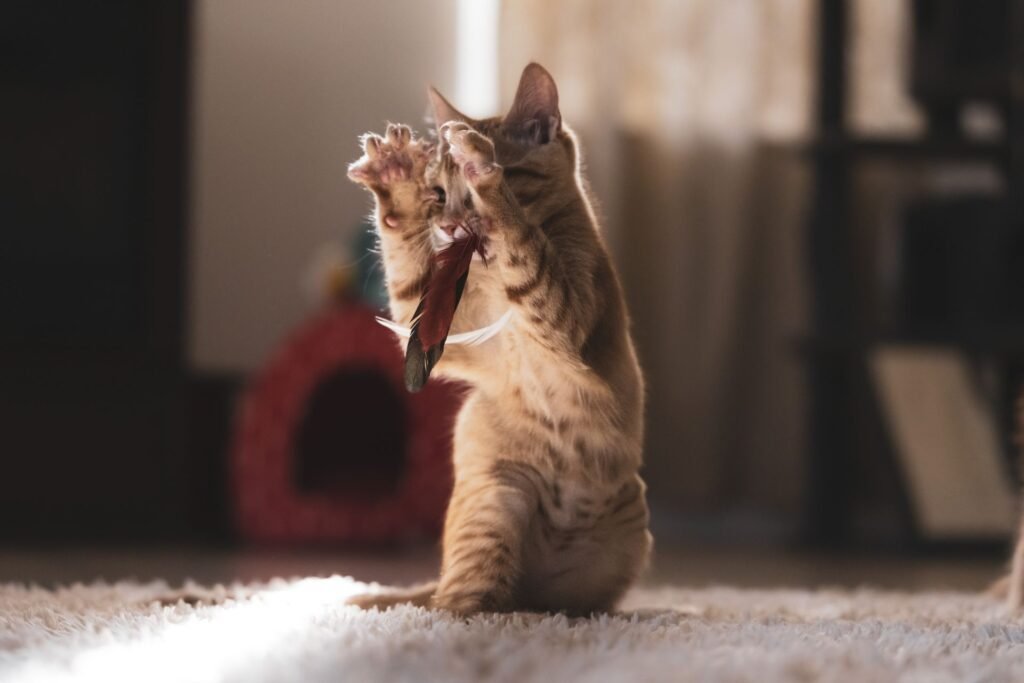
Play biting is hunting practice, and it is the most common reason young cats bite people.
Kittens learn bite control from their littermates. When a bite hurts, the other kitten yelps and stops playing, so the biter learns to hold back. Kittens taken from littermates early miss this learning — play with toys, never hands.
Hands and feet under blankets look like prey. Ankle bites as you walk by are the same game — the cat stalks from a hiding place and pounces as you pass. Cornell notes that cats about to play-bite often thrash their tails, pin their ears, and dilate their pupils first.
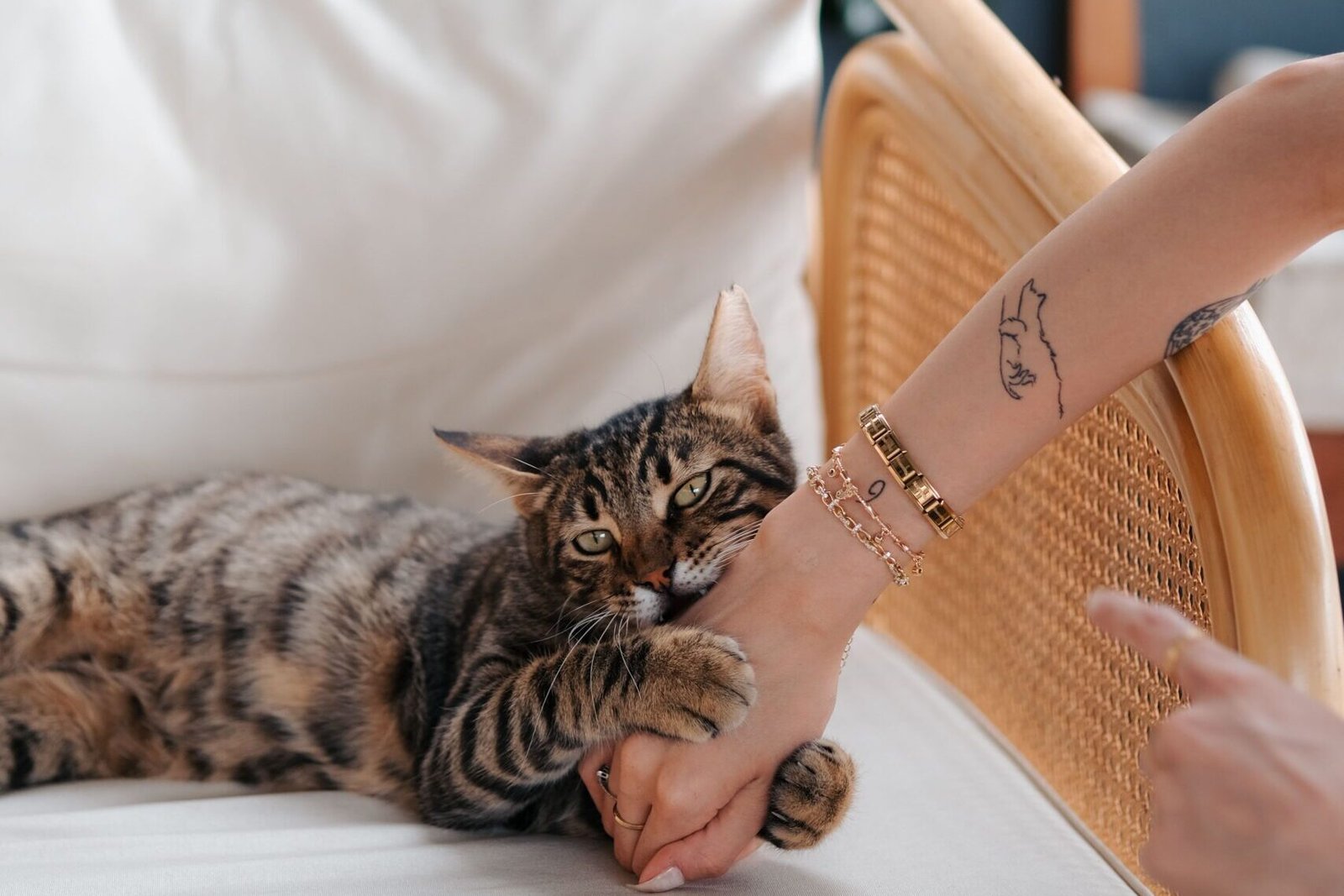
The fix is simple, but it must be consistent. Never use hands or feet as toys — redirect to a wand toy at once. If your cat wraps its front paws round your arm and kicks with its back feet, that is play, not cuddling: go limp, do not pull away, and wait for it to let go.

2. Overstimulation — “I’ve had enough” while being petted
Your cat enjoyed the petting — until it didn’t. This is the most common reason for a bite mid-cuddle.
VCA explains that the feeling of being stroked can turn unpleasant after a while, even for a cat that was enjoying it.
Learn how many strokes your cat tolerates and always stay below that limit — that is VCA’s advice, and it works. Keep sessions short and stop at the first tail flick.
Where you pet matters too. The belly and the base of the tail are sensitive spots; the chin, cheeks and head are usually safer.
3. Love bites and grooming bites — affection, and how to tell them from a real bite
A love bite is a soft nibble from a relaxed cat. It is social, not aggressive.
Love bites usually come with soft eyes, a loose body, and purring that keeps going. The bite-then-lick pattern is social grooming, not a warning.
Check pressure, body language and what happens next. A love bite is soft, leaves no mark, and the cat stays close. A real bite is harder, may break the skin, and comes with tense body language — then the cat pulls away.
A soft nibble from a relaxed cat is normal. A hard bite that breaks the skin is a problem to fix, not a habit to accept.
Purring does not always mean happy — cats also purr when self-soothing. A gentle bite while purring is usually still a love bite, not aggression.
4. Fear and stress — the defensive bite
A frightened cat would rather run than fight. It bites when it feels trapped.
The signs are clear once you know them: crouched low, ears flat, pupils wide, tail tucked, hissing or growling.
The fix is space. Give the cat a way out and do not reach for it. Keep the house calm and let the cat come to you. If you have a cat that hides then bites when cornered, take that seriously as well.
One short note: some behaviour guides point out that declawed cats may bite more, because biting becomes their main defence once claws are gone.
Never corner a scared cat. A cat with no escape route is a cat with no choice but teeth. Supervise children with cats, teach them to stop stroking at the first warning sign, and never let them corner a cat.
5. Redirected aggression — angry at something else, biting you
Your cat saw another cat through the window, or heard a sudden noise — and you were the nearest target.
The ASPCA calls redirected aggression “probably the most dangerous type of cat aggression” because the bites are uninhibited. The cat is not being spiteful. It is aroused by something it cannot reach, and the frustration lands on whoever is close by. The delay can be long — the ASPCA notes it can be as long as hours — which is why this bite so often looks like it came “out of nowhere.”
Common triggers are another cat outside, birds at the window, a loud noise, or a smell on your clothes.
Do not touch an agitated cat. Let it calm down first. Close the curtains or block the view, and remove the trigger where you can. If two indoor cats fought, keep them apart until both are fully calm.
6. Pain or illness — when a new bite is a medical signal
If a friendly cat suddenly starts biting, think pain first — especially if the bite happens when you touch one spot.
Cornell Feline Health Center lists hyperthyroidism, osteoarthritis, dental disease, and central nervous system problems among the medical causes of aggression. Pain lowers a cat’s tolerance for handling, and the bite is a reflex that says “don’t touch there.”
Watch for flinching when touched, biting only when one area is stroked, hiding, eating less, or grooming less.
Rippling back skin with frantic grooming, tail-chasing, or startled bolting can point to feline hyperesthesia — ask your vet.
No behaviour plan until pain is ruled out. Book a vet visit first, then work on behaviour.
7. Attention-seeking and territorial biting — including multi-cat homes
Some bites are a request: play with me, feed me, or leave my space alone.
An attention-seeking nip works because it gets a reaction — even scolding counts. If a nip reliably gets a reaction, your cat will keep doing it.
For attention-seeking nips, end the interaction calmly every time — no reaction, no scolding, just walk away.
Territorial biting is different. A cat may block doorways, guard food or litter boxes, or stare down another cat.
Give each cat its own food, water, and litter box in separate spots, plus one extra litter box.
Kitten vs adult: why age changes the answer
Kittens bite more, and for different reasons. Teething makes them mouth and bite everything, and they are still learning bite control.
For kittens, the rules are: toys, not hands; short play sessions; and everyone in the house follows the same rules.
For adults, a new bite usually means overstimulation, pain, or a change at home. Bites when you get home are often excitement; a bite when you wake a sleeping cat is a startled bite — never wake a sleeping cat by touch. If a new bite comes with flinching when touched, think pain and see a vet.
Warning signs to learn before the bite
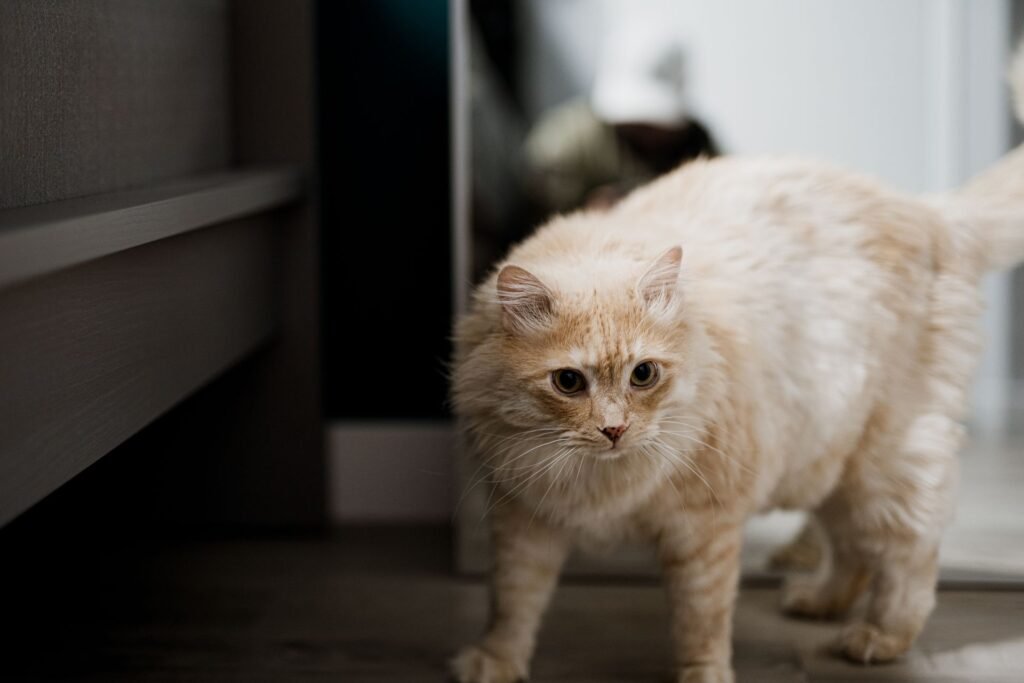
The bite almost never comes out of nowhere. Learn these signs and you get about ten seconds to stop.
| Signal | What it looks like | What it means |
|---|---|---|
| Tail | Flicking, twitching, or lashing side to side | Arousal rising — the most reliable early warning |
| Ears | Rotating back or flattening | Discomfort; the cat is no longer enjoying this |
| Skin ripple | Twitching across the shoulders or back | Sensitivity spike — a classic pre-bite sign |
| Eyes | Pupils dilating, hard stare at your hand | Attention locking onto the “target” |
| The freeze | Sudden stillness mid-petting | A decision is being made — give space now |
| Purring stops | The rumble cuts out abruptly | Contentment ended; the next move may be teeth |
| Whiskers forward | Whiskers pushed forward, body stiff | Arousal rising |
| Stiff body | Body goes tense, weight shifts | The cat is bracing, not relaxing |
A hard, unblinking stare is a warning too — learn what the different stares mean in our guide to why cats freeze and stare. Our guide to why cats wag their tails explains the tail flicks that warn of a bite.
When you see any of these signs, stop. Stop petting, stop reaching, and give your cat room. That one habit prevents most bites.
What to do in the moment — step by step
Teeth are already on your skin. Do this, in order:
- Freeze. Do not yank your hand away. Pulling back can make the cat bite down harder, or trigger a chase reflex.
- Go still. Stay calm and quiet. Let the cat disengage first.
- Withdraw slowly. Once the cat lets go, calmly move your hand away.
- Walk away. Leave the room for a few minutes. Biting must end the fun.
- Wait. Do not go back for a cuddle right away. Give your cat time to settle.
Stay silent and walk away calmly. The interaction ends, and your cat learns that biting stops the fun.
What NOT to do — never punish or scare your cat
Never yell at, hit, scruff, squirt, or chase your cat for biting. Punishment breaks trust, adds fear, and makes biting worse.
The American Veterinary Society of Animal Behavior (AVSAB) recommends only reward-based training methods and says aversive methods should not be used under any circumstances. Cornell agrees: any type of physical punishment can increase a cat’s fear or anxiety and worsen aggression. VCA puts it plainly — do not punish your cat, as this will create fear.
Do not use a squirt bottle. Even mild punishment can backfire — the cat learns to fear your hands.
How to stop it for good
Stopping bites for good means changing the setup, not just reacting to each bite.
Use toys, not hands. Wand toys keep teeth far from fingers. If anyone in the house still wiggles fingers as a toy, stop that at once.
Play every day. Two short play sessions a day give the hunting instinct a proper outlet. Rotate toys so they stay interesting.
Learn the petting limit. Every cat has one. Build tolerance in four steps: keep sessions short, stop before the warning signs, treat for calm, and build up over days.
Keep a bite diary for one week. Each time your cat bites, jot down what you were doing, where you touched it, and what happened just before.
Reward calm. Give treats and attention when your cat is relaxed. Biting gets boredom; calm gets the good stuff.
Keep the routine steady. Same feeding times, same play times, a calm house. A pheromone diffuser can also help a stressed cat settle — ask your vet which one suits your home.
What to do if a bite breaks the skin
This is general information, not medical advice. If in doubt, call your doctor.
The CDC advises washing any cat bite wound with warm soapy water immediately. Cat bites can spread germs even when the wound does not look deep. The CDC notes that 20–80% of reported cat bites and scratches become infected.
Seek medical attention if the wound is serious, becomes red, painful, warm or swollen, or if the cat appears ill.
When it needs a vet
Book a vet visit if you see any of these:
- A friendly cat suddenly starts biting.
- Biting tied to touching one spot.
- Biting plus hiding, eating less, or litter-box changes.
- Bites getting more frequent, harder, or breaking skin more often.
- Biting with other illness signs — vomiting, limping, weight loss, or over-grooming.
- Rippling back skin with frantic grooming, tail-chasing, or startled bolting.
- Biting that keeps getting worse even after you change the setup.
Aggression is a common reason cats lose their homes. Cornell reports that 27% of cats surrendered to shelters were given up for behaviour reasons. If biting continues, ask your vet for a referral to a qualified behaviourist. Medication can help in some cases, but only alongside behaviour and environment changes, never alone.
Key Takeaways
- Most cat bites are communication, not spite — play, overstimulation, fear, pain, or attention.
- Match the fix to the cause: more play for play biting, shorter petting for overstimulation, space for fear, and a vet for pain.
- Learn the warning signs — tail flick, ears back, skin ripple, purring stops — and stop before the bite.
- Freeze, don’t yank. Walk away calmly. Never punish — it breaks trust and makes biting worse.
- Wash any bite that breaks the skin with warm soapy water at once, and seek medical care if it is deep or infected.
- Gentle, unbroken-skin bites are covered in depth in our gentle-bites guide.
Frequently asked questions
Why does my cat bite me when I pet him/her?
Usually overstimulation. Your cat enjoyed the petting, then hit a limit — the bite means ‘that’s enough.’ Watch for the warning signs: tail flicking, ears turning back, skin rippling. Stop petting before they grow, keep sessions short, and stick to the chin and cheeks, where most cats like to be touched.
Why does my cat bite me gently and then lick me, even while purring?
In a relaxed cuddle, a soft bite followed by licking is social grooming — your cat is treating you as a safe group member. A gentle bite while purring is usually the same love bite; purring alone is not proof of happiness.
Why does my cat bite me when I walk by?
This is usually play biting. Your moving ankles look like prey, so your cat stalks from a hiding place and pounces as you pass. It is common in young cats and in cats that get little play. Redirect the energy with two short play sessions a day, and never let your cat practise the game on bare feet.
Why does my cat bite me all of a sudden?
It rarely comes out of nowhere. The warning signs — tail flicking, ears back, skin rippling, purring stopping — are easy to miss. Or the cause is new: pain, illness, or a scare you did not see. If a friendly cat suddenly starts biting, book a vet visit first, before trying any behaviour fix.
Is it bad if I let my cat bite me?
A gentle love bite that does not break the skin is harmless. A harder bite is different: it teaches your cat that biting works, and cat teeth make deep puncture wounds that can infect easily. So allow soft nibbles if you like them, but calmly end the fun — walk away — for any bite with real pressure.
How do I discipline a cat for biting?
Do not punish your cat — yelling, hitting, scruffing, and squirt bottles only add fear and make biting worse. Instead, make biting end the fun: freeze, calmly walk away, and give no attention for a few minutes. Reward calm behaviour with treats and play, and use toys — never hands — for games.
Photo Credits
Featured image: Esra Afşar, via Pexels (Pexels licence). Play biting photo: Dmytro Koplyk, via Pexels (Pexels licence). Warning signs photo: Alberta Studios, via Pexels (Pexels licence). Kitten with toy photo: 大 董, via Pexels (Pexels licence).



5 Comments