

Why Does My Cat Come to Me When I Cry? 7 Sweet Reasons
Why does your cat come to you when you cry? Seven likely reasons, from voice and scent changes to habit, plus signs to watch and when to ask your vet.
Have you ever started crying and suddenly found your cat beside you — rubbing against your legs, climbing into your lap, or simply sitting close? It can feel as though your cat understands exactly what you’re going through.
The truth is more nuanced — and more interesting. Your cat probably isn’t analysing your sadness the way a person would. But research shows cats notice far more than we give them credit for: shifts in your voice, posture, scent, and routine. There’s even a plausible acoustic overlap: crying is high-pitched and repetitive — the same qualities that make a kitten’s distress call so hard for a cat to ignore.
So, why does my cat come to me when I cry? Your cat has noticed you’re behaving unusually, and has come to investigate. Whether that turns into a comforting cuddle depends on your cat’s personality and the bond you share. Here’s what’s really going on.
The Short Answer
Your cat may come to you when you cry because it notices that something about your usual behaviour has changed. Crying alters your sounds, facial expression, posture, breathing, movement — even your scent. Cats are capable of responding to human voices and other social cues, although researchers are still working out exactly how much emotional information cats take in.
There’s also simple opportunity. Crying often means sitting still and quiet in one place — prime conditions for a cat that already associates you with safety, warmth, and affection to come and join you.
The important distinction is this: your cat may notice that something is different without understanding exactly why you’re crying.

7 Reasons Your Cat Comes to You When You Cry
1. Your cat notices the unusual sounds of crying
Crying sounds nothing like ordinary conversation. Your breathing changes, your voice goes quieter or higher-pitched, and unfamiliar sounds — sobs, sniffles, sharp intakes of breath — fill the room. That change alone can capture a cat’s famously acute hearing.
There may be a deeper layer. Crying is high-pitched, repetitive, and urgent — the same qualities that make a kitten’s distress call almost impossible for a cat to ignore. It’s plausible that crying trips some of the same auditory wiring, which could help explain why it triggers such a prompt approach.
Research confirms cats distinguish familiar human voices from strangers’, often orienting their ears or head toward the sound. Your cat doesn’t need to understand tears to recognise that your voice is doing something unusual — and worth checking out.
Example: if you normally speak at a steady volume but suddenly start sobbing, don’t be surprised when your cat appears within moments — staring, sniffing your face, or parking itself nearby. The sound changed; the cat clocked it.
2. Your cat recognizes your voice
Your cat knows more about your voice than you might realise.
Research involving domestic cats found that cats can distinguish their owner’s voice from unfamiliar human voices using vocal cues alone. The cats in that study often responded by orienting their ears or heads toward the sound.
That doesn’t mean your cat understands every word you say. It means your voice carries familiar, meaningful information — tone, rhythm, emotional colouring — learned over months or years together. So when you cry, your cat recognises who is making that unusual sound, even without grasping why. (This voice-tuning shows up in other ways too — many cats meow when their owner is on the phone, reacting to the odd, one-sided vocal patterns.)
3. Your body language has suddenly changed
Cats don’t experience your crying through sound alone.
Think about what happens when you’re upset. You may:
- Sit or lie down differently
- Cover your face
- Become unusually still
- Move more slowly
- Change your facial expression
- Stop doing whatever you were doing before
- Speak differently
Your cat may notice these changes.
Research on cat–human communication suggests cats respond to combinations of human social cues — vocal and visual together. One study found evidence that cats use their owner’s emotional signals when reacting to unfamiliar objects, even if the behavioural effects were subtle.
So your cat may be reacting to the overall changed picture of you, rather than recognising “sadness” as a specific human emotion.
4. Your cat may respond to some emotional cues
This is where things get interesting.
Research has found that cats show some sensitivity to human emotional cues, including facial, postural, and vocal information. But the evidence is much thinner than the popular idea that cats simply “sense your emotions.”
A newer study examining cats’ responses to human emotional vocalizations found measurable changes in behaviour and arousal, but no strong evidence that cats reliably distinguished specific emotions from vocalizations alone. The safest summary is:
Your cat may notice emotional or behavioural changes without necessarily understanding the specific emotion behind them.
There’s also a chemical dimension. When you’re upset, your body chemistry shifts — stress hormones such as cortisol and adrenaline rise, changing the scent of your sweat and breath. With an estimated 45 to 200 million scent receptors, cats may well detect these biochemical changes. Your cat might, quite literally, smell that something is different.
That doesn’t make your cat a furry diagnostician — but it adds scent to the channels (sound, sight, routine) through which “something’s wrong” reaches them. And this distinction keeps the behaviour interesting without turning it into a human-like interpretation of your cat’s mind.
5. Your cat already has a social bond with you
Often the simplest explanation: you’re their person. Your cat may approach you during ordinary moments because you’re a familiar and trusted part of its environment.
If your cat normally:
- Follows you around
- Sleeps near you
- Rubs against you
- Sits beside you
- Greets you
- Seeks petting
- Comes when you call
then approaching you while you’re crying may simply fit an existing pattern of social interaction.
Your cat probably isn’t thinking, “My person is sad, so I need to comfort them.”
It could be doing something much simpler: going to a familiar person during an unusual moment.
That doesn’t make the interaction meaningless — it just means we should be careful about assuming exactly what the cat is thinking. And this bond wears many faces: the same attachment drives cats that insist on sleeping on your chest and those that prefer to sit beside you rather than on you.
6. Your cat is curious about the unusual behavior
Sometimes curiosity is the simplest explanation.
Picture it from the cat’s perspective: everything is normal, and suddenly your large, predictable human starts making strange noises and behaving erratically. Of course they come to investigate.
Your cat may come over to investigate — sniffing your face, staring, touching you with a paw, or sitting nearby for a few seconds before wandering off. That isn’t failed empathy; it’s a cat gathering data.
Read the follow-through: a cat that investigates briefly and leaves was curious, while a cat that settles in beside you is choosing your company. Both are responses to the same trigger — look at what your cat does after approaching, not just the approach itself.
7. Your cat has learned that approaching you leads to interaction
Cats learn from repeated experiences.
Suppose your cat approaches you when you’re upset and you immediately pet it, talk to it, pick it up, or give it attention. Over time, approaching you in those moments becomes associated with social interaction — a reliable route to good things.
This doesn’t mean your cat is manipulating you.
It’s normal learning — the same mechanism behind every trained behaviour. The ASPCA notes that cats commonly seek people for attention, social contact, food, and other needs, and recommends reading the circumstances around a behaviour rather than assuming it always means the same thing.
The same principle can apply to approaching behavior: what happens after your cat comes to you influences whether it repeats the behavior. Gentle, welcome interaction strengthens the pattern; pushing them away when you’re not in the mood weakens it.
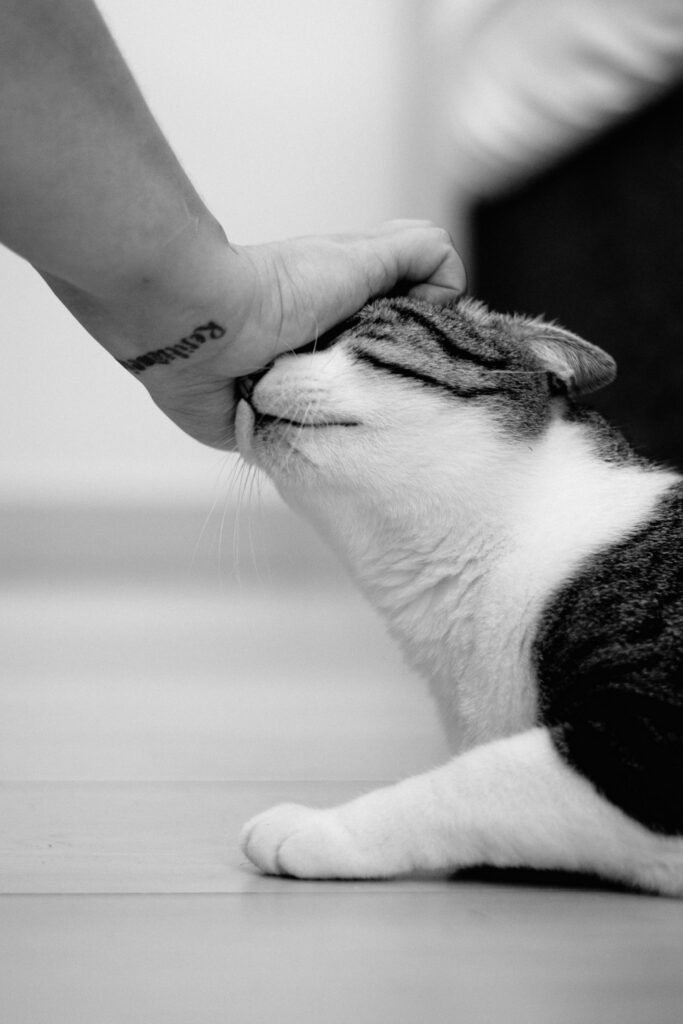
Do Cats Know When You Are Sad?
Cats may notice that you are behaving differently when you’re sad or crying, but there is not enough evidence to say they understand sadness exactly as humans do.
This is an important distinction.
Studies have found that cats can distinguish familiar human voices and respond to certain human emotional or social cues. Some research also suggests cats can use information from their owners when deciding how to respond to something unfamiliar.
However, recognizing a change in your behavior is not the same as understanding the cause of that change.
Your cat may notice:
“My person’s voice sounds different.”
“My person is sitting strangely.”
“Something unusual is happening.”
That is different from:
“My person is experiencing sadness because of a specific event.”
We simply don’t have evidence to make that final leap — and recognising the gap makes the science more honest, not the moment less meaningful.
Why Does My Cat Cuddle Me When I’m Sad?
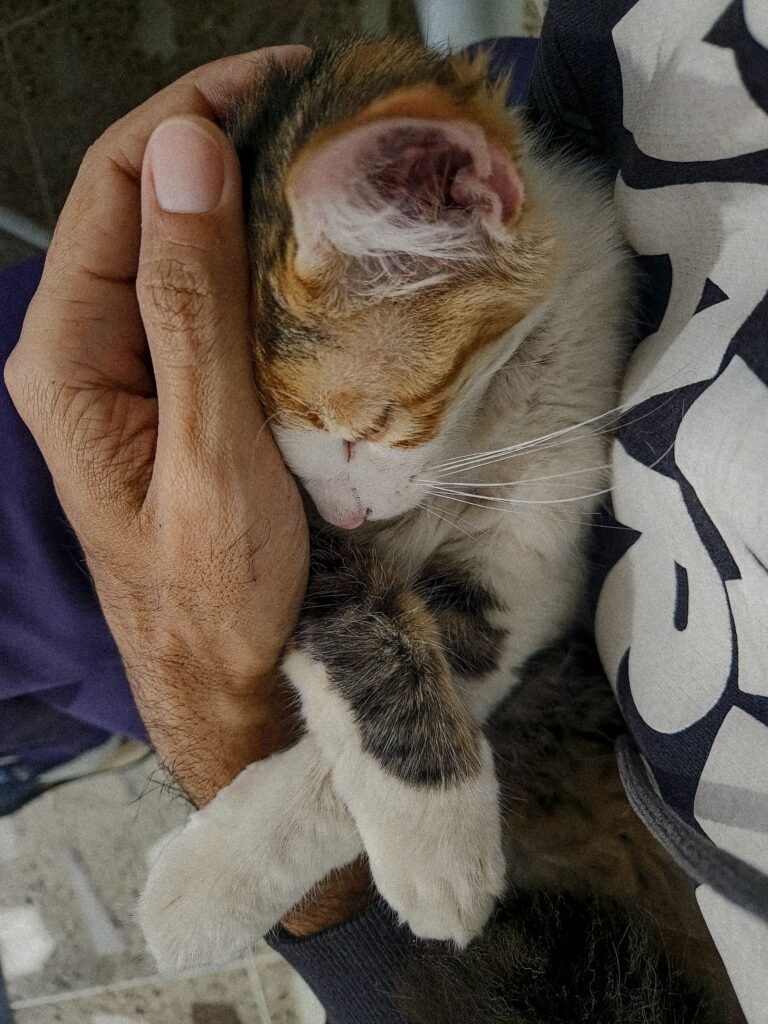
If your cat climbs onto your lap, lies beside you, purrs, or rubs against you while you’re crying, it can certainly feel like comfort — and functionally, it can be, whatever the cat’s internal reasoning.
There are several possible explanations. Your cat may already enjoy close physical contact with you; your still, quiet posture may make you easy to approach; the unusual situation may have drawn its attention; or past experience may have taught it that closeness with you pays off in pleasant interaction. Cats that routinely seek this kind of contact — like those that insist on sleeping on your chest at night — are often just extending a familiar habit into an unusual moment.
Purring deserves a note: it accompanies contentment, but also self-soothing and stress. Don’t read a purr as a single emotion — read the whole cat instead. A relaxed cat with loose muscles, a comfortable posture, normal ears, and voluntary proximity is telling you something very different from one that’s tense, flattened, or trying to leave.
The best approach is to let your cat choose the interaction — welcome what they offer, and don’t try to extract more than they volunteer.
How to Tell What Your Cat’s Behaviour May Mean
No single behavior gives you a perfect translation of what your cat is feeling.
Instead, look at the pattern:
| What your cat does | What it may suggest |
|---|---|
| Comes over, sniffs you, then leaves | Curiosity or investigation — data gathered, mission complete |
| Rubs against your legs or head-bunts you | Social bonding; scent-marking you as “theirs” |
| Sits quietly beside you | Comfortable proximity — choosing your company |
| Climbs onto your lap unprompted | Seeking familiar physical contact and warmth |
| Purrs while relaxed beside you | Often positive, but context decides — read the body language too |
| Watches you intently from a short distance | Monitoring something unusual (frequent starers: see why cats stare at their owners) |
| Approaches but stays tense | Uncertainty or discomfort — give space, don’t pursue |
| Becomes vocal and demanding | Attention-seeking, or possibly an unrelated need — check food, water, and litter |
These are possible interpretations, not a cat-emotion dictionary.
Context — your cat’s baseline personality, the situation, the full body-language picture — matters more than any single entry.
Why Doesn’t My Cat Come to Me When I Cry?
Your cat not coming to you when you cry does not automatically mean your cat doesn’t care about you.
Cats vary enormously in how they interact with people.
Some cats enjoy sitting on laps. Others prefer staying a few feet away. Some follow their owners around the house but rarely cuddle. Others show their social bond through play, sleeping nearby, greeting behavior, or simply choosing to remain in the same room.
A cat that watches you from across the room may still be responding to you — in its own register. And many cats show love precisely by not crowding you: they sit next to you rather than on you, or sleep beside you without touching.
Don’t use cuddling as the only measurement of your relationship.
A better question to ask
Instead of:
“Does my cat comfort me?”
look at:
“Does my cat voluntarily choose to spend time around me?”
That gives you a much broader — and more accurate — picture of the relationship.
Should You Encourage Your Cat to Comfort You?
You don’t need to train your cat to comfort you — and trying to manufacture it usually backfires.
If your cat voluntarily approaches while you’re crying and you enjoy the contact, you can gently interact with it. A simple approach is:
- Let your cat approach on its own.
- Watch its body language throughout.
- Pet it if it appears comfortable; pause if it tenses.
- Stop the moment it tries to leave.
- Never pin it to your lap or chase it for cuddles.
- Let the interaction happen naturally.
Your cat’s willingness to leave is just as important as its willingness to approach.
If your cat chooses to sit beside you rather than on you, that’s still a choice to be near you — honour the choice they made, not the one you wanted. It is the same quiet preference you see in cats who sit next to you but not on you.
When Should You Be Concerned?
Your cat coming to you when you cry isn’t, by itself, a sign of illness.
The bigger concern is a sudden change in your cat’s overall behavior.
Pay attention if your cat suddenly becomes much more vocal, withdrawn, restless, clingy, aggressive, or unusually quiet — especially alongside changes in eating, drinking, litter-box habits, grooming, or activity levels. The ASPCA notes that excessive or unusual vocalization can sometimes be associated with medical problems, particularly as cats age.
For example, a sudden behavioral change accompanied by changes in eating, drinking, litter-box use, grooming, or general behavior deserves attention. If your cat’s behavior has changed noticeably and you aren’t sure why, a veterinarian can help determine whether there is an underlying health issue — behaviour is often the first place illness shows up.

Common Mistakes to Avoid
Assuming your cat understands exactly why you’re crying
Your cat may notice that something is different without knowing what caused it. The specific reason — the argument, the bad news, the sad film — is almost certainly beyond them. Respond to what they’re actually perceiving, not the story in your head.
Treating every cuddle as proof of empathy
A cat can approach you for several reasons, including familiarity, curiosity, attention, or social contact. A cuddle can mean habit as easily as empathy — enjoy it without needing it to prove a theory of feline mind-reading.
Ignoring body language
Don’t focus only on whether your cat approaches. Look at its ears, posture, tail, facial expression, and willingness to stay. The approach is only half the story — the body tells you whether this is comfort or coping, so adjust what you do accordingly.
Forcing your cat to cuddle
If your cat walks away, let it go. Grabbing a cat that walked away teaches them that approaching you is a trap. Voluntary interaction, freely ended, is better than forcing physical contact — and it’s what keeps them coming back.
Assuming a distant cat doesn’t care
Some cats prefer proximity without physical contact. Social behavior varies between individuals — judge the relationship by the full repertoire (play, greeting, presence, routine), not by a single cuddle metric.
Myth vs. Fact
| Myth | Fact |
|---|---|
| My cat definitely knows I’m sad. | Your cat detects changes linked to crying; understanding human sadness as we experience it is a claim the evidence doesn’t support. |
| My cat only comes to me out of pity. | Curiosity, familiarity, habit, scent changes, and learned interaction are all plausible — pity is the least evidenced of the lot. |
| A cat that doesn’t cuddle doesn’t love its owner. | Cats express bonds through proximity, routine, play, and presence — cuddling is one dialect among many. |
| Purring always means happiness. | Purring also accompanies self-soothing and stress; context and body language decide the meaning. |
| Cats can’t recognize their owners’ voices. | Research shows they distinguish familiar voices from strangers’ reliably. |
| Cats can’t smell human emotions. | They can’t label emotions — but they can likely detect the stress-related scent changes (cortisol, adrenaline) that accompany them. |
How Cats Show Comfort: Purring, Head Bunting, and Slow Blinks
When your cat does come to you while you are crying, their comfort looks different from human comfort. Learn the vocabulary: purring — rhythmic vibration that may soothe you both (but can also be self-soothing, so check the rest of the body); head bunting — pressing the forehead or cheek against you, a genuine compliment that also marks you with their scent; slow blinks — deliberate, heavy-lidded blinks that signal trust and safety; and kneading — rhythmic paw-pressing left over from kittenhood, linked to contentment.
Not every cat uses every signal. A cat that simply sits quietly beside you — no touching, no sound — is still making a choice to be there. For more on reading these signals, see the ASPCA’s guide to common cat behavior issues.
What love bites mean: gentle nibbles are another comfort signal — here’s how to tell affectionate nips from real bites.
Can Crying Stress Your Cat Out?
Yes — loud, prolonged crying can unsettle noise-sensitive cats or those already on edge from household tension. Flattened ears, hiding, leaving the room, or sudden skittishness are stress responses, not rejection. Give them space and a quiet retreat rather than pulling them back for comfort.
Most cats rebound quickly once the household calms down. But if anxiety lingers — hiding for hours, appetite loss, over-grooming — the stress needs addressing in its own right, beyond the crying episode. A cat that freezes and stares during tense moments may be showing a fear response; see why cats freeze and stare for what to watch for.
Frequently Asked Questions
How do cats react when you cry?
Common reactions include approaching and sitting nearby, rubbing against you, purring, head-bunting, or slow blinking — but also simply watching from a distance. Some cats become clingy; others give you space. The specific reaction depends on your cat’s personality and your relationship history.
Do cats get clingy when you’re sad?
Some do — sticking closer, following you, or demanding more attention when your routine shifts. But sudden, persistent clinginess shouldn’t automatically be attributed to your mood; it can also signal that your cat is unwell or stressed, so rule that out if it’s new.
Why does my cat slow-blink at me when I cry?
Slow blinking signals trust and relaxation. A cat that slow-blinks while sitting with you is calm and comfortable in your presence — a genuinely positive sign in an emotional moment. Try slow-blinking back; many cats return the gesture.
Can my crying stress out my cat?
Yes — loud or prolonged crying can unsettle some cats, especially those sensitive to noise or household tension. Flattened ears, hiding, or leaving the room mean they need space, not that they don’t care. Let them retreat and recover at their own pace.
Why does my cat purr when I cry?
Purring is multipurpose: it can signal contentment, but cats also purr to soothe themselves when uncertain or stressed. A cat purring beside you while you cry may be settling itself as much as comforting you — read the body language around the purr (relaxed versus tense) to tell which is dominant.
Why does my cat come to me when I cry?
Because you’ve changed — your voice, posture, scent, and routine are all suddenly different, and your cat has noticed. It may approach out of curiosity, social habit, or learned expectation of interaction. The approach is real; the human-like understanding of your sadness probably isn’t.
Do cats know when you are sad?
They detect the signals that accompany sadness — vocal, visual, behavioural, and possibly scent changes — but research doesn’t support the idea that they comprehend sadness the way humans do.
Why does my cat cuddle me when I’m sad?
Likely a mix of existing affection, your approachable stillness, curiosity, and learned habit. Cuddling is consistent with a strong bond — it just doesn’t prove your cat understands the reason you’re upset.
Can cats sense when you are crying?
Yes, in the sense that they notice the sounds and behavioural changes crying involves, and they respond to them. “Sensing” the emotion itself as a labelled human feeling goes beyond what the evidence supports.
Can cats smell tears?
There’s no strong evidence cats detect “sadness” in tears specifically. But crying changes your scent in other ways — stress hormones such as cortisol shift the smell of sweat and breath — and a cat’s nose is exquisitely sensitive to such changes. If your cat sniffs your face intently while you cry, scent is likely part of what they’re reading.
Why doesn’t my cat come to me when I cry?
Some cats bond at a distance — watching from nearby, staying in the room, or seeking you out at other times. Not cuddling during a crying episode says nothing definitive about the relationship.
Conclusion
So, why does my cat come to me when I cry?
Because you became interesting: your voice changed, your body changed, your scent may have changed — and possibly because your crying echoes the distress calls cats are built to notice. Add an existing bond and a history of rewarding interactions, and approaching you is the natural move.
Research supports the building blocks — voice recognition, sensitivity to social cues, responsiveness to behavioural change — without justifying the leap to ‘my cat understands my sadness.’ That gap doesn’t cheapen the moment; if anything, it makes it more honest.
Photo Credits
Article images © PetCavo. Featured image by Mel Elias on Unsplash (Unsplash Licence).




3 Comments