
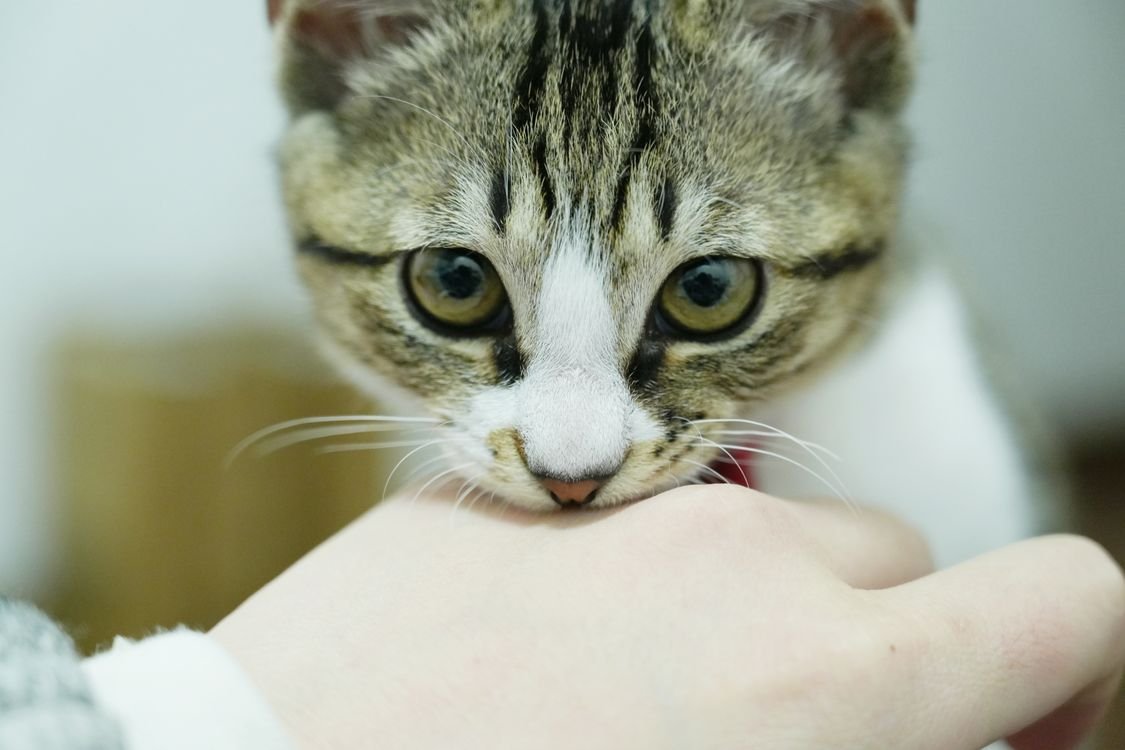
Why Does My Cat Bite Me Gently Out of Nowhere? 6 Reasons
Why does your cat bite you gently out of nowhere? The 6 real reasons — from love bites to overstimulation — plus how to tell which one it is and what to do about it.
The short answer
Why does my cat bite me gently? It’s normal cat communication, not aggression. The main causes are affectionate “love bites,” overstimulation during petting, and play instincts. The bite feels sudden because cats give subtle warning signs — tail flicks, ear shifts, rippling skin — that are easy to miss. Read the body language around the bite to tell which kind it is.
6 real reasons your cat bites you gently
1. Love bites — a clumsy compliment

The classic love bite is a soft nibble that doesn’t break the skin, delivered while the cat looks completely relaxed — soft eyes, loose body, maybe purring. Behaviourists link this to allogrooming, the social grooming kittens first experience with their mother and that adult cats use to strengthen bonds. When your cat licks you and then softly nibbles, she’s essentially treating you as a bonded social partner — tidying you up the way she’d groom another cat.
One honest caveat: researchers don’t claim every nibble is proven affection. A 2026 Ghent University study (Van Belle et al.) found that allogrooming between cats isn’t always friendly — it can shade into mild bullying. The affection reading holds when the whole picture is relaxed. Tense body plus teeth is a different message (see reason 2).
2. Overstimulation — “I’ve had enough”
This is the most misunderstood one. Many cats have a limited tolerance for sustained touch: petting that starts out pleasurable can flip to irritating after a while, and the bite is simply the cat saying “stop” after you missed the earlier, quieter requests. This is often called petting-induced aggression, and it’s the reason most “out of nowhere” bites happen mid-cuddle.
The useful part is recognising it before the teeth come out — which is exactly what the warning-signs section below is for.
3. Play aggression — you’re the toy
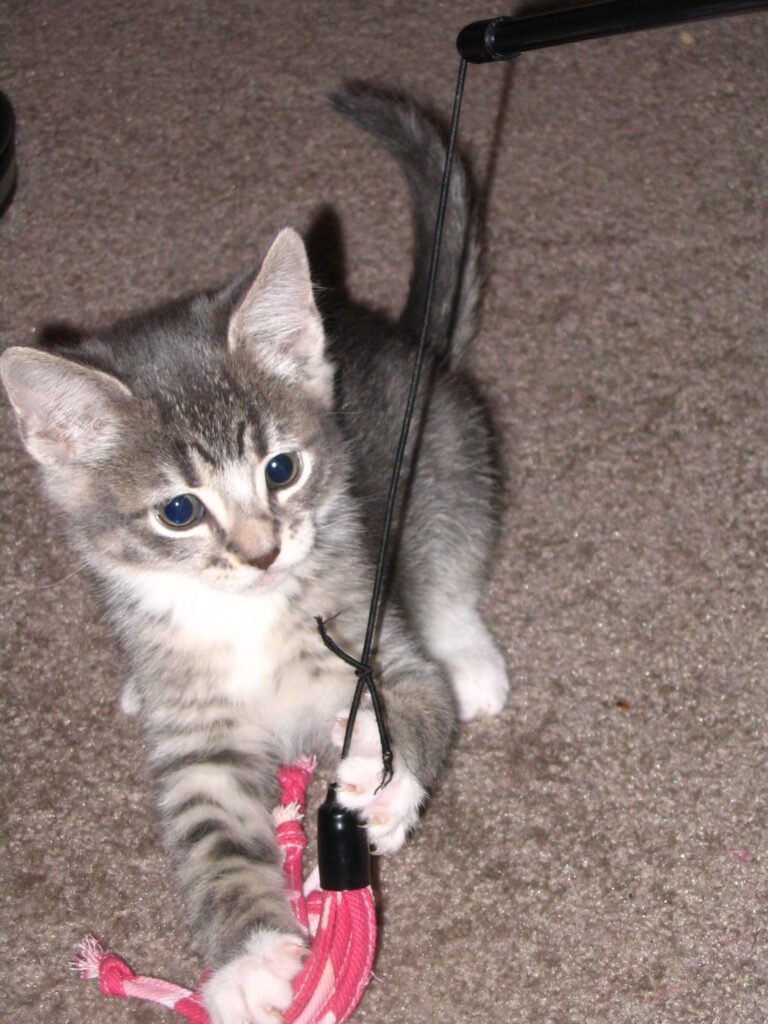
In kittens, stalking, pouncing, and biting are how they rehearse adult hunting skills — play is predatory practice. Kittens separated from their mother and littermates too early can miss out on learning bite inhibition (how hard is too hard), because that lesson is normally taught by siblings yelping and disengaging.
The human mistake: letting a tiny kitten “play” with your fingers. It’s adorable at eight weeks. It’s a problem at eight pounds, when the same game uses adult teeth. If your cat grabs your hand and bunny-kicks it, that’s play aggression — and hands should never have become toys in the first place.
4. Attention-seeking — because it worked
Cats are fast learners about cause and effect. If a nip reliably makes you engage — even if that engagement is scolding, pushing them away, or laughing — the cat has learned a reliable button for getting your attention. Cats that aren’t getting enough interactive play are especially prone to “asking” this way. The fix isn’t complicated, but it requires consistency (see “What to do” below). You’ll sometimes see the reverse too: a cat that nips the moment you stop petting — a “keep going!” request that gets rewarded every time you resume stroking. Morning wake-up nips run on exactly the same logic — there’s a dedicated FAQ on those below.
5. Grooming you — the bite-then-lick
The lick-then-bite (or bite-then-lick) sequence has two genuinely different meanings, and context tells them apart. In a relaxed cuddle, small nips mixed into licking fit social grooming — cats use their teeth while grooming to work through fur, so a gentle nip can be the feline equivalent of tidying you up. In a petting session, the same sequence more often means overstimulation: the cat enjoyed the contact, hit its tolerance limit, and the bite means “I need a break now.” Check the body language in the seconds before the bite — relaxed versus tense tells you which one it was.
6. Something hurts — biting because of pain
This one matters most when the behaviour is new. A cat that previously enjoyed petting but suddenly bites when a particular spot is touched may be dealing with pain — dental disease, arthritis, an ear infection, or an injury. Pain lowers a cat’s tolerance for handling, and the bite is a reflexive “don’t touch there.” If touch-sensitivity appears out of nowhere in an adult cat, a veterinary check comes before any behaviour plan.
Which kind of bite is it? A quick decision table
Find your scenario:
| Love bite | Overstimulation bite | Play bite | |
|---|---|---|---|
| When it happens | During calm cuddling, often mixed with licking | After a stretch of petting, especially along the back or belly | When hands/feet move — under blankets, wiggling fingers |
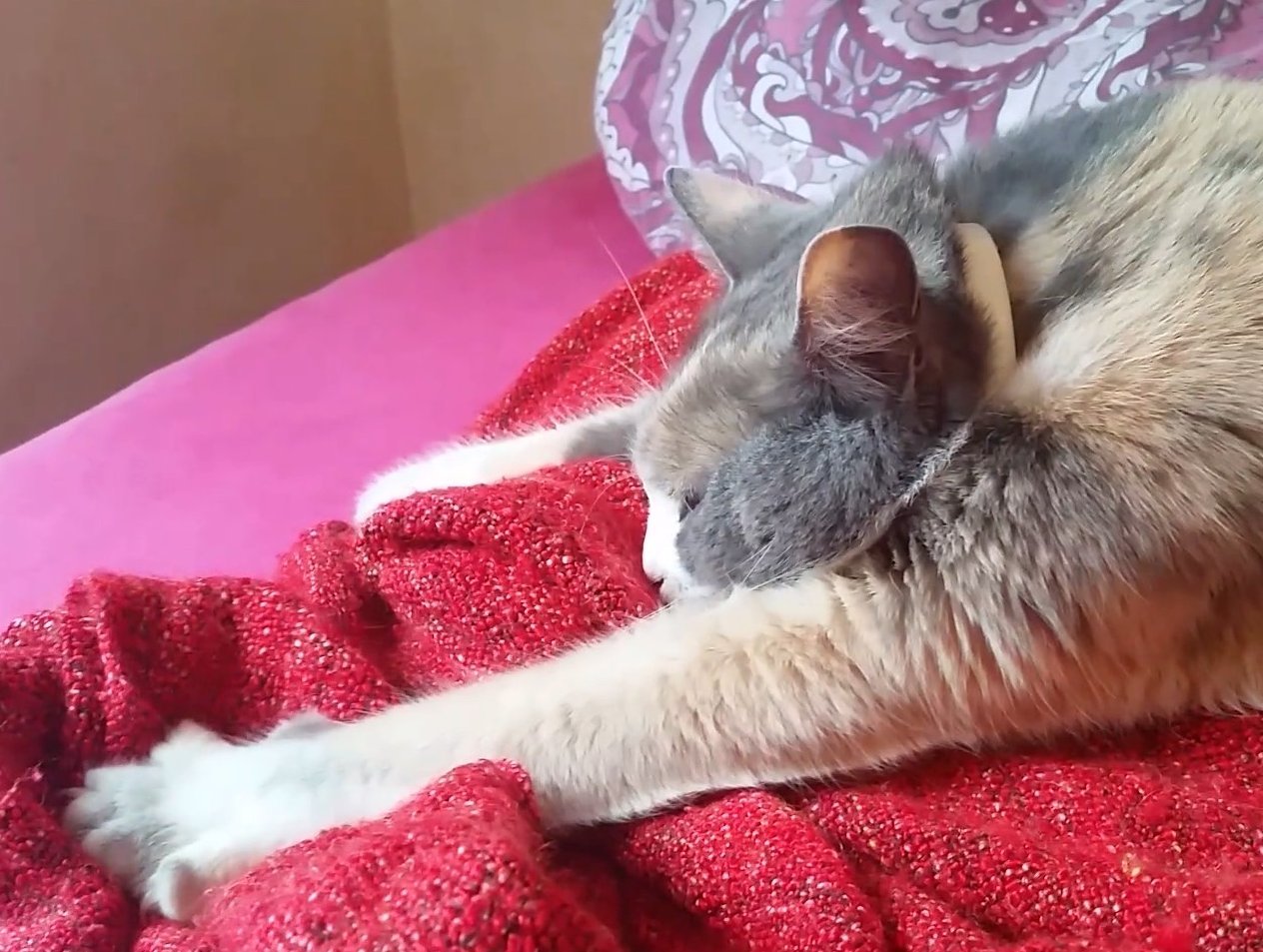
| Body language just before | Relaxed: soft eyes, loose posture, purring continues | Tail flicking, ears rotating back, skin rippling, purring stops | Crouched, wiggly rear, dilated pupils, ears forward |
| Bite pressure | Soft nibble, no pain, no marks | Firmer, may leave a red mark; cat often walks away after | Grab-and-hold with front paws, bunny kicks, more intense |
| What to do | Nothing — it’s social. Enjoy it (or calmly redirect if you’d rather not) | Stop petting before the signals escalate; learn your cat’s limit | Redirect to a toy immediately; never play with bare hands |
Nipping for attention, the bite-then-lick of social grooming, and pain-related biting aren’t in this table — they’re covered in reasons 4–6 and the triage section below.
Why it feels like it comes “out of nowhere”
Here’s the uncomfortable truth: the bite almost never comes out of nowhere. Cats broadcast their state constantly — tail position, ear angle, skin tension, pupil size, whether purring suddenly stops. The signals are just subtle, and most of us are looking at our phones, not our cat’s shoulders. For a full primer on reading those broadcasts — pupils, ears, tail, posture — see our guide to why cats stare at you.
Try this for one week — call it a bite diary. Each time your cat nips you, jot down four things: what you were doing in the 30 seconds before, where on the cat’s body you were touching, the time of day, and what the cat did right after. Most owners spot their cat’s pattern within three or four entries: always the same petting spot, always after the same number of minutes, always right before dinner. Once you see the pattern, the bites stop feeling random — because they never were.
Warning signs to learn (with 10 seconds to spare)
These are the pre-bite signals behaviourists and shelter handouts agree on. Learn them and you’ll rarely be surprised again:
| Signal | What it looks like | What it means |
|---|---|---|
| Tail talk | Flicking, twitching, or lashing side to side | Arousal rising — the most reliable early warning |
| Ears | Rotating back or flattening | Discomfort; the cat is no longer enjoying this |
| Skin ripple | Twitching across the shoulders or back | Sensitivity spike — a classic pre-bite sign |
| Eyes | Pupils dilating, hard stare at your hand | Attention locking onto the “target” |
| The freeze | Sudden stillness mid-petting | A decision is being made — give space now |
| Purring stops | The rumble cuts out abruptly | Contentment ended; the next move may be teeth |
A small practical note from research: in a 2015 University of Lincoln study, the base of the tail was the least-tolerated petting spot, while the face area — chin, cheeks, lips, where scent glands sit — was the most accepted. If your cat’s bites cluster around back-stroking sessions, try sticking to the head and see what changes.

Should you worry? An honest triage
Normal — no action needed
- Occasional gentle nibbles during relaxed cuddling, skin unbroken
- Soft mouthing during play with toys (not hands)
- The cat’s body stays loose and calm throughout
Watch and adjust
- Bites getting more frequent or firmer over weeks
- Biting tied to a specific trigger you can now predict (see the bite diary)
- A kitten whose play bites are getting harder — intervene now before adulthood cements the habit
See a vet
- Sudden touch-sensitivity in a previously cuddly cat — especially flinching when the back, tail base, or jaw is touched. Rule out dental pain, arthritis, or injury before assuming it’s behavioural.
- Repeated episodes of rippling back skin with frantic grooming, tail-chasing, or startled bolting — this can indicate feline hyperesthesia syndrome, a neurological sensitivity condition. Cornell’s Feline Health Center notes it needs a vet to rule out other pain sources first, and that skin rippling alone doesn’t confirm it. We cover hyperesthesia in more detail in our guide to cats that suddenly freeze and stare.
- Any bite that breaks the skin deeply. This isn’t about love nibbles — but know that cat teeth make deep puncture wounds prone to serious infection. A Mayo Clinic study of patients who sought care for cat bites to the hand found about 30% were hospitalised. Clean any broken-skin bite promptly and watch for spreading redness or swelling.
What to do when your cat bites gently
- Never punish. The American Veterinary Society of Animal Behavior opposes force and aversives for behaviour problems, and veterinary behaviour handouts are blunt: physical punishment almost always makes biting worse, because the cat becomes fearful and starts associating your hands with bad things.
- Redirect to a toy. When teeth find your hand during play, swap in a toy immediately — a fishing-pole style wand keeps teeth far from fingers. Aim for a couple of short interactive play sessions a day so the hunting instinct has a legitimate outlet.
- Make biting end the fun. For attention-seeking nips, calmly put the cat down or walk away with zero drama. Biting must reliably produce boredom, not engagement — that’s the whole lesson.
- Retire your hands as toys. If anyone in the household still wiggles fingers for the kitten to chase, the training is undone every time. Everyone follows the same rule.
- Stay within the petting budget. Learn your individual cat’s tolerance — some cats tap out after ten seconds of back stroking and will happily take chin scratches indefinitely. The bite diary will tell you exactly where the line is.
- Vet first for new behaviour. New biting, new sensitivity, new anything in an adult cat — medical causes get ruled out before behaviour plans begin.
- Don’t yank your hand away. If teeth are already on your skin, freeze for a second instead of pulling back — jerking away can startle the cat into biting down harder or trigger a chase reflex. Let the cat disengage first, then calmly withdraw your hand.
Frequently asked questions
Why does my cat bite me gently when I pet her?
Usually overstimulation: she enjoyed the petting, hit her tolerance limit, and the bite means “that’s enough.” Watch for the warning signs — tail flicking, ears back, skin rippling — and stop petting before they escalate. Shorter sessions in her favourite spots (chin, cheeks) usually fix it.
Why does my cat bite me and then lick me?
Two possibilities. In a relaxed cuddle, it’s social grooming — teeth are part of how cats groom. During petting, it more often means she hit her stimulation limit and needs a break. Tense body language before the bite points to the second one.
Why does my cat bite me gently while purring?
Purring doesn’t always mean happy — cats also purr when self-soothing. A gentle bite during purring is often a love bite (relaxed body, soft eyes) or early overstimulation (body tensing, tail starting to flick). Read the body, not just the sound.
Do cats bite to show affection?
Gentle, non-breaking “love bites” are widely interpreted by behaviourists as social bonding, linked to allogrooming between bonded cats. But it’s an interpretation, not a proven fact — and it only fits when the cat is clearly relaxed. Hard bites, flattened ears, or growling are not affection.
Why does my cat grab my hand and bite it?
That’s play aggression: the grab-and-bunny-kick is predatory rehearsal. It usually means hands became toys at some point. Redirect to a wand toy every single time, and make sure everyone in the house stops offering fingers as playthings.
How do I get my cat to stop biting me gently?
Match the fix to the cause: shorter petting sessions for overstimulation, daily interactive play plus toy redirection for play aggression, and calmly walking away for attention-seeking nips. Never punish — it makes biting worse. If the biting is new or escalating, see a vet first to rule out pain.
Why is my cat suddenly biting me when they never used to?
Sudden behaviour change in an adult cat is the one scenario to take seriously: pain (dental issues, arthritis), illness, or a neurological issue like hyperesthesia can all cause new biting. Book a vet visit before trying behaviour fixes — medical causes come first.
How can I tell if my cat is really bonded with me?
Bonded cats show it consistently: slow blinks, head-butting, kneading, choosing your lap over the sofa, sleeping pressed against you — and yes, the occasional gentle love bite. If the nibbles arrive wrapped in relaxed, affectionate body language, they’re part of the bond, not a problem to fix.
What is the difference between a cat love bite and a real bite?
Pressure, body language, and what happens next. A love bite is a soft nibble that doesn’t hurt or mark the skin, delivered by a relaxed cat that keeps purring and stays close. A real bite is harder, often breaks the skin, and comes with tense body language — flattened ears, dilated pupils, hissing or growling — after which the cat usually disengages or escalates. When in doubt, treat the body language as the verdict, not the teeth.
Are cat love bites dangerous?
A genuine love bite that doesn’t break the skin is harmless. The risk starts when teeth puncture skin: cat teeth make narrow, deep wounds that seal over quickly and can trap bacteria, which is why any bite that breaks skin deserves prompt cleaning and watching for redness or swelling. See the triage section above for when a bite warrants a call to your doctor.
Why does my cat bite me gently in the morning or while I’m sleeping?
That’s usually a wake-up routine your cat trained — possibly with your help. Cats are naturally most active around dawn, and a cat that discovers a gentle nibble gets you vertical (and, crucially, gets breakfast served) will happily repeat the experiment every morning. The fix is gloriously boring: don’t reward it. Keep a consistent wake time, feed on your schedule rather than in response to teeth, and consider an automatic feeder for the dawn shift. Within a week or two, most cats retire the alarm-clock teeth in favour of something that actually works — usually sitting on your chest and staring.
Why does my cat bite me gently on the face?
Your face is prime feline real estate. It’s where your scent is strongest, it’s at nose level during cuddles, and it’s usually the closest available skin when a cat wants interaction while you’re asleep. Gentle face nibbles are typically the same social grooming or attention-seeking behaviour as hand nibbles, just relocated. That said, faces are worth protecting — a startled flinch can turn a love bite into a scratch, so calmly redirect face-nibblers to a hand or a toy, and don’t encourage the habit by laughing it off every time.
Should I let my cat playfully bite me?
Short answer: no — even when it doesn’t hurt. Every playful bite you allow is a rehearsal, and the kitten practising on your fingers today is the eight-pound cat practising on your fingers next year, with adult teeth. Redirect to a wand toy every single time, keep play sessions regular so the hunting instinct has a proper outlet, and make sure everyone in the house follows the same rule. One person’s ‘it’s cute when she does it’ undoes everyone else’s training.
Why are my cat’s gentle bites getting harder?
Usually because it worked. Biting that reliably produces a reaction — laughter, scolding, a hand that jerks away to be chased — gets repeated with more enthusiasm, and kittens that never learned bite inhibition press harder as they grow. Rewind to the play-aggression fixes: redirect to toys, end the fun calmly when teeth touch skin, and stay consistent. The exception is a sudden change in an adult cat — gentle nibbles turning firm out of nowhere can signal pain or stress, and that version deserves a vet visit before a behaviour plan.
Photo credits
- Cat gently biting finger: Laurits Boe Sørensen, CC BY-SA 3.0, via Wikimedia Commons
- Kitten playing with lure toy: Dcoetzee, public domain, via Wikimedia Commons
- Calico cat warning body language: JLHA3050, CC BY-SA 3.0, via Wikimedia Commons
- Featured image (tabby cat gently biting a hand): 夕云 简, via Pexels (free licence)





7 Comments